
The venture studio is a young institution with an old problem. Idealab was founded in 1996, Rocket Internet in 2007, eFounders in 2011, and by 2024 a landscape count put the number of studios founded worldwide above 1,100. Yet almost all public discussion about studios is about the ones that worked. The exits of Spendesk, Aircall and Front, the IPOs of Delivery Hero and HelloFresh, the sale of Dollar Shave Club to Unilever: these are the stories told at conferences. The studios that quietly stopped building, pivoted into consulting, ran out of money or found they had nothing left to originate are rarely written up, because nobody has an incentive to write them up.
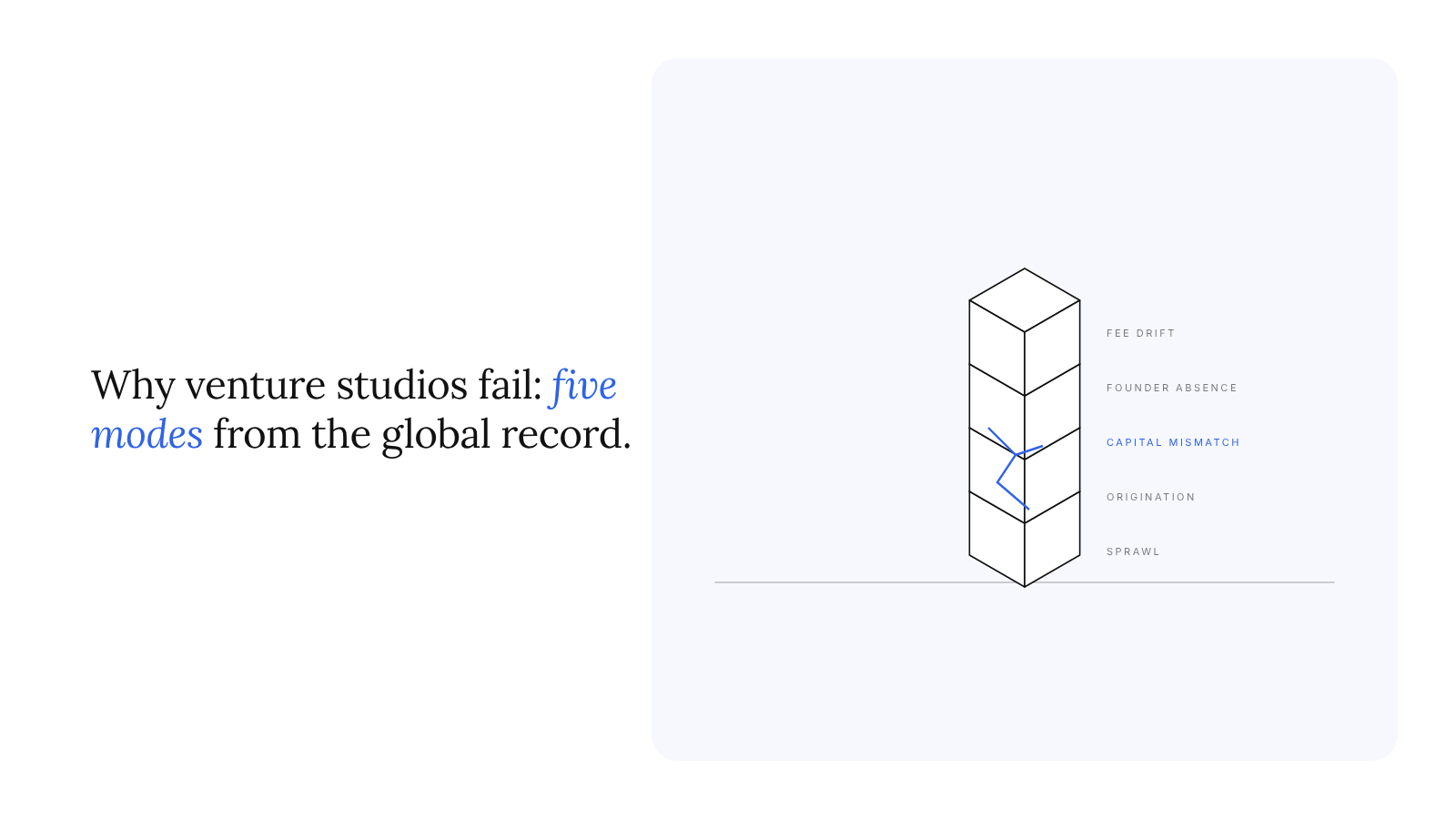
That silence about why venture studios fail matters for anyone deciding whether to fund, run or join a studio. A studio is an operating company that must pay salaries every month, generate ideas worth incorporating, produce founders who will stay, and fund each venture long enough for someone else to take over the funding. Each obligation can fail independently, and the published record shows the failures falling into five recurring patterns: fee drift, founder absence, capital mismatch, origination exhaustion and portfolio sprawl. This article describes a documented global case for each and closes with a table of early warning signs for studio boards, limited partners and operators.
What counts as failure, and why venture studios fail as institutions
A studio can fail while its ventures succeed. Bundl, a corporate venture-building firm, reviewed five corporate studios that closed and observed that they "were well funded and well staffed" and "did not fail at building ventures"; the reasons it gives are unmet financial expectations, shifts in strategic focus at the parent, operational misalignment, too much or too little autonomy, and what it calls innovation theatre, visible activity with no business impact (Bundl, 5 Failed Venture Studios). The academic literature is thin: a 2025 paper from Politecnico di Milano analysing 25 European studios founded between 2009 and 2014 notes that research on studio success "is limited" (Del Prete et al., ECIE 2024). The industry body GSSN reported in 2020 that 9% of 415 companies created by 23 surveyed studios had failed, a self-reported figure that measures venture death, not studio death. The failure modes below are therefore drawn from reported cases, and they describe how the studio itself breaks.
Failure mode one: fee drift, or becoming an agency
A studio's shared team is expensive and sits idle between ventures. The quickest way to cover that cost is to sell the team's time to corporates who want innovation capability without building it. The first engagement looks like a sensible subsidy. Within two or three years the fee revenue is the business, the equity portfolio is a side pocket, and the studio has become an agency with a venture- flavoured brochure.
The documented cases tend to be small, because by the time a studio has fully drifted it no longer calls itself a studio. One candid example is Spreenkler, a Milwaukee "startup developer" founded in 2006 that ran Wisconsin's first software seed incubator and worked with more than 30 technology startups from 2012. In March 2014 it repositioned itself as an "innovation agency" consulting with corporations on lean innovation strategy; its founder described the shift as a "natural evolution" because clients had been asking for consulting (BizTimes, 25 March 2014). The corporate version appears in the Bundl review: a studio that cannot show returns on its sponsor's timetable slides into "innovation theatre", producing workshops and pilots that keep the sponsor engaged without producing companies.
What makes fee drift dangerous is that every step is defensible. The warning sign is not the first consulting contract but the moment service revenue is needed to make payroll, because from that point the studio's best people go to whichever activity pays this quarter, and ventures never do.
Failure mode two: founder absence
The second failure mode is the one most specific to studios. In a conventional startup a founder exists before the company does. In a studio the idea often exists before the founder, and the studio must either hire a leader into it or grow one from the operating team. When no owner emerges, the venture remains a project run by studio staff, and projects do not raise Series A rounds.
Rocket Internet offers the richest documented record of what happens when control sits with the studio. At Nestpick, a Berlin furnished-apartment marketplace, the founders including the chief executive left in May 2016, having already lost majority ownership to Rocket, which had taken a majority stake at Series A or earlier and with it control of the board. The company was restructured under a new managing director, pivoted to a meta-search model and shrank from roughly 150 staff to about 20. Mark Tluszcz of co-investor Mangrove said Rocket had "effectively bought the company from the founders", which he called the start of the problems, and that continued dilution led the founders to lose interest and the company to lose its culture (TechCrunch, 26 October 2016).
At Zalora, Rocket's Southeast Asian fashion venture, two managing directors including a listed co- founder left in 2016 after tension with Global Fashion Group, the Rocket umbrella company above them, over whether to invest for the long term in Southeast Asia or prioritise faster-return markets. The venture had been run by five joint managing directors, a structure TechCrunch called "unorthodox", and the author described Rocket as "quite the management circus at times" (TechCrunch, 20 April 2016).
The pattern is the same in both: when the studio retains control and the operators hold small stakes and limited authority, the people running the venture behave like executives who can be replaced, because they can be. The remedy is structural: a named chief executive with a meaningful stake, authority over hiring and product, and governance the studio cannot override on a whim.
Failure mode three: capital mismatch
A studio funds its ventures from its own balance sheet until they can raise from outsiders. If the studio's capital runs out before the ventures reach that point, or if the studio's structure prevents it from following its winners, the portfolio is starved at exactly the moment it needs feeding.
Idealab is the canonical case. Founded by Bill Gross in Pasadena in 1996, it raised nearly $1 billion in March 2000 from investors including Dell USA and a T. Rowe Price fund, at a $10 billion valuation, weeks before the dot-com bubble burst. By January 2002 those investors were suing in Los Angeles Superior Court to have the company liquidated and the remaining $500 million returned, alleging that "in just two years, the defendants burned through more than $500 million". eToys had shut down the previous year and dozens of smaller Idealab companies had closed; the website listed 26 active companies, of which only Overture Services, with a $2.2 billion market capitalisation, was a major success. Gross called the suit "completely and totally baseless" (Ian Bell, citing press reports, 21 January 2002). The bubble's collapse led Idealab to scrap a long-planned IPO, lay off workers and close satellite offices before refocusing on robotics and clean energy (Marketplace, 21 February 2008). Idealab survived, but the mismatch between capital raised at the top of a cycle and the time its ventures needed nearly ended it.
Betaworks shows the subtler form. The New York studio behind Giphy, TweetDeck and Dots funded everything from a holding company until 2016. When it announced a $50 million fund in August 2017, John Borthwick explained that the holding company had been the firm's only capital source, which prevented it from doubling down on fast-growing companies; he cited Giphy, which "grew extraordinarily fast" while betaworks could not keep investing as it scaled (TechCrunch, 10 August 2017). The mismatch was not a shortage of money but a vehicle that could not follow on.
The most recent form is sponsor withdrawal. In February 2025, 54 Collective, formerly Founders Factory Africa, told staff that its venture studio would wind down when its partnership with the Mastercard Foundation ended on 30 April 2025, because it "could not secure alternative funding to keep the venture studio running". The studio had supported more than 40 startups and planned to back 105 over five years; a separate $40 million fund was unaffected (TechCabal, 25 February 2025). A studio funded by a single sponsor has a runway exactly as long as that sponsor's strategy.
Failure mode four: origination exhaustion
Studios claim to manufacture ideas. The claim is tested when the first wave of obvious opportunities has been built and the team must find the next one. Two things can happen: the ideas stop, or they become derivative, variations on what the studio has already done or copies of what others have proven elsewhere.
Rocket Internet documented its own exhaustion with unusual frankness. The firm had built its reputation adapting proven models, chiefly American ones, to markets they had not yet reached, a strategy it defended as adapting proven models to untapped local markets (CNBC, 1 September 2020). By 2019 it was sitting on cash from the IPOs of its earlier ventures. At the annual general meeting in Berlin in June 2019 Oliver Samwer told shareholders: "We have more capital than ideas." Bloomberg reported net cash of $3.5 billion (Bloomberg, 6 June 2019). Earlier that year Samwer had said Rocket would "build more companies than in 2018" but gave no number, and did not expect any of its smaller holdings to become established companies that year; its stakes in roughly 200 smaller private startups were worth about €1.2 billion against about €400 million invested (Business of Fashion, 2019). By September 2019 the company reported 15 new business models launched since January 2018 and net cash of €3.0 billion (Rocket Internet, 19 September 2019).
A year later Rocket announced it would delist from the Frankfurt and Luxembourg exchanges, offering €18.57 per share against a market value of €2.6 billion, down from €6.7 billion on its 2014 IPO day, on the grounds that "adequate access to capital is secured outside the stock exchange" (CNBC and tech.eu, 1 September 2020). The sequence is clear: a studio whose origination engine had slowed found itself with more money than it could deploy into new companies, and withdrew from public scrutiny. The lesson is not that imitation fails; Rocket's adapted models produced several listed companies. It is that an origination method tied to one source has a finite yield, and a studio needs a second source before the first runs dry.
Failure mode five: portfolio sprawl
The fifth mode is the simplest to state and the hardest to resist. Every new venture looks cheap at the margin, so studios launch more than their senior operators can carry, and most ventures then receive too little attention to reach escape velocity.
Rocket's roughly 200 smaller holdings are the extreme case: two-thirds of the estimated value of its private portfolio was tied up in small firms the founder did not expect to mature. The Hexa case is the opposite, and more instructive, because it describes a studio that identified sprawl as the constraint before it did damage. When eFounders rebranded as Hexa in November 2022, co-founder Thibaud Elzière said: "We reached a limit when it comes to scalability," describing the studio's work as handcrafted and hard to scale. The firm had launched more than 30 startups in eleven years, including the unicorns Spendesk, Aircall and Front, and its answer was not to launch more ventures from the same team but to create a holding company of separate studios, each with its own head and core product team, each focused on one domain. Elzière also said that studios have a limited lifespan and may end when their head leaves or opportunities run out (TechCrunch, 29 November 2022). By late 2023 Hexa had raised about €20 million and stated an ambition of 30 startups a year across multiple studios, having created 40 companies in twelve years (TechCrunch, 27 November 2023).
The structural insight is that a studio's capacity is bounded by senior operator time, not by capital. The failure version is the studio that keeps the single team and simply adds ventures.
The Five Failure Modes table
The table below is this article's analytical contribution, derived from the cases above and intended as a diagnostic for boards and limited partners. The warning signs are observable before the failure is complete.
| Failure mode | What it looks like from outside | Underlying cause | Early warning signs | Documented case |
| Fee drift | Studio markets "venture building as a service"; website leads with corporate clients | Shared team cost exceeds what the balance sheet can carry between ventures | Service revenue needed to meet payroll; best engineers staffed on client work; no new incorporation in 12 months; pitch deck leads with logos not cap tables | Spreenkler's 2014 repositioning as an innovation agency; Bundl's "innovation theatre" pattern in corporate studios |
| Founder absence | Ventures run by rotating managing directors; studio partners sit on every board as decision-makers | Studio retains control; operators hold small stakes and limited authority | No named CEO at month 6; CEO changes before Series A; studio approves hires below VP level; venture staff describe themselves as studio employees | Nestpick founder exit and restructuring (2016); Zalora managing director turnover under Global Fashion Group (2016) |
| Capital mismatch | Ventures stall at pre-seed; studio raises emergency capital or seeks a sponsor | Studio capital horizon shorter than venture time to external funding, or vehicle cannot follow on | Studio runway under 18 months with no venture at Series A; bridge rounds from the studio to its own ventures; single-sponsor dependency; inability to participate in winners' rounds | Idealab after March 2000; Betaworks' 2017 fund to fix a holding-company constraint; 54 Collective's 2025 studio wind-down |
| Origination exhaustion | Fewer launches per year; new ventures resemble old ones or foreign models | Idea sourcing tied to one method or one sector whose yield is finite | Launch cadence falling for two consecutive years; cash accumulating uninvested; management saying it will "build more" without a pipeline; ventures that are variants of earlier ventures | Rocket Internet, "more capital than ideas" (2019), delisting (2020) |
| Portfolio sprawl | Dozens of active ventures per handful of partners; most ventures at the same early stage | Marginal cost of launching a venture is low; marginal cost of carrying it is high and deferred | More than three or four active pre-Series A ventures per senior operator; no venture in the bottom half of the portfolio has had a board meeting in a quarter; follow-on reserved capital under 30% of commitments | Rocket's ~200 small holdings (2019); eFounders' stated "limit" on scalability and reorganisation into Hexa (2022) |
Two observations follow. First, the modes interact. Portfolio sprawl produces founder absence, because there are not enough credible leaders for the number of ventures. Capital mismatch produces fee drift, because the team must be paid. Origination exhaustion produces sprawl, because a studio with cash and no good ideas launches mediocre ones. A board that sees one mode should look for the others. Second, the early warning signs are mostly operating metrics rather than financial ones: launch cadence, time to a named chief executive, ratio of ventures to senior operators, share of revenue from services. These are cheap to collect and rarely reported.
What the studios that survived did differently
The cases also show recoveries. Betaworks separated its capital vehicle from its operating company so that it could follow its winners. eFounders split itself into focused studios with named heads rather than adding ventures to one team. Idealab shrank, abandoned its IPO and refocused on a small number of deep-technology bets. Each is a response to one failure mode, and each involved giving something up: control, breadth or scale. The consistent thread is that surviving studios treated the studio itself as a company with a business model to be fixed, rather than as a platform that would be vindicated by its next exit.
Conclusion
Venture studios fail in ways specific to their structure. Because they carry a permanent team, they drift toward selling that team's time. Because ideas precede founders, they can end up with ventures nobody owns. Because they fund from a balance sheet, they can run out before their ventures reach outside capital. Because origination is their claimed advantage, they are exposed when the idea pipeline thins. And because launching is cheap, they launch more than they can carry. None of these is inevitable, and the global record contains both cautionary cases and studios that identified the problem and reorganised around it. The five-mode table is offered so that boards and investors can ask the right questions before, rather than after, the failure becomes visible in the portfolio.
Methodology and sources
This article classifies studio failure into five modes on the basis of publicly reported cases rather than a quantitative dataset. The classification is the author's own; the cases are described from the sources below, and where a source does not support a stronger claim the claim has been omitted. In particular, no source opened for this article gives an aggregate studio closure rate, and none should be inferred. The GSSN figure that 9% of 415 companies from 23 studios had failed is self-reported by studios and measures venture failure, not studio failure, and is included only to illustrate that point. The Bundl review of five closed corporate studios does not name the studios on the page opened, so its findings are used only for the general pattern it describes. The early warning thresholds in the table (for example, three or four active pre-Series A ventures per senior operator, or 30% reserved follow-on capital) are judgements based on the cases and on how studio economics work, not measured benchmarks, and readers should treat them as starting points for their own calibration.
Sources opened: CNBC, "Start-up factory Rocket Internet to delist", 1 September 2020 (https://www.cnbc.com/2020/09/01/startup-factory-rocket-internet-to-delist.html); tech.eu, "Rocket Internet to delist", 1 September 2020 (https://tech.eu/2020/09/01/rocket-internet-delist); Bloomberg, "Rocket's Founder Admits Company Has 'More Capital Than Ideas'", 6 June 2019 (https://www.bloomberg.com/news/articles/2019-06-06/rocket-s-founder-admits-company-has- more-capital-than-ideas); Business of Fashion via Reuters, "Rocket Internet set to found more companies in 2019" (https://www.businessoffashion.com/news/retail/jumia-founder-rocket-internet- set-to-found-more-companies/); Rocket Internet SE, H1 2019 results release, 19 September 2019 (https://www.rocket-internet.com/news/2019-09-19-06-00-05); FashionNetwork via Reuters, "Rocket Internet posts first-half loss, shares plunge", 2 September 2016 (https://au.fashionnetwork.com/news/Rocket-internet-posts-first-half-loss-shares- plunge,727928.html); TechCrunch, "With founders out, Rocket-backed Nestpick reboots", 26 October 2016 (https://techcrunch.com/2016/10/26/founders-leave-the-nestpick/); TechCrunch, "Rocket Internet's Zalora loses co-founder and MD", 20 April 2016 (https://techcrunch.com/2016/04/20/rocket-internets-zalora-loses-co-founder-and-md-amid- uncertain-future/); TechCrunch, "eFounders morphs into Hexa", 29 November 2022 (https://techcrunch.com/2022/11/29/efounders-morphs-into-hexa-a-portfolio-company-of-startup- studios); TechCrunch, "Hexa raises some funding to launch even more startups", 27 November 2023 (https://techcrunch.com/2023/11/27/paris-based-startup-studio-hexa-raises-some-funding-to- launch-even-more-startups); TechCrunch, "betaworks ventures is a not-so-new $50 million early- stage fund", 10 August 2017 (https://techcrunch.com/2017/08/10/betaworks-ventures-is-a-not-so- new-50-million-early-stage-fund/); Ian Bell, "Revenge: Investors Want Idealab Liquidated", reproducing press coverage of the January 2002 lawsuit (https://ianbell.com/2002/01/21/revenge- investors-want-idealab-liquidated/); Marketplace, "Idealab corporate history", 21 February 2008 (https://www.marketplace.org/2008/02/21/idealab-corporate-history/); TechCabal, "54 Collective to cut jobs as Mastercard Foundation partnership ends", 25 February 2025 (https://techcabal.com/2025/02/25/54-mastercard-foundation-partnership/); BizTimes, "Spreenkler shifts focus to corporate consulting", 25 March 2014 (https://biztimes.com/spreenkler-shifts-focus- to-corporate-consulting); Bundl, "5 Failed Venture Studios" (https://www.bundl.com/knowledge/reports/5-failed-venture-studios); Del Prete, Franchi, Moiana, Ghezzi and Rangone, "What Drives Venture Studios Success?", ECIE 2024, published 19 September 2025 (https://papers.academic-conferences.org/index.php/ecie/article/view/4143); GSSN 2020 white paper figures and the 2024 landscape count of more than 1,100 studios as summarised in the editor's verified-figures note.