
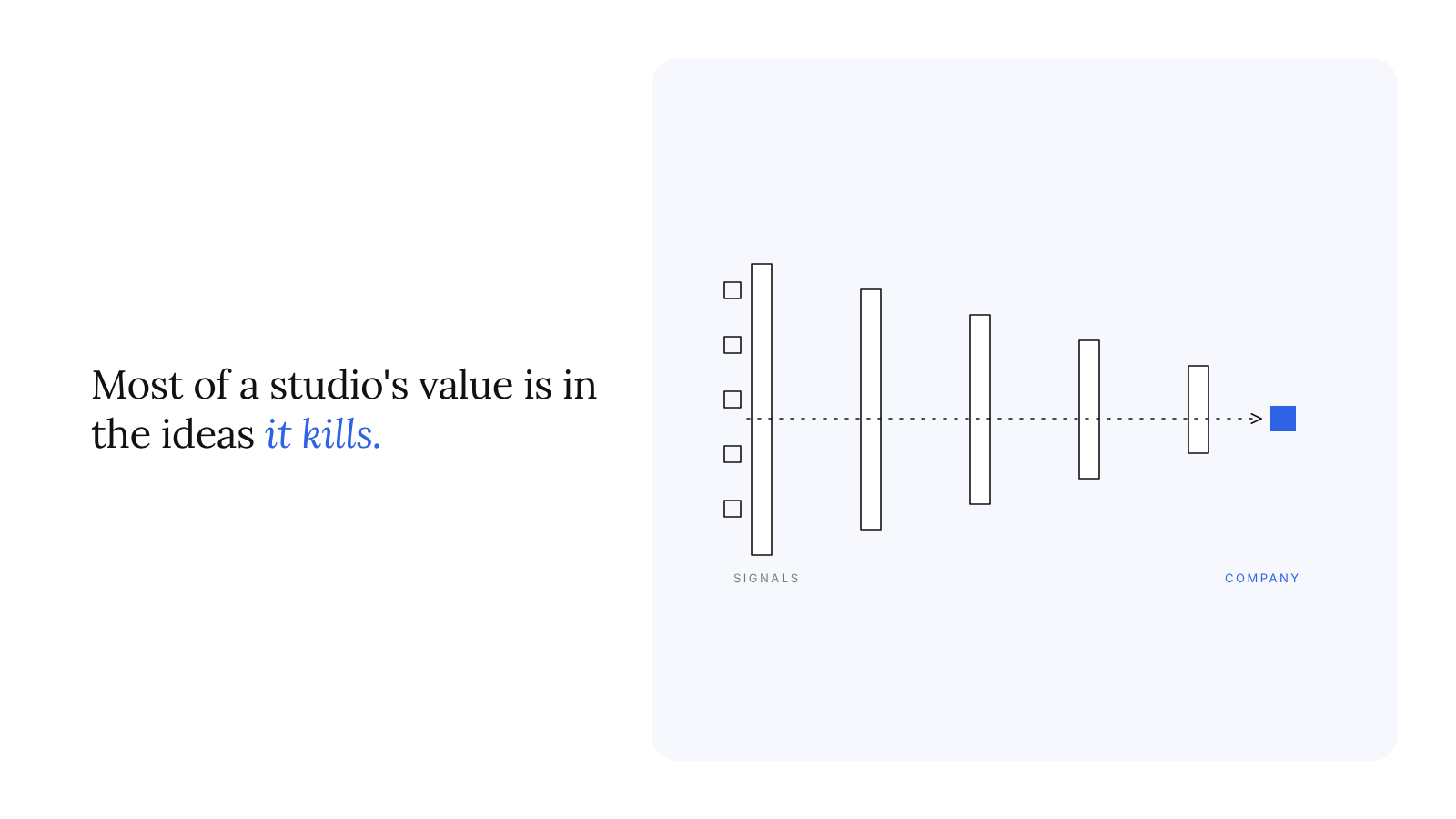
Ask a venture capital firm where its companies come from and the answer is simple: founders bring them. Ask how venture studios find ideas and the honest answer is uncomfortable. At the moment a studio begins work on a company, there is no company, no founder and usually no idea in the form a founder would recognise. There is a signal. Most signals are wrong. The studio's real product is the process that tells the difference.
This is the stage of venture building that is least written about, because it is the stage with nothing to show. A studio's website lists the companies it built. It does not list the forty problems it investigated and walked away from, or the three ventures it reframed so thoroughly that the company it incorporated bore no resemblance to the idea it started with. Yet origination is the one thing a studio does that no investor, accelerator or incubator does, and it is the thing a founder, corporate or investor should examine most closely before trusting one.
This article describes what origination is, where signals come from, how a disciplined studio moves from a signal to an incorporated company, and why the ideas a studio kills say more about it than the ones it keeps.
A signal is not an idea
The conventional story of a startup begins with an idea: a founder notices a problem and decides to solve it. Studios do not begin there. They begin earlier, with something less formed. A regulator changes a rule and nobody has worked out the consequences. A technology crosses a threshold of cost or accuracy that it did not clear last year. A hospital administrator describes a workaround her staff have been using for a decade. A research paper reports a result that is interesting and commercially unexplored. A customer the studio already serves asks whether the same team could do something adjacent.
None of these is an idea for a company. Each is a reason to look. The distinction matters because the two are confused constantly, and the confusion produces most of the failed ventures in any portfolio. A company built directly on a signal is a company built on an untested assumption about what the signal means. The studio's first job is to refuse to build until it knows.
PanScience describes its own starting condition this way: at the beginning, the studio rarely knows what the company is. It knows something is interesting. The work is finding out whether there is a company worth building inside it.
How venture studios find ideas: four channels, four failure rates
Signals reach a studio through four channels, and the channel shapes everything that follows.
| Channel | What arrives | Typical strength | Typical weakness |
| Enterprise pull | An institution or company the studio already works with describes a problem it would pay to have solved | The first customer is in the room; demand is real and priced | The problem is one organisation's problem; the venture risks becoming a captive supplier with a market of one |
| Research transfer | A result from a lab, a paper or an in-house research effort that could be productised | Defensibility; the technology is hard to copy | No customer has asked for it; the gap between a result and a product is usually larger than the researchers believe |
| Thesis- driven | The studio's own view that a category is about to become buildable, usually because of a technology shift or a regulatory change | Timing; the studio can be first | The thesis can be wrong, and the studio is its own echo chamber |
| Founder- brought | A person with domain depth or a half-formed idea approaches the studio | A committed leader exists from day one | The idea arrives with an owner, and owners resist reframing |
These channels are not mutually exclusive; the strongest ventures tend to sit where two overlap, such as a research result that an institutional partner has already asked for. But a studio should know which channel each venture came through, because the channel predicts the way the venture is most likely to fail and therefore what the validation stage has to test hardest. An enterprise-pull venture must be tested for a second customer. A research-transfer venture must be tested for a first one. A thesis-driven venture must be tested against someone who disagrees with the thesis. A founder- brought venture must be tested for whether the founder will accept being told the idea is wrong.
In PanScience's case, all four channels are visible from the outside. Its published ecosystem lists corporates running pilots and co-creating go-to-market, which is enterprise pull; its Lab To Launch and Curiosity Labs initiatives exist to move research toward revenue, which is research transfer; its stated stealth pipeline in protein design, emissions and agentic infrastructure reflects theses about what is becoming buildable; and its Student Cohort and SheEO programmes bring people before they bring ideas. The point is not that PanScience has four channels. It is that a studio needs all four, because each corrects the blind spots of the others.
From signal to company: the gates
Between a signal and an incorporated company there are decisions, and a disciplined studio makes them in order. The sequence below is written as a set of gates because that is what they are: each one exists to stop something.
| Gate | The question | What it stops | What passes |
| 1. Listen | What is the world actually saying? Customers, operators and experts, not the studio's own enthusiasm | Signals that exist only in the studio's head | A problem that at least one person outside the studio describes unprompted |
| 2. Frame | What is the problem's shape and edges? Who has it, how often, what it costs them, what they do about it today | Problems too vague to build against | A problem statement a stranger could use to recognise the problem in the wild |
| 3. Reframe | Is the obvious problem really the right problem? | The most common failure in origination: building the first thing that looks like a solution | Usually a different problem from the one that arrived, narrower or adjacent, with a clearer buyer |
| 4. Choose | Proceed, or walk away with a reason | Sunk-cost momentum | A written decision either way; a rejected idea leaves a record |
| 5. Validate | Test the belief against the market before building the company around it | Ventures built on assumptions nobody checked | Evidence that a specific buyer values a specific thing, often not the thing the studio first believed |
The third gate deserves emphasis because it is where the model earns its keep. The signal that arrives is almost never the problem worth solving. It is the symptom a customer can see, or the technology a researcher is proud of, or the obvious application a thesis suggests. The reframe asks what sits underneath. A request for a predictive maintenance system may really be a request to pass a quality audit. A request to automate a legal workflow may really be a problem of interpretation, not digitisation. A request for a general-purpose AI assistant in a regulated industry may really be a need for one narrow, defensible capability that the regulator will accept. The reframe is uncomfortable, because it usually means telling the person who brought the signal that they have misdescribed their own problem. It is also the reason studio-built companies tend to look different from the companies a founder would have built on the same signal.
The fourth gate is the one most studios skip, and the one most worth asking about. A studio that cannot show a founder, a corporate or an investor the ideas it rejected and why has not been making decisions. It has been accumulating projects. Rejection with a written reason is the evidence that origination is a process rather than a mood.
Validate before you build the company
The fifth gate is where a studio's approach diverges most sharply from the lean-startup orthodoxy that most founders have absorbed. The orthodoxy says build a minimum product and learn from it. A studio can do something a lone founder cannot: it can run validation before the company exists, using a small team, a few experiments and, ideally, a lighthouse partner who will tell the truth.
A lighthouse partner is an institution or company that agrees to be the first user of something that does not yet exist, in exchange for shaping it. It is not a customer in the ordinary sense, because it is not yet buying anything. It is a source of evidence. In regulated and institutional sectors, where the eventual buyer is a court, a hospital, a bank or a plant, it is often the only way to learn what the buyer actually values before spending a year building the wrong thing. PanScience describes lighthouse partners as sitting at the heart of its venture-building process, and its published ecosystem of government agencies, universities and corporates is, in effect, its supply of them.
Validation of this kind produces a specific and valuable output: a reframed proposition. The studio believed one thing, tested it, learned something narrower or different, and decided to build that instead. The company that is then incorporated has already survived its first contact with the market, which is more than most incorporated companies can say.
Why rejected ideas are the asset
It is tempting to measure a studio by its portfolio: how many companies, how much raised, what valuation. These are outputs. The input that produces them is the rejection rate at the gates, and it is almost never published.
Consider what a high rejection rate implies. It means the studio is listening widely enough to receive many signals, which requires a network. It means the studio is framing problems precisely enough to see which ones are not real, which requires domain depth. It means the studio is willing to walk away from ideas it has already spent money investigating, which requires a culture that rewards stopping. And it means that the ventures that do get built have been selected from a large field, which is the whole statistical argument for the studio model: a studio is a portfolio of attempts at the origination stage, not only at the company stage.
A studio with a low rejection rate is either not receiving enough signals or not killing enough of them. Either way, its portfolio is a list of things it happened to start, not things it chose.
What this means for a founder, a corporate and an investor
For a founder considering joining a studio-built venture, the question is not whether the idea is good but what the studio did to it. Ask which channel the signal came through. Ask what the original framing was and how it changed. Ask who the lighthouse partner was and what they said. If the venture has not been reframed at least once, it has probably not been validated.
For a corporate bringing a problem to a studio, expect to be told that the problem is not quite the one you described. That is the reframe working. A studio that accepts your framing without challenge is a services firm, and you should price it as one. Expect also to be asked whether a second organisation has the same problem; if the studio does not ask, it is building you a supplier, not a company.
For an investor underwriting a studio, ask for the rejection log. The companies in the portfolio tell you what the studio built. The rejected ideas tell you whether it can choose. A studio that cannot produce the log has no process to underwrite, and its portfolio is a collection of outcomes rather than evidence of a method.
The stage with nothing to show
Origination produces no product, no revenue and no press. It produces decisions, most of them negative, and a small number of reframed problems that go on to become companies. It is the hardest part of the venture studio model to see from outside and the part that most distinguishes building from investing. An investor's edge is in choosing among companies that exist. A studio's edge is in choosing among problems before any company does, and in being willing to choose none.
Methodology and sources
The four channels and five gates are this platform's own framework, drawn from PanScience's practice and from the general structure of origination described in the venture studio literature. PanScience's starting condition, lighthouse partner approach, initiatives and stealth pipeline are as described on its published Approach, Initiatives, Ecosystem and Ventures pages (panscience.xyz), read on 24 October 2026. No figures from internal materials are used. The reframe examples in the third gate are illustrative patterns, not accounts of specific ventures.