
Open almost any explainer on the venture studio success rate and the same figures appear in the same order. Studio-built startups have a 30 per cent higher success rate. Eighty-four per cent raise a seed round. Seventy-two per cent reach Series A, against 42 per cent for ordinary startups. They get there in 25.2 months rather than 56. The internal rate of return is 53 per cent, against 21.3 per cent for conventional venture capital. Only 9 per cent fail. The figures are quoted by studios in their decks, by consultancies selling corporate venture building, by LinkedIn posts, and increasingly by Indian founders and investors who are trying to decide whether a studio is a good way to start a company.
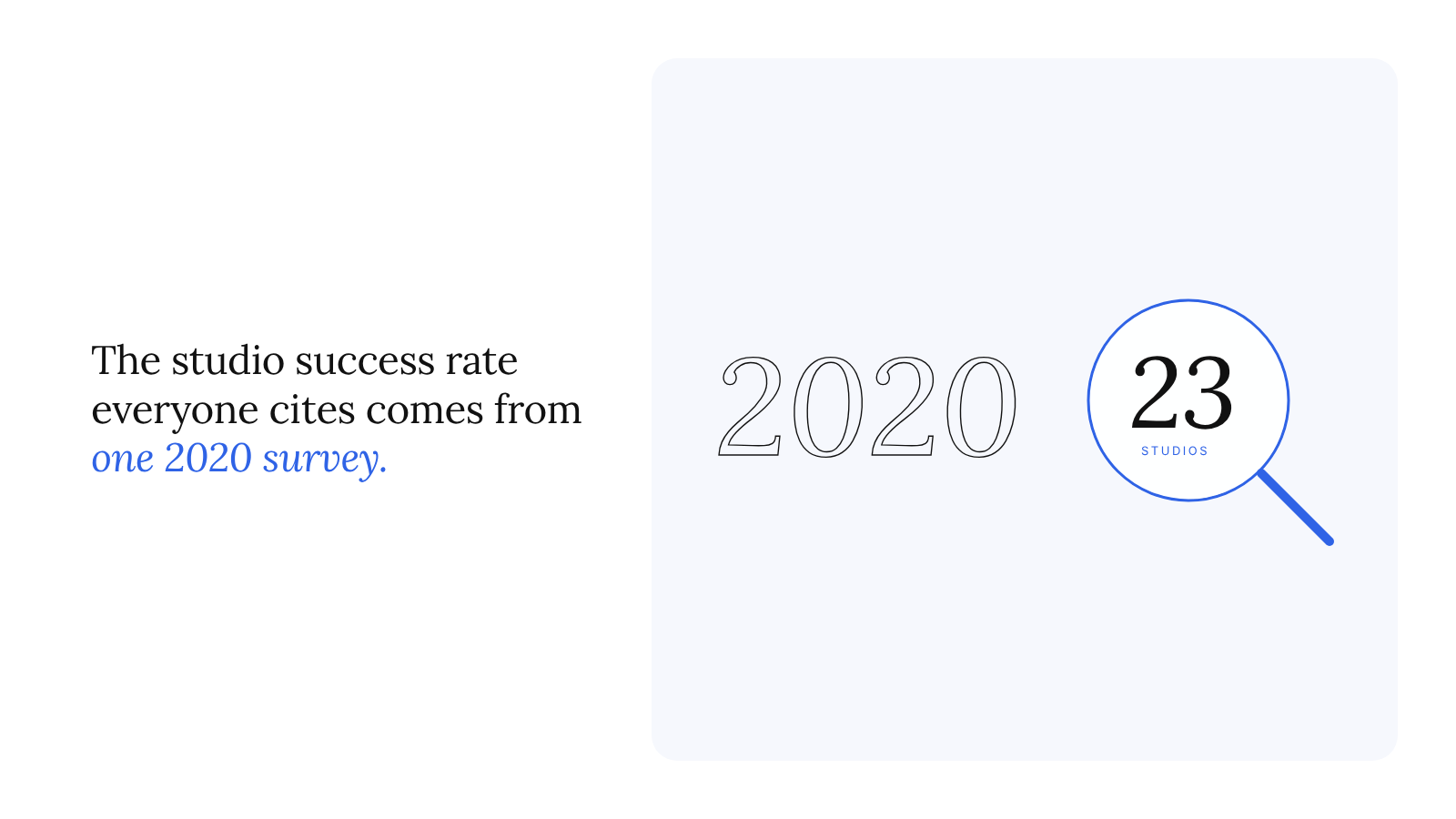
This article traces where each number comes from. The short version is that nearly all of them originate in a single 2020 white paper from the Global Startup Studio Network (GSSN), a membership body for studios, based on self-reported data from 23 studios, and in a follow-up survey from the same network. Nobody outside the industry has reproduced them. The academic literature that does exist, including work from Politecnico di Milano and a 2026 paper in Technovation, measures different things with different samples and explicitly describes research on studio performance as limited. In India, where the model is now attracting founders, corporates and government interest, there is no dataset at all.
None of this means the numbers are wrong. They may well be directionally right, and there are structural reasons to expect studio companies to raise seed capital more often than companies that start in a garage. The point is narrower and more useful: the figures have not been tested, they are not comparable with the venture capital benchmarks they are set against, and anyone making a capital allocation or career decision on the strength of them should know how thin the evidence is. The second half of the article proposes what a credible measure of studio performance would need to include.
Where the venture studio success rate figures come from
The founding document is GSSN's 2020 white paper, "Disrupting the Venture Landscape". According to the figures the paper reported, it drew on 23 studios and 415 companies they had created, of which 9 per cent had failed. A December 2020 master's thesis at Politecnico di Torino, which cites the same GSSN 2020 data, records the composition of the sample as 10 American studios and 13 from elsewhere, an average studio stake of 36 per cent, average studio capital per startup of about 232,000 dollars, and an average annual studio budget of about 2.27 million dollars. The headline comparisons appeared almost immediately in studio marketing. A High Alpha blog post dated 15 December 2020 cites "the GSSN 2020 report" for the claims that studio-launched startups show 30 per cent higher success rates, that nearly all raise a seed round, that 72 per cent of those raise a Series A, and that studio startups average a 53 per cent IRR against 21 per cent for non-studio startups. Two months later, on 19 February 2021, GSSN's own director Nick Zasowski wrote on the Angel Capital Association blog that 84 per cent of studio startups go on to raise a seed round, that 72 per cent of those advance to Series A against 42 per cent of traditional startups, that studios take between 15 and 100 per cent of the companies they found with an average of about 40 per cent, and that accelerators average about 7 per cent. In January 2021 GeekWire, reporting on a GSSN survey, put the average stake at 34 per cent, with a floor around 15 per cent and some studios taking upwards of 80 per cent.
By 2023 the same figures were being attributed to a "2022 report by GSSN". A widely shared March 2023 article by the Belgian venture builder Bundl lists the 30 per cent, 84 per cent, 72 per cent, 42 per cent, 25.2 month, 56 month, 53 per cent and 21.3 per cent figures with that attribution and no sample size, methodology or definition of success. Whether the 2022 document was a new survey or a restatement of the 2020 one cannot be determined from the public record; GSSN's current website names the white paper but publishes no statistics, and GSSN has since been absorbed into Morrow, a Denver-based network operator. What can be said is that several of the "2022" figures were already in circulation in December 2020, attributed to the 2020 report.
The sourcing audit table
The table below records, for each figure in common use, what it claims to measure, the earliest source in which the figure could be opened and read for this article, the sample disclosed at that point, and who produced it. "Not disclosed" means the opened source does not state it, not that it does not exist.
| Figure as commonly quoted | What it measures | Earliest openable source | Sample disclosed | Producer | Independent test |
| 23 studios, 415 companies, 9% failed | Share of studio-created companies that had shut by 2020 | GSSN white paper, 2020 | 23 member studios, self- reported | Studio network | None |
| 84% raise a seed round | Share of studio companies that raise seed | GSSN director, ACA blog, Feb 2021 | Not disclosed | Studio network | None |
| 72% reach Series A vs 42% | Share of seeded companies reaching Series A, studio vs "traditional" | High Alpha blog, Dec 2020 (citing GSSN 2020); ACA blog, Feb 2021 | Not disclosed; comparison base not defined | Studio network, repeated by a studio | None |
| 30% higher success rate | Undefined "success" | High Alpha blog, Dec 2020 (citing GSSN 2020) | Not disclosed; "success" undefined | Studio network, repeated by a studio | None |
| 53% IRR vs 21.3% | Average IRR of studio startups vs non-studio | High Alpha blog, Dec 2020 (53 vs 21); Bundl, Mar 2023 (53 vs 21.3, citing "GSSN 2022") | Not disclosed; realised or unrealised not stated | Studio network, repeated by studios and venture builders | None |
| 25.2 months to Series A vs 56 | Time from founding to Series A | Bundl, Mar 2023 (citing "GSSN 2022") | Not disclosed | Studio network, repeated by a venture builder | None |
| Studios hold 34% on average (15 to 80%) | Equity at founding | GeekWire, Jan 2021 (GSSN survey) | Not disclosed | Studio network | Torino thesis records 36% from the same 2020 data; ACA blog gives ~40% and 15 to 100% |
| Accelerators take ~7% | Equity at entry | ACA blog, Feb 2021 | Not disclosed | Studio network | Consistent with published accelerator terms, but not a study |
| ~560 studios worldwide (2020) | Count of studios | 500 Global, Jan 2022, attributing Enhance Ventures; ACA blog, Feb 2021 | Database count | Studio operator, repeated by a VC | CB Insights counted 338 active studios in 2020 (via Startup Studio Insider, 2023); Venture Studio Index lists 407 studios and 1,844 startups |
| Median studio budget $1.36M, average $2.49M | Annual operating budget | GSSN 2022, cited by Ben Yoskovitz, Oct 2023 | Not disclosed | Studio network | None |
Three things stand out. First, every performance figure comes from one producer, and that producer is a membership network whose purpose, in its own words, is to help studios share ideas, recommend talent and raise capital for their portfolio companies. Second, no opened source discloses the denominator, the vintage of the companies or the definition of success behind the headline comparisons. Third, the comparison group is never specified. "Traditional startups" that reach Series A at 42 per cent, and venture capital that returns 21.3 per cent, are not drawn from a stated dataset.
What each figure does and does not measure
The 9 per cent failure rate is the easiest to put in context. In 2020 the studio sector was young. The Angel Capital Association post describes growth of more than 625 per cent over seven years, which means most studios, and therefore most of their companies, were only a few years old when surveyed. Startups rarely shut in their first two years because they still have founding capital. A failure rate measured across a portfolio that is mostly young is a statement about age, not about the model. It also counts only companies the studio chose to launch; ideas killed inside the studio, which several studios describe as the majority of what they test, are not in the denominator, and that is the correct treatment for a company failure rate but makes it incomparable with any figure for independent startups, where the equivalent of a killed idea is a founder who never incorporated.
The 84 per cent seed rate measures something real but unsurprising. A studio that provides the first cheque is, in most structures, the seed investor. A company whose co-founder is a capital-holding institution raises seed capital at a high rate by construction. The useful question is what share raises seed capital from outsiders at a valuation set by someone other than the studio, and no public figure answers it.
The 72 per cent against 42 per cent Series A comparison is the most quoted and the least examined. It is unclear whether 72 per cent applies to all studio companies or only to those that raised seed, and the two readings give very different results. The 42 per cent benchmark has no stated source. Published venture data on graduation rates from seed to Series A varies enormously by vintage, geography and whether institutional seed rounds alone are counted, so a single number without a definition cannot be used for comparison.
The 53 per cent IRR is the figure that should concern investors most. An IRR for a studio portfolio depends on whether it is realised or marked, on the entry valuation the studio assigned to itself at founding, and on the date range. A studio that takes 34 per cent of a company at incorporation for a few hundred thousand dollars and then marks that stake at the next external round will show a very high unrealised IRR in its early years regardless of eventual outcomes. None of the opened sources says whether the 53 per cent is realised, which studios reported it, or over what period. The 21.3 per cent comparator is similarly unattributed.
The 25.2 months to Series A against 56 is plausible as a directional claim, since studio companies typically begin with a team and a product in place rather than with a single founder. But the measurement start point matters: a studio company's clock starts at incorporation, often after months of in-house validation, while an independent founder's clock might start at the first line of code. A fair comparison would start both at the same milestone.
What independent evidence exists
The academic record is small and does not test the GSSN claims. The most rigorous recent work comes from Politecnico di Milano. A 2024 paper by Moiana, Ghezzi and Rangone at the European Conference on Innovation and Entrepreneurship (ECIE), based on interviews with 14 Italian studios, states that "little is known regarding the design choices, activities, and outcomes of Venture Studios". A 2025 ECIE paper by Del Prete, Franchi, Moiana, Ghezzi and Rangone applies qualitative comparative analysis to 25 European studios founded between 2009 and 2014, measuring success as the ratio of exits achieved by a studio's startups to the studio's lifetime. It finds four distinct configurations that lead to success, with the founders' prior entrepreneurial experience the most prominent condition, and a compensating relationship between industry specialisation and location. Its stated limitations are candid: exits alone miss other dimensions of value, results depend on calibration choices, and the authors call for replication. The paper also records, without comment, that the industry's own counts of studios conflict: it cites "over 560" studios while referencing an industry source whose title claims 724.
The same group's 2026 paper in Technovation, "Institutionalizing portfolio entrepreneurship: the Venture Studio model", by Viglialoro, Sansone, Ughetto, Landoni and Lukeš, is based on a global database, twelve European case studies and a worldwide survey. It is a theory-building paper about how studios turn individual entrepreneurial expertise into organisational capital. It publishes no performance figures and its data are confidential.
Stanford's Graduate School of Business is frequently cited as a source for studio statistics, usually for the claim that the number of studios has grown more than 600 per cent since 2013. The material that could be located is an alumni listing for an independently published 2022 book, "Venture Studios Demystified", by two GSB MBA graduates, based on interviews with more than 20 studio leaders. It is a practitioner book, not a GSB study, and the 600 per cent figure is the same Enhance Ventures growth figure that GSSN's director cited. 500 Global's January 2022 study, "The Secrets to Venture Studio Model Success", is the nearest thing to an outside look. It used PitchBook and a third-party studio database as of June 2021, filtered for studios with at least ten investments, and ranked 15 studios by investments-to-exits ratio, identifying Idealab, Quasar Builders, Betaworks and Science as the leaders. It does not report success rates, time to Series A or IRR, and its disclaimer states that third-party information has not been verified. Its 560-studio figure is attributed to Enhance Ventures in the text and to GSSN in the footnote.
Taken together, the independent literature agrees on two things: studios are heterogeneous, and the evidence on outcomes is thin. It does not contradict the GSSN figures. It simply does not engage with them, because no outside researcher has had access to a dataset that could.
The India gap
India has no studio dataset at all. DPIIT counted more than 2.23 lakh recognised startups as of 31 March 2026 and, in a parliamentary statement in early 2026, 6,789 recognised startups that had shut against a base of 2.12 lakh. Neither figure distinguishes studio-built companies from others, and DPIIT recognition is a registration status rather than a cohort. Nasscom-Zinnov's 2025 report counts 4,200 or more deeptech startups and describes capital as "selective and milestone-linked", a market condition under which the studio claim of faster graduation to Series A would be most valuable to test and is least tested.
Indian studios, like studios elsewhere, publish their own metrics. PanScience Innovations in New Delhi, for example, reports a 91 per cent venture survival rate across 24 or more co-founded ventures since 2021, with 13 described as active and scaling. That is a company-reported figure of exactly the kind this article is auditing, and it illustrates the problem rather than solving it: without the vintage of each venture, the definition of survival, and the share of ventures that have raised external capital at an externally set price, a reader cannot compare it with any other studio's number or with the GSSN figures. The same is true of every studio's self-reported metric, in India or anywhere else.
What a credible measure would require
A studio-performance figure that an investor or a founder could rely on would need to satisfy conditions that none of the circulating numbers meets. The proposal below is a minimum reporting standard, not a maximum, and it is deliberately modest enough that a studio of ten people could comply.
| Element | What the studio would disclose | Why it matters |
| Cohort and vintage | Every company launched, by year of incorporation, including stealth and shut companies | Removes selection of favourable examples; lets readers age- adjust failure rates |
| Denominator rule | Whether ideas killed before incorporation are counted, and how many there were | Makes the failure rate interpretable |
| Definition of outcomes | Written definitions of "active", "failed", "exited", "zombie" | Prevents a dormant entity being counted as surviving |
| External validation of value | Share of companies that raised a priced round from an investor unaffiliated with the studio, and the studio's stake at that point | Separates studio marks from market marks |
| Capital accounting | Studio capital invested per company, operating cost per company, and external capital raised, separately | Allows a cost-per-outcome comparison with accelerators and funds |
| Returns basis | Realised vs unrealised, gross vs net of studio opex, and the valuation method for unrealised holdings | Makes any IRR or multiple meaningful |
| Equity disclosure | Range and median of studio stake at incorporation and after seed | Lets founders compare terms |
| Comparison group | If a comparison with "traditional startups" is made, the named dataset and matching rule | Replaces an unattributed 42 per cent with a testable one |
| Third-party review | Whether the figures have been checked by an auditor, an LP, or an academic team under NDA | Moves the number from marketing to evidence |
Under this standard, "91 per cent survival" or "84 per cent raise seed" would become a table of companies by vintage with a stated rule for counting, which is more work to produce and much more useful to read. A network such as GSSN, or an Indian body such as a deeptech industry association, could collect these fields under confidentiality and publish aggregates, which is how private equity performance data eventually became usable. Until something like this exists, the honest statement about studio performance is that the model has strong structural arguments in its favour, a handful of celebrated examples such as Idealab, eFounders and High Alpha, and no independently verified outcome data.
Conclusion
The venture studio figures in circulation are not fabrications. They appear to be a reasonable summary of what 23 studios told their own trade body in 2020, restated and relabelled over the following years until the date and the sample fell away and only the percentages remained. The problem is what has been done with them since. A self-reported, age-biased failure rate from a young sector has been placed next to unattributed venture capital benchmarks and presented as a settled finding about a model. The academic work that exists is careful not to make that claim, and the one outside study that looked at exits by studio did not attempt to reproduce the headline numbers.
For founders considering a studio, the practical consequence is to ask the studio for its own cohort table rather than the industry's percentages. For investors, it is to treat any studio IRR as unrealised until shown otherwise. For Indian policymakers, who are now being asked to support company- building programmes on the strength of these figures, it is an opportunity: a reporting standard adopted early would give India something the rest of the world does not yet have, which is evidence.
Methodology and sources
This article traced each commonly cited venture studio statistic to the earliest page on which it could be opened and read, recorded the sample and definitions disclosed on that page, and then searched for independent or academic work that measured studio outcomes. Figures were not taken from search snippets or secondary summaries. The limitation is that the GSSN 2020 white paper itself is no longer downloadable from GSSN's site, so its sample figures (23 studios, 415 companies, 9 per cent failed) are taken from the editor's verified record and corroborated by a Politecnico di Torino thesis that cites the same data; the existence and content of a separate 2022 GSSN report could not be confirmed from any primary page. The sourcing audit table therefore records the earliest openable source, not necessarily the first publication.
Sources opened: High Alpha, "Why Venture Studios Are the Future of Company Building", 15 December 2020 (https://highalpha.com/why-venture-studios-are-the-future-of-company-building/); Nick Zasowski, Angel Capital Association blog, 19 February 2021 (https://angelcapitalassociation.org/blog/2021/2); GeekWire, "How Seattle startup studio Pioneer Square Labs spun out 25 ideas in 5 years", 8 January 2021 (https://www.geekwire.com/2021/seattle- startup-studio-pioneer-square-labs-spun-25-ideas-5-years-way/); Bundl, "Why venture studio startups have higher long-term success rates", 28 March 2023 (https://bundl.com/articles/why- venture-studio-startups-have-higher-long-term-success-rates); 500 Global, "The Secrets to Venture Studio Model Success", 28 January 2022 (https://mena.500.co/content/the-secrets-to-venture- studio-model-success); GSSN website (https://www.gssn.co/); Francesco Tisci, "Evaluating the Impact of Startup Studios on Startup Performances", Politecnico di Torino, December 2020 (https://webthesis.biblio.polito.it/16456/1/tesi.pdf); Moiana, Ghezzi and Rangone, "Venture Studios: Beyond Entrepreneurial Support Organisations?", ECIE 2024 (https://papers.academic- conferences.org/index.php/ecie/article/view/2873); Del Prete, Franchi, Moiana, Ghezzi and Rangone, "What Drives Venture Studios Success?", ECIE 2025 (https://papers.academic- conferences.org/index.php/ecie/article/view/4143); Viglialoro, Sansone, Ughetto, Landoni and Lukeš, "Institutionalizing portfolio entrepreneurship: the Venture Studio model", Technovation vol. 158, 2026 (https://research-portal.uea.ac.uk/en/publications/institutionalizing-portfolio- entrepreneurship-the-venture-studio-/); Stanford GSB alumni listing for "Venture Studios Demystified", February 2022 (https://www.gsb.stanford.edu/index%2Ephp/alumni/news/books/venture-studios-demystified); Startup Studio Insider, "The Global Landscape of Startup Studios, Part 1", 28 April 2023 (https://www.startupstudios.com/post/the-global-landscape-of-startup-studios-part-1); Ben Yoskovitz, "Understanding Venture Studio Math", Focused Chaos, 17 October 2023 (https://www.focusedchaos.co/p/venture-studio-math); GoingVC, "The Rise of Venture Studios", 4 March 2026 (https://www.goingvc.com/post/the-rise-of-venture-studios). Indian figures: DPIIT statements as reported by Inc42 (April 2026) and the MoS Commerce statement to Parliament (early 2026); Nasscom-Zinnov Indian Tech Start-up Report 2025 (press release, 25 February 2026). PanScience figures are company-reported from panscience.xyz, read 24 October 2026.