
Zalando, HelloFresh and Delivery Hero are household names in Europe. Hims & Hers is one in the United States, as is Dollar Shave Club. Front, Aircall and Spendesk are familiar to anyone who buys software for a growing company. Very few people who use these products could say what a venture studio is, or name the organisation that conceived them, hired their first teams, wrote their first code and incorporated them: Rocket Internet in the first case, Atomic and Science in the next two, eFounders in the last three.
That invisibility is not an accident. It is a feature of a particular way of creating companies, one that is now arriving in India faster than the vocabulary to describe it. The organisations that do this work are called venture studios. Their output is visible everywhere; the studios themselves rarely are. This article explains what a venture studio is, what it actually does, how it differs from the investors and programmes most people already understand, and what the model looks like when it is practised in India.
What is a venture studio? The one-sentence distinction
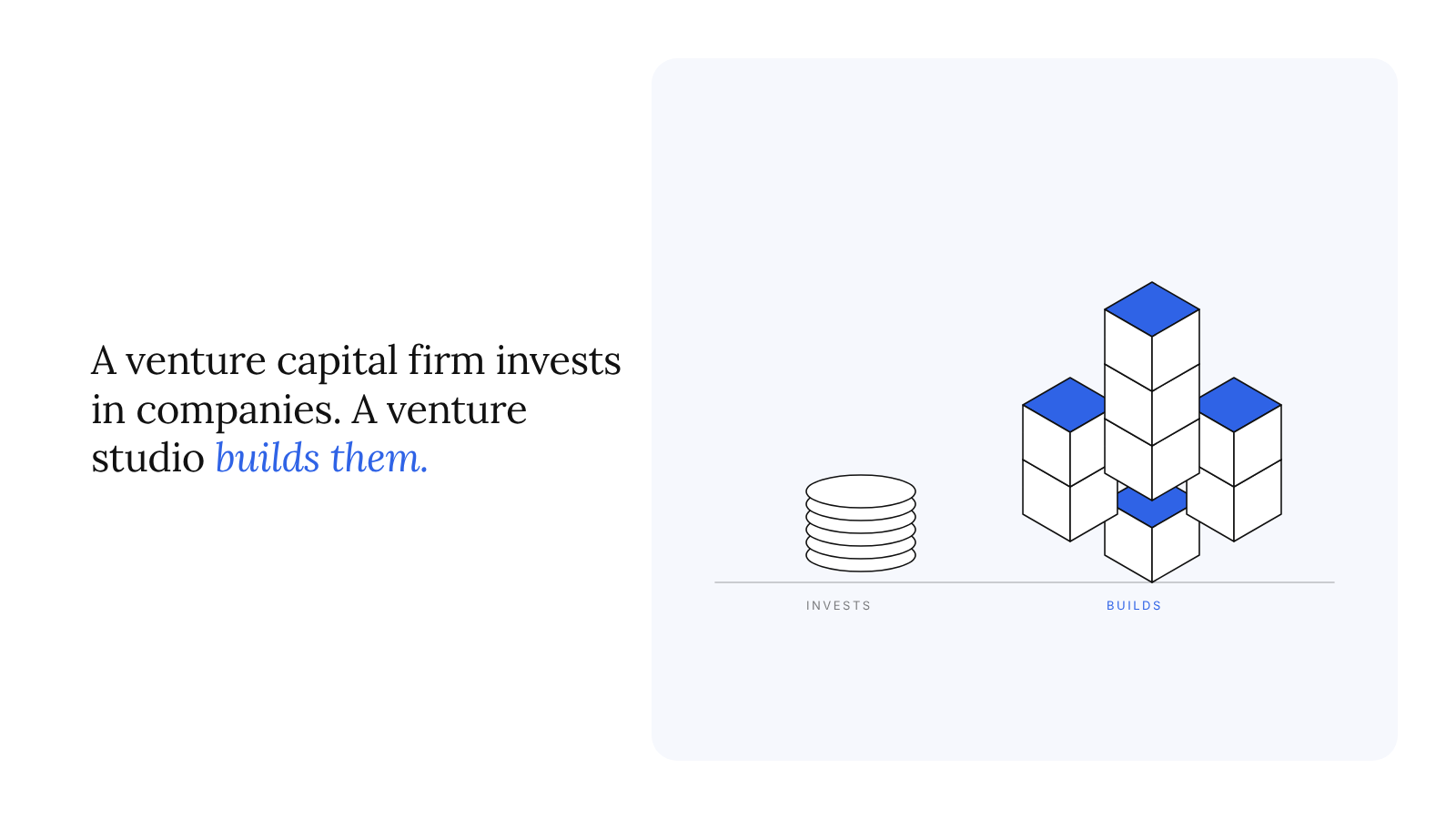
A venture capital firm invests in companies. A venture studio builds them.
Everything else follows from that. A venture capital firm waits. A founder arrives with an idea, a team and some early evidence, and the firm decides whether to buy a minority stake. The firm's skill is selection, and its leverage is capital. An accelerator admits companies that already exist and runs them through a short programme. An incubator provides space, mentoring and introductions to companies that have already been formed. All three are useful. All three begin after the company does.
A venture studio begins before the company does. It identifies a problem, decides whether there is a business worth building around it, assembles the founding team, builds the technology with its own engineers, incorporates the company, finds the first customers and takes the product to market. It does not wait for an entrepreneur to arrive with a pitch deck, because at the moment the studio starts work there is no entrepreneur and no deck. The studio is not a backer of the company. In the ordinary legal and practical sense of the word, it is one of the founders.
The idea is older than the current enthusiasm for it. Bill Gross founded Idealab in Pasadena in 1996 to create companies systematically rather than one at a time; Picasa, CitySearch and GoTo.com, the company that invented paid search, came out of it. Rocket Internet in Berlin industrialised the approach through the 2000s. What has changed since is that the term has spread much faster than the practice, and in a market like India, where capital is plentiful and company-building capacity is scarce, the difference between the two deserves to be understood precisely.
What a studio actually does, stage by stage
The easiest way to understand a studio is to follow one company through it. The sequence below is the one PanScience Innovations publishes for its own ventures; other studios use different names for similar stages.
| Stage | When | What happens | Who is in the room |
| Originate | Before any company exists | A problem is identified and tested. Does it exist, is it large, is there a credible advantage in solving it, and can a company be built around it? Most candidates are rejected here | The studio's own team, domain experts, prospective customers |
| Co-found | Month 0 | The company is incorporated. First capital is committed from the studio's own balance sheet. A founding team is assigned, with studio operators holding founding roles | Studio operators, a founder or founder-to-be |
| Build | Months 1 to 12 | The first product is shipped by in-house engineers. Go-to-market, hiring, operations, finance and legal are stood up as functions rather than improvised | Shared studio teams across product, technology, GTM, operations, finance, legal |
| Scale and spin | Month 18 onwards | The venture graduates: its own leadership, its own external funding, independence from the studio's day-to-day. It keeps access to the studio's network | Venture leadership, outside investors |
| Compound | Ongoing | The studio stays on the cap table and contributes senior talent, introductions and follow-on capital. What was learned building this company becomes an input to the next | The studio, as a shareholder and partner |
Two features of this sequence explain almost everything about the model.
The first is that the riskiest work happens before the company has a founder. Validating the problem, deciding what to build and shipping the first version are the stages at which most new ventures fail, and in the studio model they are done by people who have done them many times before, using teams that are shared across every company the studio builds. A founder who joins at month 0 or month 6 inherits a company that has already cleared the hurdles that kill most startups.
The second is that ownership moves. At the start, the studio carries nearly everything: product, engineering, hiring, finance, legal. As the venture proves itself, these functions migrate into the venture until it is its own centre of gravity and the studio is a shareholder with a network. A studio that never lets go has built a subsidiary, not a company. A studio that lets go too early has built an orphan.
Four conditions that make it a studio
Because the word is now used loosely, it is worth stating what has to be true for an organisation to be a venture studio in the sense described above. Four conditions have to hold at once.
| Condition | The question | Why it is decisive |
| Origination | Did the organisation identify and validate the problem before a founder existed? | This is the line between creating companies and selecting them. An organisation that admits founders on the strength of their own idea is a selector, however good its support |
| Capital at day zero | Did it commit its own money at incorporation, before there was any external traction? | This is the line between building and investing. Credits, grants and mentoring are valuable, but they are not founding capital |
| Operator co- founding | Do its own staff hold founding roles and do the work, rather than advise on it? | This is the line between a studio and a network. Office hours and visiting experts are advice; shipped code and signed customers are work |
| Retained equity and spin-out | Does it keep a meaningful stake, and does the company become independent? | This is the line that separates a studio from a services firm on one side and a corporate lab on the other. A vendor keeps no equity; a parent never lets go |
An organisation that meets three of the four is usually something excellent: a well-run accelerator, an operator-led fund, a university commercialisation programme. The point of the four conditions is not to rank organisations but to let a founder, a corporate or an investor know what kind of relationship they are entering, because each condition changes the terms.
Why a studio takes the stake it takes
The feature of the model that founders ask about first is equity, and it is the feature studios discuss least. The logic is simple even where the numbers are not.
A venture capital firm buys a minority stake because it contributes capital after the hard early work is done. A studio contributes the idea, the validation, the first team, the first product, the first customers and the first capital, and it does so before anyone else will. It therefore holds a founding stake rather than an investor's stake. Surveys by the Global Startup Studio Network, a membership body, have put the average studio stake at formation somewhere between a third and 40 percent, with a range running from about 15 percent to, in some cases, majority ownership, against roughly 7 percent for an accelerator. Founders in studio-built companies typically retain around half, with the balance reserved for employee options. These figures are self-reported by studios and vary by telling, and this research platform examines them critically in a separate piece. But the shape they describe is right: the studio owns a large stake because it did a large share of the work.
Whether that is a good trade for a founder depends entirely on what the studio actually did. A founder with a validated idea and a working team does not need a studio and should not pay a studio's price. A founder with the appetite to run a company but no company to run, or a domain expert who knows the problem but has never built software, is receiving a different proposition: a de-risked business in exchange for a smaller share of something far more likely to exist in five years. The equity question is really a question about the first three conditions. A studio whose operators co-founded the company has earned its stake in a way a mentor network has not.
The model in practice: what building looks like in India
Abstractions about venture building are easy to write and hard to check. The most useful evidence is a portfolio, so this section uses PanScience's own, with the caveat that every figure is company- reported.
PanScience was founded in New Delhi in 2021 on a thesis the founder has described as a frustration: India produces world-class research and ambitious people, but too little of either becomes an enduring company, because the years between a breakthrough and a business are the years nobody is paid to carry. Five years on, the studio reports 24 co-founded ventures across nine verticals, with 13 described as active and scaling, seven at growth stage, four at seed and three in stealth.
What the portfolio shows about the model is more interesting than its size.
It shows that origination produces companies in places investors rarely look. Nyaay AI builds judicial workflow tools and reports deployments in more than a dozen Indian High Courts and three national supreme courts. OnFinance AI builds a regulatory and compliance language model for banking and reports more than 70 agents in production across 40 regulatory regimes. Parchaa is a healthcare platform built to India's Ayushman Bharat Digital Mission standard. PredCo builds industrial AI for manufacturing plants. None of these began with a founder pitching a deck; each began with a problem the studio chose to investigate, in a sector where a conventional startup would have struggled to find its first customer without an institutional partner already in the room.
It shows that shared infrastructure compounds. Eight of the 24 ventures are themselves AI infrastructure companies: on-premise language models, enterprise retrieval and agent platforms, model gateways, data annotation and model operations. Those capabilities were built because earlier ventures needed them, and they now reduce the cost and time of building each subsequent venture. This is the mechanism by which a studio gets better at its job with every company, and it is the reason the model is hard to copy by hiring consultants.
And it shows the invisibility described at the start of this article. A judge using Nyaay AI, a compliance officer using OnFinance AI or a plant manager using PredCo has no reason to know that the same organisation built all three. The studio's reputation, where it has one, is with the founders it has co-founded with, the institutions it has partnered with and the investors who have followed its ventures. Its work is visible in the companies, not in its own name. That is as it should be. A studio that needs to be famous has confused itself with its portfolio.
Why India needs company builders, not only company backers
India does not lack startups. The Nasscom-Zinnov Tech Start-up Report published in February 2026 counts more than 4,200 deeptech startups, over 550 of them founded in 2025 alone, and reports that AI accounted for 84 percent of those startups and 91 percent of the $2.3 billion they raised that year. The same report describes capital as becoming more selective and milestone-linked.
Selective capital is a problem for the kind of company India most needs and least produces: deep, slow, institutional businesses in justice, healthcare, regulated finance and industry, where the first customer is a court or a hospital or a plant, the sales cycle is measured in quarters, and the founding team needs domain depth that few first-time founders possess. A fund cannot manufacture those companies; it can only wait for them and most never arrive. A studio can manufacture them, because it supplies the pieces a founder would otherwise have to assemble alone: the validated problem, the institutional relationship, the engineering team and the first year of runway.
That is the capacity a venture studio adds to an ecosystem, and it is the capacity that registration counts and funding totals cannot measure. A country can have many startups and few company builders. India has, by every published count, the former. Whether it develops the latter is a question that will be answered by what gets built over the next five years, not by what gets announced.
What this means if you are deciding whether to work with one
For a founder: ask what the studio did before you arrived, in specifics. Which problem did it validate, with whom, and what did it reject? Who wrote the first code? Who signed the first customer? If the answers are vague, you are being offered a programme, and you should price it as one.
For a corporate: the model gives you a third option between buying software from a vendor and building a team you will struggle to keep. A studio can build a company around a problem you bring, and the fourth condition decides whether you end up with a supplier, a subsidiary or a stake in an independent business. Decide which you want before the first meeting, because the studio's model will decide for you otherwise.
For an investor: an organisation that meets all four conditions is carrying execution risk on its own balance sheet, which is why both its stakes and its reported survival rates tend to be high and both deserve scrutiny. Underwrite the process, not the headline numbers. Ask to see what was rejected at the origination stage; a studio with no rejected ideas has no process.
The quiet model
A venture capital firm invests in companies. A venture studio builds them. The investing model is well understood because it has been explained for forty years and its practitioners are public figures. The building model is poorly understood because its practitioners are, by design, behind the companies they create. This research platform exists partly to correct that imbalance: to explain how companies are built from zero, what it costs, what it produces and where it fails, using the evidence of having done it. The studio's name matters less than the reader's ability to recognise the model when they see it.
Methodology and sources
The stage sequence and the PanScience portfolio figures are taken from the company's published Approach, Ventures and About pages (panscience.xyz/approach, panscience.xyz/ventures, panscience.xyz/about), read on 24 October 2026, and are company-reported. Global studio examples (Idealab, Rocket Internet, Atomic, Science, eFounders) are matters of public record. Equity ranges are as reported by the Global Startup Studio Network's own director (Angel Capital Association blog, February 2021, angelcapitalassociation.org) and by a GSSN survey quoted in GeekWire (2021, geekwire.com); they are self-reported by studios and should be treated as directional. Indian deeptech figures are from the Nasscom-Zinnov Indian Tech Start-up Report 2025, released 25 February 2026 (zinnov.com press release).