
By every measure that gets published, India's startup ecosystem is large and growing. The Department for Promotion of Industry and Internal Trade had recognised more than 2.23 lakh startups by 31 March 2026, and the 55,200 recognised in the 2025-26 financial year were the most in any year since the Startup India programme began in 2016. Nasscom and Zinnov count more than 4,200 deeptech startups, over 550 of them founded in 2025, and report that they raised $2.3 billion that year, up 37 percent, with artificial intelligence accounting for 84 percent of the startups and 91 percent of the money.
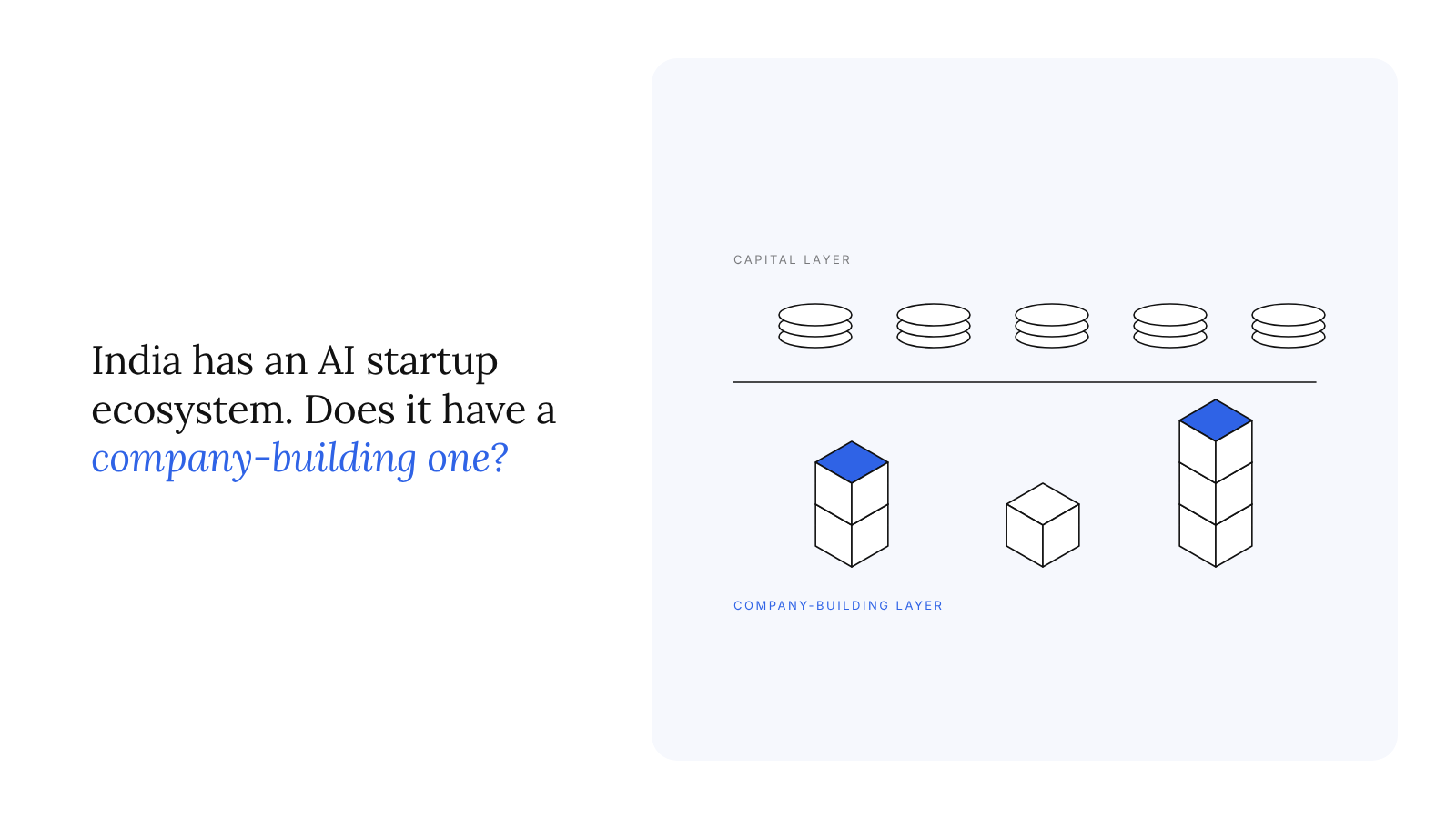
These are measures of two things: how many companies have been registered, and how much capital has been committed to them. They are good measures of what they measure, and they say nothing about whether there is a company-building ecosystem in India. The argument of this article is that they measure the wrong layer. India has built, over a decade, a capital-formation ecosystem of real depth: funds, angels, accelerators, government schemes and a registration system that recognises a new startup every few minutes. What it has not built, or has not measured, is a company-formation ecosystem: the institutions and people who turn a problem into a functioning business before capital arrives. The two are different, the second is scarcer, and the published numbers cannot tell them apart.
Two layers, one set of statistics
Every startup ecosystem has two layers. The capital layer selects among companies that exist and funds them. The company-building layer creates companies: it finds problems, validates them, assembles teams, builds first products and finds first customers. In mature ecosystems the second layer is thick and largely invisible, made of repeat founders, experienced early operators, specialist engineering talent and organisations that build companies as a discipline. In younger ecosystems the first layer tends to arrive before the second, because capital is easier to import than company- building capacity.
India's published statistics describe the first layer almost exclusively. Registration counts tell you how many entities have been formed, not how they were formed. Funding totals tell you how much capital was deployed, not whether the companies receiving it had a product, a customer or a team capable of building either. Even the deeptech counts, which are the most careful numbers available, describe what was funded and founded, not what was built.
The gap shows up in a different set of numbers, when one looks for them.
What the gap looks like in the data
The Stanford AI Index 2025 ranked India fourth in the world for newly funded AI companies in 2024, with 74, behind the United States with 1,073, the United Kingdom with 116 and China with 98. On cumulative private AI investment between 2013 and 2024 it ranked seventh, at roughly $11.3 billion, against $471 billion for the United States. India also topped the Index's measure of AI hiring vibrancy and was the second-largest contributor to AI projects on GitHub.
Read together, these say something specific. India has a large and active AI talent base, a respectable number of new AI companies and a small amount of capital per company. That is the signature of an ecosystem that forms companies easily and builds them with difficulty: plenty of starts, modest scale, and a long tail.
The 2025 funding figures make the same point from another direction. Tracxn, reported by TechCrunch, put Indian AI startup funding in 2025 at just over $643 million across 100 deals. Other published tallies for the same year range up to $1.34 billion across 198 deals, and the Nasscom- Zinnov deeptech figure, if AI is 91 percent of $2.3 billion, implies something above $2 billion. The sources disagree by a factor of three because they define "AI startup" differently, which this platform examines in a separate piece. But every one of them agrees that the median deal is small and that most of the money went to early-stage companies. An ecosystem in which most AI capital goes to early stages is one in which most AI companies have not yet proved they can be built.
There is also the attrition that registration counts conceal. In early 2026 the Ministry of Commerce told Parliament that 6,789 DPIIT-recognised startups had shut down, against a base of just over 2.12 lakh at the time. That is a small share, and it is almost certainly an undercount, because a company that stops operating does not usually tell the department. The point is not the number but the fact that nobody tracks the thing that matters: of the companies recognised, how many ever built a product that someone paid for?
Why a company-building ecosystem in India is harder to build
Company-building capacity is made of three things, and India is short of each in a particular way.
The first is repeat founders and early operators. A founder who has built one company knows the sequence: what to validate, whom to hire first, how long enterprise procurement takes, when to stop. India's ecosystem is young enough that its first large cohort of such people is only now emerging, and many of them are absorbed into the capital layer as investors rather than returning to build.
The second is institutional access. The companies India most needs and least produces are deep institutional businesses: tools for courts, hospitals, banks, utilities and factories. Their first customer is an institution with a procurement process, a security review and a tolerance for risk measured in years. A first-time founder with a product and no relationships cannot reach that first customer, and the capital layer cannot help, because capital does not open institutional doors. This is the specific reason India's AI startups cluster in horizontal software and consumer applications rather than in the sectors where the country's problems are.
The third is shared engineering depth. Building an AI product for a regulated institution requires capabilities that a seed-stage team cannot afford to hire: on-premise deployment, Indic-language data, evaluation harnesses, compliance tooling. Each venture building these from scratch is a waste the ecosystem cannot absorb. In mature ecosystems these capabilities are supplied by a dense market of specialist firms and experienced engineers. In India they are mostly supplied by services companies whose business model is hours, not products.
What company builders do that capital cannot
This is the gap that a venture studio exists to fill, and it is worth being precise about why a studio can fill it when a fund cannot.
A fund selects. It can only invest in companies that founders have already formed, which means it inherits the ecosystem's company-building capacity rather than adding to it. If few founders can build institutional AI companies, a fund with an institutional AI thesis will have few companies to choose from, however much capital it raises.
A studio creates. It supplies the three missing inputs directly: experienced operators who hold founding roles, institutional relationships that function as lighthouse partners and first customers, and shared engineering that each venture inherits rather than rebuilds. It does this before capital arrives, which is exactly where the gap is.
PanScience's portfolio is one piece of evidence that this works in India, and it is cited here as evidence of the mechanism rather than as a boast. Its ventures in the judiciary, in regulated finance, in public health infrastructure and in industrial plants are the kinds of companies the capital layer rarely produces, because each needed an institutional partner in the room before it had a product. The studio reports 24 such ventures built since 2021, with eight of them in AI infrastructure: the shared capabilities that the next ventures inherit. Whether that portfolio succeeds is for time to judge. What it already shows is that the company-building layer can be built deliberately, as an institution, rather than waited for.
Measuring the layer that is not measured
If India wants a company-building ecosystem and not only a startup ecosystem, it will need to measure the former. The existing measures will not do it. Five that would, none of which is currently published for India:
| Measure | What it captures | Who could publish it |
| Repeat-founder share | Proportion of new ventures with at least one founder who has built a company before | Registries, with a one-field addition to DPIIT recognition |
| Time to first paying customer | Median months from incorporation to first invoice, by sector | Studios, accelerators and funds, from portfolio data |
| Institutional-sector share | Proportion of new AI ventures whose first customer is a court, hospital, bank, utility or plant | Industry bodies, by classifying funded companies |
| Operator depth | Number of people in the ecosystem who have held a founding or executive role through a company's first three years | Professional networks, by survey |
| Builder-institution output | Companies created by organisations whose business is company creation, as a share of all new ventures | A census of such organisations, which does not yet exist |
None of these is difficult. All of them would change the conversation from how many companies India has to how many it can build. The first ten thousand DPIIT recognitions took 808 days; the most recent ten thousand took 156. That acceleration is real and worth celebrating. It is also exactly the kind of number that tells you nothing about whether the companies behind it will exist in five years.
The question that matters
India will not run out of startups. It will not, on current evidence, run out of capital for them either, though the capital has become more selective and milestone-linked. The constraint on what India's AI ecosystem produces over the next decade is not the number of companies formed or the amount of money raised. It is the number of companies that can be built: by people who have done it before, with institutions that will be their first customers, on infrastructure they do not have to invent. That is a company-building ecosystem, and India's statistics do not yet know whether it has one.
Methodology and sources
DPIIT recognition figures are from the Ministry of Commerce and Industry statement of April 2026 as reported by Inc42 and others (2.23 lakh as of 31 March 2026; 55,200 recognised in FY2025-26; inc42.com), and from the Minister of State's reply in Parliament in early 2026 (6,789 shut; 2.12 lakh base at end-January 2026; inc42.com). The pace of recognitions (808 days versus 156 days) is from Vikaspedia (vikaspedia.in, January 2026). Deeptech counts and funding are from the Nasscom- Zinnov Indian Tech Start-up Report 2025, released 25 February 2026 (zinnov.com press release). Stanford AI Index 2025 figures (74 newly funded AI companies in India in 2024; about $11.3 billion cumulative private investment 2013 to 2024; rankings) are as reported by Indian trade press from the Index (tele.net.in; communicationstoday.co.in). 2025 AI funding figures are from Tracxn as reported by TechCrunch (techcrunch.com) and from Angel One (angelone.in); their disagreement is noted in the text. PanScience portfolio figures are company-reported from panscience.xyz, read 24 October 2026. The five proposed measures are this platform's own.