
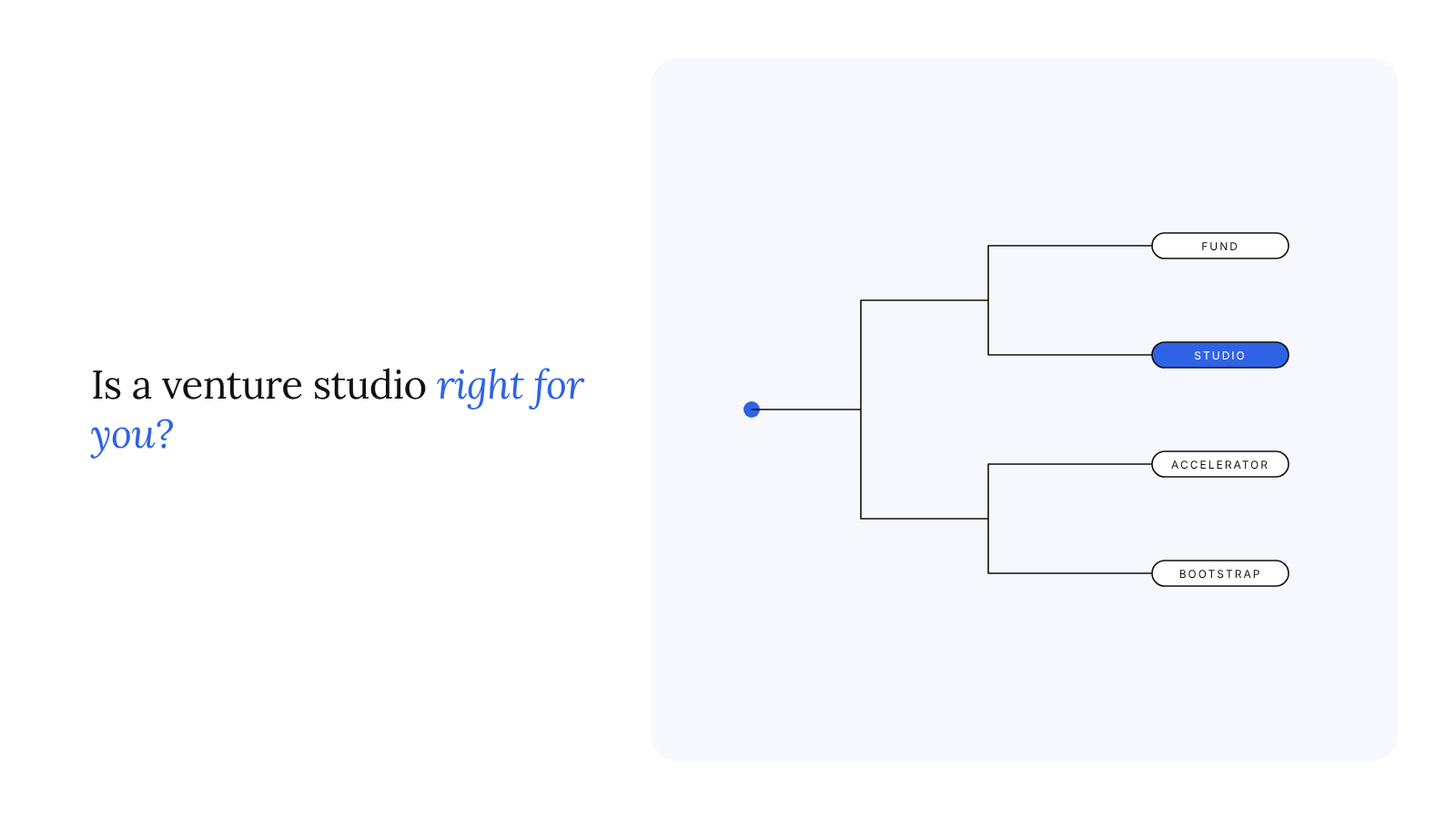
The venture studio has become a fashionable answer to a question most people asking it have not fully stated. A would-be founder with an idea hears that studios provide a team and capital, frames the choice as venture studio vs accelerator, and wonders whether the studio is a shortcut. A senior operator leaving a large company hears that studios recruit chief executives for ventures they have already validated and wonders whether that is a safer way to become a founder. A domain expert, a clinician or a process engineer or a lawyer, hears that studios turn insight into product and wonders whether that is how to build something without learning to code. Each of them is asking a different question, and the honest answer to at least one of them is that a studio is the wrong choice.
This guide sets out a decision tree in prose and in a table. It is written for the person deciding, not for the studio recruiting them, which means it spends as much time on when to walk away as on when to join. The tree turns on four facts about the person's situation: whether a validated idea exists, whether a team exists, how much of the early risk the person is willing and able to carry, and whether the person has domain depth without the capability to build. No operating programme is named except where a global historical example makes a point about the model concrete.
Venture studio vs accelerator: what a studio is, and what it is not, from the applicant's side
From the outside, a studio looks like an accelerator with more involvement. From the applicant's side the difference is in who owns the idea and who is at risk before a company exists. In the studio model as described by its longest-running practitioner, Idealab, founded in Pasadena in 1996, the studio tests "many ideas in parallel" and, when one shows promise and "we recruit a great team", spins it off into a company; because it develops ideas internally, it does not accept outside business plans (idealab.com). Idealab reports having created more than 145 companies with more than 45 IPOs and acquisitions (company-reported). The applicant to such a studio is not pitching an idea. They are applying to lead one the studio already has.
The price of that arrangement is equity. A Global Startup Studio Network survey cited by GeekWire in 2021 found studios take 34 per cent on average at founding, with a range from around 15 per cent to as high as 80 per cent (GeekWire, January 2021). The European studio eFounders, now Hexa, has described a model in which founders receive an idea, initial funding of up to 800,000 euros, and a team of ten to fifteen people for a first product, and in which the studio takes 30 per cent at independence with founders keeping the majority (Wikipedia, "Hexa (formerly eFounders)"); its current programme page states 25 per cent for a funded year (hexa.com/start). For comparison, the standard accelerator deal at Y Combinator gives the accelerator 7 per cent for a $125,000 post- money SAFE plus $375,000 on an uncapped MFN SAFE (ycombinator.com/deal), and a talent investor such as Entrepreneur First, founded in 2011, invests in individuals "before they have established a cofounder or a specific business concept", pays them a stipend, and takes a pre-seed stake (Wikipedia, "Entrepreneur First").
Those three numbers, roughly 7 per cent, a pre-seed stake, and 25 to 35 per cent, correspond to three very different amounts of work done before the founder arrives. The accelerator does almost none; the founder brings the idea and the team. The talent investor does the matching but not the idea. The studio does the idea, the validation, the first capital, and often the first product. The equity is the price of the work. The decision for the applicant is whether they need the work done, and the honest test is how much of it they could do themselves.
The four questions
The decision tree turns on four questions, asked in order. The order matters because the answer to each changes which later questions are relevant.
The first question is whether a validated idea exists. Validated means more than conviction: it means evidence from the market, customers who have paid or committed, usage that has grown without paid acquisition, or a regulatory or technical result that removes the main uncertainty. A person with a validated idea has done the most expensive thing a studio does. Paying a studio 25 to 35 per cent to do it again is an error, and it is the single most common error this guide exists to prevent. A person without a validated idea, or with an idea that is really a domain observation ("this process in my industry is broken") rather than a product, has not done that work and may reasonably want someone to do it with them.
The second question is whether a team exists. A team here means at least the two or three people who will build and sell the first product, committed full time or ready to be. A person with a validated idea and a team should raise from a fund: an angel round, a pre-seed or seed fund, or an accelerator, each of which will take a fraction of the equity a studio would and leave the founders in control. A person with a validated idea and no team is in the one position where a studio's offer of a built-in team is worth considering, though the better first move is often a talent-matching programme or a direct co-founder search, which costs less equity. A person with neither idea nor team is the studio's natural recruit, or the talent investor's.
The third question is how much early risk the person wants to carry. This is about money and time, and it is personal. A founder who can fund twelve months of their own living costs and a small team's salaries, or who can raise that from people who already trust them, is carrying the early risk themselves and should be paid for it in ownership. A founder who cannot, whether because of family obligations, geography, or the absence of a network that writes cheques on trust, faces a real choice between not starting and starting on a studio's capital. For that person the studio's equity is not expensive relative to the alternative, which is zero. Entrepreneur First's model of paying a stipend to individuals with no idea and no co-founder exists precisely for this population, and a studio that pays operator co-founders a salary from month zero is making the same trade at a higher equity price for a more complete package.
The fourth question is whether the person has domain depth but no build capability. This is the case the studio model fits best and the one the person is most likely to misjudge. A clinician who understands exactly where a hospital's workflow breaks, a process engineer who knows which sensor data a plant ignores, a lawyer who knows which filings consume paralegals' weeks: each has an insight that is worth a company and none can ship software. Their alternatives are to hire a development agency, which produces a product nobody owns the roadmap for; to find a technical co-founder, which takes months and often fails; or to join a studio that has a shared engineering pool and will co-found with them. The studio is often the right answer here because the thing the person lacks is exactly the thing the studio has in surplus. The risk is the mirror image: the domain expert must be willing to become an operator, not remain an advisor, and must accept that the studio will shape the product in ways their domain judgement would not have.
The Programme Fit Decision Tree
The table below is the decision tree in a form that can be read in one pass. Each row is a combination of answers; the recommendation column states the programme type that fits, and the final column states the reason in terms of what the person would be paying for and whether they need it. It is original to this article.
| Validated idea? | Team? | Can carry early risk? | Domain depth without build capability? | Best fit | Why |
| Yes | Yes | Yes | Any | Raise from angels, a seed fund, or an accelerator | The expensive work is done; a studio would charge 25 to 35 per cent for services already performed. Founders keep control |
| Yes | Yes | No | Any | Accelerator or seed fund | Accelerator capital solves the cash constraint at a fraction of studio equity; the team exists so a built-in team adds nothing |
| Yes | No | Yes | No | Co-founder search, then raise; talent- matching programme as a fallback | The gap is people, not idea or money; pay for matching, not for validation |
| Yes | No | Yes | Yes | Studio, if its pool matches the domain; otherwise technical co-founder search | The studio supplies the build capability the person lacks; but only a studio with engineers in the right stack is worth the equity |
| Yes | No | No | Yes | Studio | Three gaps (team, capital, build) and one asset (validated domain insight); this is the studio's strongest case |
| No | Yes | Yes | Any | Build and validate independently, then raise | A team with money and no idea should spend the money finding one; a studio's idea comes with a studio's stake |
| No | Yes | No | Any | Talent investor or studio, depending on whether the team wants its own idea | A talent investor funds the search for an idea at a lower stake; a studio supplies one at a higher stake |
| No | No | Yes | Yes | Studio or venture builder with a shared pool, as a co-founder | Domain depth is the asset; everything else is missing; the studio originates and builds around the insight |
| No | No | Yes | No | Talent investor, or join an early-stage company as an operator | Without idea, team or domain edge there is nothing yet for a studio to build around; earn one of the three first |
| No | No | No | Yes | Studio, as a salaried operator co-founder | The studio's salary and capital remove the risk barrier and its pool removes the build barrier; the person's domain depth is the contribution |
| No | No | No | No | Join an early-stage company; revisit in two to three years | A studio needs a contribution to build around; a salaried role at a venture is the way to acquire one |
Three rows deserve comment. The first row is the one studios would prefer not to be in the table, and it is the most important: a founder with a validated idea and a team should not join a studio. Nothing the studio offers is worth the equity to that person, and a studio that recruits them anyway is pricing its services at a level the market would not accept if the founder knew their alternatives. The fifth and tenth rows, the domain expert without team, capital or build capability, are where the studio is unambiguously the best available option, and they are where the honest studio should concentrate its recruiting. The ninth and eleventh rows, the person with none of the four assets, are a reminder that a studio is not a career entry point; it is a vehicle for combining a contribution the person already has with capabilities they lack.
When the studio is the wrong choice
The tree makes the cases explicit, but it is worth stating them in prose because the person in each case is often the least likely to see it.
A founder with traction and a team who joins a studio has usually done so because the studio offered certainty: a salary, an office, a team on day one, and no fundraising. Those are real. The cost is that the founder has sold a third of a company that already worked for services it did not need, and will carry that stake through every later round. Carta's data on more than 1,000 software rounds in the six months to July 2026 put median dilution at 18 per cent at seed and 18 per cent at Series A (Carta, July 2026). A founder who enters those rounds owning 55 per cent because a studio holds 35 ends them owning around 37; a founder who enters owning 85 per cent after a 7 per cent accelerator and a small angel round ends them owning around 57. The difference is twenty points of a company the founder built either way.
A technical founder with a product and no distribution is a second case that looks like a studio fit and is not. The gap is go-to-market, and studios do have shared go-to-market functions. But a founder with a working product can hire a head of sales or take a seed round from a fund with commercial operating partners for far less than studio equity. The studio's shared go-to-market pool is designed for ventures that have nothing, not for products that need one commercial hire.
A domain expert who wants to remain in their profession is a third case. The studio model requires the domain expert to become the venture's operator; a studio cannot build a company around an advisor who gives four hours a week. The person in this situation should license their insight, consult, or join an existing venture's advisory board, and should be wary of any studio that suggests their part-time involvement is enough. It is not, and the equity they would be issued for it will not vest in any meaningful sense.
Finally, anyone considering a studio should run the diligence the studio will run on them. A 2026 founder's guide on due diligence for studios lists the questions: whether the studio's contribution is recorded as equity or as a loan that will shrink the founder's stake later; how many board seats the studio keeps after launch and whether it holds vetoes over fundraising or hiring; whether the venture owns its intellectual property or the studio does, and whether terms like "studio tools" could cover technology the venture's own team built; whether the studio's service commitments are written down with remedies if not delivered; and whether founder equity vests on time or on milestones the studio defines (startupstudios.com, March 2026). A studio that cannot answer those questions crisply is not ready to co-found with anyone.
What the studio should want from the applicant
The tree can be read from the other direction. A studio that recruits from the first row is buying founders who do not need it and will resent the stake. A studio that recruits from the rows where idea, team and capital are all missing but domain depth is present is doing what the model was built for: originating an idea around an insight, surrounding it with a built-in team, funding it at idea zero, and spinning it out when it has earned independence. PanScience Innovations in New Delhi, which publishes a model that originates ideas in-house, co-founds at month zero with studio operators as co-founders, and explicitly states that it "does not source startups" (company-reported, panscience.xyz, read October 2026), is describing a studio that has, in effect, chosen the lower rows of the table and declined the upper ones. Whether a given studio has made that choice is something an applicant can test in the first conversation: a studio that asks what idea you have brought is not operating the originate-and-co-found model, whatever it calls itself.
Conclusion
The question "is a venture studio right for you" has a short answer that depends on four facts, and the facts are about the applicant, not the studio. If the idea is validated and the team exists, the answer is no: raise from a fund, keep the equity, and buy services as you need them. If the person has deep knowledge of a problem but cannot build, cannot fund a team, and has no co-founder, the answer is often yes, because the studio's surplus is exactly the person's deficit and the equity is the fair price of closing that gap. In between, talent investors and accelerators exist for the cases where only one of the four is missing, at a lower stake.
What the person should not do is let the studio's offer, the salary and the team and the absence of fundraising, substitute for the analysis. Those benefits are real and they are priced. The price is a stake that will be on the cap table through every round the company ever raises, and the only way to know whether it is worth paying is to be honest about which of the four things you already have.
Methodology and sources
The Programme Fit Decision Tree is original to this article and is a qualitative framework built from the author's reading of how studios, accelerators and talent investors describe their own offers and equity terms. The cap-table arithmetic is a worked example using the GSSN average studio stake, the Y Combinator standard deal and Carta's median dilution figures, and is illustrative. Limitations: equity figures for studios are self-reported by studios or second hand from the business press and vary widely; Carta's dilution data covers software companies on its platform in one six-month window; the tree is a decision aid and does not substitute for the specific terms of any programme, which an applicant should read with counsel; no Indian programme is named or compared, in keeping with the editorial policy of this platform.
Sources: Idealab, company page (https://www.idealab.com/); GeekWire, "How Seattle startup studio Pioneer Square Labs spun out 25 ideas in 5 years", 8 January 2021 (https://www.geekwire.com/2021/seattle-startup-studio-pioneer-square-labs-spun-25-ideas-5- years/); Wikipedia, "Hexa (formerly eFounders)" (https://en.wikipedia.org/wiki/EFounders); Hexa, "Start" programme page (https://www.hexa.com/start); Y Combinator, "The YC Deal" (https://www.ycombinator.com/deal); Wikipedia, "Entrepreneur First" (https://en.wikipedia.org/wiki/Entrepreneur_First); Carta, Peter Walker, "Founders sell 20 percent at seed and 20 percent at Series A", 10 July 2026 (https://carta.com/data/linkedin-founders-sell-20- percent-seed-series-a/); startupstudios.com, "Measure Twice, Sign Once: A Founder's Due Diligence Guide for Startup Studios", 16 March 2026 (https://www.startupstudios.com/post/measure-twice- sign-once-a-founders-due-diligence-guide-for-startup-studios); PanScience Innovations, company- reported model (https://panscience.xyz).