
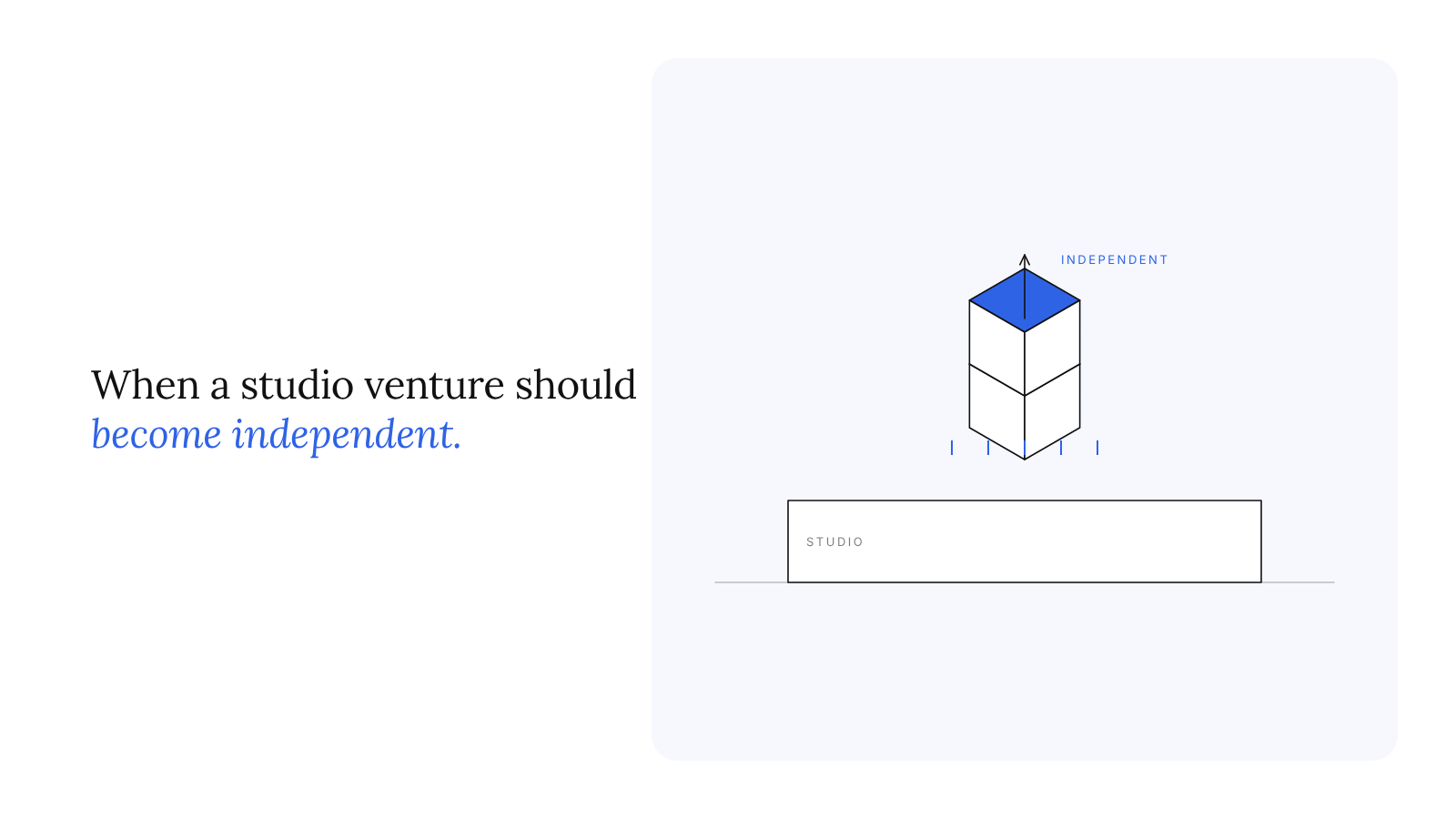
The venture studio spin-out is the moment every studio describes in its pitch as graduation. The venture that began as a slide in an internal review, was incorporated with studio operators as co- founders and was built by the studio's shared engineers, becomes a company with its own leadership, its own investors and its own payroll. Studios tend to put a number on that moment. The European studio eFounders, now Hexa, has described a model in which "after about 18 months, the startup becomes independent and seeks investors"; its current programme page says the funded journey "typically lasts 12 months" and that "once the company raises a seed round, it becomes a completely 'normal' startup". PanScience Innovations in New Delhi publishes month 18-plus as the point at which a venture "graduates to independent company with own leadership and external funding" (company-reported).
A fixed month is useful for planning and misleading as a decision rule. Spin out too early and the venture loses the shared services and senior attention that justified the studio in the first place, usually just as it is starting to need them for commercial rather than technical work. Spin out too late and the venture's founders, if there are any distinct from the studio, never learn to own a decision, the cap table hardens around a studio stake that later investors find hard to price, and the venture's costs stay buried in the studio's accounts where nobody can see whether it works. This article proposes a set of observable triggers to replace the calendar, treats the published month markers as reference points to be tested against those triggers, and names the two failure modes that follow from getting the timing wrong.
Why a fixed month is the wrong instrument
Studio timelines are averages of very different things. A venture building a software product for a market the studio already understands may be commercially independent in nine months. A venture building a regulated healthcare product or a scientific instrument may not have a product to sell at eighteen. A single month marker applied to both either strands the first in the studio past its useful life or ejects the second before it can survive.
The deeper problem is what the month marker measures. It measures elapsed time, which is a proxy for progress. Progress in a venture is observable directly: there either is or is not a lead investor who has committed outside money; revenue either does or does not cover a stated share of burn; a chief executive either is or is not in place full time and accountable. When the proxy and the direct observations disagree, the direct observations should win, and a studio that insists on the proxy is choosing administrative convenience over the venture's interest.
There is also a commercial reason the marker drifts. The studio's own economics, as set out in the companion article on shared services, depend on ventures leaving the shared pool so that capacity is freed for new ones. A studio under pressure to start new ventures has an incentive to push spin-outs earlier than readiness warrants; a studio with a weak pipeline has the opposite incentive, to keep mature ventures inside because they make the portfolio look busy. Neither incentive has anything to do with whether the venture is ready. An explicit set of triggers, agreed in advance, is a defence against both.
What the outside world does at the spin-out
The spin-out is, in most studio models, coincident with the first priced round from outside investors. That is not an accident. The outside investor is the first party to price the venture who has not been inside it, and their diligence is the first independent test of whether the studio's work has produced a company. Hexa's programme page states the sequence plainly: the studio covers costs for the funded year, then helps the founders raise a seed round, after which the company is "normal". The venture has, in effect, been underwritten by the studio until a stranger agrees to underwrite it instead.
That makes the cap table the central object of the spin-out. Studios hold founder-scale stakes. A Global Startup Studio Network survey cited by GeekWire found studios take 34 per cent on average at founding, with a range from around 15 per cent to as much as 80 per cent; Pioneer Square Labs in Seattle was reported to have started at roughly 40 per cent or more and to have since reduced its initial stake according to founder experience and the studio investment required (GeekWire, January 2021). The eFounders model as described on Wikipedia has the studio take 30 per cent at independence with founders keeping the majority; Hexa's current page states 25 per cent. For comparison, an accelerator at the other end of the spectrum takes far less: Y Combinator's standard deal gives it 7 per cent for its $125,000 post-money SAFE, with a further $375,000 on an uncapped MFN SAFE (ycombinator.com/deal). And an ordinary priced round dilutes founders by a known amount: Carta's data on more than 1,000 software rounds in the six months to July 2026 put median seed dilution at 18 per cent, with Series A dilution also at 18 per cent (Carta, Peter Walker, July 2026).
Put those numbers together and the timing problem becomes arithmetic. A venture that spins out with the studio at 35 per cent, two founders at 55 per cent and an option pool at 10 per cent, and then sells 18 per cent at seed and 18 per cent at Series A, has founders at roughly 37 per cent after two rounds, and a studio that is a larger single shareholder than either founder. A venture that spins out later, with the studio at 45 per cent because it funded another year of build, and founders at 45 per cent, has founders at about 30 per cent after the same two rounds. The later the spin-out, the more the studio has spent, the more it reasonably holds, and the smaller the slice left for the people who have to run the company for the next decade. Outside investors read that slice as a signal of whether the founders are founders or employees, and price accordingly or walk away.
Venture studio spin-out readiness triggers
The table below sets out five observable triggers, what each one tells you, and the failure that follows from spinning out before it is met. They are original to this article. The claim is not that all five must be met, but that a studio should know which are met, which are not, and why it is proceeding anyway.
| Trigger | Observable test | What it shows | Risk of spinning out before it is met |
| External lead investor committed | A term sheet or signed instrument from an investor with no prior relationship to the studio, at a price the studio did not set | A stranger has priced the company and will sit on the board | The studio keeps funding a venture nobody else will; the cap table has no external reference price |
| Independent revenue covering a defined share of burn | Contracted or recurring revenue from customers not introduced by the studio, covering an agreed fraction (for example a third) of monthly cost for three consecutive months | The product sells on its own; the venture can survive a delayed round | The venture is a cost centre with a logo; its first independent quarter is a cash crisis |
| Full-time chief executive in place | One named person, employed by the venture not the studio, with no other operating role, accountable to a board | Someone owns decisions and can be fired for them | Decisions keep being made by studio partners who do not bear the consequences |
| Product run without studio engineers for a period | No studio-pool engineer has committed to the production codebase for an agreed period (for example 90 days); on-call and releases handled by venture staff | The venture can ship and keep the lights on alone | A hidden dependency on the pool surfaces as an outage or a stalled roadmap in the first months of independence |
| Own legal, finance and compliance stack | Separate bank accounts, payroll, statutory filings, accounting, contracts in the venture's name, and its own counsel | The venture is a legal and financial entity, not a cost code | Co-mingled costs mean nobody knows the venture's true burn; investors find it in diligence |
Two further observations about the table. First, the triggers are deliberately phrased so that a studio cannot satisfy them by fiat. A studio can appoint a chief executive on paper; it cannot make an unrelated investor sign a term sheet or make a customer it did not introduce pay an invoice. The external triggers are the ones that matter most for that reason. Second, the triggers interact. A lead investor usually requires a full-time chief executive and clean books as conditions of closing, so meeting the first trigger tends to force the third and fifth. Revenue from independent customers is what allows the product to run without studio engineers, because the venture can hire. The sequence in practice is often revenue, then chief executive, then investor, with the legal and engineering separations completed in the closing.
Testing the eighteen-month marker against the triggers
PanScience's published model has five phases: Originate, before any company exists; Co-found at month zero with incorporation, first capital from the studio and studio operators as co-founders; Build from months one to twelve, with in-house teams shipping a first product and standing up go- to-market, hiring, operations, finance and legal; Scale and spin at month 18-plus, with the venture graduating to independent leadership and external funding; and Compound, with the studio staying on the cap table and providing talent, introductions, follow-on capital and shared services (company-reported, panscience.xyz, read October 2026).
Read against the triggers, the marker is a statement about when the studio expects the triggers to be met, not a rule that they have been. The Build phase description covers the fifth trigger explicitly: finance and legal are stood up inside the first twelve months, so by month 18 the venture should have its own stack. The phrase "own leadership and external funding" at month 18-plus maps to the first and third triggers. The second and fourth triggers, independent revenue and product run without studio engineers, are not named in the published model, and the "plus" in month 18-plus is where the model acknowledges that the calendar is a floor rather than a rule.
The marker is testable in a way most studio claims are not. A studio with 24 ventures, 13 of them described as active and scaling, has a dataset: for each venture, the month at which each trigger was met and the month at which it was formally spun out. If spin-out months cluster at 18 while trigger months are scattered from 9 to 30, the calendar is driving the decision. If spin-out months track the trigger months, the calendar is a planning device and the triggers are the rule. PanScience does not publish that dataset and this article does not assume what it would show. The point is that the eighteen-month figure, like eFounders' eighteen months and Hexa's twelve, is best understood as the studio's expectation of when a well-built venture meets the external triggers, and that the triggers, not the figure, should decide any individual case.
The two failure modes
Getting the timing wrong produces one of two recognisable outcomes. They are mirror images and both are common enough to deserve names.
The subsidiary is the venture that never really left. It has a chief executive, but the chief executive checks with the studio before hiring, pricing or signing. Its engineers are still half studio-pool. Its books are separate on paper but its costs are subsidised by services it does not pay for, so its reported burn flatters it. Its cap table shows the studio as the largest shareholder by a wide margin and no outside lead, because every round so far has been studio capital or studio-introduced capital. The subsidiary is comfortable and it is a trap: the shared services that made it cheap to start make it impossible to value, because no outsider can tell what it would cost to run alone. When an outside investor finally does look, the diligence question is not "is this a good company" but "is this a company at all", and the answer is often a lower price than the studio has been carrying it at.
Studios produce subsidiaries when they delay spin-out past the point at which the external triggers are met, usually because the venture is a reliable contributor to portfolio metrics and nobody wants to disturb it.
The orphan is the venture that left too soon. It was spun out on the calendar, or because the studio needed the pool capacity, before an outside investor had committed or revenue covered a meaningful share of burn. It has its own legal stack and its own chief executive, so it looks independent. It also has nine months of runway, a product that still needs the studio's platform team for anything non-trivial, and a cap table with a 40 per cent studio stake that every investor it meets asks about first. The orphan spends its independence fundraising rather than building, and its founders, who were studio operators until recently, learn that the studio's attention has moved to the next venture. The 2026 CB Insights analysis of 431 venture-backed shutdowns found that 70 per cent ran out of capital, which the analysts note is "almost always the final cause of death, not the root problem", and 43 per cent cited poor product-market fit (CB Insights, March 2026). The orphan's root problem is that it was declared a company before it had the evidence of one; running out of capital is how that shows up.
The subsidiary is the more expensive failure for the studio and the orphan the more expensive for the venture's people. A studio that tracks its spin-outs against the triggers can see which direction it tends to err in: a studio whose ventures routinely meet the triggers months before they are spun out is producing subsidiaries, and one whose ventures are routinely spun out with two or three triggers unmet is producing orphans. Most studios lean one way, and knowing which is the first step to correcting it.
Conclusion
The spin-out is the one event in a studio venture's life that is both a legal transaction and a test of the studio's model. Studios reach for a month marker because it is simple to communicate and it disciplines the shared pool. The marker should stay in the plan and leave the decision. The decision belongs to a short set of facts about the venture that anyone can check: whether a stranger has priced it, whether customers the studio did not bring pay for it, whether one person runs it full time, whether it ships without the pool, and whether its money and contracts are its own.
Published markers, PanScience's eighteen-plus months among them, are statements of when a studio expects those facts to be in place. They are testable against each venture's history, and a studio that publishes a marker should be willing to publish the test. Until it does, the marker is a hypothesis, and the triggers are how a founder, an investor or the studio itself can tell whether the hypothesis held for the company in front of them.
Methodology and sources
The Spin-out Readiness Triggers table and the two failure modes are original to this article; they are constructed from the author's reading of how studio spin-outs are described by the studios themselves and from the dilution and failure data cited. The cap-table arithmetic in the text is a worked example using the GSSN average studio stake and Carta's median dilution figures, and is illustrative. Limitations: the studio stake figures are self-reported by studios or reported second hand by the business press; Carta's dilution data covers software companies on its platform in one six-month window and is not specific to studio-backed ventures; the CB Insights shutdown analysis is of venture-backed companies generally, not studio ventures; no studio publishes trigger-level data on its spin-outs, so the test proposed for the eighteen-month marker could not be run. PanScience figures are company-reported.
Sources: Wikipedia, "Hexa (formerly eFounders)" (https://en.wikipedia.org/wiki/EFounders); Hexa, "Start" programme page (https://www.hexa.com/start); GeekWire, "How Seattle startup studio Pioneer Square Labs spun out 25 ideas in 5 years", 8 January 2021 (https://www.geekwire.com/2021/seattle-startup-studio-pioneer-square-labs-spun-25-ideas-5- years/); Y Combinator, "The YC Deal" (https://www.ycombinator.com/deal); Carta, Peter Walker, "Founders sell 20 percent at seed and 20 percent at Series A", 10 July 2026 (https://carta.com/data/linkedin-founders-sell-20-percent-seed-series-a/); CB Insights, "Why startups fail: top reasons", 5 March 2026 (https://www.cbinsights.com/research/report/startup- failure-reasons-top/); PanScience Innovations, company-reported model (https://panscience.xyz).