
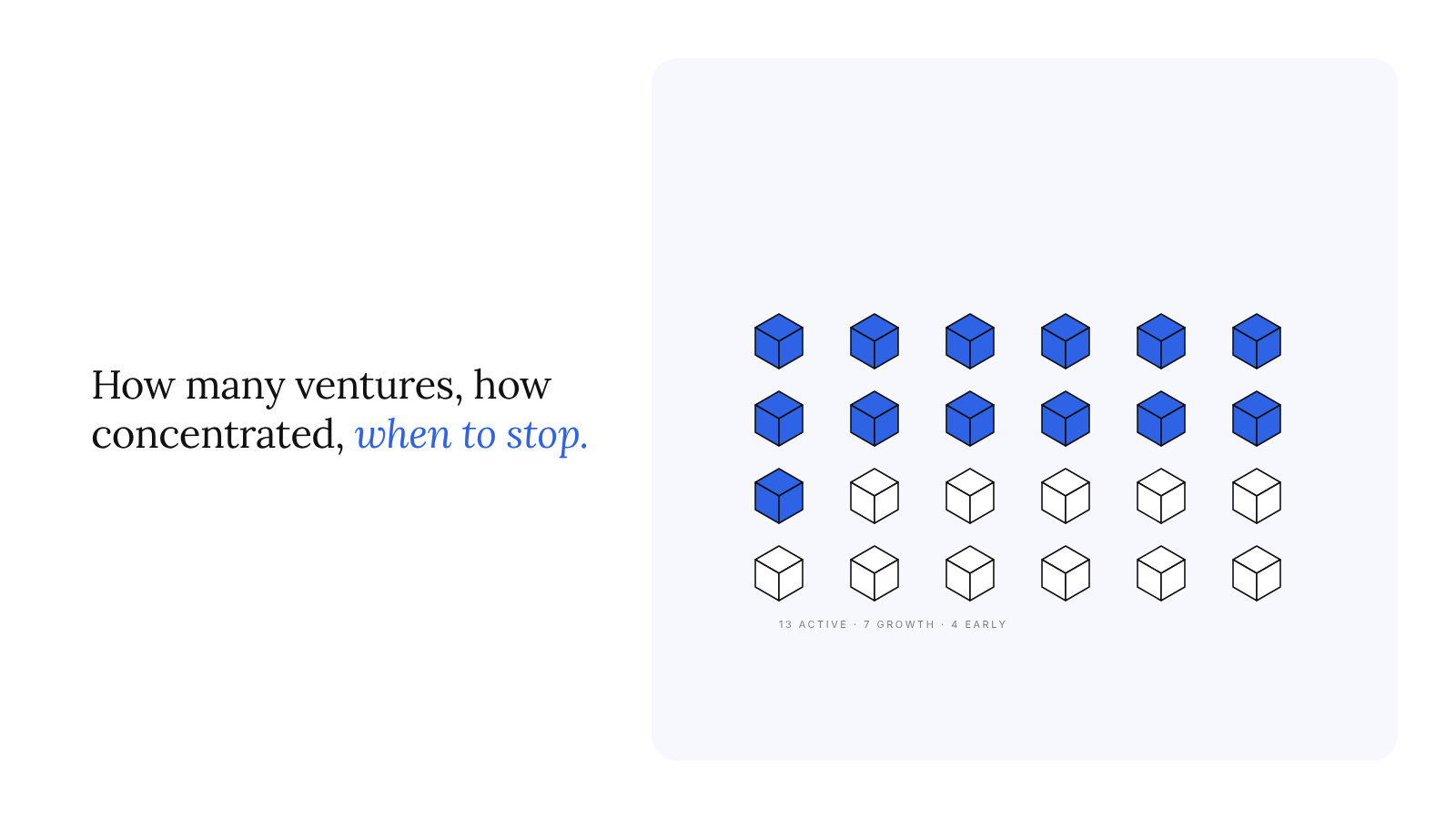
A venture fund's portfolio problem is arithmetic. Given a fund size, a cheque size and a reserve ratio, the number of companies falls out, and the partners' time is a soft constraint that stretches when a deal is good. The venture studio portfolio problem is physical. Every venture it starts draws on the same pool of senior engineers, the same go-to-market lead, the same finance and legal function and the same handful of partners who decide what gets built. Start one more and every existing venture gets a little less. The constraint does not stretch; it is paid for in attention that is no longer available elsewhere.
That difference is why the questions a studio must answer are not the ones a fund answers. How many ventures can run at once before the shared team becomes the bottleneck? How concentrated should the studio be in a vertical, given that concentration is what makes the shared team useful but also what makes the portfolio fragile? And when does a studio stop: stop starting new ventures, stop feeding a venture that is not working, or stop supporting a venture that has outgrown the studio?
This article builds a simple capacity model with stated assumptions to make those trade-offs explicit, reads the published cadence of several global studios against it, and sets out three stopping rules a studio can write down in advance. PanScience Innovations' published portfolio of 24 ventures across nine verticals is used as a worked case for the arithmetic, without any judgement on whether its particular numbers are right.
What studios have said about their own cadence
Studios rarely publish a target number of concurrent ventures, but their cadence can be read from press coverage and their own pages. Idealab, the oldest, described its funnel to Marketplace in 2008: "we probably come up with an idea a day, maybe filter that down to one a month that we want to take forward", and "turn only one or two of those a year into a company". Its website now reports "145+ companies" since 1996, which is consistent with a long-run average of about five a year including the dot-com peak, and well above the one or two a year Bill Gross described in 2008 after what he called a period of starting fewer companies and pushing them further before funding.
Pioneer Square Labs in Seattle gave GeekWire a fuller picture in January 2021: 25 spinouts in five years from a 22-person firm, with "about 215 ideas that didn't make the cut" along the way, and "most of the 25 PSL spinouts" launched in the preceding eighteen months. That is a kill ratio of roughly nine ideas for every company, and a run rate that rose from a few a year to around eight a year as the team matured.
Atomic in San Francisco told TechCrunch in November 2021 that it had produced 14 companies in the previous twelve months on top of nine the year before, with headcount rising from about 15 to 50 and a list of "well over 600" candidate ideas. Hexa in Paris, which began as eFounders in 2011, launched roughly three to four companies a year over its first twelve years and told TechCrunch in November 2023 that it expected to reach 30 a year by splitting into vertical studios, each with its own partners. High Alpha in Indianapolis went from three studio companies to nine between 2015 and early 2018 with 23 staff, and its website now reports "40+ Studio Company Starts" over roughly a decade, about four a year.
Three regularities appear. First, cadence rises with headcount: Atomic tripled staff and tripled launches; Hexa's path to 30 a year runs through more partners, not more hours. Second, the funnel is wide and the mortality is early: PSL's 215 rejected ideas and Idealab's one-a-month filter are both ways of spending cheap attention before spending expensive attention. Third, nobody publishes a concurrent count. The published number is always launches per year or cumulative companies, which hides the figure that matters most for capacity: how many ventures are drawing on the shared team at the same time.
The Studio Capacity Model
The model below is illustrative. It uses stated assumptions that a reader can replace with their own, and it is meant to make the trade-off visible rather than to prescribe a number.
Start with the supply side. A studio has a shared senior pool: partners, the heads of its in-house functions and the senior engineers and operators who move between ventures. Call the number of such people S. Each has roughly 1,800 working hours a year, of which some fraction goes to the studio itself (origination, fundraising, hiring, governance) rather than to ventures. Assume 30 per cent, leaving 1,260 venture hours per senior person per year. Supply is therefore S multiplied by 1,260 hours.
Now the demand side. Ventures at different stages consume different amounts of shared senior attention. The assumptions below express that as a fraction of one senior person's venture hours:
| Venture stage | Assumed senior attention per venture (FTE-equivalent) | Rationale |
| Stealth or validation (pre- incorporation) | 0.5 | Partners and a small team testing the problem; cheap to kill |
| Early or seed (first product, first customers) | 1.0 | The build year; shared engineering, GTM and finance are all engaged |
| Growth (own team forming, raising externally) | 0.4 | Shared functions hand over; partners still on the board and in the round |
| Scaling and independent (spun out) | 0.15 | Board seat, intros, follow-on decisions |
These weights are judgement calls drawn from the published stage descriptions of studios that run a build year followed by a hand-over, including PanScience's own month 0 to month 18 sequence. A studio with a different model should change them. The point is the shape: the build year is roughly twice as expensive in senior attention as validation and more than twice as expensive as growth, and a spun-out venture is close to free but never zero.
Capacity is then a comparison. Total demand is the sum, across the portfolio, of ventures at each stage multiplied by the weight for that stage. If total demand exceeds S, the studio is overcommitted and something is being starved; the usual symptom is that the oldest or least promising venture quietly stops getting senior time without anyone deciding to kill it. If total demand is well below S, the studio is carrying idle senior cost, which is the more expensive error in a thin-margin business.
Worked case: PanScience's published portfolio
PanScience reports 24 co-founded ventures across nine verticals, of which 13 are active and scaling, 7 are at growth stage, 4 are early or seed and 3 are in stealth. Applying the weights above:
| Stage | Ventures (company-reported) | Weight | Senior FTE demand |
| Stealth | 3 | 0.5 | 1.5 |
| Early or seed | 4 | 1.0 | 4.0 |
| Growth | 7 | 0.4 | 2.8 |
| Active and scaling | 13 | 0.15 | 1.95 |
| Total | 27 (the company's four categories sum to 27 against a headline of 24+) | 10.25 |
On these assumptions the portfolio demands the full venture time of a little over ten senior people. PanScience reports six shared in-house functions and a group team of 250 or more; it does not publish the size of its senior pool, so the model cannot say whether ten is comfortable or tight. What the arithmetic does show is where the demand sits: the four early ventures and three stealth ventures, seven companies in all, account for more than half of senior demand, while the thirteen scaling ventures, nearly half the portfolio by count, account for under a fifth. That pattern is the general one. A studio's capacity is consumed by its youngest ventures, and a large portfolio of graduated companies is not, by itself, evidence of a large shared team.
Two caveats. The company's four stage counts add to 27, not 24, which suggests the categories overlap or that the headline figure is conservative; the model uses the stage counts as published. And the weights are illustrative; halving the early-stage weight would reduce demand to about eight senior FTE, doubling it would raise demand to about fourteen. The sensitivity is almost entirely in the early-stage weight, which is a useful finding in itself: the single most important number for a studio's capacity planning is how much senior attention one venture needs in its build year.
Concentration: the vertical trade-off
The shared team is only valuable if it is reusable. An engineer who has built an on-premise inference stack for one venture is far more useful to a second venture that needs one than to a venture in a different domain. That pushes a studio toward vertical concentration. Against this, concentration correlates the portfolio: a regulatory change, a platform shift or a funding winter in one sector hits every venture at once, and the studio's shared knowledge becomes a shared blind spot.
The Politecnico di Milano study of 25 European studios founded between 2009 and 2014, presented at the European Conference on Innovation and Entrepreneurship, found that "deep domain expertise can offset geographical disadvantages" and identified "Domain-Specific Expertise" as one of four configurations associated with a higher exit rate per year of studio life. The authors are careful to say that no single condition was necessary and that research on the question "remains limited". The finding is suggestive rather than conclusive, but it points the same way as the capacity logic: specialisation makes the shared team worth more per venture.
A workable rule is to count verticals by the depth of the shared team rather than by the breadth of the portfolio. A studio with a shared machine learning and data platform pool can credibly serve several verticals if the technical substrate is common; PanScience reports that eight of its 24 ventures are in AI infrastructure and that the rest span finance, legal, health, industrial, media and hiring, which the company presents as nine verticals on one substrate. Whether that counts as concentrated or diversified depends on which layer you look at. In the capacity model it is the substrate that determines reusability, so the relevant question for any studio is how many of its verticals share a team, not how many it names.
The trade-off can be stated as a rule of thumb. Each additional vertical that does not share a substrate with an existing one adds roughly the cost of a new early-stage venture in senior attention, because the shared team must learn the domain before it can be shared. A studio should therefore enter a new vertical only when it intends to build at least two or three ventures in it; a single venture in a new vertical is, in capacity terms, an outside investment with a studio's cost structure.
Three stopping rules
A fund stops investing when the fund is deployed. A studio has no equivalent trigger, and the consequence is that studios tend to stop late: too many concurrent ventures, zombies that nobody kills, and graduated companies that keep calling the shared team. The three rules below are written to be decided in advance and applied mechanically.
Rule one: the capacity stop. Do not start a new venture when projected senior demand, using the stage weights, would exceed the senior pool for the coming four quarters. Because a new venture enters at the most expensive stage, the test should be run with the new venture weighted at 1.0 from its planned incorporation date, and with every existing venture advanced to its expected stage over the same period. In practice this rule means that a studio with a fixed senior pool must graduate or kill roughly one build-year venture for every one it starts. Atomic's and Hexa's published paths both illustrate the alternative: more launches came with more senior people, not with the same people spread thinner.
Rule two: the evidence stop. Kill a venture in validation or early stage when it misses a milestone that was written down before the milestone period began, and do not let the milestone move. The published practice at Pioneer Square Labs, which rejected around 215 ideas for 25 companies, and at Idealab, which filtered an idea a day to one a month to one or two a year, both depend on killing early when killing is cheap. The reason the rule must be pre-committed is structural: a studio co- founded the venture, staffed it with its own people and announced it to its investors, and every one of those facts is an incentive to extend. The GoingVC survey of the sector in March 2026 names the failure directly, warning that a studio that is "too invested, financially and emotionally" in its own venture may struggle to exit underperformers. A fund's portfolio company can fail without the fund being blamed. A studio's cannot, which is exactly why the rule must be written down.
Rule three: the graduation stop. Stop supplying shared services to a venture when the venture could hire the function for less than the studio's opportunity cost of providing it, and transfer the function on a schedule. The symptom of a studio that has not applied this rule is a shared team whose time is consumed by its largest, oldest ventures, which are the ones best able to pay for their own staff, while the build-year ventures that need the team most are starved. The weight of 0.15 for a scaling venture in the model is an assumption that this rule has been applied; a studio that lets graduated ventures keep drawing a 0.4 weight will find its capacity for new ventures halved without any change in headcount. PanScience's published model places this transition at month eighteen or later, when a venture "graduates to independent company with own leadership and external funding" while keeping ecosystem access; whether that schedule holds in practice is a question for diligence, not for this article.
What the model says about venture studio portfolio size
Put the three rules together with the capacity arithmetic and a steady-state picture emerges for a studio of a given size. With a senior pool of S people and the illustrative weights, a studio in steady state can carry roughly S venture-equivalents of demand. If each venture spends one year at weight 1.0, one at 0.4 and then rests at 0.15 indefinitely, then after several years the graduated tail dominates the count but not the demand. A studio with ten senior people could, on these assumptions, sustain about four new ventures a year, with four in the build year, four in growth and a growing tail of graduates, before the tail alone begins to consume the capacity needed for new starts. That is close to the four-a-year run rate High Alpha and Hexa reported before they expanded, and it is a useful sanity check on the weights: they reproduce the observed cadence of mid-sized studios without being fitted to it.
The implication for a studio that wants to grow its launch rate is that it has only two levers. It can add senior people, which is what Atomic and Hexa did, or it can reduce the weight of the build year by making the shared platform more reusable, which is the argument for vertical concentration. There is no third lever. A studio that announces a higher cadence without either is announcing that its existing ventures will get less.
Conclusion
A fund's portfolio is a list of positions; a studio's portfolio is a queue for a shared resource. That single difference means a studio must decide how many ventures to run at once, how much to concentrate them, and when to stop, in advance and in numbers, because the alternative is that the decisions are made by default in the form of neglected ventures and an exhausted senior team.
The Studio Capacity Model is a way of making those decisions visible. Its weights are assumptions and its worked case is a reading of company-reported figures, but its central finding does not depend on the exact numbers: a studio's capacity is spent on its youngest ventures, its graduated ventures are cheap only if they are actually graduated, and launch rate scales with senior headcount and substrate reuse and with nothing else. The three stopping rules are the operational form of the same finding. A studio that can state its senior pool, its stage weights and its stopping rules has a portfolio policy. One that can state only its cumulative count of ventures has a press release.
Methodology and sources
The Studio Capacity Model is an original, illustrative construction. Its supply assumption (1,800 hours per senior person, 30 per cent to studio overhead) and its stage weights (0.5, 1.0, 0.4, 0.15) are stated so that readers can substitute their own; they are informed by the published stage descriptions of studios that run a build year and a hand-over but are not estimated from data. The worked case applies the model to PanScience Innovations' company-reported stage counts (13 active and scaling, 7 growth, 4 early, 3 stealth) and does not assess whether the resulting demand is appropriate for the company's actual senior pool, which is not published. Cadence figures for other studios are taken from press coverage and the studios' own pages as cited, and per-year rates derived from them are simple averages. The Politecnico di Milano finding on domain expertise comes from a 25-studio European sample and the authors themselves note that research on studio success remains limited.
Sources opened: Marketplace interview transcript with Bill Gross, 21 February 2008 (https://www.marketplace.org/2008/02/21/interview-transcript-bill-gross); Idealab homepage (https://www.idealab.com/); GeekWire, "Seattle startup studio Pioneer Square Labs has spun out 25 ideas in 5 years", 8 January 2021 (https://www.geekwire.com/2021/seattle-startup-studio-pioneer- square-labs-spun-25-ideas-5-years-way/); TechCrunch, "Atomic has launched 14 startups in the last 12 months", 17 November 2021 (https://techcrunch.com/2021/11/17/talking-atomic/); TechCrunch, "Paris-based startup studio Hexa raises some funding to launch even more startups", 27 November 2023 (https://techcrunch.com/2023/11/27/paris-based-startup-studio-hexa-raises-some-funding-to- launch-even-more-startups); Indianapolis Business Journal, "More than money", March 2018 (https://www.ibj.com/articles/68078-more-than-money); High Alpha About page (https://www.highalpha.com/about); Del Prete, Franchi, Moiana, Ghezzi and Rangone, "What Drives Venture Studios Success? Uncovering Successful Configurations in the European Landscape", Proceedings of the 20th European Conference on Innovation and Entrepreneurship (https://papers.academic-conferences.org/index.php/ecie/article/download/4143/3584/14723); GoingVC, "The Rise of Venture Studios", 4 March 2026 (https://www.goingvc.com/post/the-rise- of-venture-studios); PanScience Innovations published model and portfolio figures (https://panscience.xyz).