
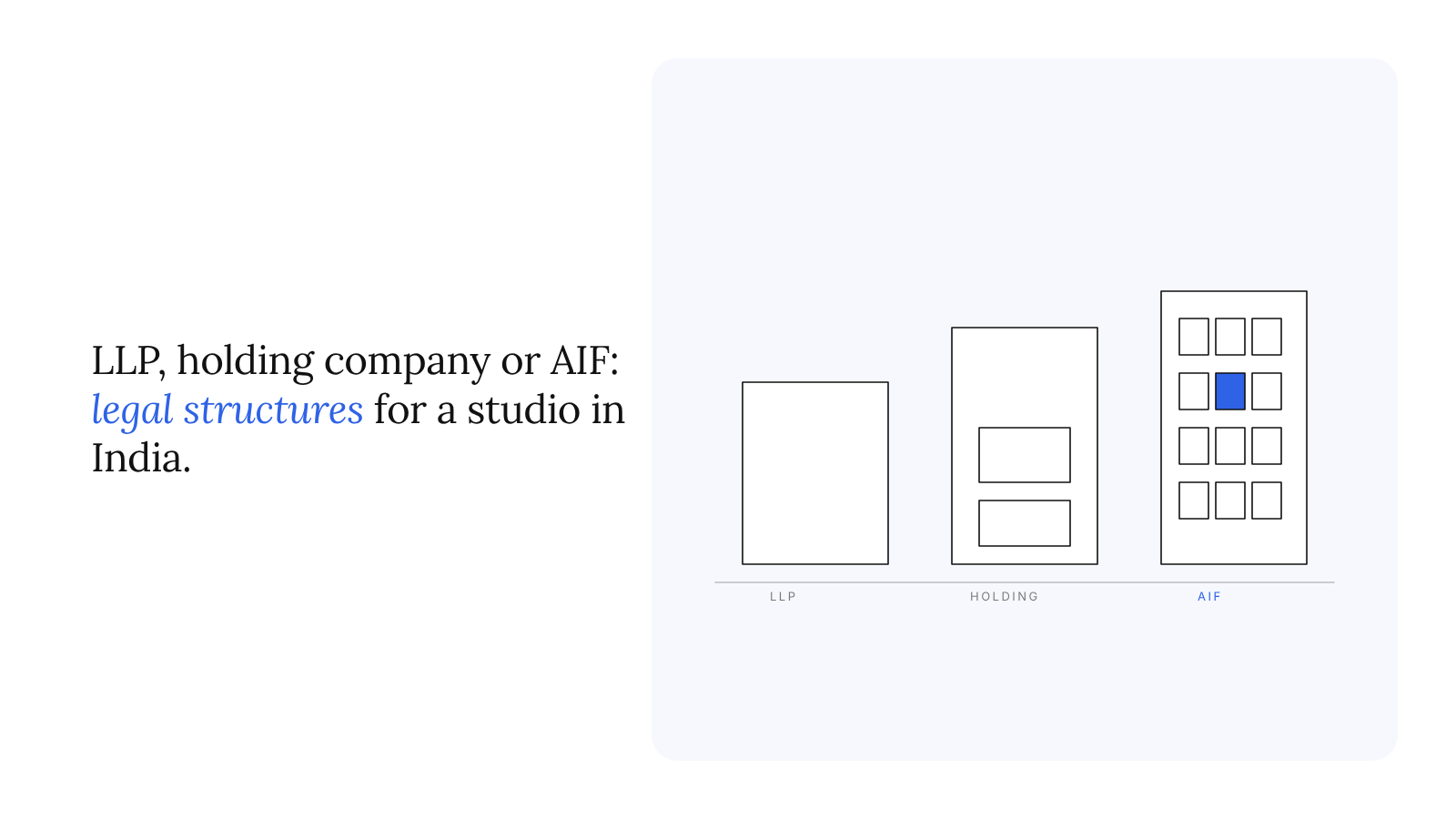
A venture studio does something no other vehicle in Indian company law was designed for. It spends its own money before a company exists, it incorporates that company and takes founder- scale equity in it, it runs shared teams that bill or do not bill the venture, and then it tries to get the venture financed by outside investors who want a clean cap table. A fund structure handles the capital side of that well and the operating side badly. An operating company handles the operating side well and the capital side badly. A venture studio legal structure in India therefore usually means one of three vehicles, or a combination of them, and the choice shapes everything from whether the studio can charge a management fee to whether its ventures qualify for DPIIT recognition.
This article describes those three vehicles factually: an operating limited liability partnership or private limited company that holds stakes directly; a holding-company structure; and a SEBI- registered Alternative Investment Fund, Category I or II, running alongside an operating studio. For each it sets out what the structure implies for capital calls, carried interest, management fees, DPIIT eligibility of the ventures, tax treatment at a high level, and exits. It is not legal or tax advice. The rules cited change often, several of them changed in 2025 and 2026, and any real structure needs counsel who has read the current text.
Why venture studio legal structure in India is a different question
A conventional venture capital manager raises a pool from limited partners, invests it over a few years, charges a fee and takes a share of profits. The SEBI (Alternative Investment Funds) Regulations, 2012 assume that pattern. A studio's cash flows look different. Money goes out before there is anything to invest in, as salaries for engineers and product people validating an idea. The studio's return comes partly from equity issued at incorporation, which no outside investor priced, and partly from later rounds.
Three decisions follow. Whether pre-incorporation spend is an operating expense or a capital contribution to a fund. Who owns the equity: the operating entity, a separate holding entity, or a regulated fund with outside investors. And how the shared-service relationship is papered, because that determines whether the venture pays for services (taxable revenue for the studio) or receives them for equity (a valuation question for everyone who joins the cap table later).
PanScience Innovations, the New Delhi studio behind this research platform, is itself an LLP (PanScience Innovations LLP, company-reported) with six in-house functions including finance and capital and legal. It is a reference point only in that the simplest structure is the one many studios start with; it does not publish its equity range per venture, so nothing here describes its terms.
Vehicle one: an operating LLP or private limited company holding stakes
The simplest arrangement is a single operating entity that employs the shared teams, incorporates each venture as a private limited company, and subscribes to shares at or near incorporation. There is no fund, no outside limited partners and no capital calls in the fund sense: the studio's owners or their investors put money into the operating entity, and the entity spends it.
The LLP form is attractive for a closely held studio because partner profit shares are exempt in the partners' hands under Section 10(2A) of the Income-tax Act, so the LLP's 30 per cent rate (about 34.94 per cent with surcharge and cess) is a single layer of tax (Treelife, "Startup Tax Structuring in India", June 2026). The private limited form carries a lower headline rate under Section 115BAA, 22 per cent or about 25.17 per cent all in, but dividends are then taxed again in the shareholder's hands at slab rates, which is why the same source describes it as a two-level tax.
The LLP form has two disadvantages specific to studios. Only companies can issue employee stock options under Section 62(1)(b) of the Companies Act, 2013, so a studio that wants to give shared engineers equity in the studio itself cannot do so cleanly as an LLP. And SEBI-registered AIFs and most institutional investors cannot invest in LLPs, which cannot issue equity shares (Treelife, June 2026). A studio that expects institutional capital into the studio entity is therefore usually pushed towards a company.
There is no carried interest and no management fee in the formal sense; the studio's return is share appreciation plus whatever it charges the ventures for services. On exit, a sale of unlisted shares held for more than 24 months is taxed as long-term capital gain at 12.5 per cent without indexation, the uniform rate introduced by the Finance Act 2024 with effect from 23 July 2024 (Treelife, June 2026).
Vehicle two: a holding company above the operating studio
The second arrangement separates two things the first vehicle mixes: the operating business (people, services, costs) and the portfolio (shares in ventures). A holding company, usually a private limited company, owns the venture stakes and may own the operating studio as a subsidiary. The operating studio provides services to the ventures and to the holding company, typically under written service agreements.
The appeal is clarity. Investors into the holding company buy a portfolio; investors into the operating company buy a services business; a venture's cap table shows one corporate shareholder. Written service agreements make the shared-service relationship visible, which later investors prefer to an arrangement where studio engineers simply appear in a venture's product.
Two regulatory points shape this vehicle. The first is the Reserve Bank of India's Core Investment Company regime. The RBI's FAQ defines a CIC as a non-banking financial company with an asset size of ₹100 crore and above that holds not less than 90 per cent of its net assets in equity, preference shares, debt or loans in group companies, with equity constituting not less than 60 per cent of net assets, and that accepts public funds. Entities below ₹100 crore in asset size, or at or above it but without public funds, are "Unregistered CICs" and "are exempted from the regulation of Reserve Bank" (RBI FAQ as reproduced by TaxGuru). A holding company that grows past that size and borrows from banks or issues debentures crosses into a registration requirement.
The second is dividend tax. Inter-corporate dividends are fully taxable as business income at the corporate rate, with no exemption (Treelife, June 2026). Section 80M, inserted by the Finance Act 2020 for dividends distributed on or after 1 April 2020, allows a domestic company to deduct dividends received from another domestic company to the extent it redistributes them to its own shareholders before the due date for filing its return, which cuts the cascading effect but only when the holding company passes the cash through rather than retaining it to fund the next venture (ClearTax, "Section 80M"). For a studio, which usually wants to recycle exit proceeds into new ventures, the deduction is less useful than it first appears.
Like vehicle one, this structure has no carried interest or fee in the regulatory sense, though something close to carry can be created contractually through share classes or by having the operating company hold a stake in the holding company. These are private company arrangements under the Companies Act, not regulated fund terms.
Vehicle three: a SEBI-registered AIF alongside an operating studio
The third arrangement adds a regulated fund. The studio's operating entity acts as sponsor and manager (or as an affiliate of them), and a SEBI-registered AIF, typically a trust, raises capital from outside investors and invests in the ventures the studio builds. Category I includes venture capital funds, which "invests in start-up, early-stage" ventures, and Category II is the residual category for funds that are neither Category I nor Category III and do not borrow beyond what the regulations permit (SEBI AIF Regulations, Regulation 3(4)).
This is the only one of the three vehicles with capital calls, management fees and carried interest in the ordinary sense, because it is the only one with investors who are not owners of the operating business. The regulations set the hard parameters. Each scheme "shall have corpus of at least twenty crore rupees" (Regulation 10(b)). The fund "shall not accept from an investor, an investment of value less than one crore rupees", with relaxations for employees, directors and accredited investors (Regulation 10(c)). The sponsor or manager must hold a continuing interest of at least 2.5 per cent of corpus or ₹5 crore, whichever is lower, and not through fee waivers (Regulation 10(d)). No scheme may have "more than one thousand investors" (Regulation 10(f)). Category I and II funds "shall have a minimum tenure of three years" (Regulation 13(2)), and extension of a close-ended fund's tenure "may be permitted up to two years" with approval of two-thirds of unit holders by value (Regulation 13(5)).
The investment limits bite hardest on a studio. Category I and II funds may invest "not more than twenty five per cent of the investable funds in an Investee Company" (Regulation 15(1)(c)). A Category I venture capital fund must invest at least 75 per cent of investable funds in unlisted equity or equity-linked instruments of venture capital undertakings or SME-exchange companies (Regulation 16(2)(a), as amended with effect from 13 August 2021). A Category II fund must "invest primarily in unlisted securities and/or listed debt securities" rated A or below (Regulation 17(a), as amended with effect from 23 May 2025). A "venture capital undertaking" is a "domestic company which is not listed on a recognised stock exchange at the time of making investments" (Regulation 2(1)(za)), which means the fund can only hold the ventures if they are companies, not LLPs.
Fee and carry terms are not prescribed by the regulations; they are contractual, set in the placement memorandum and contribution agreements. What the regulations force is a separation between the studio as manager, which earns fee and carry, and the fund, which owns the shares. Pre- incorporation spend cannot easily be charged to the fund because the fund has nothing to invest in yet, so studios running this structure fund validation from the operating entity and have the AIF invest at or after incorporation, with the operating entity holding its own founder-scale stake alongside.
Tax at the fund level follows Section 115UB. Interest, dividend and capital gain income of a Category I or II AIF is taxable in the hands of the unit holder and exempt for the fund, retaining its character; business income is taxed at the fund level. The Finance Bill 2025 amended Section 2(14) to include securities held by Category I and II AIFs within the definition of capital asset from financial year 2025-26, so gains on them are capital gains passed through to investors (Lakshmikumaran and Sridharan, "Union Budget 2025: Tax treatment of securities held by AIF Cat I and II"). The same source notes that carried interest distributed to a manager who holds units retains its capital gains character, and that an earlier service tax attempt to treat carry as compensation for management services was rejected by the higher judiciary.
For studios with overseas limited partners, Schedule VIII of the FEMA Non-Debt Instruments Rules, 2019 reckons an AIF's downstream investment as domestic if the fund is owned and controlled by an Indian-resident sponsor or manager, regardless of how much foreign money is in the fund (IndiaCorpLaw, April 2024). Keeping the manager Indian owned and controlled therefore lets the fund take foreign capital without the ventures inheriting foreign-investment restrictions.
DPIIT recognition: what the February 2026 notification changed for studio ventures
DPIIT's notification G.S.R. 108(E) of 4 February 2026 superseded the 2019 definition. A recognised startup must be a private limited company, registered partnership firm, LLP, multi-state cooperative society or state cooperative society; be within ten years of incorporation; have turnover "not above ₹200 crore (₹300 crore for Deep Tech) in any financial year since incorporation or registration"; and be working towards "innovation, development or improvement of products, processes or services" or running "a scalable business model with high potential for employment generation or wealth creation" (TaxGuru summary of G.S.R. 108(E)). The 2019 threshold was ₹100 crore (Nishith Desai Associates; Lakshmikumaran and Sridharan).
Two provisions matter directly for studio ventures. The first is the exclusion: "An entity formed by splitting up or reconstructing an existing business is not a startup" (TaxGuru summary). A studio that builds a product inside its own operating entity and then hives it off into a new company is close to that line, and the way the transfer is documented, as a fresh incorporation with assigned IP and a subscription of shares rather than a demerger of a going business, is a matter for counsel. The second is the new Deep Tech category: a startup that is "working on producing a solution based on new knowledge/advancements within a scientific or engineering discipline", has a "high percentage of expenditure on research and development (R&D) activities", "owns or is in the process of creating significant novel intellectual property (IP)" and faces "extended development timelines, long gestation periods, high capital and infrastructure requirements" qualifies for recognition for 20 years and a ₹300 crore turnover ceiling (ICSI Chartered Secretary, April 2026; TaxGuru). No numerical R&D threshold is set in the notification; DPIIT assesses the attributes under a framework it issues (TaxGuru).
The tax holiday under Section 80-IAC is separate from recognition. It requires an Inter-Ministerial Board certificate, is available only to recognised private limited companies and LLPs, and gives a 100 per cent deduction of profits for any three consecutive years within the first ten, for entities incorporated on or after 1 April 2016 and before 1 April 2030 (TaxGuru). The angel tax under Section 56(2)(viib) was abolished from assessment year 2025-26 (TaxGuru), removing the older concern that a studio's low-price subscription at incorporation would be challenged against a later valuation.
None of the three vehicles affects a venture's DPIIT eligibility by itself; eligibility sits with the venture. The structure matters indirectly, through the reconstruction exclusion and through the fact that an AIF can hold only companies, which pushes most studio ventures towards the private limited form.
Decision table: structure versus consequence
The table below sets out the consequences of each vehicle against the questions a studio has to answer. It is an original synthesis of the rules cited above and is descriptive, not a recommendation.
| Question | Operating LLP or company holding stakes | Holding company with operating subsidiary | SEBI AIF (Cat I or II) plus operating studio |
| Who funds pre- incorporation work | The studio's own owners or investors, as operating expense | The operating subsidiary, funded by the holding company | The operating studio; the AIF cannot invest before a company exists |
| Capital calls | None in the fund sense; equity or loans into the entity | None; equity into the holding company | Yes, from unit holders, under the contribution agreement; corpus at least ₹20 crore per scheme, minimum ₹1 crore per investor |
| Management fee | None as such; service fees to ventures if charged | Service fees from ventures to the operating subsidiary under written agreements | Yes, contractual, paid by the fund to the manager |
| Carried interest | None; return is share appreciation | None formally; can be mimicked through share classes | Yes, contractual; retains capital gains character per the LKS reading |
| Sponsor commitment | Not applicable | Not applicable | At least 2.5 per cent of corpus or ₹5 crore, whichever is lower |
| Concentration limits | None | None | Not more than 25 per cent of investable funds in one investee company |
| What the vehicle can hold | Companies or LLPs | Companies or LLPs | Companies only (venture capital undertaking is a domestic company) |
| Outside institutional money into the vehicle | Hard for an LLP; possible for a company | Possible, into the holding company | Designed for it; up to 1,000 investors per scheme |
| Tax on the vehicle's own income | LLP 30 per cent, partner share exempt; company 22 per cent plus dividend tax at shareholder | Company rate; inter- corporate dividends taxable, 80M relief if passed through | Pass-through for capital gains, interest and dividends under 115UB; business income taxed at fund level |
| Tax on exit of a venture stake | LTCG at 12.5 per cent if held over 24 months | Same, at the holding company | Capital gains passed through to unit holders |
| DPIIT recognition of ventures | Unaffected by the vehicle; watch the reconstruction exclusion | Same | Same; ventures must be companies for the AIF to hold them |
| Tenure pressure to exit | None | None | Minimum three years, extension up to two years; the fund must return capital |
| Regulatory registration | None specific | RBI CIC registration if assets reach ₹100 crore and public funds are accepted | SEBI registration, reporting, and the regulations' investment limits |
Conclusion
The three vehicles are better understood as stages a studio may pass through than as alternatives. Many begin as an operating LLP or company because it is quick to set up; they add a holding company when the number of ventures and co-investors makes a single balance sheet confusing; and they add an AIF when they want to manage other people's money with a fee and carry. Each step adds regulation and reduces flexibility in exchange for access to capital. The operating entity is cheapest but cannot take outside limited partners; the holding company improves legibility but taxes recycled dividends; the AIF alone gives fee and carry, but its corpus, concentration, tenure and company-only rules were written for funds investing in companies someone else started, so an operating entity must sit beside it.
The February 2026 DPIIT notification raised the turnover ceiling to ₹200 crore, added a 20-year deep tech window, and kept recognition open to companies and LLPs. It also preserved the exclusion for entities formed by reconstructing an existing business, which is precisely what a studio does when it spins a product out of its own walls. How that moment is papered, as a fresh company with assigned IP rather than a demerger, is where structure and recognition meet, and where counsel earns its fee. Nothing in this article is a substitute for that.
Methodology and sources
This article is a descriptive synthesis of primary regulatory texts and reputable secondary commentary, read in October 2026. The decision table is the author's own organisation of those rules against the questions a studio operator typically asks; it introduces no new facts. Limitations: tax rates and thresholds cited are as reported by the named sources and may have changed; several SEBI provisions have been amended more than once since 2012 and the consolidated text read is the version last amended on 23 May 2025; the DPIIT notification was read through professional summaries because the Startup India portal page did not open at the time of writing; the RBI CIC definition was read through a reproduced FAQ. No claim here is legal, tax or investment advice.
Sources: SEBI (Alternative Investment Funds) Regulations, 2012, consolidated text last amended 23 May 2025 (https://www.sebi.gov.in/sebi_data/attachdocs/sep-2025/1756961989592.pdf); Nishith Desai Associates, "DPIIT's new startup framework: deep tech startup recognition and key reforms" (https://www.nishithdesai.com/research-and-articles/hotline/regulatory-digest/dpiits-new-startup- framework-deep-tech-startup-recognition-and-key-reforms-15498); Lakshmikumaran and Sridharan, "India's new startup and deep tech startup framework: why the 2026 DPIIT notification matters" (https://www.lkslaw.com/insights/articles/india-s-new-startup-and-deep-tech-startup- framework-why-the-2026-dpiit-notification-matters); TaxGuru summary of G.S.R. 108(E) (https://taxguru.in/?p=1086474); ICSI Chartered Secretary, April 2026 (https://www.icsi.edu/media/webmodules/CSJ/Apr2026/35.pdf); Treelife, "India's revised startup recognition framework 2026" (https://treelife.in/startups/indias-revised-startup-recognition- framework-2026/); Treelife, "Startup tax structuring in India", June 2026 (https://treelife.in/taxation/startup-tax-structuring-in-india/); Lakshmikumaran and Sridharan, "Union Budget 2025: tax treatment of securities held by AIF Cat I and II in India" (https://www.lkslaw.com/insights/articles/union-budget-2025-tax-treatment-of-securities-held-by- aif-cat-i-and-ii-in-india); ClearTax, "Section 80M" (https://cleartax.in/s/section-80m); RBI Core Investment Company FAQ as reproduced by TaxGuru (https://taxguru.in/?p=65069); IndiaCorpLaw, "Addressing regulatory arbitrage: foreign investment compliance recommendations for AIFs", 21 April 2024 (https://indiacorplaw.in/2024/04/21/addressing-regulatory-arbitrage- foreign-investment-compliance-recommendations-for-aifs/); PanScience Innovations fact sheet, company-reported (https://panscience.xyz).