
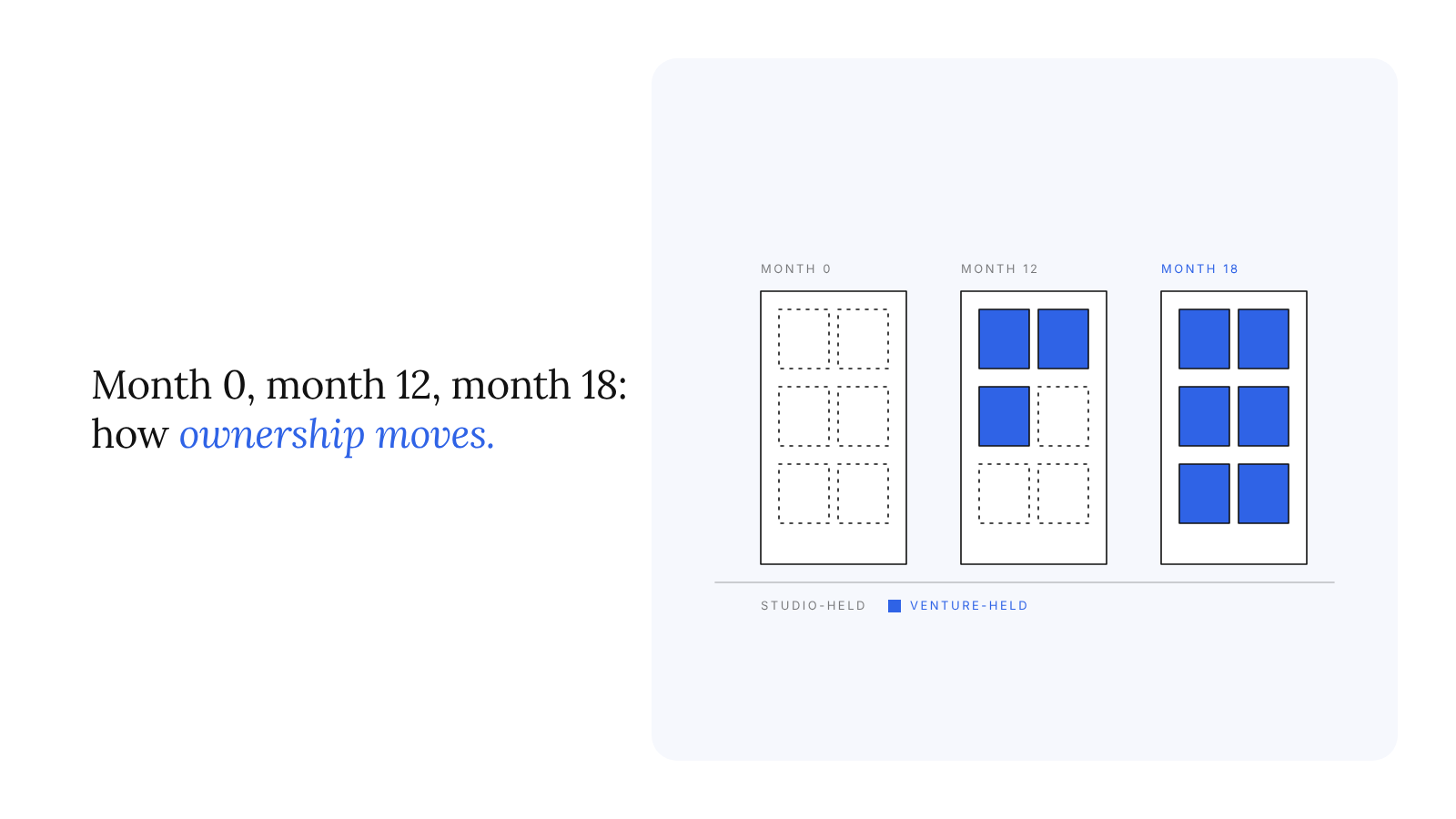
A venture built inside a studio starts life owning almost nothing. On the day it is incorporated, its product is a document in the studio's drive, its engineers are on the studio's payroll, its first customer conversations are being had by the studio's commercial lead and its shareholder agreement was drafted by the studio's lawyer. Eighteen months later, if things have gone well, the same venture has its own chief executive, engineering team, pipeline, books and counsel, and the studio has become a shareholder with a board seat rather than an operator.
How that venture studio handover happens, function by function, is the least discussed and most consequential part of studio practice. Studios publish their stage models, and some describe the shared functions they provide. Very few say when each function is handed over, who makes decisions during the handover, or what goes wrong when the timing is off. Yet almost every studio failure of the venture kind can be traced to a function transferred too early (the venture could not carry it) or too late (the venture never learned to). This article uses one published stage model as a reference frame and builds on it an illustrative sequence for six functions. The sequence is an analytical construction, not a description of any specific venture.
The reference model and what it leaves open
PanScience Innovations, a New Delhi studio founded in 2021, publishes a five-stage model: Originate (before any company exists, validating a problem in-house), Co-found (month 0: incorporation, first capital from the studio, studio operators as co-founders), Build (months 1 to 12: in-house teams ship the first product and stand up go-to-market, hiring, operations, finance and legal), Scale and spin (month 18 and beyond: the venture graduates to an independent company with its own leadership and external funding, keeping ecosystem access) and Compound (the studio stays on the cap table and supplies talent, introductions, follow-on capital and shared services). It names six shared functions: product; technology, described as a shared pool of senior machine learning, data and platform engineers; go-to-market; operations and hiring; finance and capital; and legal, covering incorporation, compliance, intellectual property and governance. All of this is company-reported.
The model fixes three dates and six functions, which is enough to draw a grid. What it does not say, and what no published studio model this author has seen says, is the order in which the functions move from studio to venture, or what "moved" means. Other studios' published practice gives the same shape with different numbers. Hexa, the Paris holding company formed from eFounders in 2022, pairs an idea with a founding team, supplies resources to build the product, and once the startup raises funding it becomes independent; its startups typically raise outside money about a year in, and Hexa aims to keep a 30% stake after seed (TechCrunch, 29 November 2022 and 27 November 2023). Betaworks launches two or three studio companies a year and created a separate fund in 2017 so that it could keep investing after a company outgrew its holding company (TechCrunch, 10 August 2017). In both cases the trigger for independence is external capital, not a date.
What "handed over" means
A function has been handed over when three things are true at once: the venture's own people make the decisions, the venture's chief executive is accountable to the venture's board for the outcomes, and the people doing the work are on the venture's payroll. Each can move separately. Decision rights move first: a venture chief executive can decide what to build while the engineers are still studio staff. Accountability moves when the board stops asking the studio partner why the product slipped and starts asking the chief executive. Payroll moves last, when the venture can pay people and the people are willing to move.
The sequence below treats a function as "studio-owned" when the studio holds all three, "shared" when decision rights have moved but accountability or payroll has not, and "venture-owned" when all three have moved. The common failure is a function that looks transferred, because the chief executive makes the decisions, but is not, because the studio still pays and still answers for it.
The venture studio handover, function by function
Product: first to move in decision, last to leave in practice
Product is where a studio's origination work lives. At month 0 the studio has validated a problem, chosen a wedge and usually written the first specification. The venture inherits this as a gift it did not ask for. The first transfer should therefore be of decision rights over product, within the first quarter, because a venture leader who cannot change the product is not a founder but a programme manager. What stays shared longer is product craft: research method, prioritisation discipline, the instinct for what to cut. Accountability for product should move to the chief executive at month 12 at the latest.
Too early: a venture that owns product fully at month 0 with a first-time founder tends to rebuild what the studio already validated, or to drift toward a more exciting problem. Too late: a venture at month 18 whose roadmap is still set in a studio meeting will struggle to raise external capital, because investors fund teams that own their product, and will struggle to hire senior product people.
Technology: the function that moves most slowly, and should
A shared engineering pool is the studio's most expensive asset and its biggest lever. Senior machine learning and platform engineers cost more than an early venture can bear, and spreading them across ventures is how a studio makes the economics work. The transfer of technology is therefore the slowest of the six. The sequence that works is decision rights at month 3 to 6 (the venture's technical lead decides architecture, the pool executes), accountability at month 12 and payroll at month 18 or at external funding, whichever comes first. Between months 12 and 18 the venture hires its own engineers and the pool shrinks to a specialist resource; after spin-out it becomes a paid service.
Too early: a venture that hires its own engineering team in month 3 spends its first capital on salaries for work the pool could have done faster, with a weaker team because early ventures cannot attract senior engineers. Too late: a venture at month 18 whose code is entirely written by people who will never join it has a bus-factor problem that any technical due diligence will find.
Go-to-market: the function most often handed over too late
Studios tend to have one or two commercially senior people who open doors for every venture. This is valuable at month 0 and corrosive by month 12, because a venture whose customers were acquired through the studio's network has no evidence that it can acquire customers itself, which is the one thing a seed investor is trying to find out. Decision rights over go-to-market (who to sell to, at what price, through which channel) should sit with the venture chief executive from month 0, because they are inseparable from the product decision. The studio supports execution and introductions in months 1 to 6; the venture's first commercial hire is in place by month 9 and accountable for pipeline by month 12.
Too early: a venture with no studio commercial support at month 0 wastes six months learning how to get meetings. Too late: a venture at month 18 whose revenue is concentrated in accounts the studio introduced will be marked down by investors and will have a chief executive who has never closed a deal unaided.
Operations and hiring: shared infrastructure, venture decisions
Operations covers the unglamorous machinery: payroll processing, benefits, tooling, vendor contracts, the hiring pipeline. The studio should run this for as long as it is cheaper to run centrally, in practice through month 12 and often beyond as a paid service. What must move early is the hiring decision: by month 3 the venture chief executive decides who is hired, even if the studio sources candidates and processes paperwork.
Payroll is the hardest question here because it is literal. People hired for the venture should be on the venture's payroll from the start, even if the venture's account is funded by the studio, because the alternative, everyone a studio employee seconded to the venture, creates the founder-absence problem documented at Rocket Internet's Nestpick, where the founders lost majority ownership and the controlling shareholder restructured the company over their heads (TechCrunch, 26 October 2016). Secondment is defensible for the shared pool and for specialists, not for the core team. Too early: a venture that sets up its own HR and tooling in month 1 spends founder time on things a studio exists to absorb. Too late: a venture at month 18 whose team is formally employed by the studio will discover at its first external round that it has no employees and intellectual property assignments that run to the wrong company.
Finance and capital: separating control from support
Finance is two things that are easy to confuse. One is bookkeeping, compliance and reporting, which a studio should provide as a shared service for as long as the venture wants it. The other is the capital decision: how much to raise, from whom, at what terms, how fast to spend. The second must move to the venture early and the studio's role in it must be explicit, because the studio is also a shareholder with its own interests in the round. Spending decisions sit with the chief executive from month 0 within an agreed budget; accountability for the plan moves at the first board meeting; fundraising is co-led until the first external round but the venture leads the process. The Betaworks case is instructive: a studio that wants to follow on in its winners needs a vehicle that can do so, a structural question to settle before the venture's first round, not during it (TechCrunch, 10 August 2017).
Too early: a venture that raises external capital at month 6 to escape the studio's budget is raising on a demo, at a price that reflects it. Too late: a venture at month 18 still funded by studio bridges, with no external term sheet, has a capital mismatch problem that is the studio's as much as its own.
Legal: studio-owned at month 0, venture-owned at spin-out, documented throughout
Legal is the function most completely studio-owned at month 0, because incorporation, the founders' agreement, the option plan and the intellectual property assignment are drafted by the studio's counsel before the venture has anyone to review them. It is also where the venture's interests and the studio's diverge most clearly, because those documents define the studio's stake. The sequence that protects both sides: studio counsel drafts at month 0; the venture has independent advice on founder-facing documents before signing, even if the studio pays; compliance is a studio shared service through month 12 and a paid service thereafter; at spin-out the venture appoints its own counsel. Intellectual property is assigned to the venture entity from day one, with seconded engineers signing assignments that run to the venture, not the studio.
Too early: a venture that insists on its own counsel at month 0 spends scarce money on advice the studio would have provided. Too late: a venture at month 18 whose IP is held by the studio and whose only legal adviser also represents its largest shareholder will fail legal due diligence, and the remedy is expensive and dilutive.
The Ownership Transfer Matrix
The matrix below is this article's analytical contribution. "Studio" means decision, accountability and payroll all sit with the studio. "Shared" means decision rights have moved but accountability or payroll has not. "Venture" means all three have moved. "Service" means the venture owns the function and buys execution from the studio at arm's length.
| Function | Month 0 (Co- found) | Months 1 to 12 (Build) | Month 18+ (Scale and spin) | Compound (post spin-out) |
| Product | Studio drafts; venture CEO holds decision from month 1 | Shared: venture decides, studio product lead coaches; accountability to CEO by month 12 | Venture | Venture; studio advises on request |
| Technology | Studio (shared pool builds) | Shared: venture tech lead decides architecture from month 3 to 6; pool executes; accountability to venture by month 12 | Venture core team; pool as specialist resource | Service: pool available at agreed rates |
| Go-to- market | Shared: venture CEO decides target and price; studio opens doors | Shared to month 9; venture commercial hire accountable for pipeline by month 12 | Venture | Venture; studio makes occasional introductions |
| Operations and hiring | Studio runs machinery; venture CEO decides hires from month 3 | Shared: studio runs HR, payroll processing, tooling; venture decides and employs | Venture; may buy back-office from studio | Service |
| Finance and capital | Shared: venture CEO spends within agreed budget; studio keeps books | Shared: venture owns plan and spend; studio provides bookkeeping; fundraising co-led | Venture leads raise; studio is one shareholder with board seat | Venture; studio holds pro-rata and board seat |
| Legal | Studio drafts; venture has independent advice on founder documents | Studio shared service for compliance; IP assigned to venture from day one | Venture appoints own counsel; studio counsel ceases to act | Venture; studio is a shareholder only |
Three patterns stand out. First, decision rights move early in every function, mostly within the first quarter; payroll and accountability move late, for reasons of money and experience. Second, the two functions that should transfer slowest, technology and operations, are where the studio's shared infrastructure delivers the most economic value, while the two that should transfer fastest, product and go-to-market, are where investors look for evidence that the venture can stand alone. Third, finance and legal are where the studio's interests as a shareholder and its role as a service provider are in tension, and the matrix handles this by separating support, provided for as long as useful, from control, which moves early and is documented.
Why the trigger should be a milestone, not a date
The reference model gives month 18 as the point of graduation, and the matrix uses that date for comparability, but the trigger that moves a function from shared to venture-owned is better defined by an event. The event that matters most is the first external priced round, because that is when a new shareholder arrives with its own view of who should own what, and because Hexa and Betaworks both treat it as the moment of independence. Three events are enough to define the transfer: a named chief executive with a meaningful stake and authority over hiring (month 0 to 3), a first product in front of paying users (month 6 to 12) and a first external priced round (month 12 to 24). A venture that reaches the third has persuaded someone other than the studio that it owns its functions. A venture that reaches month 18 without it has a problem a handover ceremony will not fix. The matrix should therefore be written into the founder agreement at month 0 with milestones rather than dates.
What this means for the people involved
For a studio-side operator who co-founds a venture, the matrix is a career plan: move with the function, taking the venture's payroll and equity, or return to the pool and hand the function to someone who will. For a chief executive hired into a studio venture, it is a negotiation checklist: which functions are decided by whom, when accountability moves, whose payroll the core team sits on, and what the studio's rights are in the first external round. For an investor pricing the first external round, it is a diligence frame: is the team employed by the venture, does the IP sit in the venture, was the revenue won by the venture, is the roadmap set by the venture, and are the studio's rights consistent with independent operation. A venture that scores well on all five is a company. One that does not is still a project.
Conclusion
A studio venture becomes a company not when it is incorporated and not when it is spun out but somewhere in between, one function at a time. Decision rights over product and go-to-market move first because they are what a founder is. Technology and operations move slowly because shared infrastructure is the studio's economic reason to exist. Finance and legal are where the studio's two roles, operator and shareholder, pull in different directions, and the transfer must be documented so that the second role does not corrupt the first. The matrix is an illustrative pattern against which any studio's practice can be checked, and the check is worth making at month 0, because by month 18 the cost of getting it wrong is paid in diligence, dilution or a founder who leaves.
Methodology and sources
This article uses PanScience Innovations' published stage model and six shared functions as a reference frame; all statements about PanScience are company-reported from its website (https://panscience.xyz) as read on 24 October 2026, and the article does not claim that any specific PanScience venture followed the sequence described. The function-by-function transfer sequence, the three-part definition of "handed over" (decision, accountability, payroll) and the Ownership Transfer Matrix are the author's analytical constructions. They are illustrative patterns derived from how studio economics and early-stage investor diligence work, not findings from a dataset, and their month markers follow the reference model's dates for comparability rather than from measurement. The limitations are those of any pattern: ventures in regulated sectors, hardware or deep science will move some functions, particularly legal and technology, later than the matrix suggests, and a venture led by an experienced founder from month 0 will move product and go-to- market sooner.
External sources opened: TechCrunch, "eFounders morphs into Hexa, a portfolio company of startup studios", 29 November 2022 (https://techcrunch.com/2022/11/29/efounders-morphs-into- hexa-a-portfolio-company-of-startup-studios), for the Hexa model in which a startup becomes independent after raising funding and the studio aims to keep a 30% stake after seed; TechCrunch, "Hexa raises some funding to launch even more startups", 27 November 2023 (https://techcrunch.com/2023/11/27/paris-based-startup-studio-hexa-raises-some-funding-to-launch- even-more-startups), for the statement that Hexa startups typically raise outside money about a year in; TechCrunch, "betaworks ventures is a not-so-new $50 million early-stage fund", 10 August 2017 (https://techcrunch.com/2017/08/10/betaworks-ventures-is-a-not-so-new-50-million-early-stage- fund/), for the studio cadence of two or three companies a year and the holding-company follow-on constraint; TechCrunch, "With founders out, Rocket-backed Nestpick reboots as apartment rentals aggregator", 26 October 2016 (https://techcrunch.com/2016/10/26/founders-leave-the-nestpick/), for the case of a controlling studio shareholder restructuring a venture after its founders lost majority ownership.