
A venture studio can manufacture almost everything a new company needs before it exists: the thesis, the first capital, the legal entity, the product team, the pipeline. The one thing it cannot manufacture is the person who will run it. Every studio that has lasted more than a few years has had to answer the same question, usually after an early venture stalled for want of a leader: where does the chief executive come from, when does he or she arrive, and what do they own?
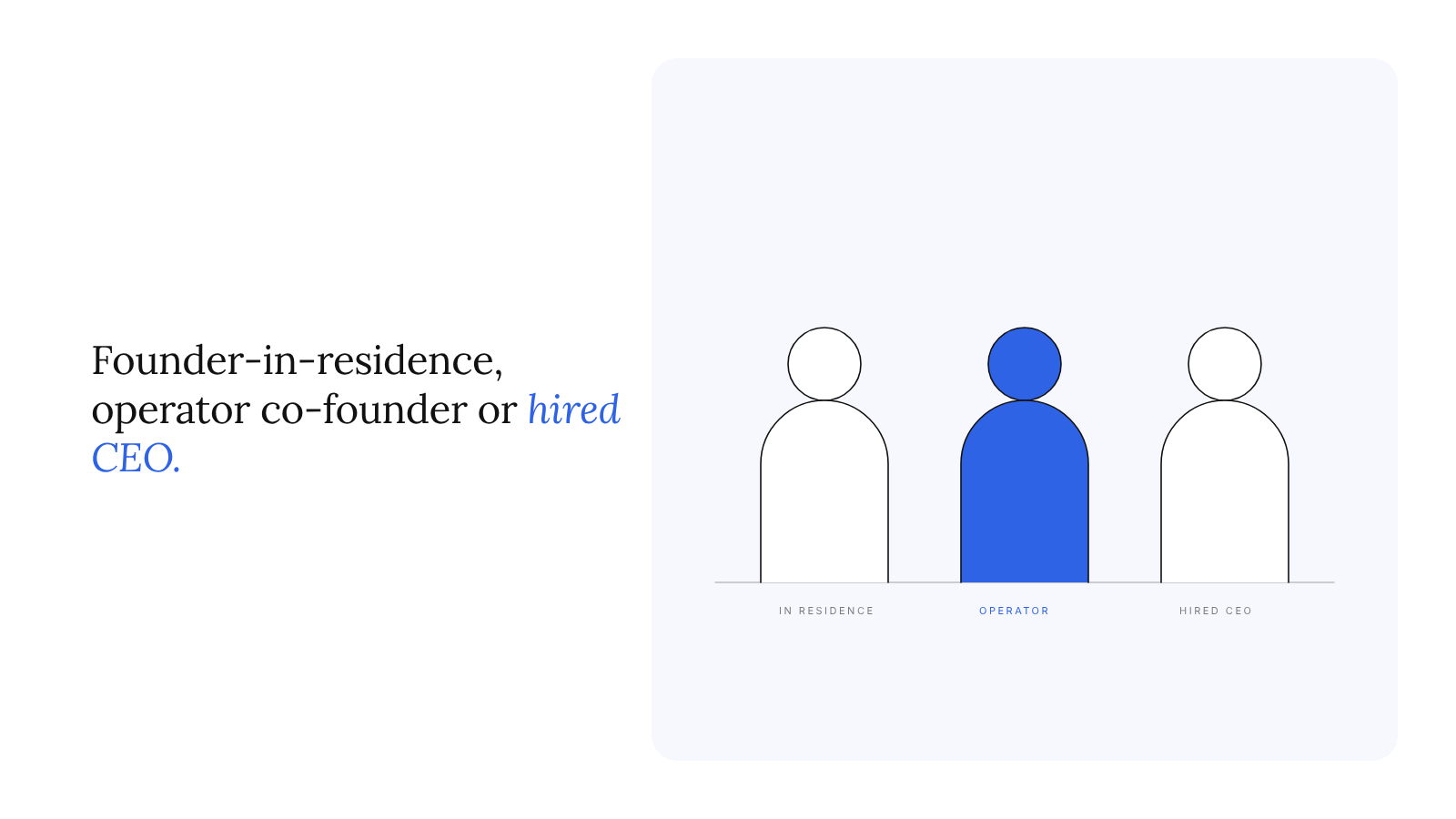
Three answers have emerged over thirty years of practice. The first recruits talented individuals before there is an idea and lets them form teams and companies inside the studio: the venture studio founder-in-residence model, in the sense this article uses the term. The second assigns a person already employed by the studio to found the company as its operating co-founder. The third builds the business first and then hires a chief executive from outside, often after the product has revenue. Each allocates risk, equity and authority between the studio and the leader differently, and the allocation is visible in the terms if you know where to look.
The choice is not free. It depends on the supply of people who have already run something, and that supply is thin in India in a way it is not in the Bay Area or London. This article sets out the three models, the cases that defined them, the trade-offs, and a table that puts risk, equity and authority side by side.
The venture studio founder-in-residence model: back the person, then find the company
Entrepreneur First, founded in London in 2011 by Alice Bentinck and Matt Clifford, built its business on the proposition that "it matters not only which companies get started, but who starts them". Its website states plainly that it builds "cofounding teams from scratch" and that applicants may arrive with an early idea, a possible co-founder, or "nothing". A 2014 TechCrunch report on the then three-year-old programme described selection "purely on talent, pre-team", a twelve-month window for individuals to form teams and build a product, an intake doubling from 30 to 60 people, and an investment at the time of £20,000 for 8 per cent. By 2026 the published offer had changed shape: an equity-free grant during ideation, up to $250,000 once a company is formed, up to $5 million in follow-on, and a portfolio the firm values at over $16 billion. The equity stake at company formation is not stated on the public pages.
Antler runs a version of the same idea at larger scale: more than 2,000 portfolio companies, a founder community of over 12,000 and offices in 27 cities. Its Korean programme page is the most explicit about mechanics: two cohorts a year, an eleven-week first phase in which selected individuals "refine ideas and form founding teams", investment committee reviews at weeks four, seven and eleven, and investment of up to roughly $260,000 per team. The Brazil page is candid that "joining the Residency does not guarantee an investment". Neither page publishes the equity Antler takes.
Hexa, the Paris studio that began as eFounders in 2011 and, according to TechCrunch in November 2023, launched roughly three to four companies a year over its first twelve years while keeping "30% in equity post-seed", sits between this model and the next. Its Start programme says the partners "identify high-potential opportunities" and "match you with the most promising ones", that the studio "cover[s] all your costs for 12 months", and that the deal is "for 25% of the company". Roughly a thousand aspiring founders approach the studio each year and it selects "an average of 12 founders (two per project)". The founders are outsiders; the ideas are the studio's. That is founder recruitment onto a studio thesis, and the 25 per cent figure is one of the few published equity numbers in the industry.
The logic of the model is that talent is scarcer than ideas and that selecting people before they have a company lets the studio buy in at the lowest price. The cost is a stipend or grant for a cohort most of whom will not form a fundable company, and authority over the venture, once formed, that is an investor's rather than a co-founder's. The founders own the company; the studio owns a minority and a relationship.
The operator co-founder model: the studio's own people found the company
The second model puts a person already employed by the studio into the founding team, with the studio's idea and the studio's capital. Rocket Internet, founded in Berlin in 2007, is the most complete historical case. A Harvard Business School digital initiative case describes its ventures as led by "Entrepreneurs", general managers "often poached from top Investment Banks, Consultancies and PE shops", supported by "functional experts" and a "core platform" for each of three sectors, with a stated aim to launch a scalable venture "in under 100 days". Managers who missed targets "are quickly replaced". A 2012 TechCrunch article counted more than 50 active companies across more than 40 countries and over 700 staff at Rocket itself. In that model the managing director was an employee first and a co-founder second: salaried at bank or consultancy levels, holding, as the case puts it, a "relatively small equity stake", and removable.
Atomic, the San Francisco studio run by Jack Abraham, shows a softer version. A 2021 TechCrunch interview describes Abraham as co-founder of dozens of Atomic companies including Hims & Hers, Bungalow and OpenStore. The studio starts "either with a person or with an idea"; when it starts with an idea, it builds the company to "millions of dollars of revenue" and then brings in a leader whom it "makes a co-founder", with an equity split that varies with "how much value they're adding". Atomic had grown from about 15 to 50 people and launched 14 companies in the preceding twelve months. The studio partner is the operating co-founder until an external leader is ready; the model then hands over.
PanScience Innovations in New Delhi describes its own practice in these terms. Its published model is to originate the problem in-house, incorporate at month zero with the first capital from the studio and "PSI operators as co-founders", build with in-house teams for twelve months, and have the venture graduate at month eighteen or later "to independent company with own leadership and external funding", with the studio staying on the cap table. The equity range is not stated publicly. The sequence, operator co-founders first and independent leadership later, is closer to Atomic's path than to Rocket's.
The advantages of the operator co-founder model are speed and control. The studio does not wait for a founder to appear; it assigns one, and it knows that person's record from direct observation rather than an interview. The costs are the mirror image. A salaried employee asked to behave like an owner may not, and an equity grant large enough to make them one dilutes the studio's economics. Authority is ambiguous: the co-founder reports, in some sense, to the studio that employs them, which later investors may read as a governance problem. And the model only works if the studio has operators to spare, which brings us to India.
The hired CEO model: build the business, then recruit the leader
The third model is the oldest. Idealab, founded by Bill Gross in Pasadena in 1996, describes itself as "the longest running technology incubator" and reports "145+ companies with more than 45 IPOs and acquisitions". In a 2008 interview with Marketplace, Gross explained that the team builds the concept in-house and then "start[s] recruiting from the outside", and that he deliberately "tried not to be CEO's of our companies". A longer account of the same practice records that Idealab starts with full ownership and that "immediately, at least 50% goes to the team", after which the studio is a minority holder because "we want it to be their company". Candidates had to "fall in love with the idea"; Gross's phrase for the constraint was "our bottleneck is talent, not number of ideas".
High Alpha in Indianapolis, founded in 2015 by Scott Dorsey, Eric Tobias, Kristian Andersen and Mike Fitzgerald, institutionalised the front end of this process in "Sprint Week", in which a handful of ideas are tested over a week and, as an Indianapolis Business Journal profile put it in 2018, "usually, only one is chosen to become part of the studio". The firm reported nine studio companies and 23 staff at that point; its website now lists "40+ Studio Company Starts" and "100+ Founders Backed", and describes "Founding Team Build" as a service in the Build phase, after validation. The leader arrives after the idea has survived the sprint, not before.
The strength of the hired CEO model is that the studio de-risks the opportunity before it asks anyone to bet a career on it, and can therefore recruit a more senior person than a blank-sheet idea would attract. The weakness is the one Gross named: the search is the bottleneck, and a company with a product and no leader is burning capital while the studio interviews.
The Studio Staffing Models table
The three models are easiest to compare on who carries the risk of a venture without a leader, how equity is divided at formation, who holds authority in the first year, and where each fits. Equity figures are illustrative ranges drawn from the published cases above and from the GSSN survey range of 15 to 80 per cent for studio stakes reported by GeekWire in 2021. None should be read as a norm.
| Dimension | Founder-in-residence | Operator co-founder | Hired CEO |
| Who bears pre-leader risk | The individual (unpaid or stipend) and the studio's cohort budget; most residents never form a fundable company | The studio, which pays the operator's salary whether or not the venture works | The studio, which funds build-out and search before a leader exists |
| Equity to studio at formation | Low to moderate (historically single digits to about 25 per cent, with the studio acting as first investor) | High; the studio is the originating shareholder and the operator receives a grant or vesting stake sized to the role | High at inception (up to 100 per cent), reduced by a large grant to the recruited team (Idealab: at least half) |
| Authority in year one | Founders; studio has investor rights, not operating control | Studio, with the operator as an executive accountable to it; ambiguous to outside investors | Studio until the CEO is hired, then shared; board typically studio-controlled until external funding |
| What the leader brings | Raw ambition and skill; usually a first-time founder | Knowledge of the studio's systems and sector; proven inside the building, unproven as an owner | Prior operating record; often a repeat executive attracted by a de-risked business |
| Studio's main cost | Cohort stipends, matching infrastructure, high attrition | Senior salaries carried on the studio's books; risk of losing operators to the ventures | Search time, interim management, and dilution to attract seniority |
| Where it fits | Deep talent pools with many strong individuals and few good jobs; investor-style studios | Thin markets for experienced founders; thesis-heavy studios with in-house operating depth | Capital-intensive or regulated businesses where a seasoned executive is a condition of raising; mature studio brands |
| Failure mode | Teams form around weak ideas; studio has little leverage to redirect | Operator never becomes an owner; venture reads as a subsidiary to later investors | Search drags; recruited CEO does not adopt the idea |
Two patterns stand out. Equity and authority move together and in the opposite direction to risk: the model in which the studio takes the least risk per venture is the one in which it holds the least equity and the least say. And each model has a characteristic failure the others avoid, which is why mature studios run hybrids: Atomic starts with either a person or an idea, Hexa recruits outsiders onto inside ideas, and PanScience's published sequence moves from operator co-founders to independent leadership at spin-out.
Why India's thin bench changes the answer
The founder-in-residence and hired CEO models both assume a supply of people who have already operated at scale. In India that supply exists but is small relative to the volume of company formation. A July 2026 report by RTP Global, using data compiled by Tracxn, counted 189 "operator-led" technology startups founded in India between 2023 and 2025, defined as companies led by executives "with prior experience operating, scaling or managing businesses at high-growth companies", against a base of 20,457 technology startups founded in the same period: "less than 1% of all technology startups". The previous edition, published in June 2025, found nearly 250 operators who became founders between 2022 and 2024, and that operator-led startups took "over 11.5% of all venture funding in India during 2024".
The same reports show why that bench is contested. In the 2022 cohort, operator-led startups reached seed at 11.2 per cent against 4.4 per cent for the rest of Indian tech, and Series A at 7.1 per cent against 0.3 per cent. Average seed rounds for operator-led companies in the 2023 to 2025 cohort were $2.4 million against $1.4 million. Capital already prices experienced operators at a premium, and a studio competing for them against a seed fund's term sheet is bidding for a scarce asset against a buyer offering more autonomy and often more money. DPIIT's figures frame the denominator: more than 2.23 lakh recognised startups as of 31 March 2026, with 55,200 recognised in the 2025-26 financial year alone. Most Indian founders are first-time founders, and most experienced operators who want to found a company can do so on their own terms. That has three consequences for a studio.
First, the founder-in-residence model is viable in India only if the studio is content to back first-time founders, which is what EF's and Antler's Bangalore operations in effect do; matching substitutes for scarce experience by pairing complementary strengths, at the cost of lower ownership and less steer. Second, the hired CEO model is hardest in India where it is most attractive: a de-risked, revenue-generating deep-tech company is what an experienced operator would join, but there are few to recruit and those few can usually raise their own capital, so searches stretch and the studio carries the cost. Third, the operator co-founder model becomes the default by elimination. If the studio cannot reliably recruit a repeat founder at formation it must create one: hire capable people into the studio, train them on one or two ventures as part of the shared team, and assign them as co- founder of the next. This is the model PanScience reports, and it is closest to what Rocket Internet did in Berlin when German repeat founders were rare. The trade-off is the one already described: the studio's payroll carries the risk, the venture may look like a subsidiary to a Series A investor, and the operator's path to genuine ownership has to be designed through vesting and governance that transfers at spin-out, or it will not happen.
For an Indian deep-tech studio the third case is therefore the common one, but the model's known failure mode means the design of the handover matters more than the choice itself. The published sequences at Atomic and PanScience both separate the operating co-founder phase from independent leadership and make the transition a stated milestone. Whether that transition happens on schedule is, for an investor or a prospective operator, the single most useful question to ask any studio that runs this model.
Conclusion
The three staffing models are three positions on a single trade-off between the studio's control and the leader's ownership, with the risk of a leaderless venture moving from the individual to the studio as control rises. Entrepreneur First and Antler sit at one end, Idealab and High Alpha at the other, Rocket Internet and the operator-driven studios in between, and the most durable firms have moved along the line as circumstances changed.
India's circumstances push studios toward the middle. Fewer than one in a hundred new technology companies is led by someone who has operated at scale, and those people are already priced at a premium by seed investors. A studio that waits to recruit them will wait a long time; a studio that grows them has to design a credible route from employee to owner. The choice of model is therefore less interesting than the quality of the handover, and that is where diligence should focus.
Methodology and sources
This article classifies studio staffing practice into three models using published descriptions and press coverage of named studios, and summarises the allocation of risk, equity and authority in each in the Studio Staffing Models table. The equity ranges in the table are illustrative, drawn from the specific published figures cited in the text and from the GSSN survey range of 15 to 80 per cent; they are not a statistical norm, and most studios do not publish their stakes. The India analysis rests on two RTP Global reports compiled with Tracxn data; both define "operator-led" narrowly and neither measures survival, so the thinness of the bench is inferred from counts and funding rates rather than outcomes. PanScience Innovations' practice is described only from its own published model and is company-reported.
Sources opened: Entrepreneur First homepage and About page (https://www.joinef.com/, https://www.joinef.com/about); TechCrunch, "Entrepreneur First Thinks It Can Grab The Talent Long Before YC", 14 April 2014 (https://techcrunch.com/?p=987269); Antler homepage, About, Brazil and Korea programme pages (https://www.antler.co/, https://www.antler.co/about, https://www.antler.co/location/brazil, https://ko.antler.co/location/korea); Hexa homepage and Start programme page (https://www.hexa.com/, https://www.hexa.com/start); TechCrunch, "Paris-based startup studio Hexa raises some funding to launch even more startups", 27 November 2023 (https://techcrunch.com/2023/11/27/paris-based-startup-studio-hexa-raises-some-funding-to-launch- even-more-startups); Harvard Business School Digital Initiative, "Rocket Internet – Sprawling digital business empire", 2015 (https://d3.harvard.edu/platform-rctom/submission/rocket-internet- sprawling-digital-business-empire/); TechCrunch, "Rocket Internet's New Site Reveals A Huge Global Cloning Operation", 20 July 2012 (https://techcrunch.com/?p=612737); TechCrunch, "Atomic has launched 14 startups in the last 12 months", 17 November 2021 (https://techcrunch.com/2021/11/17/talking-atomic/); Idealab homepage (https://www.idealab.com/); Marketplace interview transcript with Bill Gross, 21 February 2008 (https://www.marketplace.org/2008/02/21/interview-transcript-bill-gross); Ross Dawson, "Bill Gross on Idealab" (https://rossdawson.com/startup-studios/bill-gross-idealab-company-builder- successful); First Round Review, "Lessons Learned from Bill Gross' 35 IPOs and 40 Failures" (https://review.firstround.com/Lessons-Learned-from-Bill-Gross-35-IPOs-and-40-Failures); High Alpha About and Studio pages (https://www.highalpha.com/about, https://highalpha.com/studio); Indianapolis Business Journal, "More than money", March 2018 (https://www.ibj.com/articles/68078-more-than-money); GeekWire on Pioneer Square Labs and the GSSN equity survey, 8 January 2021 (https://www.geekwire.com/2021/seattle-startup-studio- pioneer-square-labs-spun-25-ideas-5-years-way/); RTP Global, "The State of Operator-Led Startups", June 2025 and July 2026 (https://rtp.vc/state-of-operator-led-startups-india-2025/, https://rtp.vc/operator-report-2026/); DPIIT recognition figures via Inc42, April 2026; PanScience Innovations published model (https://panscience.xyz).