
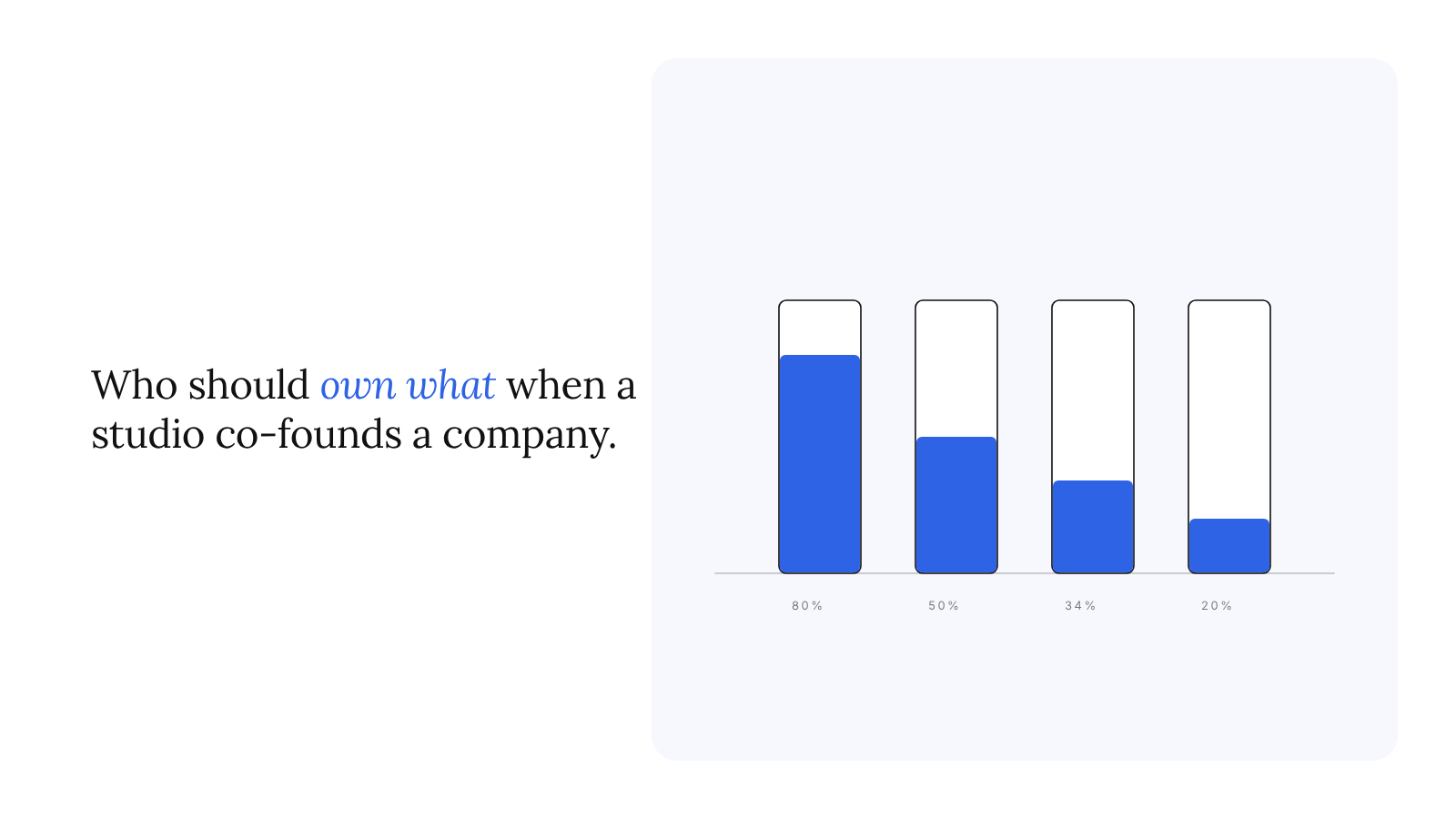
When a venture studio co-founds a company, the first negotiation is about venture studio equity, and it happens before there is anything to own. The studio has an idea it has validated, some capital, a few operators and a set of shared services. The founder has their time, their reputation and the next five to ten years. Industry surveys put the studio's share at anywhere between 15 and 80 per cent of the new company, with the average reported at 34 per cent in one Global Startup Studio Network survey and about 40 per cent in another, and at least one well-known studio, by published accounts, started at around 40 per cent or more before reducing it. Those are wide ranges for a decision that determines who is still motivated in year four.
The reason the range matters is dilution. A founding stake is not what a founder owns; it is the starting point for a sequence of subtractions. An option pool, a seed round, a Series A and a Series B each take a slice, and they take it from everyone proportionally, so a founder who starts at 20 per cent ends up with a single-digit holding before the company is five years old. A founder who starts at 66 per cent ends up with roughly a third. The studio's choice of initial stake therefore has a mathematical consequence for the founder that is easy to state and rarely shown.
This article shows it. It builds a dilution model from incorporation through three rounds at four studio stakes, with every assumption stated and labelled illustrative, and identifies where founder incentives break under widely used venture capital heuristics. It then sets out the India-specific rules that shape how a studio and founder structure ownership, including the tax treatment of employee stock options for recognised startups and the position on angel tax after the 2024 Budget, and proposes a principle for a fair stake tied to what the studio actually did before the founder arrived. This article is not legal or tax advice; the Indian provisions discussed change with each Finance Act and must be confirmed with a chartered accountant and a lawyer for any specific structure.
The dilution model: venture studio equity through three rounds
The model follows a company from incorporation to the close of its Series B under one set of assumptions, varying only the studio's stake at founding. The assumptions are illustrative and chosen to be close to published medians rather than to any particular company. Carta's data on more than 1,000 software rounds in the six months to July 2026 put median dilution at 18 per cent at seed, 18 per cent at Series A and 12 per cent at Series B; the model rounds these to 20, 20 and 15 per cent to allow for the slightly larger rounds Indian companies tend to need per unit of ownership sold, and to make the arithmetic transparent. Carta's 2026 founder ownership report put the median employee option pool at seed at 12.1 per cent; the model uses a 12 per cent pool created before the seed round, within the 10 to 15 per cent range most term sheets ask for. All percentages are fully diluted.
The founding cap table has two parties, the studio and the founder team. The founder team is treated as a single block; where two founders split it equally, each holds half of the figures shown. The sequence is: incorporation; option pool of 12 per cent created; seed round sells 20 per cent; Series A sells 20 per cent; Series B sells 15 per cent. Each step multiplies every existing holding by one minus the dilution, so the cumulative factor from incorporation to post-Series B is 0.88 × 0.80 × 0.80 × 0.85, or 0.479. A founding stake of any size retains 47.9 per cent of itself by the end.
| Stage | Dilution | Studio 20% / Founders 80% | Studio 34% / Founders 66% | Studio 50% / Founders 50% | Studio 80% / Founders 20% |
| Incorporation | 20.0 / 80.0 | 34.0 / 66.0 | 50.0 / 50.0 | 80.0 / 20.0 | |
| Option pool created | 12% | 17.6 / 70.4 | 29.9 / 58.1 | 44.0 / 44.0 | 70.4 / 17.6 |
| Post-seed | 20% | 14.1 / 56.3 | 23.9 / 46.5 | 35.2 / 35.2 | 56.3 / 14.1 |
| Post-Series A | 20% | 11.3 / 45.1 | 19.1 / 37.2 | 28.2 / 28.2 | 45.1 / 11.3 |
| Post-Series B | 15% | 9.6 / 38.3 | 16.3 / 31.6 | 23.9 / 23.9 | 38.3 / 9.6 |
| Each of two founders, post- Series A | 22.5 | 18.6 | 14.1 | 5.6 | |
| Each of two founders, post- Series B | 19.2 | 15.8 | 12.0 | 4.8 |
Two reference points help to read the table. Carta's July 2025 analysis of more than 3,500 US startups found the median founding team owned 55.1 per cent the day after a seed round and 36.6 per cent after Series A, with only about one in five founding teams still above 50 per cent after Series A. Carta's 2026 report gives similar figures, about 56 per cent at seed and 36 per cent at Series A, and 16.1 per cent at Series C, by which point the median employee pool of 16.8 per cent is larger than the founders' holding. These are for companies without a studio on the cap table. In the model, the 20 per cent studio stake leaves the founder team almost exactly where the Carta medians sit: 56.3 per cent after seed and 45.1 per cent after Series A, slightly above the medians because a 20 per cent studio stake is smaller than the combined pre-seed dilution most independent founders absorb from angels and advisers. The 34 per cent stake leaves them at 46.5 and 37.2 per cent, close to the median at Series A. The 50 per cent stake leaves the founders at 35.2 per cent after seed and 28.2 per cent after Series A, which is below the typical non-studio founder's Series B position. The 80 per cent stake leaves a two-founder team with 5.6 per cent each after Series A, less than many Series A investors would give a senior hire.
Where founder incentives break
Venture investors have a widely used rule of thumb that the founding team should still hold a substantial stake, commonly expressed as somewhere between a third and a half of the company, at the time of the Series A, because it is the founders' remaining upside that pays for the next five years of effort. Y Combinator's published advice, as reported by GeekWire, is that founders should avoid giving up more than 25 per cent in a seed round and that Series A lead investors typically want about 20 per cent. Carta's data confirm the rule reflects practice: the median founding team holds about 36 to 37 per cent after Series A, and the distribution is tight enough that only a fifth are above half.
Set against that benchmark, the four studio stakes behave very differently. At 20 per cent and 34 per cent the founder team arrives at Series A inside or above the normal range, and a Series A investor will see a cap table that looks like any other. At 50 per cent the founder team is at 28 per cent after Series A, below the median and heading for the low teens by Series C; investors will ask who is really running the company, and the honest answer is that the studio is the largest shareholder and the founders are a well-paid minority. At 80 per cent the founders are below the option pool from the first day, and by Series A each of two founders holds less than the company's employee pool will grant to its next vice-president. There is no incentive problem to solve at that point, because there is no incentive.
The break is not a cliff but it is visible. In this model it sits between a 34 per cent and a 50 per cent studio stake. Above roughly 40 per cent, a studio that wants its founders to behave like founders through a Series B has to top them up, either by reserving part of the option pool for founder grants, by selling down its own stake at the Series A, or by structuring the initial allocation so that the founders' share vests up as they hit milestones and the studio's share falls. All three are used; Hexa, for example, has said it holds 30 per cent after seed and allocates 5 to 10 per cent of its own stake to the people running each studio, and its chief executive has acknowledged that founders in the model "can potentially get a smaller portion of a bigger cake". The question a founder should ask is not what the studio's stake is on day one, but what the founder team will hold on the day after the Series A, under the studio's own assumptions about rounds.
What the Indian rules change
The arithmetic above is universal. The structure around it is not, and two Indian provisions bear directly on how a studio and founder should set up ownership. Both are described from government and reputable professional sources opened for this article; both have conditions and thresholds that change with Finance Acts, and a chartered accountant's confirmation is required before relying on either.
ESOP taxation and the deferral for eligible startups
In India an employee stock option is taxed twice. At exercise, the difference between the fair market value of the shares and the exercise price is a perquisite, added to salary and taxed at the employee's slab rate, with the employer required to deduct tax at source. At sale, the gain over the fair market value at exercise is taxed as capital gains, with the holding period and rate depending on whether the shares are listed and how long they were held. For an employee of an unlisted company, the first stage is the problem: tax is due on paper value in the year of exercise, with no cash to pay it, which is why employees of unlisted Indian companies historically did not exercise.
The Finance Act 2020 deferred the first-stage tax for employees of an "eligible start-up" as defined in section 80-IAC of the Income-tax Act. The Income Tax Department's own guidance states that for such employees, tax on the ESOP perquisite becomes payable within 14 days of the earliest of three events: the expiry of 48 months from the end of the assessment year in which the shares are allotted, the employee ceasing employment with the company, or the sale of the shares. The tax is computed at the rates in force in the year of allotment. The deferral applies to the perquisite only; capital gains at sale are unaffected.
The catch is eligibility. Section 80-IAC eligibility, which also provides the better-known 100 per cent deduction of profits for three consecutive years out of ten, is separate from DPIIT recognition. A startup must be DPIIT-recognised, must be a private limited company or LLP incorporated within a window that the Finance Bill 2025 extended to before 1 April 2030, must have turnover under 100 crore rupees, and must obtain a certificate from the Inter-Ministerial Board. DPIIT announced in May 2025 that it had approved 187 startups in one batch under the revised framework, which gives a sense of how selective the certificate remains relative to the 2.23 lakh startups DPIIT had recognised by March 2026. For a studio-built company, the practical point is that the ESOP pool in the dilution model is worth far more to employees if the company secures 80-IAC status early, and the studio's legal function, if it has one, should be pursuing that certificate from incorporation rather than at the first senior hire.
Angel tax after the 2024 Budget
Until 2024, section 56(2)(viib) of the Income-tax Act treated the amount by which an unlisted company's share issue price exceeded fair market value as income of the company, taxable at the rate Business Standard reported as 30.9 per cent. Inserted in 2012 to curb money laundering through shell companies, the provision began to be applied to startups around 2016, when tax officers questioned valuation methods, and was extended to non-resident investors by the Finance Act 2023. A conditional exemption for DPIIT-recognised startups was introduced in 2019, but it depended on declarations and was not available to every company or every investor.
In the Budget speech of 23 July 2024, the Finance Minister said: "I propose to abolish the so-called angel tax for all classes of investors." Business Standard reported that companies raising capital from 1 April 2024 would not face the tax. The practical effect for studio structures is significant. A studio that subscribes to shares in a new company at a premium, or that brings in its own investor club at a valuation set internally, previously had to defend that valuation against a fair-market-value test; the abolition removes that exposure for issues from April 2024, though past assessments and the disclosure requirements that Inc42 reported as replacing it, including reporting of unlisted investments and mandatory dematerialisation, remain. Whether any residual provision applies to a specific structure, in particular to share issues made before the effective date or to transfers rather than issues, needs a chartered accountant's view.
A fair stake principle
If 15 to 80 per cent is the observed range, what should a studio take? The useful answer is not a number but a principle: the studio's stake should correspond to what the studio contributed before the founder arrived, measured against what the company would have had to pay for the same inputs on the market, and it should be capped at the level that leaves founders with a normal cap table at Series A.
There are four things a studio can contribute before a founder joins. Origination is the validated idea: customer discovery, a problem statement, perhaps a prototype, and the opportunity cost of the ideas it killed to find this one. Capital is the first cheque, which in the published data averages a few hundred thousand dollars, or about 2 to 3 crore rupees. Operators are the people the studio assigns to the company, some of whom may be co-founders in substance, with the salaries the studio pays them until the company can. Infrastructure is the shared product, engineering, finance, legal and hiring functions, which have a market price as outsourced services.
A studio that contributes all four, at the scale of several crore rupees of capital and a year of senior operator time, has done the work that a founder and a seed investor together would normally do, and a stake in the 30 to 40 per cent range, consistent with the surveyed averages, leaves a founder team at or near the Carta medians after Series A. A studio that contributes origination and infrastructure but little capital, and recruits a founder who then raises the seed from outsiders, is closer to an accelerator with a longer programme and a stake in the 15 to 20 per cent range is more defensible. A studio that contributes capital and infrastructure but recruits founders to an idea they generated themselves has contributed what a seed investor contributes, and should expect a seed investor's stake. The 50 per cent and 80 per cent cases in the model are justified only where the studio is, in substance, the founder: where it has built the product and the first customers in-house and is hiring a chief executive to run an existing business, in which case the person should be compensated as a hired chief executive, with a market option grant and salary, and should not be described as a founder.
The principle has a corollary for founders. Before agreeing a stake, ask the studio to show the four contributions with numbers: how much capital, committed when; which operators, for how long, at whose cost; what the shared services would cost on the market; and what the studio did to validate the idea before the founder saw it. A studio that originates in-house and commits capital at the idea stage, as PanScience Innovations in New Delhi describes its model, with studio operators joining as co-founders at incorporation and six shared functions supporting the first year, is making a larger contribution than one that recruits a founder to an unvalidated idea with a small cheque, and the two should not take the same stake. PanScience does not publish its equity range, so the principle cannot be applied to it from public information; the point is that any studio's stake should be explicable in these terms.
Conclusion
The dilution table does not say what a studio should take. It says what a founder will have left, which is the number that determines whether the company still has a founder in year four. Below roughly 35 to 40 per cent, a studio stake leaves a founder team inside the range venture investors expect to see at Series A; above it, the studio has to design a top-up or accept that it is hiring an executive rather than co-founding with one. In India, the abolition of angel tax from April 2024 has removed one reason to be cautious about studio-set valuations at incorporation, and the ESOP deferral for section 80-IAC startups has made the option pool worth more to employees, but only for companies that go through the Inter-Ministerial Board process. Both are reasons for a studio's legal and finance functions to be involved from the first day, and both are reasons to confirm the current rules with a professional before signing anything. The fair stake is the one that can be explained by what the studio did, and that still leaves the founder with enough to want to finish.
Methodology and sources
The dilution model is illustrative. Its assumptions are: a two-party founding cap table (studio and founder team); a 12 per cent option pool created before seed; dilution of 20 per cent at seed, 20 per cent at Series A and 15 per cent at Series B; no founder top-ups, secondary sales, convertible instruments, liquidation preferences or pro-rata follow-on by the studio; and all figures fully diluted. The dilution percentages are rounded up from Carta's July 2026 medians (18, 18 and 12 per cent) to reflect the rounding used in most term sheets and the larger ownership sold per round in markets with lower valuations; readers can substitute their own figures, since each round multiplies every holding by one minus the dilution. The founder "break" point is read against Carta's published median founder ownership at Series A and the widely used venture heuristic that founders should hold a substantial stake at that stage; it is a judgement, not a threshold from any dataset. The Indian tax provisions are described from the Income Tax Department's published guidance, DPIIT and Ministry of Commerce statements, and reputable press and professional sources opened for this article; thresholds and dates change with each Finance Act and this article is not legal or tax advice. Currency conversions use 95 rupees to the dollar.
Sources opened: Carta, "VC Startup Fundraising Benchmarks From 1000 Rounds", Peter Walker, 10 July 2026 (https://carta.com/data/linkedin-founder-ownership-across-vc-journey/); Carta, "Only 1 in 5 Founding Teams Own 50 Percent After Series A", 11 July 2025 (https://carta.com/data/linkedin-founders-rarely-majority-after-series-a/); Carta, "Founder Ownership Report 2026", 12 March 2026 (https://carta.com/uk/en/data/founder-ownership-2026/); GeekWire, 8 January 2021, for GSSN survey stakes, Pioneer Square Labs' early stake and Y Combinator's guidance (https://www.geekwire.com/2021/seattle-startup-studio-pioneer-square-labs- spun-25-ideas-5-years-way/); Nick Zasowski, Angel Capital Association blog, 19 February 2021 (https://angelcapitalassociation.org/blog/2021/2); TechCrunch, "eFounders morphs into Hexa", 29 November 2022 (https://techcrunch.com/2022/11/29/efounders-morphs-into-hexa-a-portfolio- company-of-startup-studios); Income Tax Department, "Taxation of Employee Stock Option Plan (ESOP)" (https://www.incometaxindia.gov.in/w/taxation-of-employee-stock-option-plan-esop-); Ikigai Law via Mondaq, "Tax on ESOPs deferred for start-ups", 14 January 2021 (https://mondaq.com/india/income-tax/1025648/tax-on-esops-deferred-for-start-ups); EquityList, "ESOP taxation", 13 October 2026 (https://www.equitylist.co/blog-post/esop-taxation); TAXAJ, "Section 80-IAC extended to startups incorporated up to April 2030", 24 August 2026 (https://www.taxaj.com/learn/section-80-iac-extended-to-startups-incorporated-up-to-april-2030/); News on AIR (Prasar Bharati), "DPIIT approves 187 startups for income tax exemption under new Section 80-IAC", 15 May 2025 (https://www.newsonair.gov.in/dpiit-approves-187-startups-for- income-tax-exemption-under-new-section-80-iac); Business Standard, "Budget 2024 abolishes angel tax on startups for all classes of investors", 23 July 2024 (https://www.business- standard.com/budget/news/budget-2024-abolishes-angel-tax-on-startups-for-all-classes-of- investors-124072300667_1.html); Inc42, "Budget 2024-25: FM Nirmala Sitharaman abolishes angel tax", 23 July 2024 (https://inc42.com/buzz/budget-2024-25-fm-nirmala-sitharaman-abolishes- angel-tax). DPIIT recognition count from the Ministry statement of April 2026 via Inc42. PanScience model description is company-reported from panscience.xyz, read 24 October 2026.