
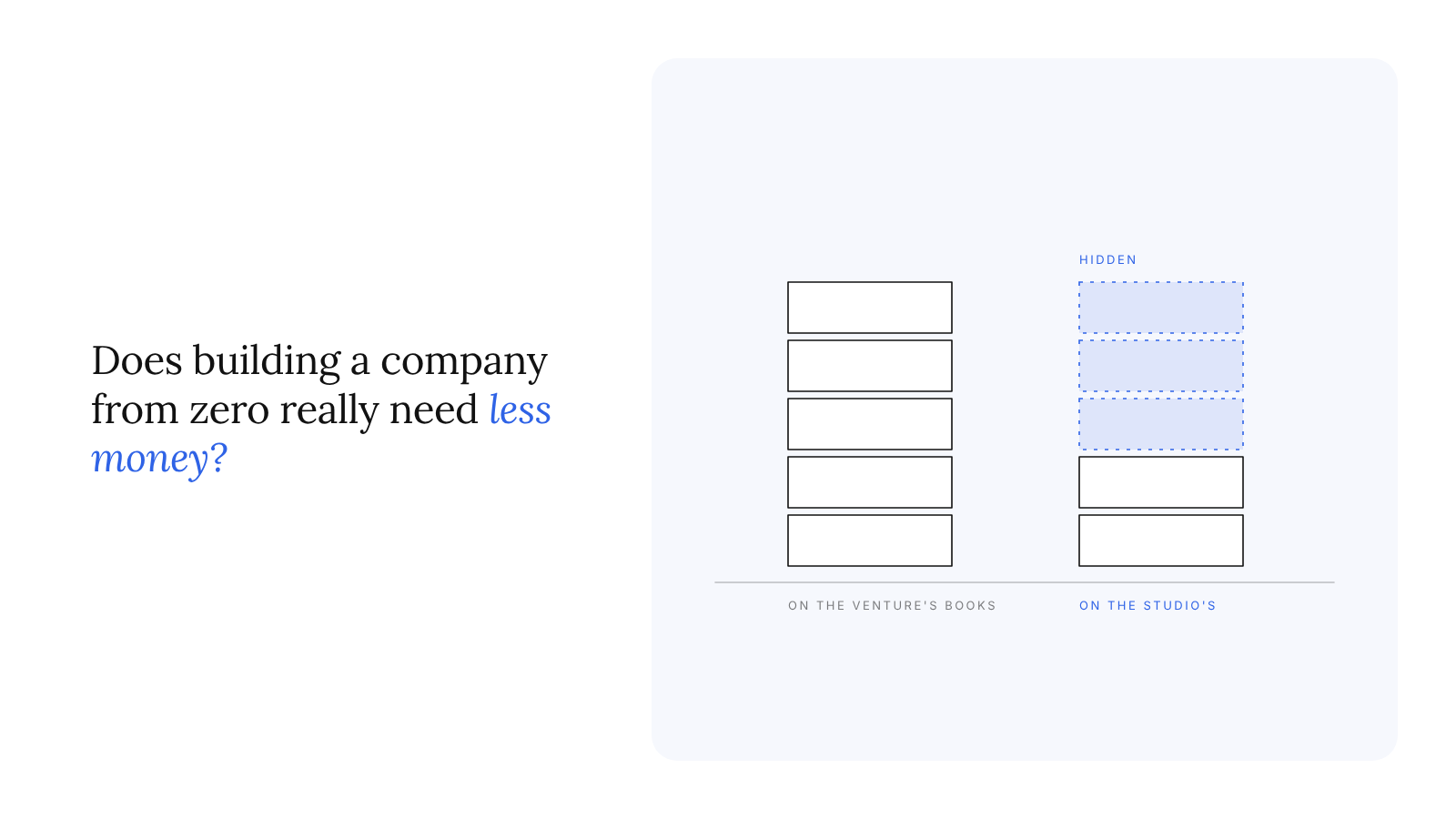
The venture studio capital efficiency claim sounds almost too good: a company built inside a studio reaches the same milestones as a conventionally funded startup while raising less outside capital and reaching Series A in less than half the time. The Global Startup Studio Network's widely repeated 2022 figures put the median time to Series A for studio companies at 25.2 months against 56 months for conventional startups, with 72% of studio companies reaching Series A against 42%. Those numbers are self-reported by the studios themselves and the academic literature, as a 2024 Politecnico di Milano paper puts it, remains limited. But even if they were only half right, they would describe a materially cheaper path to a fundable company.
The question this article asks is narrower and more uncomfortable. Cheaper for whom? A studio venture's balance sheet shows a small team, a modest burn and an early product. What it does not show is the senior engineers on the studio payroll who built the first version, the studio's legal team that incorporated it, the recruiter who staffed it, the operator co-founder whose salary the studio paid for the first year, or the three months of validation work done before the company existed at all. All of that is real money. It is simply booked somewhere else.
To test whether the capital-efficiency claim survives when those costs are counted, this article builds a simple, fully stated model comparing the first 18 months of a conventional Indian seed- funded startup with the first 18 months of a studio-built venture, adding studio-borne costs back explicitly. The model is illustrative, its assumptions are listed so a reader can change them, and its conclusion is more interesting than either camp usually admits.
What Indian seed capital actually looks like
Before modelling, it helps to anchor on what a conventional seed round in India is. Inc42's H1 2025 funding report gives a median seed ticket of $1 million, a median growth-stage (Series A and B) ticket of $8 million and a median late-stage ticket of $25 million, with an all-stage median of $3 million. Its full-year 2025 report records seed and early-stage funding of $793 million across 433 deals, which works out to an average of about $1.8 million per deal, pulled up from the median by a tail of larger rounds. Tracxn's year-end count put Indian seed funding at $1.1 billion in 2025, down 30% on 2024. The two trackers use different stage definitions, but both say the same thing: a typical Indian seed round in 2025 was in the region of $1 million to $2 million, and the pool was shrinking.
Two further data points frame the problem a studio is supposed to solve. The IVCA Bharat DeepTech Report 2026, as reported by YourStory in August 2026, found that only 15% of surveyed funds will back projects at the earliest technology readiness levels, and that fund participation drops sharply between seed and Series B. The Nasscom-Zinnov 2025 report describes capital as "selective and milestone-linked", with 74% of deal activity at seed and early stages. In other words, Indian early-stage capital is available but conditional: a founder needs a product and early evidence of demand before the median $1 million arrives, and must then stretch it to the milestones that unlock the median $8 million.
That is the gap studios claim to fill. The studio supplies the pre-seed capital, the engineering, and the operating functions to get a venture to the point where conventional capital will engage, and does so from a shared pool rather than a company-specific raise. Whether this is cheaper in total, or merely cheaper on the venture's own books, is the question the model addresses.
The model: two companies, 18 months, every cost counted
The model follows two hypothetical companies building an enterprise AI product in India from month 0 (incorporation) to month 18. Both reach the same milestone: a shipped product, a handful of paying pilots, and a team ready to raise a Series A. All figures are in US dollars, converted where relevant at ₹95 to the dollar. Salary assumptions are deliberately round and are set at fully loaded monthly cost (salary plus employer contributions and benefits) for a Delhi or Bengaluru team. They are assumptions, not survey data, and a reader with better local figures should substitute them.
Company A conventional seed-funded startup
Company A is founded by two technical founders who spend four months pre-incorporation building a prototype at their own expense (not counted below, but noted). At month 0 they incorporate and close a $1 million seed round, in line with the Inc42 median. Over 18 months they hire to a team of nine.
| Cost line | Assumption | Monthly (USD) | 18-month total (USD) |
| Two founders | $3,000 each, fully loaded | 6,000 | 108,000 |
| Five engineers | $3,500 each, hired months 1 to 6, averaged | 17,500 | 262,500 |
| Two GTM and operations hires | $2,500 each, hired from month 4 | 5,000 | 75,000 |
| Outsourced finance, legal, HR, compliance | Retainers and CA fees | 2,500 | 45,000 |
| Cloud, tooling, data and GPU credits | Net of startup credits | 3,000 | 54,000 |
| Office, travel, marketing, miscellaneous | 2,500 | 45,000 | |
| Incorporation, ESOP, seed- round legal | One-off | 25,000 | |
| Recruiting fees and onboarding | Nine hires at about $3,000 | 27,000 | |
| Total cash cost, months 0 to 18 | 36,500 | 641,500 |
Company A ends month 18 having spent roughly $640,000 of its $1 million, leaving about $360,000, or ten months of runway at the end-state burn, to raise a Series A. This is a reasonable position but a tight one: Series A processes in India commonly take four to six months, and the founders will spend a large fraction of their own time on the raise during months 14 to 18. That time has no cash cost in the table but is a real cost to product velocity.
Company B studio-built venture, as it appears on the venture's own books
Company B is originated inside a studio. Three months of validation work happen before incorporation. At month 0 the studio incorporates the company, commits the first capital, and places a studio operator as co-founder alongside a venture CEO. Senior engineering comes from the studio's shared pool for the first year; the venture hires its own dedicated engineers progressively. Legal, finance, HR, recruiting and office are provided by the studio. Here is what the venture's own profit and loss account shows.
| Cost line | Assumption | Monthly (USD) | 18-month total (USD) |
| Venture CEO | $3,000, fully loaded, from month 0 | 3,000 | 54,000 |
| Three dedicated engineers | $3,500 each, hired months 3 to 9, averaged | 10,500 | 157,500 |
| One GTM hire | $2,500, from month 6 | 2,500 | 30,000 |
| Cloud, tooling, data and GPU credits | Same as Company A | 3,000 | 54,000 |
| Travel, marketing, miscellaneous | Office is studio-provided | 1,500 | 27,000 |
| Incorporation and legal | Studio-provided | 0 | |
| Recruiting | Studio-provided | 0 | |
| Total on venture books, months 0 to 18 | 20,500 | 322,500 |
On its own books, Company B has spent about $322,000 to reach the same milestone that cost Company A $641,000. That is a 50% saving, and it is this number, or something like it, that underlies the capital-efficiency claim. A studio can point to it honestly: the venture really did reach a Series A-ready state having consumed half the cash.
Company B the studio-borne costs
Now add back what the studio paid. The assumptions below describe a studio with a shared pool of senior engineers and operators spread across several ventures at a time; the figures are the share attributable to Company B.
| Studio-borne cost line | Assumption | 18-month total (USD) |
| Pre-incorporation origination and validation | Two people, three months, $4,000 each per month | 24,000 |
| Shared senior ML and platform engineers | 1.5 FTE equivalent at $6,000 per month, months 0 to 12; 0.5 FTE months 13 to 18 | 126,000 |
| Studio operator co-founder (GTM, operations) | 0.5 FTE at $5,000 per month, 18 months | 45,000 |
| Finance, legal, HR and compliance | 0.5 FTE at $3,000 per month, plus $15,000 one- off incorporation, IP and governance | 42,000 |
| Recruiting (four venture hires plus pool allocation) | 20,000 | |
| Office and shared infrastructure | $1,500 per month | 27,000 |
| Studio management and general overhead allocation | 12% of all direct costs above | 34,000 |
| Total studio-borne, attributable to Company B | 318,000 |
The fully loaded comparison
| Company A (conventional) | Company B (studio) | |
| Cost on the venture's own books | $641,500 | $322,500 |
| Cost borne elsewhere | Founders' unpaid pre-incorporation time (not counted) | $318,000 |
| Fully loaded cost to reach month 18 milestone | $641,500 | $640,500 |
| Outside capital raised by venture | $1,000,000 | Studio first capital; amount not modelled |
| Founder time diverted to fundraising | Substantial, months 14 to 18 | Minimal; studio arranges first capital |
Under these assumptions the two paths cost almost exactly the same. The 50% saving on the venture's books is, to within rounding, a transfer of cost from the venture to the studio. This is the central finding of the model, and it is worth stating plainly: with reasonable Indian cost assumptions, a studio-built venture is not cheaper to build. It is cheaper to the venture, because someone else is paying.
Where real venture studio capital efficiency might come from
The model above is deliberately conservative towards the studio. It assumes the shared pool is charged at full cost and fully attributable, and it gives the studio no credit for anything other than moving costs around. There are three mechanisms by which a studio could genuinely lower the fully loaded number, and each depends on a condition that can be checked.
The first is utilisation of the shared pool. The 1.5 FTE of senior engineering in the studio-borne table costs $126,000 over 18 months only if those engineers would otherwise have been idle or hired by the venture directly. If the same engineers are productively deployed across four or five ventures in sequence, each venture bears only its share, which is what the model already assumes. But if the pool is under-utilised, which is common in a studio that has fewer ventures in build than it has engineers, the true cost per venture rises, and the model understates it. Utilisation is the swing variable, and it is one the studio knows and the venture's investors usually do not.
The second is reuse. A studio that has built five enterprise AI products has, in principle, an authentication layer, a deployment pipeline, a data-labelling workflow and a compliance template that the sixth product does not have to rebuild. If reuse removes two months of engineering from the build, the venture's dedicated engineering line falls by roughly $20,000 and the shared pool line by a similar amount. This is a real saving, but it is modest relative to the total, and it depends on the ventures being technically similar enough for reuse to apply.
The third, and probably the largest, is the cost of capital-raising itself. Company A's founders will spend perhaps four months at half capacity raising a Series A, and before that spent four unpaid months building a prototype in order to raise a seed. Company B's CEO does neither, because the studio commits first capital at month 0 and has relationships with follow-on investors. If GSSN's directional figure of 25.2 months to Series A against 56 months holds even approximately, the biggest saving is not in the build at all; it is in the thirty months of burn that Company A will spend between its seed and its Series A that Company B does not. That saving does not appear in an 18- month model because it falls outside the window, but it is the strongest argument for the studio path and the one that is hardest to verify, because the GSSN figures are produced by the industry about itself.
PanScience Innovations, the New Delhi studio, publishes a model in which in-house teams build the first product and stand up go-to-market, hiring, operations, finance and legal in months 1 to 12, with the venture graduating to independent leadership and external funding from month 18. It reports six shared in-house functions, including a shared pool of senior ML, data and platform engineers. That structure is exactly the one the model above describes, and the company-reported timeline (external funding from month 18 onward) is consistent with the model's end point. PanScience does not publish its equity range or the cost of its shared services per venture, which is the point of the next section.
The price of the subsidy: equity
A cost borne by the studio is not a gift. The studio is repaid in equity. The GSSN's own figures, as reported by the Angel Capital Association and GeekWire in 2021, put typical studio stakes at an average of around 34% to 40%, with a range from 15% to as high as 80% or 100% at formation. Accelerators, for comparison, take around 7%.
Return to the model. The studio contributed $318,000 of services plus first capital in exchange for, say, 35% of Company B. Company A's founders gave up a conventional seed-round stake, commonly in the range of 15% to 25%, for $1 million of cash. On a per-dollar basis, the studio's equity is expensive: $318,000 of services (plus whatever first capital it provided) for 35% is a higher effective price per percentage point than the seed investor paid, unless the studio's services and network genuinely compress the path to Series A in the way GSSN claims. If they do, the equity is well priced. If they do not, the founder of Company B has paid a premium for the comfort of not fundraising.
This is why the question "is a studio venture capital-efficient?" cannot be answered from the venture's books alone. The venture's books show low burn. The studio's books show the real build cost. The cap table shows the price. Only all three together tell an investor what was actually paid for what.
Three questions an investor should ask
An investor looking at a studio-built venture at Series A is, in effect, buying into a company whose early history is partly recorded somewhere else. The following three questions are designed to bring that history onto the table. They are phrased so that a studio with a well-run model can answer them easily and a studio without one cannot.
Question one: what is the fully loaded cost to date, including studio-borne services, and how was it allocated? A good answer is a schedule like the studio-borne table above, with the allocation method stated (hours logged, FTE share, or a standard rate card). A weak answer is "the studio provided support" with no number. The point is not to penalise the venture for the studio's spending; it is to understand the true capital intensity of the business model, because the venture will have to carry those costs itself after it spins out. A venture whose $20,000 monthly burn becomes $40,000 the month it leaves the studio has a different runway from the one its books imply.
Question two: what does the studio continue to provide after this round, on what terms, and when does it stop? PanScience, for example, states that spun-out ventures keep ecosystem access and that the studio stays on the cap table offering talent, introductions, follow-on capital and shared services. Whether those shared services are free, charged at cost, or charged at market rate from month 19 determines the post-money burn. An investor should get the service agreement, not the website description.
Question three: what did the studio's equity cost the venture, in services and capital, and how does that compare with what the same stake would have cost from a seed investor? This is the hardest question and the one most worth asking. If the studio holds 35% in exchange for $300,000 of services and $200,000 of capital, the implied pre-money at formation was well under $1 million. That may be entirely fair for a company that did not exist and had no founders until the studio created it. It is less obviously fair if the venture's CEO brought the idea and the studio supplied process. The investor's interest is in whether the remaining equity pool is large enough to motivate the operating team through two more rounds, and the answer depends on a number the studio may prefer not to volunteer.
What the model does not capture
Three limitations should be stated before drawing conclusions. First, the model holds the milestone constant and asks what it cost to reach. It does not model the probability of reaching it, which is where the studio case is strongest and least verifiable. GSSN's survival and Series A conversion figures are industry-produced; the Politecnico di Milano assessment that evidence remains limited is the appropriate caution. PanScience's company-reported 91% venture survival rate is a single studio's figure and says nothing about the model in general.
Second, the model prices founder time at salary. For Company A's founders, the four unpaid pre- incorporation months and the fundraising months are real opportunity costs that would, if counted, raise Company A's fully loaded figure by perhaps $40,000 to $60,000 and tilt the comparison modestly towards the studio.
Third, the model assumes both companies are building something that can be built. A studio's most valuable and least visible contribution may be the ideas it kills before month 0, at a cost of a few weeks of a validation team's time, which a conventional founder would have spent a year and a seed round discovering. That cost avoidance appears on no balance sheet at all.
Conclusion
Does building a company from zero really need less money? On the evidence a simple, stated model can produce, no. With reasonable Indian cost assumptions, a studio-built venture and a conventionally seeded startup cost roughly the same to bring to a Series A-ready state over 18 months. The studio venture's books show half the cost because the other half is on the studio's books. That is not a deception; it is an accounting fact, and a studio that is transparent about it has nothing to fear from the comparison.
The genuine case for studio capital efficiency lies elsewhere: in the utilisation of shared teams, in reuse across technically similar ventures, in the avoided months of fundraising, and above all in the ideas that are abandoned cheaply before a company exists. None of those appears in an 18-month cost comparison, and all of them depend on how well a particular studio is run. The investor's job is to ask where the costs are booked, what happens to them after spin-out, and what the equity actually bought. A studio with good answers to those three questions is making a capital-efficiency claim that deserves to be believed. One without them is describing a subsidy.
Methodology and sources
The two-company model is illustrative. Every cost assumption is stated in the tables and is the author's own; salary figures are round, fully loaded monthly estimates for an Indian enterprise AI team and are not drawn from a compensation survey. The rupee conversion used where relevant is ₹95 to the US dollar. The model's purpose is to show the structure of the comparison and to let a reader substitute their own figures; it should not be read as a measurement of any actual studio or startup. Studio stake ranges and time-to-Series-A figures come from the Global Startup Studio Network's self-reported surveys and are treated as directional and industry-produced, in line with the Politecnico di Milano (ECIE 2024) observation that research on studio outcomes remains limited. PanScience Innovations figures are company-reported from panscience.xyz, read 24 October 2026, and its equity range is not stated publicly.
Sources opened: Inc42, Indian Tech Startup Funding Report H1 2025, median ticket sizes and stage definitions (https://asset.inc42.com/2025/07/H1-2025-Funding-Report_v6.pdf); Inc42, "Indian Startup Funding Declines 8% YoY To $11 Bn In 2025", 28 December 2025, seed and early-stage totals and deal counts (https://inc42.com/features/indian-startup-funding-decline-8-yoy-to-11-bn-in- 2025/); PTI via The Week, Tracxn 2025 year snapshot, seed funding $1.1 billion down 30%, 18 December 2025 (https://www.theweek.in/wire-updates/business/2025/12/18/dcm91-biz-tech- startups-funding.html); YourStory, "Indian deeptech investments reach $11.4B: Report", on the IVCA Bharat DeepTech Report 2026, 17 August 2026 (https://yourstory.com/2026/08/indian- deeptech-investments-reach-114-billion-report); Zinnov press release, Nasscom-Zinnov Indian Tech Start-up Report 2025, dateline 25 February 2026 (https://zinnov.com/press-releases/indias-tech- start-ups-at-a-strategic-inflection-point-as-funding-rises-to-9-1-bn-nasscom-zinnov-tech-start-up- report-2026/). GSSN figures (2020 white paper "Disrupting the Venture Landscape"; Angel Capital Association blog, February 2021; GeekWire 2021 survey report; 2022 outcome figures) and the Politecnico di Milano ECIE 2024 paper are cited as provided in the editorial brief for this series.