
India now spends more on research than it ever has. The Department of Science and Technology's Research and Development Statistics 2025-26 put gross expenditure on R&D at ₹2,44,767.81 crore in 2023-24, or 0.84 per cent of GDP, up from 0.82 per cent the year before, and for the first time the private sector's share exceeded the government's. Patent filings at the Indian Patent Office reached 110,375 in 2024-25, nearly double the 58,503 of 2020-21, with domestic applicants at 61.79 per cent of the total. WIPO's World Intellectual Property Indicators 2025 recorded a 19.1 per cent rise in Indian patent applications in 2024, the sixth consecutive year of double-digit growth, driven primarily by resident filings.
Yet very little of this output becomes a company, and research commercialisation in India has not kept pace with the research itself. A 2025 survey of 289 Indian academic research institutions published in the Journal of Scientific and Industrial Research found that 82.1 per cent commercialise fewer than five technologies a year, and that 51.4 per cent earn between ₹1 lakh and ₹5 lakh annually from technology transfer. Those are the revenues of a modest consultancy, not of a system converting the country's research base into firms. The gap is not in the science and it is no longer principally in the money. It is in the method.
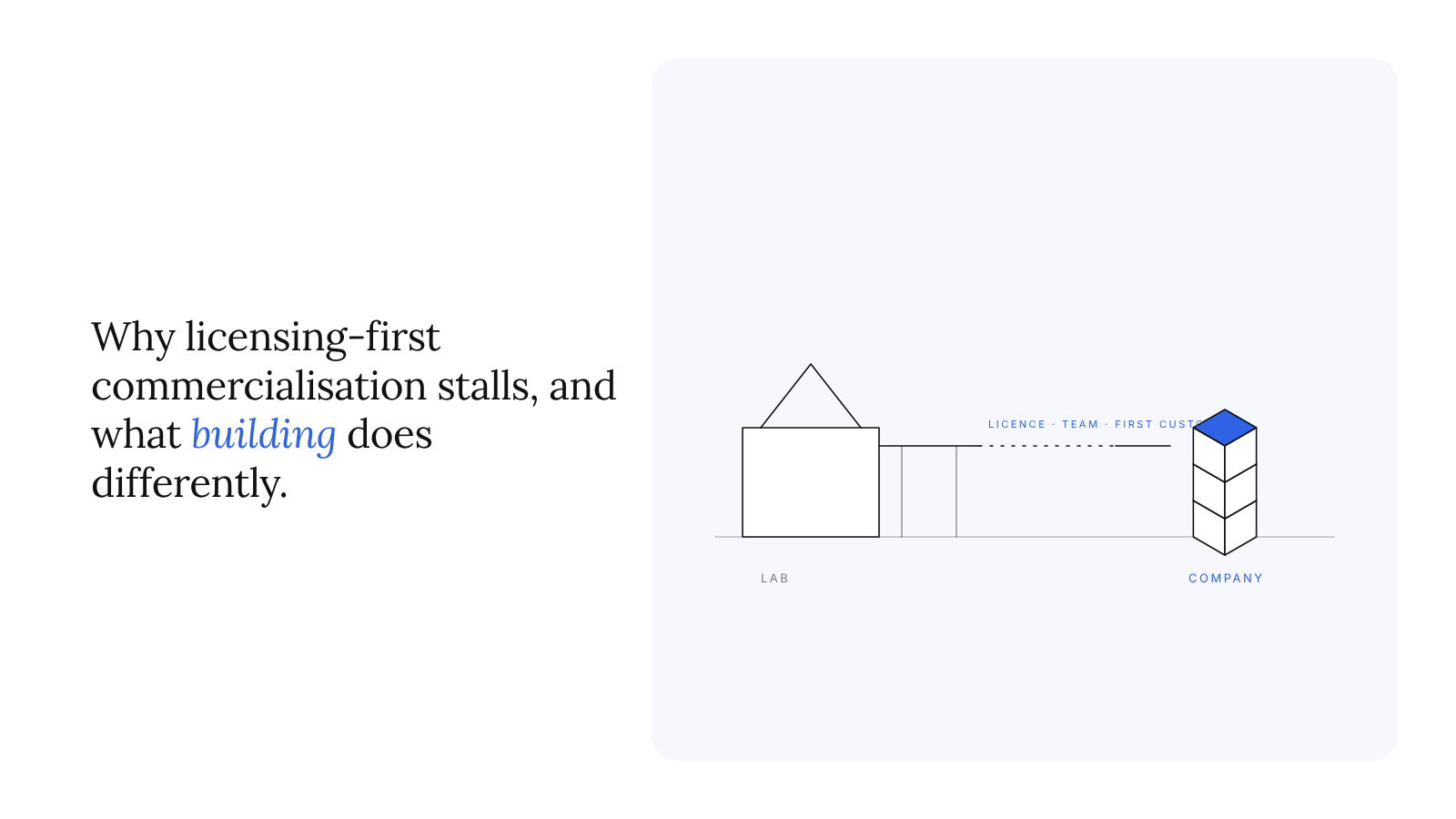
India's research commercialisation has relied on two mechanisms, licensing and incubation, and both stop before the company is built. Licensing transfers a right and walks away. Incubation provides a desk, a mentor and a grant, and waits for a founder to appear. Neither assembles what actually turns a research result into revenue: a team that can build a product, a product that solves a problem someone will pay for, and a first customer who has agreed to pay. This article examines why the two routes stall, what venture building does that they do not, and sets out a Research-to- Company Gap table naming the steps licensing skips.
Research commercialisation in India: the scale of the input, and the shape of the output
The DST figures change the usual framing. For two decades the standard complaint about Indian R&D was that there was too little of it, and the 0.6 to 0.7 per cent of GDP figures that persisted through the 2010s supported the complaint. The 2023-24 data show GERD at 0.84 per cent, with the private sector at 51.8 per cent and higher education institutions at 12.6 per cent, the latter up from 7.5 per cent over the period the DST covers. India still sits well below comparators, with Israel at around 5 per cent, South Korea at 4.8 per cent, the United States at 3.5 per cent, Japan at 3.3 per cent and China at 2.4 per cent, but the direction is unambiguous, and the ₹1 lakh crore Research, Development and Innovation fund and the ₹14,000 crore provision for the Anusandhan National Research Foundation signal that the input will keep rising.
The patent data tell the same story. The Indian Patent Office's annual report for 2024-25 shows applications rising from 66,440 in 2021-22 to 82,811 in 2022-23, 92,168 in 2023-24 and 110,375 in 2024-25. Domestic filings grew 32.23 per cent in the latest year against 3.89 per cent for foreign filings, Indian applicants' Patent Cooperation Treaty filings rose from 964 in 2020-21 to 2,600 in 2024-25, and 230,480 patents were in force on 1 April 2025. By the standard measures of input and output, India is a different country from the one described in commercialisation studies a decade ago.
What has not changed is what happens next. The Journal of Scientific and Industrial Research survey, conducted between April 2023 and May 2024, found that 57.6 per cent of institutions file five to ten patent applications a year and 56.9 per cent have five to ten staff dedicated to technology transfer, which is not negligible capacity. But 82.1 per cent commercialise fewer than five technologies a year, and roughly half report annual technology transfer revenue of ₹1 lakh to ₹5 lakh. The authors describe this as a gap between invention output and market delivery, and note that the self-reported, convenience-sampled design means the figures are indicative rather than precise.
Why licensing stops short
The licensing route is the default for a reason. The Royal Academy of Engineering's spin-out guide for entrepreneurs in India, based on a survey of 80 respondents and 16 interviews conducted between November 2024 and January 2025, describes licensing as the easier and quicker route, often recommended where institutional experience or resources are limited. It also records that many Indian universities do not consider assigning IP to a spin-out good practice, that even the original inventor typically needs a licence from the university with an upfront fee and royalties, and that institutions frequently fail to distinguish between work done at the institution and in the inventor's own time.
Licensing works when a capable licensee already exists: a firm with the product, the customers and the engineering team to absorb a new technology into an existing line. For incremental improvements this is often the case. For the results that matter most to a deep-tech or AI economy, a new model architecture, a novel sensor, a diagnostic method, a materials process, there is usually no such licensee, because the technology does not fit an existing product and no firm has the team to build the new one. The licence is signed, the royalty schedule is filed, and nothing is built.
Ravi and Janodia's cross-sectional study of 25 Indian universities, published in the Journal of the Knowledge Economy in 2022, puts the structural problem plainly: academic research is far from the demands of industry, supporting structures such as technology transfer offices exist but do not effectively direct resources toward useful innovation, and publicly funded universities have an advantage in licensing that private institutions lack. A companion paper by the same authors concludes that commercialisation by Indian universities remains limited. What both describe is a system optimised for the transfer of a right rather than the creation of a business.
The licensing office's incentives reinforce this. Its performance is measured in disclosures, filings and licence agreements, each countable at signature; whether the licensee ever ships a product is outside its remit. An office that licenses twenty technologies a year to firms that build nothing has, by its own metrics, had an excellent year.
Why incubation stops short too
Where licensing assumes a licensee, incubation assumes a founder, and the Indian incubation infrastructure is substantial. The Royal Academy of Engineering guide counts 40 Technology Business Incubators funded under the DST's NIDHI programme and 72 Atal Incubation Centres sponsored by the Atal Innovation Mission, alongside the incubation cells most universities now operate. The JSIR survey found that 49.7 per cent of research institutions support up to ten spin-offs or start-ups.
The incubation model's limitation is that it is a service to a founder who has already decided to found. It provides space, a small grant, mentorship and a network, and waits for someone to walk in with a technology and a commitment. The researcher who produced the result is usually not the person best placed to build a company around it, and the guide records mixed views on whether spin-outs can be run alongside research and teaching at all, with academic time pressures and a culture that regards commercial activity as less worthy than research among the barriers most frequently named. Roughly one respondent in five described their university administration as bureaucratic or unhelpful, and most agreed the pathway to spinning out was unclear. Approval formalities alone take four to twelve months in the United States, the United Kingdom and Europe, with initial evidence of a similar range in India and one respondent reporting 24 months.
So incubation, like licensing, has a step missing. It can support a company once a founder has formed one. It cannot form the company. Where the researcher does not want to be a founder, the technology waits for someone who may never arrive.
What building does differently
A venture-building approach treats the research result not as an asset to be transferred or a founder to be supported but as the starting input to a company the builder will assemble. McKinsey's fifth annual global survey on new-venture building, covering 1,176 senior executives in 2024, found that experienced builders are about twice as likely as novices to see new ventures meet or exceed expectations, that novices are three times more likely to build without product-market fit, and that experts are more than three times likelier to have a formal framework for identifying, evaluating, building and launching ventures. The survey is of corporate rather than academic venture building, but the finding that method matters more than enthusiasm translates directly.
The method, applied to research, has three components that neither licensing nor incubation supplies.
The first is the team. A builder brings a founding team to the technology rather than waiting for one to emerge from the laboratory. The researcher may join as a scientific co-founder, an adviser or a shareholder, and keeps their academic position if they wish. Product, engineering, commercial and operating roles are filled from the builder's bench or hired for the venture.
The second is the product. A research result is a demonstration that something is possible. A product is a packaged, supportable, priceable thing that solves a problem a buyer recognises. The distance between the two is where most of the work lies, and neither a licensing office nor an incubator does it. A builder with in-house product and engineering functions does it as a matter of course.
The third is the first customer. In a licensing model, finding a buyer is the licensee's problem. In an incubation model, it is the founder's. In a building model it is the builder's, and a builder that works across many ventures accumulates institutional relationships, with government agencies, corporates and regulated institutions, that a single new company cannot. The first customer conversation often begins before incorporation, because the builder is validating the problem with institutions it already knows.
A practice example
PanScience Innovations, a New Delhi venture studio founded in 2021, publishes a model that illustrates how these components are sequenced. Its Originate stage, by the company's description, happens before any company exists and consists of validating a problem in-house. Co-founding at month zero involves incorporation, first capital from the studio and studio operators as co-founders. The Build stage over months one to twelve has in-house teams ship a first product and stand up go- to-market, hiring, operations, finance and legal. The studio reports six shared functions, including a shared pool of senior machine learning, data and platform engineers and a legal function covering incorporation, compliance, IP and governance.
Three of its initiatives map onto the research-to-company problem. Lab To Launch is described on the company's site as research to revenue. Curiosity Labs is a paid research initiative under the heading publish, get paid, shape the field. The PALETTE Centre, launched in May 2025 with BITS Law School and inaugurated by former Chief Justice of India D.Y. Chandrachud, is described as a centre for AI in the justice system providing training in legal research, case classification and document review, with the studio's judicial venture Nyaay AI demonstrated at the launch. The company reports fifteen or more universities in its ecosystem, their role labelled as research transfer and talent.
These are company-reported descriptions and this article has no independent evidence of outcomes. The structural point is that a builder that pays researchers to publish, converts selected results into ventures with its own teams, and holds relationships with the institutions that will be first customers is doing the three things licensing and incubation leave undone. Whether any particular builder does them well is a question only outcomes can answer.
The Research-to-Company Gap
The table below is this article's original contribution. It lists the steps between a research result and a revenue-generating company and records which of them each route performs. The assignments are the author's reading of how the three routes operate in India as described in the sources above, and practitioners will disagree about individual cells. The purpose is to make visible where the work stops.
| Step | What it requires | Licensing | Incubation | Venture building |
| Problem validation | Evidence that a paying buyer has the problem the research addresses | Not performed; assumed to be licensee's concern | Performed by founder, if one exists | Performed by builder before company formation |
| IP position | Clean ownership or licence terms that permit onward commercial use | Performed, often on terms that constrain a spin- out | Left to founder to negotiate with institution | Negotiated by builder's legal function as a precondition |
| Founding team | People with product, engineering, commercial and operating capability | Not performed | Not performed; founder is a precondition | Performed; team assembled from builder's bench and hires |
| Scientific founder role | A defined, sustainable role for the researcher | Inventor named on licence; no operating role | Researcher expected to become founder | Researcher as co- founder, adviser or shareholder by choice |
| Product definition | Translation of a result into a supportable, priceable product | Not performed | Mentorship offered; execution left to founder | Performed by in- house product function |
| Engineering to production grade | Reliability, security, documentation, deployment | Not performed | Not performed | Performed by shared engineering pool |
| First customer | A signed, paying institution or enterprise | Licensee's concern | Founder's concern | Builder's concern, drawing on institutional relationships |
| Compliance and security posture | Certifications and controls a regulated buyer requires | Not performed | Not performed | Inherited from builder at group level, then transferred |
| First capital | Funds to reach first revenue | Not performed; royalty only | Small grant | Committed by builder at formation |
| Company operations | Finance, hiring, legal, governance | Not performed | Shared space and advice | Performed by shared functions until spin-out |
| Path to independence | Defined point at which the company stands alone | Not applicable | Graduation from programme | Scale and spin stage with external funding |
Eleven steps; licensing performs one of them, the IP position, and often on terms that make the next ten harder. Incubation performs several partially, through a grant, shared space and advice, and relies on a founder for the rest. The point is not that licensing and incubation are bad. Licensing is the right instrument for a result that fits an existing product line, and incubation is the right support for a founder who already exists. The point is that for the results that most need a new company, both routes leave most of the company unbuilt.
Where building has its own limits
Three limitations should be stated. Building is capital-intensive per venture, since the builder funds team, product and first customer before any revenue, and so can address only a few research results at a time; it complements licensing and incubation rather than replacing them. It concentrates equity and control in the builder rather than the researcher or institution, and the equity terms, which are often not published, determine whether researchers and universities see the model as a partnership or an extraction. And there is as yet little independent evidence on outcomes: the Politecnico di Milano analysis presented at ECIE 2024 observed that research on venture studio success remains limited, and the industry figures that circulate are self-reported. Any institution considering the model should ask for the builder's full record, including the ventures that did not work.
Conclusion
India's research system has solved the problem it was told it had. Spending is rising, patents are rising, the private sector has overtaken the government as a funder of R&D, and the policy pipeline promises more. The problem that remains is downstream, and it is a problem of method rather than money. Licensing transfers a right and stops. Incubation supports a founder and stops. Neither assembles a team, builds a product or signs a first customer, the three steps that turn a result into a company.
Venture building does, and the Research-to-Company Gap table shows precisely where. For universities and research institutions, the implication is to add a third route alongside the licensing office and the incubator, one that brings a builder to the result rather than waiting for a licensee or a founder. For policymakers, it is to measure commercialisation by companies formed and revenues earned rather than by licences signed. For builders, it is to publish outcomes, so that the next version of this analysis can rest on evidence rather than on the structure of the argument.
Methodology and sources
The Research-to-Company Gap table is an analytical framework constructed by the author from the published descriptions of how Indian licensing, incubation and venture-building routes operate; cell assignments are the author's judgement and have not been validated against a sample of actual commercialisation cases. The DST figures on GERD and sector shares were taken from secondary reports of the Research and Development Statistics 2025-26 and a Rajya Sabha reply by the Minister of State for Science and Technology, as the DST source document was not opened directly; where secondary sources differed on the private sector share, the figure given in the ministerial reply (51.8 per cent) is used. International comparisons of R&D intensity are as reported in those secondary sources and may refer to different years. The Indian Patent Office figures are from a law firm's summary of the CGPDTM Annual Report 2024-25 and were not checked against the report itself. Survey-based studies cited rely on self-reported data and convenience sampling, as their authors note.
Sources opened: NEXT IAS summary of DST Research and Development Statistics 2025-26, 5 August 2026 (https://www.nextias.com/ca/current-affairs/05-08-2026/rd-statistics-2025-26); Forum IAS, Key Highlights of Research and Development Statistics 2025-26 (https://forumias.com/blog/key-highlights-of-research-and-development-statistics-2025-26/); The Policy Edge, 5 August 2026 (https://www.policyedge.in/p/private-industry-lifts-indias-rd-spending- as-research-intensity-reaches-084); Tribune India report on the Rajya Sabha reply, 31 July 2026 (https://www.tribuneindia.com/news/business/private-sector-leads-indias-rd-spending-for-first-time- as-total-investment-reaches-rs-2-45-lakh-crore-in-fy24/); SuperKalam summary of the Parliament question on R&D expenditure, 30 July 2026 (https://superkalam.com/current-affairs/30-07- 2026/parliament-question-research-and-development-expenditure-8f56c8ac-4ea7-46c7-adb9- e12743da5726); WIPO press release PR/2025/943 on World Intellectual Property Indicators 2025, 12 November 2025 (https://www.wipo.int/pressroom/en/articles/2025/article_0012.html); S.S. Rana & Co, India's Patent Surge in the Office's Own Numbers, on the CGPDTM Annual Report 2024-25 (https://ssrana.in/articles/indias-patent-surge-in-the-offices-own-numbers-what-the-2024-25-data- shows/); Chaudhary, Chauhan, Morré and Lal, "Impact of National S&T Policy Framework on Technology Transfer from Indian Academic Research Institutions", Journal of Scientific and Industrial Research, vol. 84, September 2025 (https://or.niscpr.res.in/index.php/JSIR/article/download/15613/4913/103688); Ravi and Janodia, "Factors Affecting Technology Transfer and Commercialization of University Research in India", Journal of the Knowledge Economy, 2022 (https://impressions.manipal.edu/open-access- archive/4583); Ravi and Janodia, "University-Industry Technology Transfer in India: a Plausible Model", Journal of the Knowledge Economy, 2022 (https://ideas.repec.org/a/spr/jknowl/v13y2022i2d10.1007_s13132-022-00908-z.html); Royal Academy of Engineering, A Spin-out Guide for Entrepreneurs in India (https://raeng.org.uk/media/sshascea/a-spin-out-guide-for-entrepreneurs-in-india.pdf); McKinsey & Company, "How CEOs are turning corporate venture building into outsize growth", 22 October 2024 (https://www.mckinsey.com/capabilities/mckinsey-digital/our-insights/how-ceos-are-turning- corporate-venture-building-into-outsize-growth); Bar and Bench on the PALETTE launch, May 2025 (https://www.barandbench.com/Law-School/bits-law-school-and-panscience-innovations- unveil-palette-ai-legal-hub). PanScience Innovations descriptions are company-reported from panscience.xyz, read 24 October 2026.