
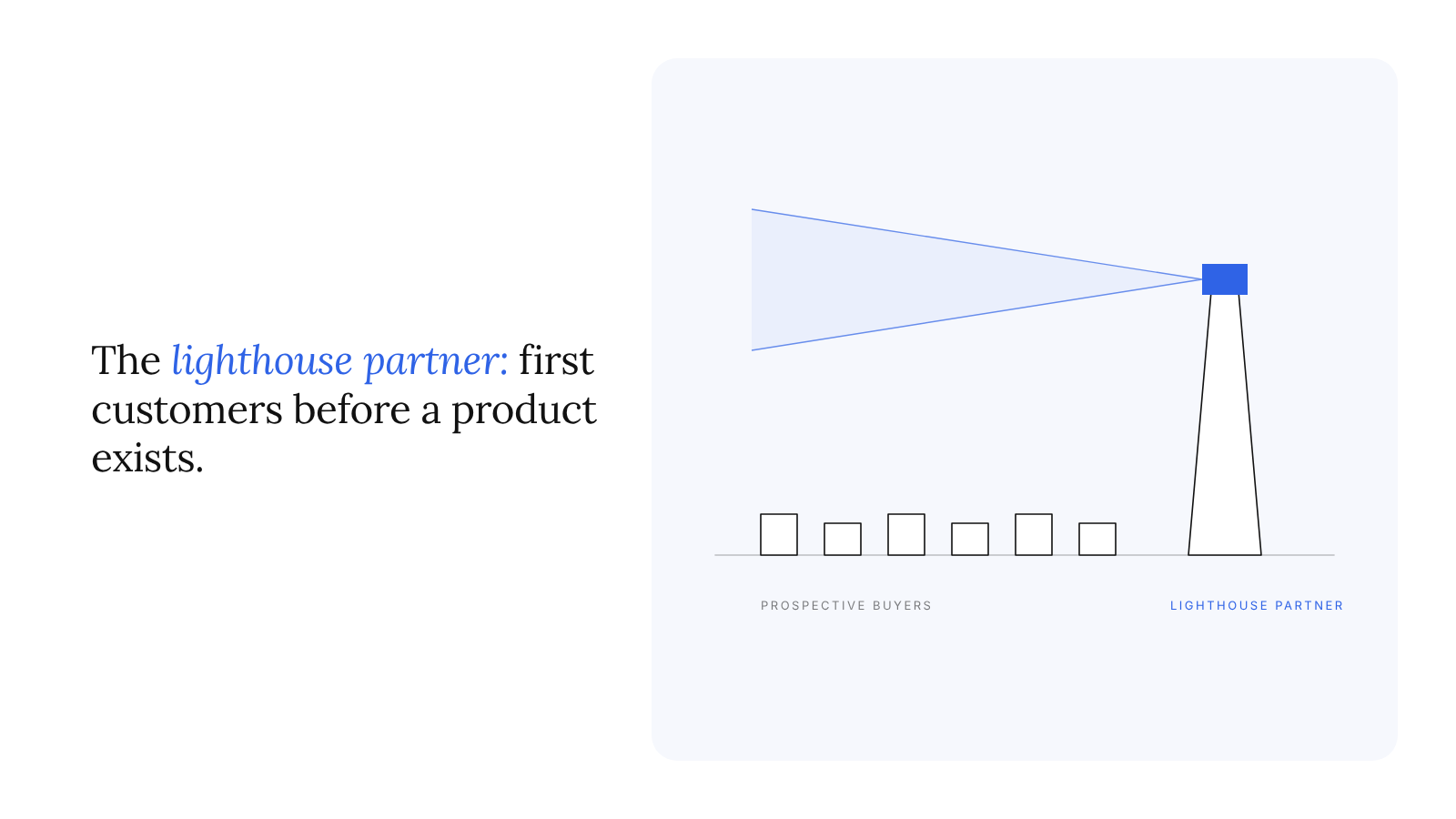
A court, a hospital group, a public sector bank, a power distribution company, a cement plant. None of these buys software the way a software company does. They have procurement committees rather than credit cards, they answer to regulators and auditors rather than to a product manager's dashboard, and the people who feel a problem most sharply are rarely the people who sign a purchase order. For a new AI venture aiming at these sectors, the scarce resource is not code, talent or even capital. It is evidence of what the buyer actually values, gathered inside the institution from a lighthouse partner, before anyone has committed to pay.
The conventional startup answer is to ship something small and iterate. In institutional and regulated settings that answer collapses on contact. There is no self-serve sign-up for a High Court registry, no freemium tier for a hospital's clinical records, and no way to observe a bank's compliance team at work without a data-sharing agreement and a security review. The venture cannot learn by releasing, so it must learn by being let in. The mechanism that lets it in is the lighthouse partner: an institution that agrees to be the first user of something that does not yet exist, in exchange for the right to shape it.
This article sets out what a lighthouse partner is and is not, how the relationship is structured, where it goes wrong, and how a venture builder runs several at once. It closes with a Lighthouse Partner Terms checklist.
What a lighthouse partner is, and what it is not
The term borrows from the reference-customer literature. HSBC Innovation Banking's practitioner guide puts the test as a single question: whose endorsement will make the next ten customers easier to win? The lighthouse need not be a famous name, only one respected by the buyers you want next. The academic root is older. Jari Ruokolainen's 2007 study of a start-up software company found that the first customer reference is an under-researched construct, and that even failed early customer cases carry value when the company extracts experimental knowledge from them.
A lighthouse partner in the sense used here is narrower and earlier than a lighthouse customer. The lighthouse customer buys a product that exists and lends its name. The lighthouse partner commits time, data and judgement before a product exists, and its contribution is not the endorsement but the specification. Three near-neighbours are often confused with it.
It is not a pilot customer. A pilot evaluates a near-finished product against a known requirement over a fixed period. A lighthouse partnership precedes the requirement: the institution and the venture are jointly discovering what it is, and the evidence produced is about the problem, not the product.
It is not a design partner in the SaaS sense. In horizontal software, a design partner is one of ten or twenty early accounts that give feedback in exchange for a discount, and the product is shaped to the common denominator. An institutional lighthouse partner is one of two or three, each with a legal or regulatory identity that shapes what is even permissible to build, and the point is depth of access rather than breadth of signal.
It is not a development contract. If the institution pays for bespoke work and owns the output, what has been created is a services engagement, not a venture. The lighthouse relationship exists to produce a product that can be sold to the partner's peers.
The distinction matters because institutions default to the forms they know: a pilot, a vendor evaluation, a tender for bespoke development. None of these produce what a new venture needs, which is sustained access to the institution's working reality while the product is still a hypothesis.
Why evidence, not capital, is the binding constraint
McKinsey's research on corporate and start-up collaboration, published in 2021, found that only 28 per cent of start-ups were satisfied with their corporate partnerships, and listed the recurring causes: weak internal sponsorship, unclear objectives, slow corporate processes such as quarterly budgeting, pilots that never reach scale, and a lack of impact tracking. The same research found that access to the partner's market was the top reason start-ups entered such relationships, and that financing was not among the top three. Start-ups go into these relationships for distribution and evidence and come out dissatisfied because the relationship was structured as something else.
Gartner's work on the B2B buying journey explains the institutional side. Seventy-seven per cent of B2B buyers describe their latest purchase as very complex or difficult. A typical buying group for a complex solution has six to ten decision makers, each holding four or five independently gathered pieces of information, and suppliers get roughly 5 per cent of a customer's time. In an institutional AI purchase the group is larger still, because it includes a data protection officer, an information security function and often a regulator or audit committee that is not in the room but whose expectations are.
A venture cannot buy its way past this. Capital can hire engineers and fund a sales team, but it cannot manufacture the knowledge of how a registry clerk files a case, which fields in a clinical record are reliably populated, or which of a bank's forty regulatory feeds its compliance team genuinely reads. That knowledge comes out only through a relationship structured to release it. The first question an investor should ask is not how much runway the venture has but who has let it in.
How the relationship is structured
A lighthouse partnership that works is a set of mutual obligations with a defined end state, written down early. Five elements recur.
Data access with a stated scope
The partner grants access to real operating data or a faithful de-identified derivative, under a data- sharing agreement that names the purpose, the categories, the retention period and the deletion obligation. In India, sector rules such as the Reserve Bank of India's Master Direction on Outsourcing of IT Services, issued in April 2023 and effective for new arrangements from October 2023, expect a bank's board-approved policy to cover provider selection, risk assessment, audit and inspection rights, data localisation and an exit strategy. A venture that turns up with a draft agreement already shaped to these requirements removes a reason to say no.
A feedback cadence owned by an operational sponsor
The McKinsey finding that start-up satisfaction rose 93 per cent when the corporate partner was highly committed, and 86 per cent when top management was involved, translates in institutions to a named sponsor who runs the operation the product touches, not an innovation cell outside it. The cadence is fortnightly or monthly, attended by the people who will use the system, and its minutes become the record of what the institution values. That record is the evidence the venture was looking for.
No exclusivity, or exclusivity that expires
The partner's natural ask is exclusivity, because it is contributing effort and does not want a competitor to benefit. The venture's natural fear is that exclusivity makes it a captive supplier. The workable middle is a defined window, usually six to twelve months from first production use, limited to the partner's direct peers in the same market, after which the venture is free to sell to anyone. For public institutions the question is often moot, since a court or a public hospital has no competitor to protect against, and the conversation becomes one about recognition and sequencing instead.
A path to a paid contract that is written down at the start
The partnership should name the conditions under which it converts to a paid contract, the approximate value, and the procurement route by which that contract will be let. If the institution must tender, the partnership should produce the specification the tender will carry. If a limited- tender or single-source route exists for innovations developed with the institution, the partnership should cite it. Without this, the venture risks building a product to a specification the institution then puts out to open competition.
Intellectual property that stays with the venture
The venture owns the product. The partner receives a perpetual licence to what is built for it, and sometimes a royalty-free licence to improvements made using its data. Joint ownership is avoided because it makes the product unsaleable to anyone else without the partner's consent. Where the partner's own contribution is substantial, as when a university supplies a model or a hospital a labelled dataset, that contribution is licensed in on terms that permit onward commercial use.
The risks, and how they are managed
Two failure modes account for most lighthouse partnerships that end badly.
The first is the captive supplier. The partner is large, the venture is small, the partner's requests are reasonable one at a time, and after eighteen months the venture has a deeply integrated system that serves one institution's workflow and nobody else's. The defence is structural: a second lighthouse in the same sector from month one, a roadmap the partner can influence but not direct, and a rule that any feature built for one partner must be generalisable to a named second institution before it is accepted.
The second is over-fitting. Even without becoming captive, a venture that learns from a single court learns that court's filing conventions, language mix and registry software, and the product is accurate in one building. The defence is the same: several lighthouses, chosen for difference rather than similarity. Two High Courts in different states with different languages and case-management systems teach more than two that are alike.
There is a third, less discussed risk: the partnership succeeds operationally and fails commercially because the institution cannot find a budget line. Deloitte's survey of 2,773 executives across fourteen countries, released in January 2025, found regulatory compliance had become the primary obstacle to generative AI adoption, cited by 38 per cent of respondents, up from 28 per cent in the first wave, and that 69 per cent expected full implementation of their AI governance strategy to take more than a year. An institution in that position may genuinely value the product and still have no mechanism to pay for it this financial year. The lighthouse agreement should name the budget cycle it is aiming at, and the venture should plan its runway accordingly.
Running several lighthouses at once
A single lighthouse is a dependency. Three lighthouses in one sector, chosen for diversity, are a product strategy. Running them concurrently is a discipline that venture studios are structurally better placed to manage than a lone founding team, because the studio can hold the relationships at the institutional level while each venture's team works inside one of them.
The rules are few. Each lighthouse has one owner on the venture side and one sponsor on the institution side. Feedback cadences are staggered. A shared specification records which requirements are common to all partners, which are specific to one, and which are contradictory and must be resolved by a product decision rather than by building both. Exclusivity windows are aligned so that the venture can sell to the wider market on a single known date. Conversions are sequenced, with the most procurement-ready partner first so that the others can cite it.
PanScience Innovations, the New Delhi venture studio, offers one worked example of the supply side. Its published ecosystem, which the company reports as ten or more government agencies, fifteen or more universities and twenty-five or more corporates, labels the role of corporates as pilots and go-to-market co-creation and the role of universities as research transfer and talent. Its judicial workflow venture Nyaay AI is company-reported as deployed across fourteen or more Indian High Courts and three national supreme courts, and in May 2025 the studio launched the PALETTE Centre with BITS Law School, inaugurated by former Chief Justice of India D.Y. Chandrachud, with a live demonstration of Nyaay AI at the launch. Read as a lighthouse strategy, the relevant features are the plurality of institutions in one sector, an academic partner that is not a buyer but supplies legitimacy and training, and a studio-level relationship that outlives any single venture's engagement. These are company-reported facts about one studio's practice, not evidence that the approach works in general.
The Lighthouse Partner Terms checklist
The checklist below is this article's original contribution: the terms to agree before the first working session, the party that typically resists each, and the compromise that usually holds. It assumes an institutional partner in a regulated sector and a venture that intends to sell to that partner's peers, and should be read alongside sector-specific regulation.
| Term | What is agreed | Who usually resists | Working compromise |
| Purpose statement | One paragraph on the problem being investigated, not the product | Venture (wants to name the product) | Problem-first wording; product named only as "the solution under development" |
| Operational sponsor | A named individual who runs the affected operation, with time allocated | Institution (offers the innovation cell) | Innovation cell coordinates; operational head is sponsor of record |
| Data access scope | Categories, volume, de- identification standard, retention, deletion | Institution's legal and DPO functions | Phased: synthetic or historical first, live data after security review |
| Security posture | Certifications and controls the venture will hold, with dates | Venture (cost and time) | Studio-level or shared certification accepted as interim evidence |
| Feedback cadence | Frequency, attendees, who owns the record | Both (time) | Fortnightly for three months, monthly thereafter; minutes shared |
| Exclusivity | None, or a window in months limited to named peers | Institution (wants protection) | Six to twelve months from first production use, scoped to direct peers |
| Intellectual property | Venture owns product; partner receives perpetual licence to its deployment | Institution (wants joint ownership) | Perpetual, royalty-free licence plus improvements made on its data |
| Partner contributions | Data, models or know-how the partner supplies, licensed for onward commercial use | Institution's research or IT function | Non-exclusive licence with attribution; no veto on resale |
| Conversion trigger | The measurable condition at which the partnership becomes a paid contract | Both (uncertainty) | Two or three operational metrics agreed in month one, reviewed at month six |
| Procurement route | How the paid contract will be let, and what the partnership must produce to enable it | Institution's procurement function | Partnership produces the specification; route named in writing |
| Budget cycle | The financial year and budget line targeted | Institution (does not want to commit) | Named as an intention with a review date |
| Second lighthouse | The venture's commitment to engage a second institution in parallel | Institution (feels less special) | Framed as the condition that makes the product sustainable for the partner too |
| Publication and reference | What each side may say publicly, and when | Institution's communications function | Joint announcement at conversion; anonymised case study earlier |
| Exit | How either side ends the partnership; fate of data and deployments | Both | Thirty-day notice; data deleted or returned; partner keeps licence to deployed version |
Three observations on using it. The terms institutions resist most, exclusivity and IP, are the ones that decide whether a venture rather than a services firm emerges, so they should not be traded for speed. The terms ventures resist most, security posture and operational sponsorship, are the ones that decide whether the partnership produces usable evidence, so they should be accepted early. And the conversion trigger and procurement route are the terms most often left vague, which is the most common reason a successful lighthouse fails to become a customer.
Conclusion
In institutional and regulated sectors, a venture's first job is not to build and not to sell. It is to be admitted. The lighthouse partner is the mechanism of admission, and the terms of admission decide whether what emerges is a product the partner's peers will buy or a bespoke system only the partner can use. The checklist above makes those terms explicit before the goodwill that starts every such partnership has been spent.
The broader point is that in these sectors institutional relationships are an asset class in their own right. They take years to build, they are not transferable by cheque, and they are what allows a studio to put a new venture inside a court or a hospital in months rather than years. A venture that has a lighthouse partner before it has a product is not behind. It is doing the work in the right order.
Methodology and sources
This article is an analytical essay rather than an empirical study. The definitions and the Lighthouse Partner Terms checklist are the author's synthesis of published practitioner guidance, management research and the author's reading of how institutional procurement operates in India; they have not been tested against a dataset and should be treated as a framework for negotiation rather than a validated instrument. The checklist assumes a regulated institutional buyer and a venture intending to sell to that buyer's peers, and it will need adaptation for other settings.
External sources opened for this article: HSBC Innovation Banking, "What is a lighthouse customer" (https://www.hsbcinnovationbanking.com/gb/en/resources/what-is-a-lighthouse- customer); Jari Ruokolainen, "Constructing the first customer reference to support the growth of a start-up software technology company", IMP Group, 2007 (https://impgroup.org/2007/01/01/constructing-the-first-customer-reference-to-support-the-growth- of-a-start-up-software-technology-company/); McKinsey & Company, "Collaborations between corporates and start-ups", Inside the Strategy Room, 10 May 2021 (https://www.mckinsey.com/capabilities/strategy-and-corporate-finance/our-insights/collaborations- between-corporates-and-start-ups); Gartner, "The B2B Buying Journey" (https://www.gartner.com/en/sales/insights/b2b-buying-journey); Khaitan & Co summary of the RBI Master Direction on Outsourcing of IT Services, April 2023 (https://khaitanco.com/thought- leaderships/RBI-Releases-Master-Direction-To-Regulate-Outsourcing-of-IT-Services); Technology Magazine report on Deloitte's State of Generative AI in the Enterprise, fourth wave, 22 January 2025 (https://technologymagazine.com/articles/deloitte-davos-survey-gen-ai-projects-face-scale- hurdles); Bar and Bench, "BITS Law School and PanScience Innovations unveil PALETTE AI Legal Hub", May 2025 (https://www.barandbench.com/Law-School/bits-law-school-and- panscience-innovations-unveil-palette-ai-legal-hub). PanScience Innovations figures on its ecosystem, portfolio and Nyaay AI deployments are company-reported and taken from panscience.xyz as read on 24 October 2026; they have not been independently verified.