
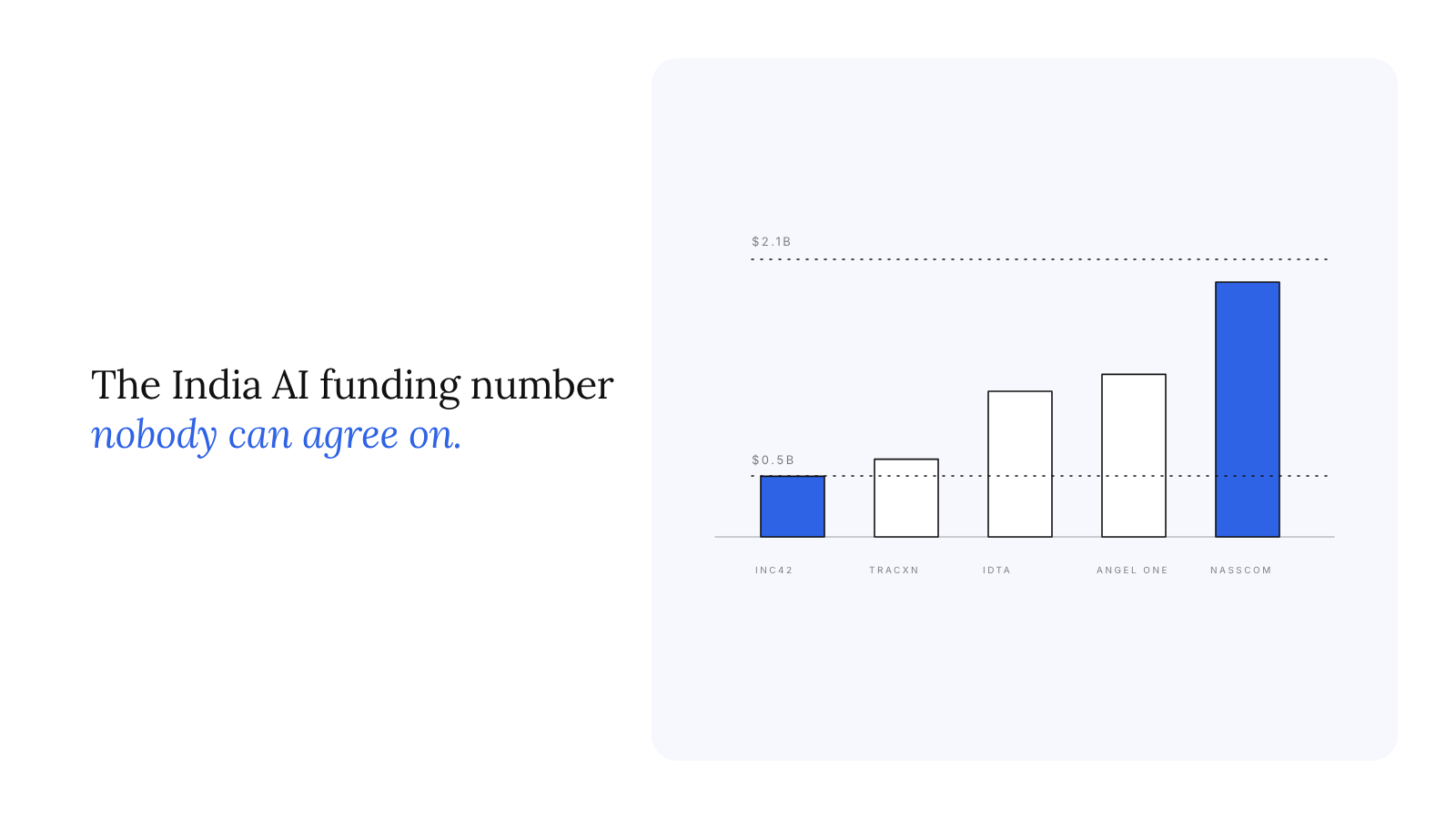
How much venture capital did Indian AI startups raise in 2025? Depending on which report you open, India AI startup funding in 2025 was $500 million, $643 million, $1.2 billion, $1.34 billion, or something above $2 billion. The spread is not a rounding error. The highest published figure is roughly four times the lowest, and every one of them comes from a serious source: Tracxn, Inc42, the India Deep Tech Alliance (IDTA), Angel One and the Nasscom-Zinnov annual start-up report.
This matters beyond bragging rights. Policymakers use these numbers to argue that India is or is not keeping pace with the United States and China. Investors use them to size funds. Founders use them to decide whether to incorporate in Bengaluru or Delaware. Venture builders use them to judge whether originated AI companies will find follow-on capital. If the denominator moves by a factor of four, every conclusion drawn from it moves too.
This article opens each source, works out what each one is actually counting, and lays the differences side by side. It does not pick a winner. The honest answer is that there is no single "true" number, because the sources are measuring different things. What a reader can do is understand what each figure measures and, where they need to count themselves, apply a consistent standard. That standard is proposed at the end.
India AI startup funding in 2025 the five figures, as published
The table below records what each source actually says, taken from the pages opened for this article, not from secondary summaries. Where a source did not state something, the cell says so.
| Source and date | Headline AI figure for 2025 | Deal count | Universe the AI figure sits inside | Growth stated | AI definition published? |
| Tracxn, via TechCrunch (27 Dec 2025) | Just over $643M | 100 | India tech startups: $10.5B across 1,518 rounds | Up 4.1% YoY | No |
| Inc42 Annual Indian Startup Trends Report (28 Dec 2025) | About $500M | Not stated | Indian startups: about $11B across 936+ deals | Not stated | No; AI is one sector among fintech, enterprise tech, ecommerce, deeptech and others |
| IDTA, AI and Deep Tech Investments Landscape 2026 (17 Feb 2026, data compiled by Venture Intelligence) | About $1.2B (about $1,221M) | 188 | Deep tech (including AI), reported in different places as $2.1B across 289 deals and about $5.1B across 285 deals | Up 58% YoY | Partly; defines "deep tech startup", notes multi-sector companies are counted in each sector |
| Angel One (20 Feb 2026) | $1.34B | 198 | Global AI PE-VC funding of $225.8B (CB Insights) | Up from $1B across 228 deals in 2024 | No; India source not named |
| Nasscom-Zinnov Indian Tech Start-up Report (press release dated 25 Feb 2026) | Not stated directly; 91% of $2.3B deeptech funding implies about $2.1B | Not stated | Indian tech startups: $9.1B, up 23% | Deeptech up 37% | No |
Three things jump out before any analysis. First, the sources do not even agree on the total for all Indian startups: Tracxn says $10.5 billion, Inc42 says about $11 billion, Nasscom-Zinnov says $9.1 billion. Second, the deal counts are wildly different: 100 AI deals at Tracxn against 198 at Angel One, and 1,518 total rounds at Tracxn against 936 at Inc42. Third, the direction of travel differs: Tracxn has AI funding up 4%, IDTA has it up 58%, and Tracxn has total funding down 17% while Nasscom-Zinnov has it up 23% for the same year.
Why the totals differ before AI is even mentioned
A reader cannot reconcile the AI figures without first understanding why the all-startup totals disagree, because each AI number is a slice of a different pie.
Tracxn's $10.5 billion is a venture-capital count across 1,518 rounds. Its stage breakdown, reported by PTI on 18 December 2025, was seed $1.1 billion, early-stage $3.9 billion and late-stage $5.5 billion, with 14 rounds of $100 million or more. It explicitly includes very large rounds: Erisha E Mobility's $1 billion Series D is named as the top deal of the year. One round therefore accounts for close to a tenth of the total.
Inc42's roughly $11 billion covers 936 or more deals, with a stage split of seed and early $793 million across 433 deals, growth $4 billion across 269 deals, and late $6 billion across 122 deals. Inc42 defines its stages precisely in its H1 2025 report methodology: seed is angel or seed stage, growth is Series A and B, late is Series C and above. It also reports 18 mega-deals of over $100 million, against Tracxn's 14. The two trackers therefore disagree on how many nine-figure rounds happened in India in 2025, which means they disagree on which companies count as Indian or which transactions count as venture rounds.
Nasscom-Zinnov's $9.1 billion, up 23%, is the odd one out. It is lower than the other two and moving in the opposite direction. The press release does not publish a definition of "tech start-up", a deal count, or the treatment of large rounds. One plausible explanation, which the release does not confirm, is that it excludes some late-stage or structured transactions that Tracxn and Inc42 include, and that 2024 was measured on the same narrower basis so that growth appears where others see decline. Without the methodology, this remains an inference.
The lesson is that "India startup funding 2025" is already three different quantities. Any AI share computed against one of them cannot be compared with an AI amount computed against another.
Six reasons the AI figures diverge
Having opened the sources, six mechanisms account for most of the spread. They are not mutually exclusive, and several sources are affected by more than one.
AI-first versus AI-enabled
The most important distinction is whether a company is counted because AI is its product or because AI is somewhere in its product. Tracxn's 100 AI deals is a narrow count; Inc42's roughly $500 million treats AI as one vertical competing with fintech, enterprise tech and healthtech, so a lending platform using machine learning is fintech, not AI. IDTA's 188 deals and Angel One's 198 deals are consistent with a broader definition in which AI-enabled companies in other sectors are included. None of the five publishes a written test for inclusion, which is itself the core finding of this article.
The deeptech boundary
Nasscom-Zinnov does not publish an AI total; it publishes a deeptech total of $2.3 billion and says AI accounted for 91% of it. The implied AI figure of about $2.1 billion is therefore a share of a category whose boundary is also unpublished. IDTA, by contrast, does define a deeptech startup, as a technology-driven company that builds or applies advanced scientific and engineering innovation, and its own deeptech figures are reported inconsistently across its report and press coverage ($2.1 billion across 289 deals in one account, about $5.1 billion across 285 deals in the report's own tables). When the container is fuzzy, the contents inherit the fuzz.
Multi-sector counting
IDTA states openly that companies falling into more than one sector are counted in each, so its sector totals overlap. This is a legitimate choice for a landscape report but it inflates any single sector relative to a tracker that assigns each company to exactly one primary sector, which is what Inc42's structure implies. Part of the gap between Inc42's $500 million and IDTA's $1.2 billion is almost certainly companies that Inc42 filed under fintech, healthtech or enterprise tech and IDTA counted under AI as well.
Deal inclusion rules
Tracxn counted 1,518 rounds in all of Indian tech; Inc42 counted 936 or more. The AI counts show the same pattern: 100 at Tracxn, 188 at IDTA, 198 at Angel One. Trackers differ on minimum disclosed size, on whether undisclosed rounds are estimated or dropped, on whether debt, secondary sales and grants count, and on whether a company headquartered in Singapore or Delaware with an Indian workforce is "Indian". IDTA explicitly includes cross-border startups whose main workforce is in India but whose headquarters are overseas. Tracxn's and Inc42's rules on this point are not published on the pages opened.
Period and cut-off
Tracxn's year-end figure was released on 18 December 2025 and TechCrunch's version on 27 December, so late-December deals may be missing or partially captured. Inc42's H1 report, for instance, ran from 1 January to 26 June, and its Q1 report to 26 March, so its annual figure likely closes before 31 December too. IDTA and Angel One published in February 2026 with a full year of data. A tracker that closes two weeks early will record fewer deals, and in a year when a single round can be worth hundreds of millions, the timing of one announcement can move a sector total by a quarter.
Treatment of large rounds and growth equity
Tracxn's AI figure splits as $273.3 million early-stage and $260 million late-stage, which means a handful of late rounds account for 40% of the total. IDTA notes that a small number of large transactions account for much of the capital and that its top-investments tables aggregate multiple rounds over several years. Whether a $100 million-plus growth round into a mature analytics company is "AI startup funding" is a judgement call, and each source makes it differently and silently.
A reconciliation table
The table below is the original contribution of this article. It takes each published figure and records, from the opened source, the choices that could move it up or down relative to a neutral baseline. Where a source does not disclose a rule, the cell says "not disclosed" rather than guessing. The "direction" column records whether the disclosed or evident choice would push the figure higher or lower than a narrow, single-sector, India-headquartered, calendar-year count.
| Reconciling factor | Tracxn ($643M) | Inc42 (~$500M) | IDTA ($1.2B) | Angel One ($1.34B) | Nasscom- Zinnov (implied ~$2.1B) |
| AI-first only or AI-enabled too | Not disclosed; 100 deals suggests narrow | Single-sector assignment; AI competes with other verticals (lower) | Multi-sector, companies counted in each sector (higher) | Not disclosed; 198 deals suggests broad | Share of deeptech; boundary not disclosed (higher) |
| Deeptech framing | Not used | Deeptech is a separate sector of about $500M across 87 deals | AI reported inside deeptech | Not used | AI exists only as 91% of deeptech |
| Cross-border or overseas- HQ companies | Not disclosed | Not disclosed | Included where main workforce is in India (higher) | Not disclosed | Not disclosed |
| Minimum deal size and undisclosed rounds | Not disclosed | Deal count stated as a minimum ("936+") | Not disclosed | Not disclosed | Not disclosed |
| Cut-off date | Released 18 Dec 2025 (lower) | Released 28 Dec 2025; prior reports closed days before period end (lower) | Full year, published Feb 2026 | Full year, published Feb 2026 | Full year, published Feb 2026 |
| Large and late-stage rounds | Included; late- stage AI $260M of $643M | Included; 18 mega-deals in total pool | Included; notes concentration in large deals | Not disclosed | Not disclosed |
| Primary data compiler | Tracxn | Inc42 | Venture Intelligence for IDTA | Not named for India figures | Nasscom- Zinnov |
| Internal consistency on the opened page | TechCrunch headline says $11B, body says $10.5B | Meta description cites $11B for 2024; body says $12B | Sector table says 188 deals and $1.2B; AI chart shows 137 deals and about $2.5B | India source not cited | Press release dateline and page date differ |
Read horizontally, the table explains most of the gap. Moving from Inc42's single-sector $500 million to IDTA's multi-sector $1.2 billion is largely a definition change plus cross-border inclusion plus a later cut-off. Moving from IDTA to the Nasscom-Zinnov implied figure is a further broadening into "deeptech" with an undisclosed boundary. Tracxn sits near Inc42 because both appear to use a narrow sector assignment and both closed before year-end.
Read vertically, the table also shows that no source is fully transparent. Even IDTA, which publishes the most methodology, carries an internal inconsistency between its sector table and its AI chart. The $643 million and $500 million figures look conservative, the $2.1 billion figure looks expansive, and the two figures in the middle are the ones a reader is most likely to encounter in a pitch deck or a ministerial speech.
What each number is good for
Rather than asking which is right, it is more useful to ask what each is for.
The Tracxn and Inc42 figures answer the question "how much venture money went into companies whose primary business is AI?" They are the right numbers for a fund manager sizing a pure-play AI thesis or a founder benchmarking a round. Their weakness is that they will miss AI-heavy companies filed under fintech, health or logistics, which in India is where much of the applied AI money actually goes.
The IDTA figure answers "how much went into companies for which AI is a core capability, wherever they sit?" It is the right number for a policymaker assessing diffusion or an operator deciding whether enterprise buyers are funding AI adoption through their vendors. Its weakness is overlap: it cannot be added to IDTA's other sector totals without double counting, and the report says so.
The Angel One figure is useful for one thing only, which is the global comparison: India at $1.34 billion against a CB Insights global total of $225.8 billion is 0.6%. Because the page does not name the source of the India number, it should not be cited for the India figure on its own.
The Nasscom-Zinnov implied figure answers "how much of India's deeptech capital is going to AI rather than to space, semiconductors or biotech?" The answer, 91%, is striking and credible as a ratio even if the absolute base is contestable. It tells a venture builder that Indian deeptech is, in funding terms, very nearly an AI story, and that non-AI deeptech is thinly capitalised. IDTA's own split, $1.22 billion AI against $1.19 billion non-AI deeptech, gives a much less lopsided picture, which again points to definitional differences rather than to different facts on the ground.
A proposed counting standard
A reader who needs a defensible number, for a board paper, a fund memo or a policy submission, cannot wait for the trackers to harmonise. The following standard is proposed as something any analyst with access to a deal database can apply, and as a checklist to interrogate any published figure. It has seven rules.
Rule 1: Declare the test for "AI company" and apply it at the company level, once. The recommended test is that the company's primary product would not function without a learned model, or that the company's primary revenue comes from building, training, serving or labelling such models. A fintech lender that uses a credit model fails the test; a company that sells credit models to lenders passes it. Record the classification date, because companies reposition.
Rule 2: One company, one sector. Assign each company to a single primary sector. Where a landscape view needs overlap, publish the overlap matrix separately and never sum overlapping sectors.
Rule 3: Define "Indian" by one of two published rules and say which. Either incorporation in India, or majority of employees in India with founders resident in India at the time of the round. Report the two totals separately where they differ materially; IDTA's inclusion of overseas- headquartered companies is defensible but must be visible.
Rule 4: Count equity venture rounds only, by announcement date, within the calendar year. Exclude venture debt, secondary sales, grants and IPO proceeds from the headline and report them in separate lines. Close the count no earlier than 15 January of the following year to capture late- December announcements.
Rule 5: Report the headline with and without rounds above $100 million. Concentration is the single largest driver of year-to-year swings. A reader should be able to see at a glance whether growth came from ten companies or from the ecosystem.
Rule 6: Report deal count alongside dollars, with a stated minimum disclosed size. A count that includes undisclosed rounds valued by estimate should flag the estimated share.
Rule 7: Publish the stage definitions. Inc42's definitions (seed is angel or seed; growth is Series A and B; late is Series C and above) are a reasonable template. Tracxn's three-way split uses "early" where Inc42 uses "growth", and the two are not obviously the same set.
Applied to the 2025 data, this standard would produce two headline figures rather than one: a narrow number close to the Tracxn and Inc42 range, and an AI-enabled number closer to IDTA's, each with a stated large-round exclusion. That is more useful than any single figure, because it tells the reader both how large the pure-play market is and how far AI has diffused into everything else.
What this means for people who build companies
For investors, the practical consequence is to stop quoting a single India AI figure without its source and definition attached. A memo that says "Indian AI startups raised $1.3 billion in 2025" is making a definitional claim, not a factual one, and a diligent LP will ask which.
For venture builders, the deeper reading is about where capital will be available to originated companies. The narrow counts show that pure-play AI in India is a market of a few hundred million dollars a year, concentrated in a few late rounds, with Tracxn recording seed funding across all sectors down 30% to $1.1 billion. The broad counts show that AI-enabled companies across fintech, health, logistics and enterprise software collectively attract two to four times that. A studio that originates AI companies therefore has a choice: build pure-play infrastructure and compete for a thin pool, or build AI-native businesses inside large verticals where the capital actually flows. PanScience Innovations, the New Delhi studio, reports that eight of its 24 co-founded ventures are in AI infrastructure with the remainder spread across verticals such as financial services, legal, health and industrial; whatever one thinks of that mix, it is a company-reported illustration of hedging across exactly this definitional boundary.
For policymakers, the message is that India's "share of global AI funding" is unknowable to better than a factor of two until a standard is adopted. Angel One's 0.6% uses a $1.34 billion numerator against a CB Insights denominator built on CB Insights' own definitions. Substituting Tracxn's numerator gives roughly 0.3%; substituting the Nasscom-Zinnov implied figure gives roughly 0.9%. All three are small, and the direction of the policy argument does not change. But the precision implied by a one-decimal percentage is false.
Conclusion
The India AI funding number for 2025 is not one number. It is at least five, produced by five organisations applying unpublished or partially published rules about what counts as AI, what counts as Indian, what counts as a deal and when the year ends. The gap between $500 million and $2.1 billion is explained almost entirely by those rules, not by disagreement about which companies raised money.
The reconciliation table above shows where each figure sits and which choices push it up or down. The proposed standard gives a reader seven rules to apply or to ask of any source. Neither resolves the question of which number is right, because that question has no answer. What a careful reader can do is choose the number that matches the question being asked, cite its definition alongside it, and treat any single-figure claim about Indian AI funding with the scepticism it deserves.
Methodology and sources
This article was built by opening each primary or nearest-available page for the five published figures and recording exactly what each states, including stated definitions, deal counts, periods and internal inconsistencies. Where a page did not state a rule, the reconciliation table records "not disclosed" rather than inferring one. The implied Nasscom-Zinnov AI figure of about $2.1 billion is an arithmetic product of two published numbers (91% of $2.3 billion) and is not a figure the report itself publishes. The proposed counting standard is the author's own and has not been applied to a deal database here; it is offered as a checklist, and its rules would need to be tested against actual transaction data before any resulting number was published. Limitations: the full Nasscom-Zinnov, Tracxn and Inc42 annual reports are behind registration or paywalls, so their methodology sections could not be read in full; the Angel One page does not name the source of its India figures; and IDTA's report contains internal discrepancies between its sector table and its AI chart that the report does not reconcile.
Sources opened: TechCrunch, "India startup funding hits $11B in 2025 as investors grow more selective", 27 December 2025, citing Tracxn (https://techcrunch.com/?p=3079055); PTI via The Week, Tracxn 2025 year snapshot, 18 December 2025 (https://www.theweek.in/wire- updates/business/2025/12/18/dcm91-biz-tech-startups-funding.html); Inc42, "Indian Startup Funding Declines 8% YoY To $11 Bn In 2025", 28 December 2025 (https://inc42.com/features/indian-startup-funding-decline-8-yoy-to-11-bn-in-2025/); Inc42, Indian Tech Startup Funding Report H1 2025, methodology slide (https://asset.inc42.com/2025/07/H1- 2025-Funding-Report_v6.pdf); India Deep Tech Alliance, "AI & Deep Tech Investments Landscape 2026", data compiled by Venture Intelligence, hosted by Nishith Desai Associates (https://nishithdesai.com/fileadmin/user_upload/pdfs/Research_Papers/AI-&-Deep-Tech- Investments-Landscape.pdf); The AI Insider, coverage of the IDTA report, 17 February 2026 (https://theaiinsider.tech/2026/02/17/india-deep-tech-alliance-issues-inaugural-report-showing-58- jump-in-ai-funding-fast-tracks-1b-usd-investment-to-ai-startup-funding/); Entrepreneur India, coverage of the IDTA report, 26 February 2026 (https://india.entrepreneur.com/?p=94159); Angel One, "India's Share of Global AI Funding Stands at 0.6% in 2025", 20 February 2026 (https://www.angelone.in/news/economy/india-s-share-of-global-ai-funding-stands-at-0-6-in-2025); Zinnov press release, Nasscom-Zinnov Indian Tech Start-up Report, dateline 25 February 2026 (https://zinnov.com/press-releases/indias-tech-start-ups-at-a-strategic-inflection-point-as-funding- rises-to-9-1-bn-nasscom-zinnov-tech-start-up-report-2026/); People Matters, coverage of the Nasscom-Zinnov report, 26 March 2026 (https://www.peoplematters.in/news/funding-and- investment/indian-startups-raise-dollar91-billion-as-ai-drives-91percent-of-deeptech-investments- 48970). PanScience Innovations portfolio figures are company-reported from panscience.xyz, read 24 October 2026.