
A venture studio is a company that builds companies. That description hides a hard financial problem. The studio must pay salaries for engineers, designers, operators and a leadership team from the day it opens, but the asset it is building, equity in companies that do not yet exist, produces no cash for years. A venture fund solves the same timing problem with a management fee, typically around 2 per cent of committed capital, paid by limited partners while the portfolio matures. Most studios have no such fee, or have one that is far too small to cover the cost of a product and engineering team.
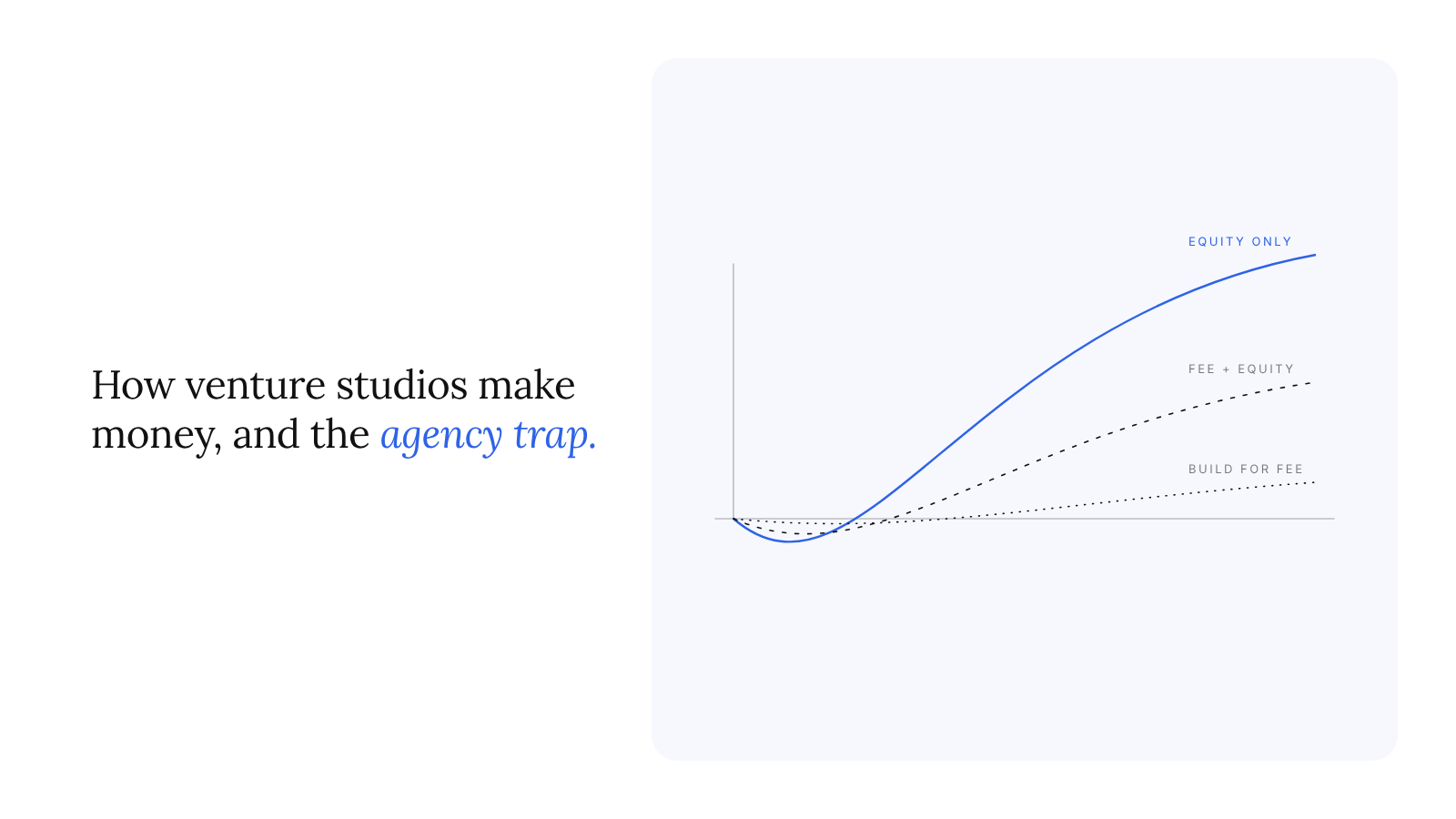
Studios have found three answers to the question of how venture studios make money. Some fund the entire build from their own or their investors' capital and live on equity alone. Some charge the companies they create, or outside parties, fees that partly cover the cost of building, and take a smaller stake in return. Some build companies for corporations that pay the full cost and keep most of the equity. These three models have very different cash curves, and the curves shape behaviour. A studio that must earn fees to survive this quarter will, over time, make different decisions from a studio whose only pay-day is an exit six years away. The industry calls the result "becoming an agency", and it is the single most common way a studio quietly stops being a studio.
This article sets out the three models with examples from published accounts of studios in the United States and Europe, compares their cash curves with an illustrative model whose assumptions are stated in full, and proposes a test for whether a studio has drifted from company-building into services.
The cost of building a company before it exists
Published figures on what studios spend are sparse but consistent. The Global Startup Studio Network's 2022 survey, as cited by the venture builder Ben Yoskovitz, put the median annual studio budget at 1.36 million dollars and the average at 2.49 million dollars; at 95 rupees to the dollar that is roughly 12.9 crore and 23.7 crore rupees a year. A 2020 Politecnico di Torino thesis drawing on GSSN's earlier data recorded average studio capital of about 232,000 dollars per startup and an average annual budget of about 2.27 million dollars. Hexa, the Paris studio formerly known as eFounders, told TechCrunch in 2022 that launching a company costs it around 800,000 euros. Yoskovitz's own estimate is that a studio needs at least one to two million dollars to get set up, and preferably five to ten million, with 18 to 24 months of operating runway costing 1.5 to 4 million dollars before any investment capital.
These are the costs of originating an idea, validating it, assembling a founding team, shipping a first product and standing up finance, legal and hiring. They are incurred before the company has a cap table that anyone outside the studio would pay for. The studio's problem is therefore not just that returns are back-loaded, as they are for any early-stage investor; it is that the studio carries the operating cost of a company on its own books until the moment the company can carry it alone, and does so for several companies at once.
Model one: equity only
In the pure form, the studio pays for everything and is compensated only through the shares it receives at incorporation. Where the money comes from varies. Atomic, the studio founded by Jack Abraham, began with about 10 million dollars largely from Abraham's own proceeds from an earlier exit and later raised outside capital, closing 260 million dollars in new commitments in 2021. Abraham described the structure to TechCrunch as "more of a fund context instead of a holding company", in which investors buy into Atomic itself rather than into individual companies, and declined to explain the economics further. Entrepreneur First raised 158 million dollars in 2022 at a valuation of about 560 million dollars on its own balance sheet, with roughly 100 million dollars earmarked for new investments through an evergreen fund and about a third for its own growth; TechCrunch noted that it charges no 2 per cent management fee.
High Alpha in Indianapolis is the clearest published example of the studio-plus-fund structure. In 2018 it raised 16.65 million dollars for High Alpha Studio II alongside 85 million dollars for a second High Alpha Capital fund that writes seed and Series A cheques, with Emergence Capital and Foundry Group as limited partners and both vehicles under the High Alpha LLC umbrella. The studio vehicle pays for company creation and takes the founding stake; the capital fund is a conventional venture fund, with conventional fund economics, that can invest in the studio's companies at priced rounds. The company has described itself as "a startup studio combined with a venture fund", and by 2020 its studio had spun up 24 companies that had raised 140 million dollars in follow-on funding, according to its managing director of corporate innovation.
The attraction of the equity-only model is alignment. The studio makes money only when its companies are worth something to someone else, so every internal decision, from which ideas to kill to how much to charge for shared services, is pulled toward venture value. The cost is a cash curve that stays negative for years and a reliance on patient capital, whether a founder's own fortune, a university endowment or a fund that accepts studio-style illiquidity. The GSSN data placed studio stakes at founding between 15 and 80 per cent, with averages reported variously at 34, 36 and about 40 per cent depending on the survey and the year, and the equity-only model sits at the upper end of that range because the studio is the only source of early capital.
Model two: fee plus equity
The second model charges somebody for part of the build. There are two variants. In the first, the studio charges its own portfolio companies for shared services, product work or a programme fee. Since a newly formed company has no revenue, that fee is paid from the company's first external capital, which means the studio is in effect recovering its cost from the seed investors who come in after it. Yoskovitz lists this among the three ways studios fund themselves and calls it, bluntly, "kick-backs". In the second variant, the studio runs paid work for third parties, such as research or product engagements for corporates, and uses the margin to subsidise company creation.
Hexa's published structure shows how a mature studio limits the fee dependence. It raised 22 million dollars in late 2023, mostly from its own community of founders and family offices, and for each startup creates a special purpose vehicle through which its investor club invests. Hexa itself aims to keep 30 per cent of each company after the seed round, falling to about 25 per cent when third-party investors participate, and allocates 5 to 10 per cent of its stake to the head of each studio and their team. Its chief executive acknowledged to TechCrunch that the deal "might seem a bit unfair" to founders, who "can potentially get a smaller portion of a bigger cake". The point for the present discussion is that Hexa's revenue is still equity; the capital that pays for the build comes from investors who want that equity, not from fees charged to the companies.
The fee-plus-equity model improves the cash curve. Some of the build cost comes back within a year or two instead of at exit. The trade is a smaller stake, since investors paying a fee to the studio will not also accept the studio holding 40 per cent, and a subtler change in incentives. Once the studio has a fee line, it has a reason to launch companies that can pay fees rather than companies that can become valuable, and it has a reason to keep providing services to companies that should have graduated.
Model three: build for fee
The third model is corporate venture building. A corporation pays the studio to build a company around a problem the corporation faces, and the corporation owns most of the resulting equity. High Alpha Innovation, launched in May 2020 as a separate business line from the High Alpha studio, is the best-documented example. Its managing director told TechCrunch that it works with corporate partners including Cummins, Allegion and Silicon Valley Bank, receives "a small amount of funding to run operations", and takes most of its compensation as an equity split with the corporate partner after founders and employees receive their allocation. He estimated that about 80 per cent of the ideas worked on become products or services inside the corporation and about 20 per cent become startups.
That last figure is the model's defining feature. Most of what a corporate venture builder does is not venture creation. It is innovation consulting that occasionally produces a company. The studio's cash curve is close to that of a professional services firm: positive from the first engagement, with margins set by negotiation rather than by exits. The equity it holds is smaller, in companies that often have a corporate majority owner, which limits their ability to raise outside capital at market terms and therefore limits the value of the studio's stake.
How venture studios make money under each model: an illustrative cash-curve comparison
The table below compares the three models for a single cohort of three companies over eight years. It is an illustration with stated assumptions, not data, and the outcome assumptions in particular are chosen for comparability rather than realism. Figures are in rupees crore. The assumptions are:
The studio spends 3 crore rupees per company (about 316,000 dollars at 95 rupees to the dollar, within the range of the published per-company and per-studio figures above) across years 0 and 1 to reach seed readiness. Each company creates a 10 per cent option pool before seed, then raises a seed round for 20 per cent, a Series A for 20 per cent and a Series B for 15 per cent, so a founding stake is multiplied by 0.9 × 0.8 × 0.8 × 0.85, or 0.49, by exit. Of the three companies, one fails and returns nothing, one is acquired in year 5 for 20 crore rupees, and one exits in year 7 for 150 crore rupees. The same outcomes are applied to all three models, which is generous to the build-for-fee model, where corporate-majority companies raise less often and exit smaller.
Under the equity-only model the studio takes 34 per cent at founding, the GSSN survey average reported by GeekWire, and charges nothing. Under fee-plus-equity it takes 20 per cent and charges each company 1 crore rupees in fees over years 0 and 1, paid from the company's seed capital. Under build-for-fee a corporate pays the studio 3.6 crore rupees per company (cost plus a 20 per cent margin) and the studio keeps a 10 per cent founding stake, diluted by the same factor.
| Year | Event | Equity only (34%) | Fee plus equity (20% + fees) | Build for fee (10% + margin) |
| 0 | Half of build cost; fees or corporate payments received | -4.5 | -3.0 | +0.9 |
| 1 | Build complete; seed rounds close | -9.0 | -6.0 | +1.8 |
| 2 to 4 | No cash events | -9.0 | -6.0 | +1.8 |
| 5 | Company two acquired for 20 crore | -5.7 | -4.0 | +2.8 |
| 7 | Company three exits for 150 crore | +19.3 | +10.7 | +10.1 |
| Studio stake at exit | 16.6% | 9.8% | 4.9% | |
| Gross receipts from equity | 28.3 | 16.7 | 8.3 | |
| Net cash deployed by studio | 9.0 | 6.0 | none | |
| Years of negative cumulative cash | 7 | 7 | 0 |
Three features of the table matter more than the specific numbers. First, the equity-only studio ends up with the most money, but has the deepest and longest trough, and in a cohort where the large exit does not happen it ends at -5.7 crore rupees with nothing to show for seven years. Second, the fee- plus-equity studio recovers a third of its build cost almost immediately and still has a positive outcome, but its final position is about 45 per cent lower; the fees it took were worth 3 crore rupees in year 1 and cost it 11.6 crore rupees of equity receipts in year 7. Third, the build-for-fee studio is never cash negative, and would show the best return on capital by any conventional measure, because it deployed no capital. Its final position is almost identical to the fee-plus-equity studio's in this generous scenario, and well below it under realistic corporate-venture outcomes.
The curves explain the drift. A studio that starts with model one and runs short of patient capital discovers that model two improves the next twelve months, and that model three removes the problem altogether. Each step is individually sensible. The cumulative effect is a firm whose revenue comes from building things for people who pay, whose stakes are small and in companies it does not control, and whose team is measured on utilisation rather than on exits.
The agency trap
The drift has a mechanism, and it is the same one that afflicts any firm with two business lines of which one pays this quarter and the other pays in year seven. Fee work has a client who calls, a deadline and an invoice. Venture work has none of these until an exit. When both compete for the same senior engineers, the client wins. When both compete for the chief executive's attention, the client wins. When the studio hires, it hires people who are good at delivering for clients, because that is what the current revenue requires, and those people are not necessarily the operators who can co-found a company. Within two or three years the studio's cost base has been shaped around fee work, its portfolio companies have been built by whoever was not billable, and the equity line has become a footnote in a services business.
Studios that have avoided this have done so by structure rather than by willpower. High Alpha separated its corporate venture-building line into a distinct business with its own leadership and kept the studio funded from a dedicated studio vehicle. Hexa raised capital from investors who wanted its equity and allocated part of the stake to the people running each studio, so that the operators are paid in the same instrument as the firm. Atomic and Entrepreneur First raised capital against the firm itself, accepting the governance that comes with it, rather than against individual engagements.
The design question for an Indian studio is sharper than in the United States because the sources of patient capital are fewer. Nasscom-Zinnov describes Indian deeptech capital in 2025 as "selective and milestone-linked", which is precisely the condition under which fee revenue looks most attractive and the trap is most tempting. A studio in India that chooses the equity-only model needs either a founder with their own capital, a parent company willing to fund building from its own revenue, or a fund structure that limited partners will accept. PanScience Innovations in New Delhi, for example, reports six shared in-house functions, including a shared pool of senior engineers, that work across its 24 or more co-founded ventures, and states that it commits capital at the idea stage and stays on the cap table after spin-out; it also runs a paid research unit. Whether a structure like that stays on the equity side of the line depends on how large the paid work is relative to the venture work and whether the two share a cost base, which is what the test below is designed to reveal. The company does not publish its equity range, so its position on the stake axis is not stated publicly.
A drift test
The following six questions can be asked of any studio, by an investor considering its fund, a founder considering joining, or the studio's own board. Each has an answer that indicates a company builder and an answer that indicates an agency with a portfolio.
| Question | Builder answer | Agency answer |
| What share of the studio's revenue in the last twelve months came from exits or secondary sales of its own equity, as opposed to fees of any kind? | Majority, or zero because the studio is young and funded by capital, not fees | Minority, and fees are growing faster than the portfolio |
| Who pays the fees, if there are fees? | Nobody; or a corporate partner for a separately staffed line | The studio's own portfolio companies, out of money raised from outside investors |
| How are senior engineers and operators allocated? | To ventures first, by the venture's needs; client work has its own team | By billability; the venture gets whoever is free |
| How is the studio's leadership compensated? | Carry or equity in the ventures | Salary and bonus tied to fee revenue or margin |
| What happened to the last three companies that reached Series A? | They left the shared services and hired their own teams; the studio stayed on the cap table only | They remain clients of the studio's services, paying fees from investor capital |
| What stake does the studio hold in companies launched in the last two years, and has it fallen? | Within the range the studio states publicly, and stable | Falling, as fees have been traded for equity |
A studio that gives the agency answer to three or more of these questions has drifted, whatever it calls itself. The test is not a judgement on the quality of its services, which may be excellent, but on whether its equity line still has a reason to exist. For founders, the practical consequence is that a studio in the agency state will leave them with the shared-services bill and little of the operator attention that justified the stake it took. For investors in the studio, it is that the firm's valuation should be that of a services business, not of a fund.
Conclusion
The three models are not a hierarchy. Build-for-fee studios do useful work for corporations that cannot build ventures internally, and fee-plus-equity structures have carried studios through periods when no other capital was available. But they are different businesses with different owners of the upside, and a studio should know which one it is running. The equity-only model has the worst cash curve and the best alignment; the build-for-fee model has the best cash curve and the least venture upside; the middle model is where most studios live, and where most drift begins. The only reliable protection is structural: capital that pays for building, a stake large enough to matter, operators paid in equity, and a wall between whatever client work exists and the people who co-found companies.
Methodology and sources
The cash-curve comparison is an illustrative model, not a dataset. Its assumptions are stated in the text: build cost of 3 crore rupees per company, a 10 per cent option pool and three rounds of 20, 20 and 15 per cent dilution (a cumulative factor of 0.49), founding stakes of 34, 20 and 10 per cent for the three models, fees of 1 crore rupees per company in the second model, a 20 per cent margin on a 3.6 crore rupee corporate payment in the third, and a fixed outcome set of one failure, one 20 crore rupee acquisition in year 5 and one 150 crore rupee exit in year 7. Changing the outcome set changes the magnitudes but not the ordering of trough depth and upside across the models. Currency conversions use 95 rupees to the dollar. The limitation is that the model applies the same outcomes to all three structures, which overstates the equity value of corporate-majority companies, and that it ignores follow-on investment by the studio, liquidation preferences and taxes. Studio stake ranges and budgets are drawn from industry-produced surveys that are self-reported and have not been independently verified.
Sources opened: Ben Yoskovitz, "Understanding Venture Studio Math", Focused Chaos, 17 October 2023 (https://www.focusedchaos.co/p/venture-studio-math); Francesco Tisci, "Evaluating the Impact of Startup Studios on Startup Performances", Politecnico di Torino, December 2020 (https://webthesis.biblio.polito.it/16456/1/tesi.pdf); GeekWire, 8 January 2021 (https://www.geekwire.com/2021/seattle-startup-studio-pioneer-square-labs-spun-25-ideas-5-years- way/); Nick Zasowski, Angel Capital Association blog, 19 February 2021 (https://angelcapitalassociation.org/blog/2021/2); TechCrunch, "Atomic just raised $260 million more to build and fund its own companies", 2 March 2021 (https://techcrunch.com/?p=2119979); TechCrunch, "Entrepreneur First raises $158M at a $560M valuation", 28 June 2022 (https://techcrunch.com/2022/06/28/entrepreneur-first-raises-158m-at-a-560m-valuation-adding- stripes-collison-brothers-to-its-list-of-backers); Crunchbase News, "Indianapolis-based High Alpha raises $100 million for second fund, re-vamped venture studio", 16 July 2018 (https://news.crunchbase.com/venture/indianapolis-based-high-alpha-raises-100-million-for-second- fund-re-vamped-venture-studio/); TechCrunch, "Indianapolis' venture studio High Alpha launches new business bringing studio model to corporations", 21 May 2020 (https://techcrunch.com/2020/05/21/indianapolis-venture-studio-high-alpha-launches-new-business- bringing-studio-model-to-corporations); High Alpha, "Why Venture Studios Are the Future of Company Building", 15 December 2020 (https://highalpha.com/why-venture-studios-are-the-future- of-company-building/); TechCrunch, "eFounders morphs into Hexa", 29 November 2022 (https://techcrunch.com/2022/11/29/efounders-morphs-into-hexa-a-portfolio-company-of-startup- studios); TechCrunch, "Paris-based startup studio Hexa raises some funding to launch even more startups", 27 November 2023 (https://techcrunch.com/2023/11/27/paris-based-startup-studio-hexa- raises-some-funding-to-launch-even-more-startups). Indian market condition from the Nasscom- Zinnov Indian Tech Start-up Report 2025 (press release, 25 February 2026). PanScience figures are company-reported from panscience.xyz, read 24 October 2026.