
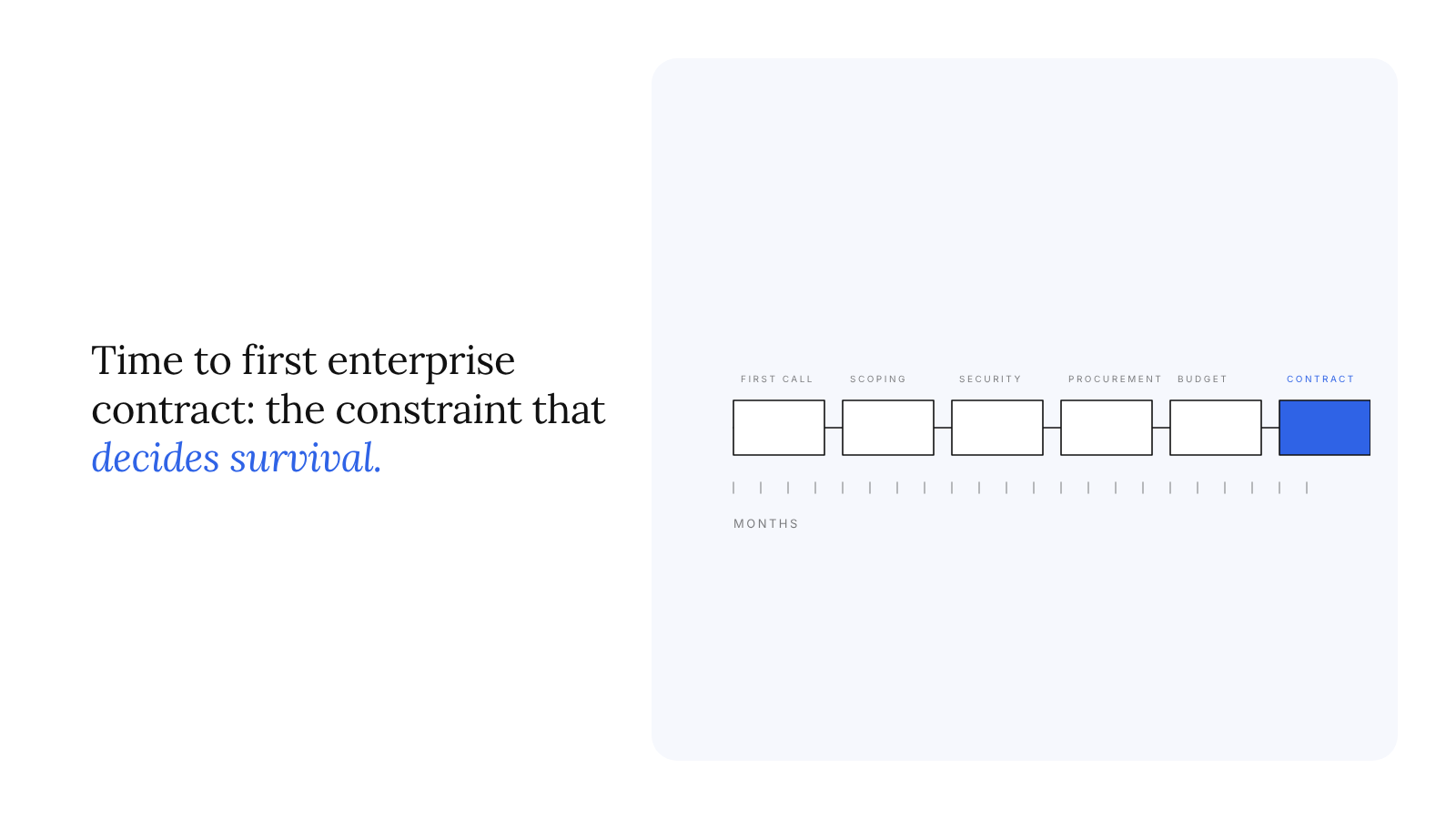
Ask the founder of an enterprise AI company in India what killed the ventures they have watched fail and the answer is rarely the model, the team or even the money. It is the calendar: the enterprise AI sales cycle in India. A first conversation with a bank, a hospital chain or a manufacturer in one quarter, a proof of concept in the next, a security review after that, a procurement process that spans a financial year end, and a signed contract, if it comes at all, fourteen or eighteen months after the first meeting. In the meantime the venture has paid salaries, built features for a buyer who has not committed, and watched its runway shorten by a figure it could have predicted on day one.
Capital does not fix this. A venture with thirty months of cash and an eighteen-month sales cycle has one shot at a first customer and no margin for slippage. A venture with twelve months of cash and the same cycle does not have a business. Nasscom and Zinnov's Indian Tech Start-up Report 2025 describes deeptech capital as selective and milestone-linked, and for an enterprise AI venture the milestone investors most want to see is the one that takes longest to reach. The binding constraint is not how much the venture has raised but how many months separate its first conversation from its first paid contract, and what can shorten them.
This article sets out the evidence on enterprise sales and procurement cycles, decomposes time-to- contract into its stages, and for each stage identifies the three things that reliably shorten it. The argument is that very little of the cycle responds to capital, a great deal responds to institutional relationships and shared compliance infrastructure, and this is why venture builders with both tend to put new companies into enterprises faster than new companies get there alone.
What the evidence says about the length of the cycle
The best available benchmarks are from vendors of sales and buying-intelligence tools, and should be read with that in mind, but they point the same way. 6sense's 2024 Buyer Experience Report, as reported by Demand Gen Report in October 2024, put the average B2B buying cycle at 11.3 months, the average buying group at eleven people, and found that buyers had completed nearly 70 per cent of their process before first contacting a vendor. Ebsta and Pavilion's 2023 B2B Sales Benchmark Report, drawn from 3.2 million opportunities across 364 companies, found that sales cycles lengthened by 32 per cent in 2022 and win rates fell 15 per cent; Ebsta's 2024 mid-year update reported cycles a further 20 per cent longer than in 2023. The 2023 report also found that enterprise deals won at an average rate of 42 per cent when the seller held ten to twelve relationships inside the account, and set the optimal closing window for larger deals at 150 to 180 days from opportunity creation, which is itself after the months of conversation that precede an opportunity being logged.
Gartner's research on the B2B buying journey describes why. Seventy-seven per cent of buyers call their most recent purchase very complex or difficult. A typical buying group for a complex solution has six to ten decision makers, each with four or five independently gathered pieces of information that must be reconciled. Gartner identifies six buying jobs, problem identification, solution exploration, requirements building, supplier selection, validation and consensus creation, which customers revisit at least once each, and during all of which sales representatives get around 5 per cent of the customer's time. None of this is a problem a venture can solve by hiring more salespeople.
For AI specifically the review burden has risen. G2's 2025 Buyer Behavior Report, a survey of 1,169 B2B decision makers fielded in April 2025, found that about eight in ten buyers face stricter requirements for AI software evaluations from IT security, legal and compliance teams, and that IT was involved in nearly half of purchase decisions. Deloitte's fourth-wave State of Generative AI in the Enterprise survey of 2,773 executives, released in January 2025, found regulatory compliance had become the primary obstacle to adoption, cited by 38 per cent of respondents and up from 28 per cent in the first wave, and that 69 per cent expected full implementation of their AI governance strategy to take more than a year. Vanta's State of Trust Report 2024, surveying 2,500 business and IT leaders, found that organisations spend eleven working weeks a year on compliance tasks and that 65 per cent say customers, investors and suppliers increasingly require demonstrated compliance.
There is a counter-current. Menlo Ventures' survey of about 500 United States enterprise decision makers in November 2025 found that 47 per cent of AI deals reach production against 25 per cent for traditional software, that 76 per cent of AI use cases were purchased rather than built, and that AI's immediate value lets it bypass standard procurement in some settings. But the same report notes that healthcare faces long procurement cycles and regulatory hurdles, and that regulated domains such as finance impose high accuracy requirements. The bypass is real for productivity tools bought by a department on a card. It is not available to a venture selling a system that touches a bank's customer data, a hospital's records or a court's case files.
For India, no published benchmark of enterprise AI sales cycles exists that this article could verify, and it would be wrong to invent one. The qualitative picture is that Indian regulated institutions sit at the longer end of the global range. The Reserve Bank of India's Master Direction on Outsourcing of IT Services, issued in April 2023 and effective for new arrangements from October 2023, requires regulated entities to conduct risk-based due diligence on service providers before contracting, to hold a board-approved outsourcing policy covering provider selection, risk assessment and exit, to secure audit and inspection rights for themselves and the RBI, and to require that data be stored only in India. Each requirement is sensible. Each adds a step, a function and a sign-off to the path from first meeting to contract.
A decomposition of the enterprise AI sales cycle in India
Time-to-contract is usually discussed as a single number. It is more useful to treat it as the sum of six stages, each with its own owner inside the buying institution, its own typical duration and its own reasons for delay. The decomposition below is this article's original contribution. The durations are indicative ranges for a first contract with an Indian enterprise or regulated institution, drawn from the benchmarks above and the author's reading of how Indian procurement operates; they are not measured and will vary widely by sector and buyer.
| Stage | What has to happen | Who owns it inside the buyer | Indicative duration for a first contract | Why it stalls |
| 1. Access | A conversation with someone who has the problem and the standing to pursue it | Operating leader | 1 to 4 months | Venture reaches the innovation cell, not the operation; no referral |
| 2. Problem validation | Agreement on what the problem is, what it costs and what good looks like | Operating leader and finance | 1 to 3 months | Buyer has a problem but no measure of it; no internal case |
| 3. Proof of concept | A demonstration on the buyer's data in a sandbox or against a historical set | Operating leader and IT | 2 to 4 months | Data access requires its own agreement; sandbox provisioning; scope creep |
| 4. Security and compliance review | Vendor due diligence, information security assessment, data protection review, regulatory mapping | CISO, legal, compliance, DPO | 2 to 6 months | Venture lacks certifications; questionnaire cycles; sector regulation requires board sign-off |
| 5. Procurement and commercial | Pricing, contract negotiation, empanelment or tender, vendor onboarding | Procurement and legal | 2 to 6 months | Tender rules; empanelment prerequisites; liability and IP terms; no precedent for an AI contract |
| 6. Budget | A funded line in an approved budget in the current financial year | CFO and business unit | 0 to 12 months | Budget cycle has passed; spend classified as capital rather than operating; approval thresholds |
Summed at the low end the stages take eight months; at the high end, nearly three years. The spread is itself the finding. A venture that cannot say which stage its prospect is in, who owns it and what will move it has no basis for forecasting its own survival.
Three features deserve comment. The stages are not strictly sequential: security review can begin during proof of concept and budget can be sought alongside procurement, but each stage has a gate the next cannot pass without, and institutions tend to run them in sequence because that is how their approval chains are built. The stage with the widest range, budget, is the one over which the venture has least control, since it depends on the buyer's financial calendar. And the two stages that most often kill the deal, security and procurement, are the ones where the venture is measured against a standard that has nothing to do with its product.
What shortens each stage
For each stage there are, in the author's analysis, three things that shorten it reliably. Some a venture can do alone. More require institutional relationships or shared compliance infrastructure the venture did not build itself. The table marks which is which.
| Stage | Shortener 1 | Shortener 2 | Shortener 3 |
| 1. Access | Warm introduction to the operating leader from a party the institution trusts (relationship) | Prior deployment at a peer institution the prospect can call (relationship) | Entry through a programme, sandbox or empanelment the institution already runs (infrastructure) |
| 2. Problem validation | Quantified problem statement from a peer deployment the buyer can adapt (relationship) | Diagnostic run on the buyer's own data in days, not months (venture) | Sponsor who runs the operation rather than the innovation function (relationship) |
| 3. Proof of concept | Pre-agreed data-sharing template the buyer's legal team has seen before (infrastructure) | Fixed scope with two or three success metrics agreed in writing (venture) | Deployment in a shared environment that already meets the buyer's security baseline (infrastructure) |
| 4. Security and compliance review | Certifications held at group level, such as ISO 27001 and SOC 2, with evidence packs ready (infrastructure) | Completed standard questionnaire and sector regulatory mapping prepared in advance (infrastructure) | Reference from a peer institution's CISO that the review has been done before (relationship) |
| 5. Procurement and commercial | Existing empanelment with the buyer or a central procurement body (infrastructure) | Contract template with liability, IP and data terms the buyer's peers have accepted (infrastructure) | Commercial structure, such as a paid pilot that converts, fitting a route procurement already allows (venture) |
| 6. Budget | Knowing the buyer's financial year and submitting the case before the cycle closes (venture) | Price and structure that fit operating rather than capital budget, below the board-approval threshold (venture) | Sponsor senior enough to find money mid-year, or a grant or mission programme that co-funds the first deployment (relationship) |
Count the eighteen shorteners by type. Six are things the venture can do alone through discipline. Seven are infrastructure: certifications, templates, questionnaires, environments, empanelments.
Five are relationships: introductions, peer references, operating sponsors, co-funding programmes. Twelve of eighteen are things a new venture does not have on its first day and cannot buy with its seed round. Capital funds the waiting. It does not shorten the wait.
Why shared infrastructure matters more than it looks
The infrastructure column is the least glamorous and the most leveraged. An ISO 27001 certification or a SOC 2 report takes a new company months to obtain and costs money it would rather spend on engineering, and the buyer's security function will not start its review until it exists. A data-sharing template a bank's legal team has already approved for one vendor will pass for a second in a fraction of the time. An empanelment with a public sector buyer or central procurement body is itself a multi-month process that, once held, removes stage five almost entirely for every subsequent sale into that buyer.
None of these is specific to a product. All can be held above any single venture and transferred to each new one. This is why venture builders in enterprise and regulated sectors invest in compliance infrastructure at group level. PanScience Innovations, the New Delhi venture studio, reports holding ISO 9001:2015, ISO 27001, ISO 45001:2018, GDPR alignment and an AICPA SOC attestation at studio level, alongside a shared legal function covering incorporation, compliance, IP and governance and an ecosystem it describes as ten or more government agencies and twenty-five or more corporates. These are company-reported and this article has no independent measure of how much they shorten any venture's cycle. But the logic is clear: a venture that inherits its security posture, contract templates and first introductions from a parent that has been through stages four and five many times starts its first sale around stage two, not stage one.
The relationships column works the same way. McKinsey's research on corporate and startup collaboration found that startups' satisfaction with corporate partners rose 93 per cent when the partner was highly committed and 86 per cent when top management was involved, and identified slow corporate processes such as quarterly budgeting as a principal cause of failure. A relationship that reaches the operating leader rather than the innovation cell, with a peer reference attached, converts the committed sponsor from something the venture must earn over months into something it starts with. HSBC Innovation Banking's guidance on lighthouse customers makes the same observation from the seller's side: local proof points shorten the cycle of needing references to win customers, and enterprise cycles in a new market without them can run twelve to twenty-four months.
What this means for founders, investors and builders
For founders, the instruction is to forecast time-to-contract by stage rather than by gut, to name the owner of each stage inside every prospect, and to treat the absence of infrastructure and relationships as the real gap rather than the absence of features. A venture that spends its first six months obtaining ISO 27001, preparing a sector regulatory mapping and securing one warm introduction to an operating leader has done more to shorten its first sale than one that spent the same six months on product.
For investors, the instruction is to ask the stage question at diligence. Where is each named prospect in the six stages, who owns the current stage, and what will move it? Fifteen conversations are worth less than two prospects in security review with certifications in hand and a budget line identified. Capital should be sized to the measured cycle, and the Nasscom-Zinnov description of milestone-linked capital cuts both ways: investors who link capital to a first contract should expect to fund the full cycle to reach it.
For builders, the instruction is to treat compliance infrastructure and institutional relationships as the studio's core asset rather than overhead, because they are what the studio contributes that a venture cannot replicate, and because they compound: every certification renewed, every template accepted, every empanelment held and every operating leader who has had a good experience shortens the cycle for the next venture.
Conclusion
Enterprise and institutional AI ventures do not usually die of a bad product. They die of a calendar they did not understand, in which the months between first conversation and first paid contract are consumed by access, validation, proof, security, procurement and budget, each owned by a different function in the buyer and each indifferent to the venture's runway. Global benchmarks put a complex B2B cycle at close to a year, and the Indian regulated context, with its board-approved outsourcing policies, data localisation and tender rules, sits at the longer end of that range.
Capital cannot shorten this. What shortens it is being introduced rather than cold, referenced rather than evaluated, certified rather than questioned, and arriving with a contract the buyer's lawyers have seen before. Those are assets a venture either inherits or spends its first year building. The decomposition offered here makes the choice visible, so that founders, investors and builders can decide which stages they will shorten and how, before the calendar decides for them.
Methodology and sources
The six-stage decomposition and the eighteen shorteners are the author's analytical framework. The indicative durations are informed judgements based on the published benchmarks cited and on how Indian enterprise and public procurement operates; they are not measured from a dataset, and no verified benchmark of Indian enterprise AI sales cycles was found. The classification of shorteners into venture, infrastructure and relationship categories is the author's and reasonable practitioners could reassign some cells. The global sales-cycle benchmarks come from vendors of sales and buyer-intelligence software and should be treated as directional; Gartner, Deloitte, G2, Vanta and Menlo figures are survey-based and self-reported by respondents.
Sources opened: Demand Gen Report on the 6sense 2024 Buyer Experience Report, 10 October 2024 (https://www.demandgenreport.com/industry-news/80-of-b2b-buyers-initiate-first-contact- once-theyre-70-through-their-buying-journey/48394); Ebsta and Pavilion, 2023 B2B Sales Benchmark Report (https://www.ebsta.com/wp-content/uploads/2023/02/2023-B2B-Sales- Benchmark-Report.pdf); Ebsta, 2024 B2B Sales Benchmarks H1 Update (https://ebsta.com/wp- content/uploads/2024/07/H1-Update-2024-B2B-Sales-Benchmarks.pdf); Gartner, The B2B Buying Journey (https://www.gartner.com/en/sales/insights/b2b-buying-journey); G2, "How AI is Redefining the Buyer Journey in 2025", 14 May 2025 (https://company.g2.com/news/buyer- behavior-in-2025); Technology Magazine on Deloitte's State of Generative AI in the Enterprise, fourth wave, 22 January 2025 (https://technologymagazine.com/articles/deloitte-davos-survey-gen- ai-projects-face-scale-hurdles); Vanta, State of Trust Report 2024 announcement, 23 October 2024 (https://www.vanta.com/resources/state-of-trust-report-2024-vantacon-agenda); Menlo Ventures, "2025: The State of Generative AI in the Enterprise", 9 December 2025 (https://menlovc.com/perspective/2025-the-state-of-generative-ai-in-the-enterprise/); Khaitan & Co summary of the RBI Master Direction on Outsourcing of IT Services, 2023 (https://khaitanco.com/thought-leaderships/RBI-Releases-Master-Direction-To-Regulate- Outsourcing-of-IT-Services); McKinsey & Company, "Collaborations between corporates and start- ups", 10 May 2021 (https://www.mckinsey.com/capabilities/strategy-and-corporate-finance/our- insights/collaborations-between-corporates-and-start-ups); HSBC Innovation Banking, "What is a lighthouse customer" (https://www.hsbcinnovationbanking.com/gb/en/resources/what-is-a- lighthouse-customer); Nasscom-Zinnov Indian Tech Start-up Report 2025, press release 25 February 2026 (zinnov.com). PanScience Innovations certifications, functions and ecosystem are company-reported from panscience.xyz, read 24 October 2026.