
Most new companies spend their first year looking for a problem someone will pay to have solved. A venture born inside an enterprise engagement starts with that problem already found, already funded and already attached to a person with authority to sign. The plant manager who cannot see why a line stops, the bank whose compliance team reads forty regulatory feeds by hand, the hospital group whose discharge summaries are typed twice: each is a paying problem before it is a product idea, and a venture built to solve it skips the most expensive search in the startup lifecycle.
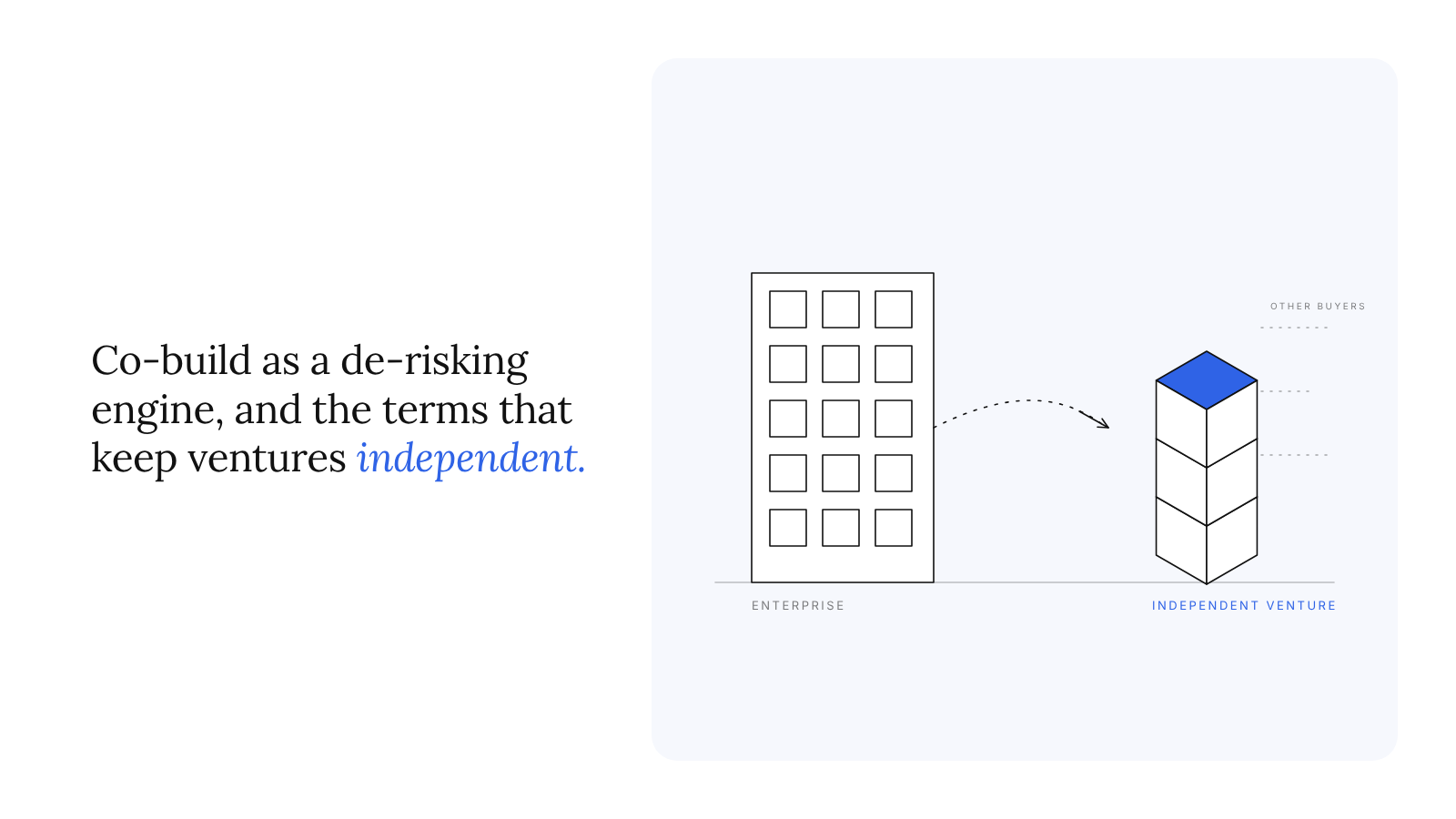
That is the promise of the co-build, a form of corporate venture building in India in which a venture builder and an enterprise jointly fund and shape a new company around a problem the enterprise has. The risk is the mirror image. A venture whose first customer is also its funder, its specifier and its largest shareholder can easily become that customer's outsourced engineering department, with a cap table and a brand but no independent commercial life. The difference between a co-built venture and a captive supplier is not the intention of either party. It is the terms.
This article draws on published management research on corporate venture building and corporate- startup collaboration to set out why co-builds de-risk, where they go wrong, and the contractual and structural terms that keep the venture independent. It closes with a Co-build Independence Terms table for use as a negotiating checklist.
The case for co-build
Enterprises want to build new ventures, and struggle to do it alone. McKinsey's fifth annual global survey on new-venture building, fielded in mid-2024 with 1,176 senior managers and C-suite executives, found that about half of CEOs regard venture building as a top-three strategic priority and about two-thirds expect to build new ventures in the coming year, more than expect to pursue joint ventures, acquisitions or organisational transformations. The difference between organisations that build well and those that do not is largely method: experienced builders are about twice as likely as novices to see ventures meet or exceed expectations, novices are three times more likely to build without product-market fit, and experts are more than three times likelier to use a formal framework for identifying, evaluating, building and launching.
BCG's account of its own corporate venturing practice, published in June 2022, describes a model that pairs a corporate asset such as customer data, billing relationships or distribution with a lean, startup-style development process, and reports a 66 per cent success rate across more than 200 ventures over roughly eight years, against the 20 to 30 per cent it attributes to venture capital and corporate venture capital. The figure is the firm's own, but its diagnosis of why corporates fail alone is widely shared: cultures and incentives that favour the existing business, slow and risk-averse governance with decision rights spread across many functions, legacy technology, and investment processes that judge progress against plan rather than against learning.
Put the two together and the logic of co-build appears. The enterprise has the problem, the data, the distribution and the budget, and lacks the method, the talent and the governance to build a company around them. An external builder has the method and the talent and lacks the problem and the first customer. A co-build combines them and removes the two largest early risks of any venture: that nobody has the problem, and that nobody will pay.
Where co-builds go wrong
McKinsey's 2021 research on corporate and startup collaboration found that only 28 per cent of startups were satisfied with their corporate partnerships. The reasons it lists are almost all governance failures rather than technical ones: weak internal sponsorship, projects treated as side initiatives, unclear objectives, slow corporate processes such as quarterly budgeting, pilots that never scale, and a lack of impact tracking. The same research found that the majority of corporate venture capital units stop investing after two to three years, which for a co-built venture means its sponsor's patience may run out before its product does.
Three failure modes recur in co-builds, and each maps to a missing term.
The first is the captive supplier. The enterprise specifies, the venture builds, the enterprise pays by the deliverable, and after two years the venture has an excellent system that serves one company's workflow, a revenue line that is entirely that company's budget, and no ability to sell elsewhere because the enterprise owns the IP or holds open-ended exclusivity. The venture is a services firm with a single client.
The second is the strategic hostage. The enterprise holds a controlling stake or a board majority, and when the venture's commercial interest diverges from the enterprise's, for example when the venture's best next customer is the enterprise's competitor, the enterprise uses its control to block the sale. The venture is independent in form and subordinate in fact.
The third is the project that never becomes a product. The engagement is priced as a statement of work with milestones, acceptance criteria and a fee that covers delivery plus a margin. No part of the price funds the generalisation, documentation, security hardening and support that make the output sellable to a second customer. The venture is paid for the project and has no product.
McKinsey's venture-building research addresses this in its recommendations: give new ventures more decision-making independence than feels comfortable, which experienced builders do twice as often as novices; support ventures when internal politics threaten them; and balance independence with access to core assets such as customers, brand and expertise. BCG's advice is parallel: small, senior investment committees; governance by milestones rather than status reports; real operating freedom from corporate processes; a named CEO early. The hard part is converting these principles into terms that survive the enterprise's legal review.
The terms that keep a venture independent
Five categories of term determine whether a co-build produces an independent company.
Intellectual property: venture owns, enterprise licenses back
The enterprise's instinct is to own what it paid for. The venture's survival depends on owning the product. The structure that reconciles them is venture ownership of all product IP, with the enterprise receiving a perpetual, royalty-free, non-transferable licence to use the product internally, and sometimes to receive improvements made on its data for a defined period. Where the enterprise contributes IP of its own, such as a dataset, a process or a domain model, that contribution is licensed in on terms that permit onward commercial use, with the enterprise retaining ownership. Joint ownership is avoided because under most legal systems it requires both parties' consent for any licence to a third party, which hands the enterprise a veto on every future sale.
Exclusivity: none, or a window with a defined end
The enterprise will often ask for exclusivity, on the reasonable ground that it is funding a product its competitors will benefit from. The venture cannot grant it indefinitely without ceasing to be a venture. The workable term is time-limited exclusivity, measured from first production deployment rather than signature, limited to named direct competitors in a named market, after which the venture may sell to anyone. Twelve months is common; longer windows should be priced, since the enterprise is purchasing a competitive advantage. A variant is a right of first refusal on new features rather than exclusivity on the product.
Right to sell to competitors after the window
This is the term enterprises find hardest and the one that most distinguishes a venture from a supplier. The product will be most valuable to the enterprise's peers, who have the same problem, and if the venture cannot sell to them it has no market. The term should be explicit: after the window, the venture may sell to any party, including competitors, with only the enterprise's confidential information and identifiable data protected. The enterprise's consolation is that the product is shaped to its workflow, it holds equity that benefits from every subsequent sale, and it has a head start.
Equity instead of control
The enterprise's contribution of problem, data, budget and distribution has value, and equity is the right instrument to recognise it. Control is not. The term that holds is a minority stake with information rights and possibly a board observer seat, but without board control, without veto rights over customers or pricing, and without rights that would make the venture a subsidiary for accounting or regulatory purposes. Where the enterprise's stake would otherwise be large, the structure can include a call option for the builder or venture to buy it down at a formula price, or conversion of part of the contribution into a commercial credit rather than shares. McKinsey's finding that experienced builders build in industries different from the core business nearly twice as often as novices is a reminder that the enterprise's strategic interest may be narrower than the venture's market, and control should not follow interest.
Pricing that funds a product, not a project
The engagement should be priced in two visible parts. The first is a commercial contract for the enterprise's own use, at a price that will become the reference for the next customer. The second is a product development contribution, structured as a non-recurring engineering fee, a prepayment against future licence fees, or the equity contribution above, which funds the generalisation, security, documentation and support a second customer will require. A single price for a single deliverable will be read by both finance functions as a project, and managed as one.
A practice example of corporate venture building in India
PanScience Innovations, the New Delhi venture studio, illustrates how a builder positions itself relative to enterprises. Its published model describes originating ideas in-house and co-founding ventures with the studio's own operators and capital, and it reports an ecosystem of twenty-five or more corporates whose role it labels as pilots and go-to-market co-creation. Its industrial AI venture PredCo, which works on predictive maintenance for manufacturing, is the kind of company whose first problem is almost always inside a plant rather than in a product brief. The studio's equity range is not stated publicly, and this article has no visibility of the terms on which any of its ventures work with enterprises. The company-reported point is only that the studio holds corporate relationships at group level and brings them to each venture, which is the position from which co-build terms can be negotiated with some leverage. A single new company negotiating with a large enterprise has none.
The Co-build Independence Terms table
The table below is this article's original contribution: a term sheet checklist for a co-build between a venture builder and an enterprise, listing each term, the position that protects independence, the enterprise's usual counter, and the compromise that most often holds. It assumes an enterprise that is both first customer and minority investor, and a builder that will hold a stake and operate shared functions. It is not legal advice; sector regulation, such as the Reserve Bank of India's Master Direction on Outsourcing of IT Services for regulated financial entities, will override several rows for buyers in those sectors.
| Term | Position that protects independence | Enterprise's usual counter | Compromise that tends to hold |
| Product IP ownership | Venture owns all product IP | Enterprise owns what it funded | Venture owns; enterprise gets perpetual, royalty-free internal licence |
| Enterprise- contributed IP and data | Licensed in, non- exclusive, permits onward commercial use | Cannot be reused | Enterprise retains ownership; venture gets non-exclusive licence to derived models and know-how, identifiable data excluded |
| Improvements made on enterprise data | Venture owns; enterprise receives them for a defined period | Enterprise owns | Venture owns; enterprise receives improvements for 12 to 24 months without charge |
| Exclusivity | None | Indefinite, product- wide | 6 to 12 months from first production use, limited to named direct competitors in a named market, priced if longer |
| Right to sell to competitors | Unrestricted after window | Never, or subject to consent | Unrestricted after window; enterprise's confidential information and identifiable data protected |
| Roadmap influence | Advisory | Approval rights over features | Right of first refusal on new features; no veto on direction |
| Enterprise equity | Minority stake below any control or consolidation threshold | Majority or blocking stake | Minority stake with information rights and board observer; no veto on customers, pricing or fundraising |
| Buy-down or conversion | Option to reduce enterprise stake at formula price | None | Call option at a defined milestone, or partial conversion of contribution to commercial credit |
| Pricing structure | Two visible components: commercial contract plus product development contribution | Single project fee per statement of work | Commercial licence at reference price; separate NRE fee, prepayment or equity for productisation |
| Reference price | Enterprise's licence price becomes the public reference | Deep discount as first customer | Discount expressed as a time- limited credit, not a lower list price |
| Sponsorship | Named operating sponsor with P&L responsibility | Innovation or digital unit | Innovation unit coordinates; operating head is sponsor of record |
| Decision cadence | Venture's own board and operating rhythm | Enterprise's quarterly cycle | Monthly steering between sponsor and venture CEO; enterprise budget cycle informs but does not gate |
| Second customer | Venture commits to a second customer within a defined period | Discouraged until enterprise deployment complete | Second customer engagement begins at first production deployment; enterprise informed, not consulted |
| Key personnel | Venture hires and manages its own team | Enterprise seconds and retains staff | Secondments for a fixed period with a conversion option; venture controls hiring |
| Use of enterprise brand | Joint announcement; anonymised reference earlier | No public reference | Case study on conversion; anonymised reference from first deployment |
| Termination | Either party on notice; licences and equity survive | Enterprise may terminate and reclaim IP | Thirty to ninety days' notice; enterprise keeps licence to deployed version; venture keeps IP; equity unaffected |
| Change of control | No enterprise veto on sale or fundraising | Right of first refusal or veto on sale | Notice and tag-along rights; no veto; optional pro rata participation in future rounds |
Three rows carry most of the weight. IP ownership decides whether there is a product. Exclusivity and the right to sell to competitors decide whether there is a market. Equity without control decides whether there is a company. The remaining rows stop the first three from being quietly undone over the life of the engagement.
The enterprise's side of the bargain
These terms are not a venture's wish list. The enterprise is contributing something real, and four arguments usually give it a reason to agree. The product it receives will be better and cheaper to maintain if it is sold to others, because the cost of security, documentation and support is spread across customers. Its equity stake converts every subsequent sale, including sales to competitors, into a return. Its head start, shaped to its workflow, is an advantage no competitor can buy for the length of the window. And a venture that becomes a captive supplier will eventually fail or be absorbed, leaving the enterprise with a system nobody else maintains. McKinsey's finding that most corporate venture capital units stop within three years is the strongest argument for independence from the enterprise's own point of view: the alternative is a system that depends on a budget line the enterprise's own history suggests will not last.
Conclusion
Co-build is a de-risking engine because it removes the two risks that kill most early ventures, the absence of a problem and the absence of a payer. It introduces a third, dependence on the party that supplied them, and that risk is managed entirely through terms. A venture that owns its product, can sell to its first customer's competitors after a defined window, gives its first customer equity rather than control, and is paid for a product rather than a project has a reasonable chance of becoming a company. One that concedes any of these has a reasonable chance of becoming a supplier.
The Co-build Independence Terms table is a starting point for the negotiation. It will not fit every case, and the enterprise's lawyers will have views on most rows. But a builder that walks in with it, and an enterprise that understands why its own interest is served by it, will spend their negotiating time on the terms that matter rather than discovering, two years in, that the venture was never going to be independent at all.
Methodology and sources
This article is an analytical synthesis rather than an empirical study. The Co-build Independence Terms table is the author's construction from published management research and general knowledge of venture and commercial contracting; it has not been validated against a sample of actual co-build agreements, which are almost never public, and the compromise column reflects the author's judgement of what tends to hold rather than a measured frequency. The BCG success rate is the firm's own figure for its own practice and is cited as such. The McKinsey surveys are of corporate executives and startups broadly, not of co-builds specifically, and their findings are applied here by analogy.
Sources opened: McKinsey & Company, "How CEOs are turning corporate venture building into outsize growth", 22 October 2024 (https://www.mckinsey.com/capabilities/mckinsey-digital/our- insights/how-ceos-are-turning-corporate-venture-building-into-outsize-growth); BCG, "A Proven Model for Corporate Venturing", 15 June 2022 (https://www.bcg.com/publications/2022/corporate- venturing-models); McKinsey & Company, "Collaborations between corporates and start-ups", Inside the Strategy Room, 10 May 2021 (https://www.mckinsey.com/capabilities/strategy-and- corporate-finance/our-insights/collaborations-between-corporates-and-start-ups); Khaitan & Co summary of the RBI Master Direction on Outsourcing of IT Services, 2023 (https://khaitanco.com/thought-leaderships/RBI-Releases-Master-Direction-To-Regulate- Outsourcing-of-IT-Services). PanScience Innovations descriptions of its model, ecosystem and PredCo are company-reported from panscience.xyz, read 24 October 2026; its equity range and co- build terms are not published.