
A venture studio that originates its own companies has one job a fund does not: deciding what should exist. A fund picks from the companies founders bring it. A studio picks from the companies nobody has yet built, and lives or dies by that choice. The best studio ideas are rarely the most exciting; they are the ones where a large institutional buyer already has a budget, a regulator is already forcing the buyer to act, and the vendors that should serve the buyer are absent, foreign, or built for a different decade.
India has an unusual number of such spaces, and together they define the AI startup opportunities in India in 2026. The state has spent five years building digital rails at a scale few countries attempt: a health data exchange with over a billion linked records, a court digitisation programme funded at ₹7,210 crore, a national AI mission with tens of thousands of subsidised GPUs, a mandatory sustainability disclosure regime for the thousand largest listed companies, and a production-linked incentive scheme that has drawn ₹2.4 lakh crore of manufacturing investment. Each rail creates demand for software that does not yet exist, and each is governed by rules that favour vendors who build for India rather than adapt a global product.
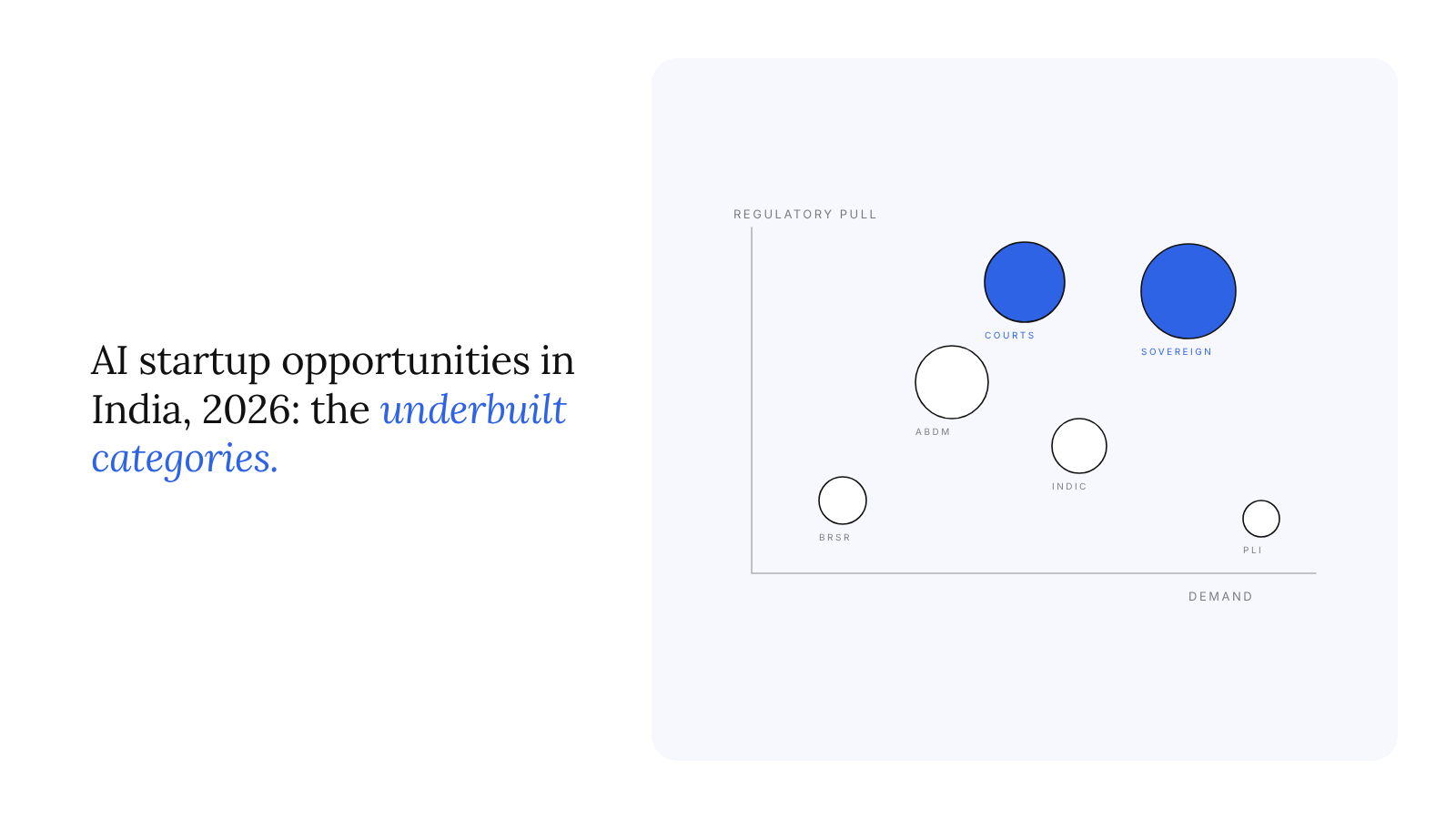
This article assesses six candidate categories against three criteria, demand signal, regulatory pull and incumbent gap, using only sources that could be opened, and scores them on an Underbuilt Category Map. The scores are qualitative and the reasoning is shown, so a reader who weighs the criteria differently can re-score them.
The three criteria
Demand signal asks whether there is an identifiable buyer with a budget, measured where possible by a public programme outlay, a disclosed spend forecast, or transaction volume on a live rail. Regulatory pull asks whether a rule, scheme or mandate obliges the buyer to act within a dated window; a deadline is stronger than an incentive, and an incentive is stronger than a guideline. Incumbent gap asks whether buyers' needs are currently met by global software vendors, large Indian IT services firms, or nobody; the gap is widest where the workflow is India-specific, the data cannot leave the country, or the language is not English.
A category can have enormous demand and no gap (global vendors already serve it), or a wide gap and no pull (nobody is obliged to buy). Studios are drawn to the second kind, and that is usually a mistake.
Category one: Indic-language systems
Demand signal. The IndiaAI Mission was approved in March 2024 with an outlay of ₹10,371.92 crore over five years. A Press Information Bureau backgrounder for the India AI Impact Summit of February 2026 reports more than 38,000 high-end GPUs onboarded at ₹65 per hour, which the government describes as roughly a third of the global average, plus 1,050 TPUs. The AIKosh platform held 7,541 datasets and 273 AI models across 20 sectors as of February 2026. Twelve startups and consortia were selected from more than 500 proposals across the first two phases of the foundation model programme, including Sarvam AI, Soket AI, Gnani AI and the IIT Bombay-led BharatGen, to build multimodal models trained on Indian data and languages. The demand is for everything between a subsidised foundation model and a working product: speech and text pipelines, evaluation, domain fine-tuning, and deployment into government and enterprise workflows that run in Hindi, Tamil, Bengali or Marathi rather than English.
Regulatory pull. Moderate. The Mission is an incentive, not a mandate; nothing obliges a bank or a state department to deploy an Indic-language system by a given date. The pull is indirect: subsidised compute lowers the cost of building, and government procurement increasingly expects multilingual delivery.
Incumbent gap. Wide at the application layer, narrower at the model layer, where global vendors cover major Indian languages with varying quality and the Mission-funded models will compete. What is missing is the operational stack: domain-tuned models for institutional workflows, annotation and evaluation in low-resource languages, and the integration that turns a model into a service a district hospital or a state treasury can run.
Category two: judiciary workflow
Demand signal. The Minister of State for Law and Justice told the Lok Sabha on 13 February 2026 that, as of 31 December 2025, 4,76,57,328 cases were pending in district and subordinate courts, 63,66,023 in the 25 High Courts, and 92,101 in the Supreme Court, per the National Judicial Data Grid: more than 5.4 crore in all. The system is already heavily digitised. A PIB backgrounder from December 2024 records 18,735 district and subordinate courts computerised under Phase II, over 27.64 crore orders and judgments on the NJDG, 3.38 crore video-conference hearings in district and High Courts to October 2024, and over 6 crore traffic challan cases handled by virtual courts in 21 states and union territories. The data exists, it is structured, and the backlog is the demand.
Regulatory pull. Strong, and dated. The Union Cabinet approved eCourts Phase III on 13 September 2023 with an outlay of ₹7,210 crore over four years, implemented by the Department of Justice and the Supreme Court's eCommittee through the High Courts. The approved cost breakdown allocates ₹2,038.40 crore to scanning, digitisation and preservation of case records, ₹1,205.23 crore to cloud infrastructure, ₹413.08 crore to 1,150 virtual courts, ₹215.97 crore to e- Filing, ₹243.52 crore to system and application software, and ₹33 crore to judicial process re- engineering. The release names AI, machine learning, OCR and NLP among the technologies for a "smart" ecosystem and expects AI tools to reduce registry data entry and file scrutiny, support scheduling and help predict case flow. A four-year scheme approved in 2023 means procurement decisions are being made now.
Incumbent gap. Wide. Court workflow in India is procedurally specific, runs in multiple languages and involves documents no global legal-tech product was built to parse. The buyers are High Courts and the eCommittee, not law firms, so the global legal AI vendors that serve corporate counsel are structurally absent. PanScience reports that its venture Nyaay AI, a judicial workflow company, works with 14 or more Indian High Courts and three national supreme courts; the company-reported figure illustrates only that the buyer exists and procures, not market size.
Category three: health rails
Demand signal. The Ayushman Bharat Digital Mission, launched in September 2021, had created over 93 crore ABHA accounts and linked over 104 crore health records by July 2026, per a PIB backgrounder dated 6 July 2026, with over 23.21 crore ABHA-linked queue tokens issued through Scan and Share as of 18 June 2026. The Health Facility Registry held about 2.35 lakh verified facilities and the Healthcare Professionals Registry over 2.84 lakh professionals as of February 2024, per a PIB factsheet. The Digital Health Incentive Scheme had paid over ₹107 crore to hospitals and over ₹26 crore to digital solution companies by June 2026. A rail with a billion linked records, a live incentive for software vendors and a registry of two lakh facilities is a demand signal by any definition.
Regulatory pull. Moderate to strong. ABDM compliance is not legally mandatory for private providers, but the incentive scheme pays for it, public hospitals are expected to adopt it, and the DPDP Rules notified on 14 November 2025 impose security, breach notification and retention obligations on anyone holding personal data, with an 18-month phased window. Health data is the obvious candidate for the restricted categories that the Rules allow the government to notify for local storage by Significant Data Fiduciaries.
Incumbent gap. Mixed. Hospital information systems exist in India, from large IT services firms and a long tail of local vendors. The gap is in the AI layer on the rail: clinical documentation in Indian languages, consent-managed analytics across the ABDM exchange, and tools that let the 2,200-plus small clinics on eSushrut@Clinic use their own data. Global health AI vendors are built for English-language records and other countries' interoperability profiles; ABDM has its own profiles and consent architecture.
Category four: industrial vision and quality in manufacturing
Demand signal. The Minister of State for Commerce and Industry told the Lok Sabha on 21 July 2026 that the production-linked incentive schemes across 14 sectors had attracted actual investment of over ₹2.40 lakh crore and generated over 14.15 lakh direct and indirect jobs as of 31 March 2026, against an approved outlay of ₹1.91 lakh crore, led by solar PV modules (₹64,873 crore), pharmaceuticals (₹45,158 crore), automobiles and components (₹44,326 crore), specialty steel (₹23,896 crore) and large-scale electronics (₹20,580 crore). Every one is a sector where quality is inspected visually and where the plants are new, built with cameras and networked machines. Gartner's November 2025 forecast puts Indian software spending at $24.7 billion in 2026, up 17.6%, and data centre systems at $9.4 billion, up 20.5%, the fastest-growing segment, attributed to AI infrastructure investment.
Regulatory pull. Weak to moderate. PLI pays for output, not for quality systems; the pull is commercial (export customers' quality requirements) rather than regulatory. Sector standards in pharmaceuticals and automotive impose inspection requirements but do not mandate AI.
Incumbent gap. Moderate. Global machine-vision vendors serve the large automotive and electronics plants. The gap is the middle of the market: mid-sized PLI beneficiaries in steel, solar, food processing and pharmaceuticals that cannot afford a global vendor's integration bill and need systems that run on-premise with intermittent connectivity. PanScience reports PredCo, an industrial AI venture focused on predictive maintenance, in its portfolio; it is cited only as a company-reported example of a studio bet in this category.
Category five: sovereign and on-premise inference for regulated sectors
Demand signal. Indian financial institutions are large buyers of AI software and are constrained in where it can run. Gartner's forecast of $176.3 billion in Indian IT spending for 2026, with data centre systems the fastest-growing line, is the broadest signal that infrastructure is being bought locally. Demand for on-premise and sovereign inference is a function of the rules below.
Regulatory pull. Strong, layered and dated. The Reserve Bank of India's circular of 6 April 2018 on storage of payment system data requires that the entire payment data, including end-to-end transaction details, be stored only in systems located in India; processing abroad is permitted but data must be deleted from overseas systems and brought back within one business day or 24 hours, whichever is earlier. It applies to all RBI-authorised payment system providers and, through their participation in RTGS, NEFT, NPCI and card schemes, to all banks operating in India. SEBI's Framework for Adoption of Cloud Services, circular of 6 March 2023, requires exchanges, clearing corporations, depositories, brokers, depository participants, asset managers, registrars and KYC agencies to store and process data only in data centres of MeitY-empanelled cloud providers with valid audit status, with a 12-month compliance window for existing cloud users. The DPDP Rules 2025, notified 14 November 2025, allow the government to notify categories of personal data that Significant Data Fiduciaries must store locally and to restrict transfers to particular foreign states and entities, with core obligations taking effect 18 months after publication. A regulated entity that wants to run a large language model over customer data must run it in India, on empanelled or on- premise infrastructure, with audit trails and, increasingly, a documented impact assessment.
Incumbent gap. Wide and structural. The hyperscalers offer Indian regions, but a regulated entity's compliance team must still prove that no inference call, log or embedding leaves the country and that the provider is MeitY-empanelled. Global AI vendors' default architectures route through overseas endpoints. The gap is for inference gateways, on-premise RAG and agent platforms, and model-serving stacks designed from the start for a compliance officer rather than a developer. PanScience reports two ventures in this space, Eigen (on-premise AI) and Insituate AI (on-premise RAG and agents); those are company-reported placements, not evidence of market size.
Category six: emissions and compliance reporting
Demand signal. SEBI's circular of 12 July 2023 established the BRSR Core, a set of key performance indicators under nine ESG attributes, with a glide path for reasonable assurance by the top listed entities by market capitalisation: top 150 in FY2023-24, top 250 in FY2024-25, top 500 in FY2025-26 and top 1,000 in FY2026-27. The same circular introduced value chain disclosures covering upstream and downstream partners making up 75% of purchases and sales by value. SEBI's board decisions of 18 December 2024, summarised by KPMG, replaced "assurance" with "assessment or assurance", deferred value chain disclosures to FY2025-26 and their assessment or assurance to FY2026-27, made value chain disclosure voluntary, and set the partner threshold at 2% of purchases or sales by value. The demand is a thousand companies that must, in the financial year beginning April 2026, produce assessed or assured ESG data, plus a much larger number of suppliers who will be asked for it.
Regulatory pull. Strong and dated, with a caveat. The top-1,000 requirement in FY2026-27 is a hard deadline. The December 2024 changes softened the value chain requirements, which reduces the pull on suppliers, but the requirement on the listed entities themselves was retained.
Incumbent gap. Moderate. Global ESG software vendors serve the largest Indian listed companies, and large audit networks provide assurance. The gap is for companies ranked roughly 300 to 1,000 by market capitalisation, which must now obtain assurance on an India-specific framework, and for the supplier tier that will be asked for data in a format they have never produced. The conflict-of- interest rule in the 2023 circular, which bars the assurance provider from also selling the entity consulting or non-audit services, separates the firms that assure from the tools that prepare, which is where software sits.
The Underbuilt Category Map of AI startup opportunities in India in 2026
The table scores each category on the three criteria from the evidence above, as high, medium or low with a one-line reason. The final column is a qualitative reading, not a sum, because the criteria interact: a hard deadline with a wide gap is worth more than its parts, and a wide gap with no buyer is worth less.
| Category | Demand signal | Regulatory pull | Incumbent gap | Overall reading |
| Indic- language systems | High: ₹10,371.92 crore Mission, 38,000+ GPUs, 7,541 AIKosh datasets, 12 funded model projects | Medium: incentive, not mandate; no dated obligation on buyers | High at application layer; medium at model layer, where funded consortia and global vendors compete | Strong for application-layer builders; crowded at the base model layer |
| Judiciary workflow | High: over 5.4 crore pending cases; 27.64 crore orders on NJDG; 6 crore virtual court cases | High: ₹7,210 crore Phase III approved 2023 over four years, with named AI, OCR and NLP use cases | High: procedurally India-specific; buyers are courts, not firms; global legal AI absent | Among the strongest; constraint is government procurement cycles |
| Health rails | High: 93 crore ABHA, 104 crore linked records, 23.21 crore tokens, live vendor incentive | Medium to high: DHIS incentive; DPDP obligations with 18-month window; likely local- storage category | Medium: HIS vendors exist; gap is AI on the ABDM exchange and Indian-language clinical tools | Strong, with a trust and procurement barrier that favours patient builders |
| Industrial vision and quality | High: ₹2.40 lakh crore PLI investment across 14 sectors; software spend up 17.6% | Low to medium: PLI rewards output; quality standards are commercial, not AI mandates | Medium: global vision vendors serve large plants; gap is mid-market and on- premise | Moderate; demand- led rather than regulation-led, so sales cycles depend on plant economics |
| Sovereign and on- premise inference | High: $176.3B IT spend, data centre systems fastest-growing; every regulated entity is a buyer | High: RBI 2018 localisation, SEBI 2023 cloud framework, DPDP Rules 2025 with 18-month window | High: global vendor defaults route offshore; empanelment and audit trail are structural barriers | Strongest on the map; the gap is created by rules that will not be relaxed |
| Emissions and compliance reporting | High: top 1,000 listed companies need assured BRSR Core data from FY2026-27 | High but softened: assurance deadline retained; value chain made voluntary in Dec 2024 | Medium: global ESG vendors serve the top tier; gap is ranks 300 to 1,000 and the supplier tier | Strong but time- bound; once the top 1,000 are served, growth depends on value chain rules tightening again |
Two categories stand out. Sovereign and on-premise inference scores high on all three criteria because its gap is manufactured by regulation that covers the entire financial sector and is layered across two regulators and a statute. It is also where a shared engineering pool has the most to reuse: an inference gateway built for one bank is substantially the same product for a depository or an insurer. Judiciary workflow scores nearly as high, with a single large buyer, a funded four-year programme and no credible foreign competitor, offset by slow and unpredictable court procurement.
Two categories deserve more caution: industrial vision, where demand is real but no regulator forces the buyer's hand and global vendors serve the top of the market, and emissions reporting, where the deadline is hard but the December 2024 softening shows the frontier can move backwards.
How a studio should read this map
A map like this is a prior, not a decision. Three further tests apply before a studio commits a validation team.
The first is whether the gap is in software or in procurement. Judiciary workflow and health rails both have identifiable buyers and wide gaps, but the buyers are public institutions whose purchasing is slow, tender-driven and frequently reset. A court-workflow company needs a balance sheet that survives two or three procurement cycles, which is a different capital plan from selling an inference gateway to a private bank facing a compliance deadline.
The second is whether the regulatory pull is stable. In 18 months SEBI moved from mandatory value chain assurance to voluntary disclosure. A studio building for a rule should ask what the rule would look like after successful industry lobbying, and whether the product survives that version. The RBI payment data rule has held since 2018 and is a safer foundation than a requirement that has already been diluted once.
The third is whether the category rewards a studio's specific advantages: a shared team that has built the same kind of thing before, and capital committed at idea zero. That edge is largest where products are structurally similar across buyers (inference infrastructure, document pipelines) and smallest where every deployment is bespoke. PanScience's published model, in which in-house teams ship the first product in months 1 to 12 before spin-out from month 18, is a company-reported example of the structure; whether it fits a category depends on whether month 12 is enough time to reach a buyer who will pay.
Conclusion
The categories where an originated AI company in India can earn its keep in 2026 are not the ones with the most hype. They are the ones where the state has built a rail, a regulator has set a date, and the vendors who should serve the buyer are built for somewhere else. On evidence that can be opened and verified, sovereign and on-premise inference and judiciary workflow score highest; health rails and Indic-language application systems are close behind with higher procurement risk; industrial vision is demand-led but unforced; and emissions reporting is strong but exposed to a regulator that has already relaxed once.
A studio originating in the first two categories is betting on rules that have held for years and buyers that cannot opt out. One originating in the last two is betting on commercial demand and on regulation continuing to tighten. Both are legitimate. The map does not make the choice; it shows what the choice is.
Methodology and sources
Each category was assessed against three criteria (demand signal, regulatory pull, incumbent gap) using only pages that could be opened. Demand signals come from government outlays, parliamentary replies, live programme statistics and a Gartner forecast; regulatory pull from primary circulars, rules and cabinet approvals or, where the primary PDF was not retrievable, from a professional-services summary; the incumbent gap is a qualitative judgement about whether global or large domestic vendors already serve the buyer, and is the least evidenced criterion because vendor market shares in these categories are not published. Scores are high, medium or low and are not weighted or summed. Limitations: PLI and court pendency figures come from press coverage of parliamentary replies rather than the Lok Sabha record; the SEBI cloud framework and December 2024 BRSR changes were read via Taxmann and KPMG summaries because the SEBI pages opened returned only header information; ABDM registry counts (facilities and professionals) are from February 2024 and will have grown since. PanScience venture names are company- reported from panscience.xyz, read 24 October 2026; nothing is stated about its stealth ventures beyond the three category labels the company publishes (agentic ops, protein design, emissions AI).
Sources opened: Press Information Bureau backgrounder on the IndiaAI Mission and India AI Impact Summit, February 2026 (https://static.pib.gov.in/WriteReadData/specificdocs/documents/2026/feb/doc2026210784401.pdf); PIB, "Cabinet approves eCourts Phase III", 13 September 2023 (https://pib.gov.in/PressReleasePage.aspx?PRID=1956919); PIB backgrounder on eCourts, 17 December 2024 (https://static.pib.gov.in/WriteReadData/specificdocs/documents/2024/dec/doc20241217473201.pdf); IANS, Lok Sabha reply on court pendency, 13 February 2026 (https://ianslive.in/over-476-crore- cases-pending-across-indian-courts-govt-tells-parliament--20260213184542); PIB backgrounder on ABDM, 6 July 2026 (https://static.pib.gov.in/WriteReadData/specificdocs/documents/2026/jul/doc202676912801.pdf); PIB factsheet on ABDM, data as of 29 February 2024 (https://www.pib.gov.in/FactsheetDetails.aspx?Id=149066); Morung Express, Lok Sabha reply on PLI schemes, 21 July 2026 (https://morungexpress.com/pli-schemes-attract-rs-24-lakh-crore- investment-create-1415-lakh-jobs-govt); Gartner, "Gartner Forecasts India IT Spending to Exceed $176 Billion in 2026", 18 November 2025 (https://www.gartner.com/en/newsroom/press- releases/2025-11-18-gartner-forecasts-india-it-spending-to-exceed-176-billion-us-dollars-in-2026); Reserve Bank of India, FAQ on Storage of Payment System Data, circular of 6 April 2018 (https://www.rbi.org.in/Scripts/FAQDisplay.aspx?Id=130); SEBI, Framework for Adoption of Cloud Services by SEBI Regulated Entities, 6 March 2023 (https://www.sebi.gov.in/legal/circulars/mar-2023/framework-for-adoption-of-cloud-services-by- sebi-regulated-entities-res-_68740.html), with content via Taxmann (https://www.taxmann.com/post/blog/sebi-introduces-framework-for-adoption-of-cloud-services- by-regulated-entities/); PIB backgrounder on the DPDP Rules 2025, November 2025 (https://static.pib.gov.in/WriteReadData/specificdocs/documents/2025/nov/doc20251117695301.pdf); Storyboard18 on the DPDP Rules phased rollout, 14 November 2025 (https://www.storyboard18.com/digital/breaking-govt-notifies-final-dpdp-rules-sets-staggered- rollout-with-key-obligations-for-data-fiduciaries-84201.htm); SEBI circular on BRSR Core, 12 July 2023, via NSE archive (https://nsearchives.nseindia.com/web/sites/default/files/inline- files/SEBI_Circular_12072023.pdf); KPMG First Notes on SEBI's December 2024 BRSR changes, 23 December 2024 (https://assets.kpmg.com/content/dam/kpmgsites/in/pdf/2025/01/firstnotes-sebi- introduces-certain-key-changes-in-brsr-reporting.pdf.coredownload.inline.pdf).