
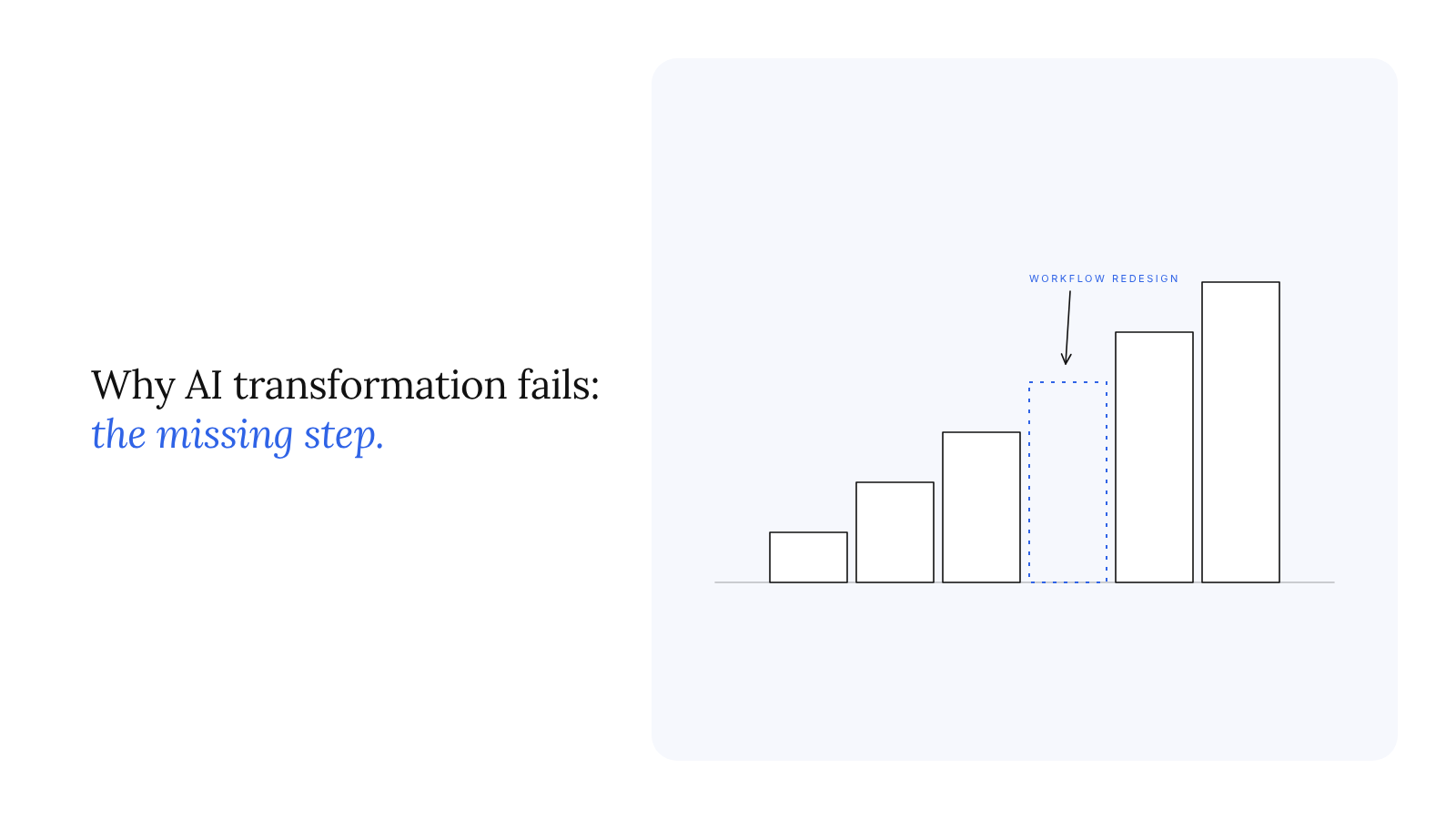
The two most cited numbers in enterprise AI this year point in opposite directions, and both are true. McKinsey's 2025 global survey finds that 88% of organisations now use AI regularly in at least one business function, up from 78% a year earlier. The same survey finds that only 39% attribute any EBIT impact to AI, most of them under 5% of EBIT, and that nearly two-thirds have not begun scaling AI across the enterprise (mckinsey.com, The state of AI in 2025). Adoption is nearly universal; transformation is rare. The gap between the two is where AI transformation challenges live.
That gap is not well explained by the usual list of obstacles. Data quality, talent shortages and legacy systems are real, but they were real for digital transformation too, and they do not explain why organisations with similar data, similar talent and similar systems end up in such different places. What explains it, on the evidence of the two large surveys examined here, is a small number of recurring patterns in how organisations decide, allocate, measure and govern. This article sets out five of them as a taxonomy of failure modes, each with the early signals a leadership team can observe before the failure is visible in the results.
The taxonomy is an analytical construction, not a survey finding. It is built by reading the McKinsey survey alongside BCG's 2024 study of 1,000 executives in 59 countries, which found that 74% of companies had yet to show tangible value from AI (bcg.com, press release, 24 October 2024), and asking what the organisations that did show value had done differently. Where the surveys are silent, the article says so.
What the surveys actually measure about AI transformation challenges
Before the taxonomy, a note on what the two studies can and cannot support. McKinsey surveyed 1,993 participants in 105 nations between 25 June and 29 July 2025 and defines "high performers" as the roughly 6% of respondents who attribute 5% or more of EBIT to AI. BCG surveyed 1,000 CxOs and senior executives across 20 sectors and 59 countries and classified 26% as "leaders": 4% with cutting-edge capabilities across functions, and a further 22% with an AI strategy and advanced capabilities beginning to see substantial gains. Both are self-reported. Both compare a successful minority to the rest and report the differences, which is suggestive of what matters but cannot prove causation. The failure modes below are therefore framed as patterns associated with the absence of value, not as proven causes.
A third study, MIT NANDA's "The GenAI Divide" (August 2025), is widely quoted for its finding that about 95% of enterprise generative AI pilots deliver no measurable P&L impact. Its methodology has been criticised, and it is noted here as a signal that the direction of the McKinsey and BCG findings is widely corroborated, not as a precise estimate.
The five failure modes
The table summarises the taxonomy. Each mode is then examined in turn.
Failure mode one: use-case sprawl without redesign
The most common shape of a stalled AI programme is a portfolio of thirty pilots, each attached to a process that otherwise runs as it did before. The pilot summarises a document the analyst still reads in full; it drafts an email the manager still rewrites; it flags a transaction the team still reviews by hand. Each pilot is individually defensible and collectively they change nothing, because the process around them has not been redesigned to depend on them.
McKinsey's finding on this point is the strongest in its survey. High performers are "nearly three times as likely as others are to fundamentally redesign their workflows", and workflow redesign is among the strongest contributors to meaningful business impact of all the factors tested. BCG's finding is the complement: leaders pursue about half as many opportunities as others, scale more than twice as many AI products and services, and expect more than twice the return. Fewer bets, redesigned around the capability, scaled further.
The early signal is a ratio. If the number of AI use cases in flight is growing faster than the number of workflows that have been redesigned end to end, the organisation is sprawling. A separate PanScience Research piece on why AI pilots rarely become products examines the pilot-to-production gap in detail; the point here is narrower. Sprawl is not a pilot problem. It is a decision to add rather than to change, and it is usually made because changing a workflow requires an owner with authority over the whole of it, while adding a pilot requires only a budget.
Failure mode two: technology-first allocation
BCG's 2024 study puts a number on where AI difficulties actually arise: roughly 70% of the challenges companies face are people and process related, 20% are technology related and 10% involve the algorithms themselves. Its prescription follows from the diagnosis, the "70-20-10 principle", under which leaders allocate about 70% of resources to people and processes, 20% to technology and data and 10% to algorithms. The study's own language is blunt: "Too many lagging companies make the mistake of prioritizing the technical issues over the human ones."
In practice, technology-first allocation looks like a procurement exercise. The organisation evaluates models, selects a platform, negotiates licences and stands up infrastructure, and then discovers that nobody has been given the time, the training or the mandate to change how work is done. The budget line for change management, if it exists, is the first to be cut when the platform costs overrun.
The early signal is the shape of the budget. An AI programme in which the technology lines account for the large majority of spend, and in which training, process design, role redesign and adoption support are a residual, is allocated in the inverse of the proportion the evidence recommends. It is worth noting that this is also the allocation most natural for an IT-led programme, which is one reason the question of where AI sits in the organisation matters; a separate PanScience Research piece on AI operating models covers that question.
Failure mode three: value measured nowhere
Eighty percent of McKinsey's respondents say efficiency is an objective of their AI programme. Thirty-nine percent report any EBIT impact at the enterprise level. The distance between those two numbers is the third failure mode: value that is asserted in the business case and never located in the accounts.
The mechanism is familiar from earlier technology cycles. Efficiency gains are claimed in hours saved; hours saved are not the same as cost removed, because the people whose hours were saved remain employed and the work that fills the freed hours is rarely measured. Revenue effects are harder still to isolate. The result is a programme that can show activity, satisfaction scores and anecdotes, and cannot show a line in the P&L.
High performers in McKinsey's data differ here in two ways. They are more likely to set growth or innovation goals alongside efficiency, which forces a revenue measurement rather than a time-saved one. And more than a third commit more than 20% of their digital budgets to AI, a level of spend that is difficult to sustain without a measured return.
The early signal is the absence of a baseline. If, for the workflows under automation, nobody can state the cost per transaction before AI and the fully loaded cost per transaction after it, the programme has no instrument with which to find value. A separate PanScience Research piece on AI deployment economics sets out such a model; its relevance to this failure mode is that a unit-cost baseline is the minimum measurement an AI programme needs, and most programmes do not have one.
Failure mode four: governance that trails deployment
McKinsey's 2025 survey finds that 51% of respondents from AI-using organisations report at least one negative consequence of AI, and that nearly a third of all respondents report consequences from inaccuracy. Organisations are responding: respondents now report acting on an average of four AI-related risks, up from two in 2022, with growing mitigation effort on privacy, explainability, reputation and regulatory compliance. But the survey also finds a telling mismatch. Explainability is the second-most-reported risk, and it is not among the most commonly mitigated.
That mismatch is the shape of the fourth failure mode. Governance that trails deployment does not mean the absence of a policy; most enterprises have one. It means that the controls which would make a system trustworthy to the people who must rely on it, such as evaluation against a defined benchmark, logging of inputs and outputs, a clear owner for each system and a defined response when it fails, are added after an incident rather than before go-live. Each incident then raises the share of outputs that humans re-check, which raises the cost per transaction, which undermines the case for the system. Governance failure becomes economic failure.
There is a twist in the data worth stating honestly. McKinsey's high performers report more negative consequences than others, particularly around intellectual property and regulatory compliance. The likeliest reading is that organisations deploying more AI, more deeply, encounter more incidents, and that reporting them is itself a sign of a functioning governance process. The failure mode is not the incident; it is the incident that nobody was positioned to detect, own and respond to.
The early signal is the gap between the risk register and the control list. If the organisation can name its top AI risks and cannot point to an active control for each, governance is trailing. In Indian regulated sectors the external version of this signal is arriving in the form of the RBI's FREE-AI recommendations and the DPDP Rules; a separate PanScience Research piece on AI governance for Indian boards maps the obligations.
Failure mode five: leadership ownership deficit
The fifth mode is the one most often omitted from technical post-mortems because it is uncomfortable to write down. McKinsey finds that high performers are three times more likely than their peers to strongly agree that senior leaders show ownership of and commitment to AI initiatives, and are more likely to report that senior leaders actively drive adoption, including by role-modelling AI use. Half of high performers intend to use AI to transform their business; high performers overall are more than three times as likely as others to say their organisation intends transformative rather than incremental change.
Leadership ownership deficit does not look like opposition. It looks like sponsorship without participation: a chief executive who approves the budget, speaks about AI at the town hall and has never used the system the company built. The consequence runs through every other failure mode. Workflow redesign needs an owner with authority over the whole workflow, which in a cross-functional process is usually a senior leader. Reallocating budget from technology to people requires someone willing to say no to a platform purchase. Measuring value requires someone who wants the number badly enough to insist on the baseline. Governance that leads deployment needs someone accountable for the incident that has not happened yet.
The early signal is behavioural and easy to observe. Do the leaders who sponsor the programme use its outputs in their own decisions? Is AI on the agenda of the operating review, or only of the technology review? BCG's data adds a financial corollary: its leaders invest twice as much in digital, allocate double the people and scale twice as many solutions, which are commitments that only a leadership team that owns the outcome tends to make.
How the failure modes compound
The five modes are presented separately for diagnosis, but in practice they reinforce each other, and the direction of reinforcement matters for where to intervene.
Leadership deficit permits sprawl, because without an owner the path of least resistance is to add pilots. Sprawl produces technology-first allocation, because thirty pilots need thirty integrations and the people budget is spread too thin to matter. Technology-first allocation produces unmeasured value, because nobody owns the baseline. Unmeasured value produces governance that trails, because without a measured return there is no budget argument for controls until something goes wrong. And an incident under weak governance confirms to the leadership that AI is a technology matter best left to the technology function, closing the loop.
The intervention point, on this reading, is at the top of the chain. The organisations that show value in both surveys share a decision to treat AI as a change to how the business works, owned by the people who run the business, rather than as a capability to be installed. BCG's language is that leaders focus on core business processes, from which 62% of their AI value comes. McKinsey's language is workflow redesign and transformative intent. The common thread is that transformation is a verb with a subject, and the subject is the leadership team.
What this means for Indian enterprises
The surveys are global, and India's position within them deserves a separate treatment. EY India's survey of over 200 Indian enterprise leaders, published in November 2025, found 47% with multiple generative AI use cases live in production and 10% scaling across the business, with 91% ranking speed of deployment as the top factor in buy- versus-build decisions (ey.com, The AIdea of India: Outlook 2026). A separate PanScience Research piece reconciles the adoption surveys; what matters here is that an organisation at the "multiple use cases live" stage is exactly where failure mode one begins, and that a strong preference for speed is exactly the condition under which failure modes two and four take hold.
Indian enterprises have one structural advantage: many are confronting AI transformation challenges at a point when the evidence from earlier adopters is already available. The five modes above are observable before they are expensive. A leadership team that counts redesigned workflows rather than use cases, inverts the budget toward people and process, insists on a unit-cost baseline, closes the gap between the risk register and the control list, and uses the systems it funds, has addressed the patterns most associated with failure. None of that requires a better model.
Methodology and sources
The five-failure-mode taxonomy is an original analytical construction by PanScience Research. It is derived by reading two large executive surveys for the differences they report between organisations that achieve measurable value from AI and those that do not, and organising those differences into recurring patterns with observable early signals. The taxonomy is interpretive; the surveys report associations between practices and outcomes, not causes, and the article treats them as such.
The McKinsey figures are from The state of AI in 2025, a survey of 1,993 participants in 105 nations fielded 25 June to 29 July 2025 (https://www.mckinsey.com/capabilities/tech-and-ai/our-insights/the-state-of-ai-2025), opened on 25 October 2026. The BCG figures are from the press release for Where's the Value in AI?, a survey of 1,000 CxOs and senior executives across 20 sectors and 59 countries, published 24 October 2024 (https://www.bcg.com/press/24october2024-ai-adoption-in-2024-74-of-companies-struggle-to-achieve-and-scale- value), opened on 25 October 2026. The EY India figures are from The AIdea of India: Outlook 2026, Chapter 2 survey findings, published 16 November 2025 (https://www.ey.com/en_in/insights/ai/agentic-ai-india/aidea-survey- findings). The MIT NANDA figure is from "The GenAI Divide: State of AI in Business 2025" (August 2025) as widely reported; its methodology has been publicly criticised and the article uses it only as corroboration of direction. No PanScience venture is used as an example in this article and no client of any PanScience venture is named or implied.