
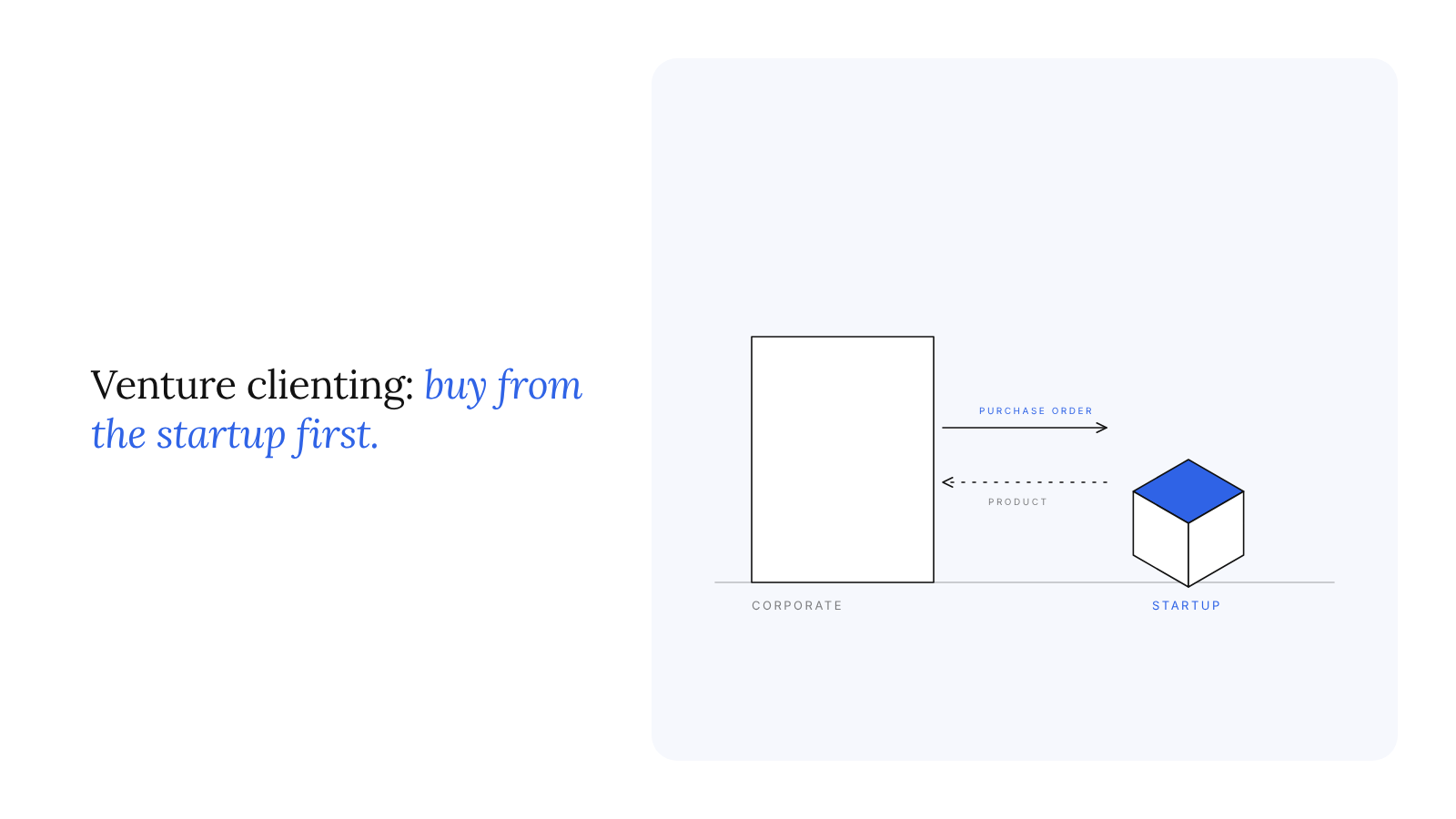
A startup with a working product and a large corporate with a matching problem have an obvious transaction available to them: the corporate can buy the product. For years, corporate innovation programmes made that transaction harder than it needed to be. They offered equity, mentoring, demo days and accelerator cohorts, when what most early-stage companies needed was a purchase order and a reference customer.
Venture clienting is the name for doing the obvious thing deliberately and at scale. A corporate sets up a dedicated unit, process and budget to find startups whose products solve real problems inside its business units, buys those products for a bounded pilot, and adopts the ones that work. It takes no equity. The term was coined at BMW in the mid-2010s, and the idea has since spread across European industrials and beyond. Its appeal is that it gives the corporate access to many more startups than an investment programme can, and gives the startups the thing they value most.
This article explains the venture client model, where it comes from, and when a corporate should buy from a startup rather than invest in it. It sets out a venture-client process map and a set of selection criteria for deciding which startups and problems suit the approach. It is written for chief strategy and innovation officers, procurement and business-unit leaders, CVC heads and founders selling to large Indian companies. The broader comparison between corporate venture capital, venture building, M&A and R&D is covered in a separate PanScience Research piece in this cluster.
Where venture clienting came from
In a July 2017 Harvard Business Review article, "What BMW's Corporate VC Offers That Regular Investors Can't," Gregor Gimmy and co- authors Dominik Kanbach, Stephan Stubner, Andreas König and Albrecht Enders set out the argument behind the model. "Startups require three things to grow: capital, coaching, and clients," they wrote. Private investors can supply the first two. "But only large corporates can offer the last one." The authors noted that CVC units and accelerators struggled to attract the best startups away from private venture capital, and that several large companies had shut down their venture arms or accelerators. Their conclusion was that corporates should compete on what they uniquely offer, not on capital.
Gimmy founded and led the BMW Startup Garage, which BMW describes as linking its specialist divisions with startups since 2015. In a May 2019 BMW Group article, Bernhard Schambeck, then head of the Startup Garage, explained the approach: BMW engages early-stage startups, which often lack a marketable product, acts as their customer, and runs joint pilot projects in which the startup supplies a functional prototype. "We purposely engage these young firms in this still very risky phase," he wrote. A BMW press release the same day stated that the programme talked with more than 1,500 startups a year, examined 600 to 800 in more detail, and had seen more than 50 startups complete the programme, 26 of them in 2018. Since 2018 the programme had been open to all of BMW's business units, not only those working on products and services.
In a July 2022 interview with Global Corporate Venturing, Gimmy, by then running a venture client advisory firm, argued that equity investors can typically add only about five new startups a year, many of them follow-on investments, whereas a venture client unit can bring in technology from hundreds. He described the model as increasing the amount of technology a corporate brings in by about ten times compared with investing. Those are his estimates, from a practitioner with an interest in the model, and should be read as such. A Startbase history of the model, published in April 2025, records that it was included in Gartner's Hype Cycle for Innovation Practices in 2024.
Venture clienting versus investing: what each buys
The difference between buying and investing is not only about equity. The two activities answer different questions.
An investment asks: will this company become valuable? The corporate's return depends on the startup's future valuation, and the corporate's strategic benefit is indirect, through information and influence.
A purchase asks: does this product solve our problem better than the alternatives? The corporate's return is the improvement in its own operations, measured directly. The strategic benefit is immediate and specific.
For a startup, a corporate customer is usually worth more than a corporate investor at the early stage. A purchase order brings revenue without dilution, a reference that other buyers trust, and feedback from real use. Equity from a corporate can complicate later fundraising and deter the corporate's competitors from buying.
McKinsey's May 2021 article on collaborations between corporates and startups found that only 28% of startups were satisfied with their corporate partnerships, and named getting stuck in pilots with no route to scale among the main reasons partnerships derail. Venture clienting, done well, is designed to address precisely that: the pilot is a purchase with a defined route to adoption, not an open-ended experiment.
When a corporate should buy instead of invest
The choice between buying and investing can be made with a small set of tests. They are the author's synthesis, based on the logic of the sources above.
The corporate has a specific problem, and a startup has a product that might solve it. If the corporate's interest is in a specific operational outcome, buying is the direct instrument. If its interest is in exposure to a technology trend with no specific application yet, investing or watching is more appropriate.
The product exists, at least as a functional prototype. Venture clienting depends on something that can be piloted. If the technology is still at the research stage, a sponsored research arrangement or a venture build may fit better.
The corporate does not need control of the company. If the corporate needs exclusivity, the ability to direct the roadmap, or ownership of the IP, buying is not enough. That points to a commercial agreement with stronger terms, an investment, or an acquisition.
The startup's independence is an asset. If the startup will sell to the corporate's competitors, and the corporate benefits from it being a viable independent supplier, buying preserves that independence better than equity does.
The corporate can adopt what works. A pilot that cannot become a purchase is a cost with no return. If the business unit cannot budget for adoption, or procurement cannot onboard a startup, venture clienting will produce pilots and nothing else.
When most of these tests point towards buying, venture clienting is the right instrument. When the corporate needs control or the product does not yet exist, other instruments fit better, and a separate PanScience Research piece on the corporate-deeptech relationship ladder covers how a purchase can deepen into investment or acquisition over time.
A venture-client process map
The process map below is the article's main contribution. It is a synthesis of the BMW stages as described in the company's 2019 materials, Gimmy's description of the model in Global Corporate Venturing, and the failure modes McKinsey identifies, adapted for an Indian corporate. Each stage has an owner, an output and a gate.
Three design features matter more than the others.
Start from the problem, not the startup. A programme that begins with scouting and then looks for problems tends to produce interesting demonstrations that nobody owns. One that begins with problems submitted by business units, each with an owner and a budget holder, produces pilots that someone wants to adopt.
Make contracting fast and standard. Gimmy's description of the model emphasises light-touch terms such as faster payment and less procurement bureaucracy. In practice this means a standard pilot contract, a pre-agreed security review path and a payment term suited to a small company. A pilot that takes longer to contract than to run will lose the best startups.
Agree the adoption decision before the pilot starts. The single most important gate is stage 4: success metrics and the adoption budget are agreed before the pilot begins. That removes the most common failure, a successful pilot that nobody has budget to adopt.
Selection criteria
The second table sets out the criteria a venture client unit can use to select both problems and startups. Each criterion is phrased as a question, with the reason it matters.
The Indian context
Several features of Indian corporates make venture clienting both attractive and harder than it looks.
The attraction is that Indian enterprises are actively buying AI and digital products. EY India's November 2025 survey of more than 200 enterprise leaders found that 91% ranked speed of deployment as the top factor in buy-versus-build decisions, and 47% said more than 10% of their proofs of concept had moved to production. Menlo Ventures' December 2025 report on generative AI in the enterprise found that 76% of buyers were buying rather than building, and that 47% of AI deals reached production, against 25% previously. Buyers who prioritise speed and are willing to buy are the natural customers for a venture client programme.
The difficulty is procurement. Many Indian corporates have supplier onboarding rules built for large vendors: minimum turnover thresholds, years of audited accounts, extensive security questionnaires and long payment terms. Each is reasonable for a strategic supplier and prohibitive for a two-year-old startup. A venture client unit has to negotiate a separate, faster path for small pilots, with the same security standards but proportionate documentation. Public sector undertakings face additional constraints through procurement rules and GeM, which a separate PanScience Research piece on PSU innovation covers.
The second difficulty is the pilot culture. Where proofs of concept are unpaid and open-ended, neither side has a reason to reach a decision. A venture client programme should insist that pilots are paid, bounded and tied to an adoption decision. That is both fairer to the startup and more useful to the corporate, because a paid pilot gets the startup's best attention.
A worked illustration
Consider a large financial services firm that wants to route internal use of several large language models through a single control point, to manage cost, security and monitoring. Proteus, a venture in the PanScience portfolio, describes itself as an LLM gateway that routes, secures and monitors model traffic. Under a venture client approach, the firm's technology risk team would be the problem owner, the metric might be the share of model traffic passing through approved controls, and the pilot would run in one business unit for a fixed period under a standard contract. If the metric is met, the adoption budget agreed in advance is released. The firm gains a capability without building it or taking a stake; the startup gains a paying, referenceable customer. The illustration describes the process, not a real engagement.
When venture clienting is the wrong tool
Venture clienting is not a universal answer. It is the wrong tool when the corporate needs to own the technology, when it needs to shape the startup's roadmap in ways a customer cannot, when the product does not yet exist, or when the corporate is really looking for an acquisition and using a pilot as diligence. In those cases the honest course is to say so and choose the appropriate instrument. Using a pilot as free diligence for an acquisition the corporate has not disclosed damages trust with the startup and, over time, the corporate's reputation among founders.
Conclusion
Venture clienting reverses the usual logic of corporate innovation. Instead of asking which startups to invest in, it asks which problems the business has and which startups can solve them now, and it pays for the answer. The model's origin at BMW, and its spread since, rest on a simple insight from the 2017 HBR article: startups need capital, coaching and clients, and only large corporates can offer the last. For an Indian corporate, the model's success will depend less on scouting, which is the visible part, than on the unglamorous parts: a named problem owner, a pre-agreed adoption budget, a standard contract and a procurement route a small company can pass. Built that way, a venture client programme turns pilots into purchases, which is what both sides wanted in the first place.
Methodology and sources
The founding argument and quotations are from Gregor Gimmy and co-authors, "What BMW's Corporate VC Offers That Regular Investors Can't," Harvard Business Review, 27 July 2017 (https://hbr.org/2017/07/what-bmws-corporate-vc-offers-that-regular-investors-cant); the page opened was an excerpt, and only its stated argument and quotations are used. BMW Startup Garage facts are from a BMW Group article by Bernhard Schambeck, 9 May 2019 (https://bmwgroup.com/en/news/general/2019/startup-garage.html) and a BMW Group press release of the same date (https://www.press.bmwgroup.com/global/article/detail/T0295365EN/bmw-startup-garage-secures-early-access-to-pioneering- innovations); these are company-reported. Gimmy's estimates on investor capacity and the tenfold figure are from Maija Palmer, Global Corporate Venturing, 7 July 2022 (https://globalventuring.com/corporate/venture-client-model/), and are a practitioner's claims. The 2014 coinage and Gartner Hype Cycle inclusion are from Startbase, 7 April 2025 (https://www.startbase.com/news/gregor-gimmy-zur-geschichte- des-venture-clienting/). The 28% satisfaction figure is from McKinsey, "Collaborations between corporates and start-ups," 10 May 2021 (https://www.mckinsey.com/capabilities/strategy-and-corporate-finance/our-insights/collaborations-between-corporates-and-start-ups). EY India and Menlo Ventures figures are from the editor-verified list (https://www.ey.com/en_in/insights/ai/agentic-ai-india/aidea-survey- findings; https://menlovc.com). The buy-versus-invest tests, the process map, the selection criteria and the worked illustration are the author's analysis and are illustrative, not observed data. The Proteus description is company-reported (https://panscience.xyz).