
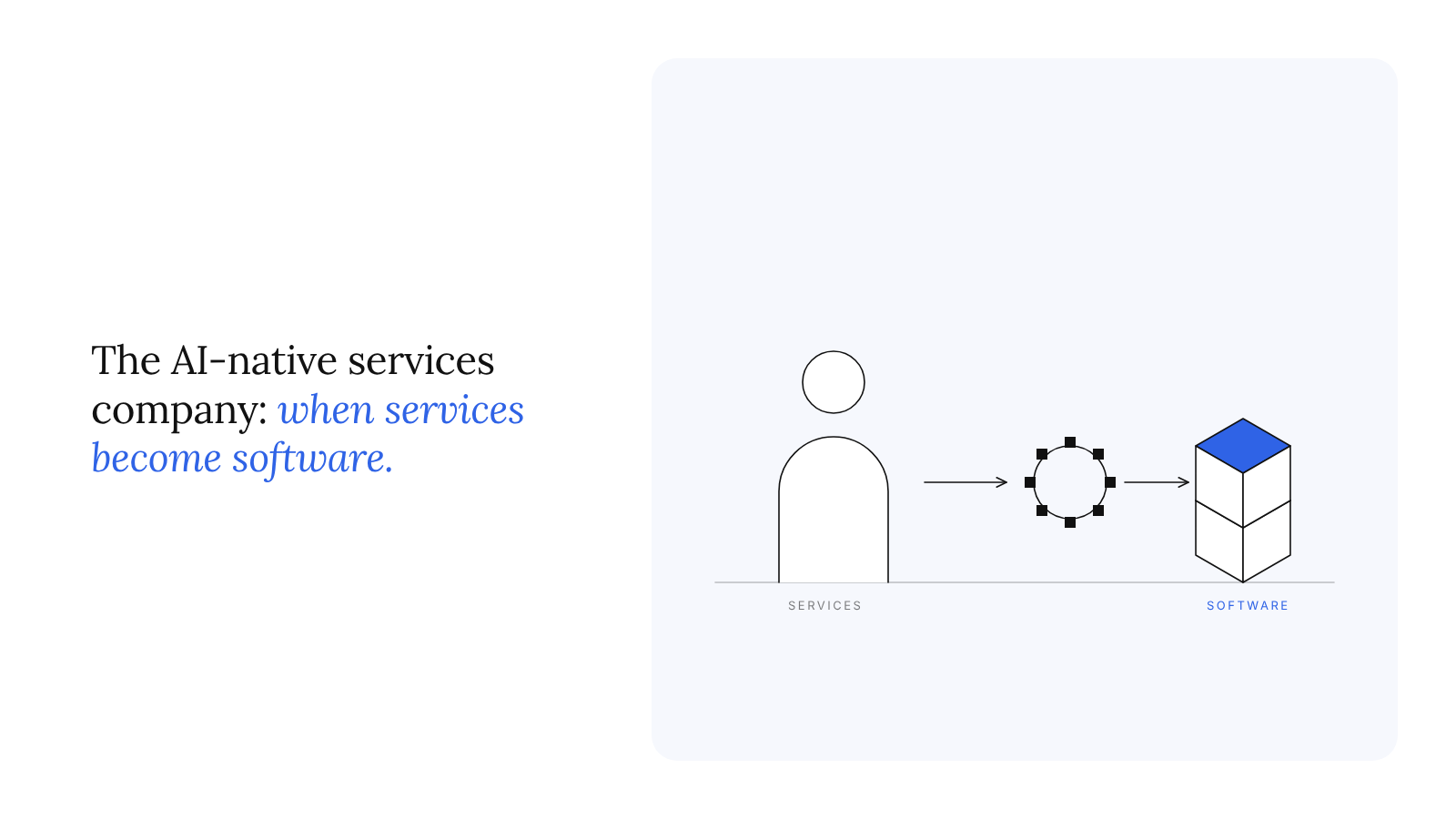
For three decades, the Indian technology services industry grew by turning skilled people into billable hours. The model was linear: more revenue required more engineers, and margins came from the pyramid, with many junior staff supervised by a few senior ones. Generative AI breaks that link. When a model can draft the code, read the documents or answer the ticket, the hour stops being the natural unit of value, and the client starts asking to pay for the result instead. That shift is what AI-native services firms are built around.
The pressure is visible in the numbers. Nasscom's Strategic Review, released on 24 February 2026, put Indian technology industry revenue at US$315 billion for FY26, growth of 6.1%, with headcount rising only 2.3% to 5.95 million. Reuters reported in August 2026 that TCS's chief executive said about 80% of contracts in the company's finance, HR and other business services segment were now based on outcome measures, and that clients of Persistent Systems wanted the same work done for 25% to 30% less. A new category of company, the AI-native services firm, is built for this world from the start: it sells completed work, like a services firm, but delivers most of it through software, like a product company.
This article defines the AI-native services model, sets out how it differs from both traditional services and software, and offers an illustrative margin model that shows the single variable on which its economics turn. Pricing design for AI products is covered in a separate PanScience Research piece, and a separate PanScience Research piece covers how venture studios originate such companies.
From selling tools to selling work
The investment case for AI-native services has been put most directly by Sequoia Capital. In "Services: The New Software", published on 5 March 2026, Julien Bek argued that "for every dollar spent on software, six are spent on services", and that "the next $1T company will be a software company masquerading as a services firm." The distinction he draws is between copilots and autopilots: "A copilot sells the tool. An autopilot sells the work." In the second model, "the customer is buying the outcome directly", and "the work budget in any profession dwarfs the tool budget."
The argument matters for India because India's technology industry is, overwhelmingly, a services industry. Nasscom's FY25 release, issued in February 2025, broke the then-estimated US$282.6 billion of revenue into US$137.1 billion of IT services, US$54.6 billion of business process management and US$55.7 billion of engineering research and development, with exports of US$224.4 billion. Nasscom later revised FY25 revenue to US$297 billion. Most of that revenue is priced, directly or indirectly, on effort. If the work budget that Sequoia describes is captured by firms that deliver it through software, the question for Indian services companies is whether they become those firms or compete against them.
What an AI-native services company is
An AI-native services company has four defining features.
It sells an outcome, not access or effort. The contract specifies completed work: claims adjudicated, documents reviewed, invoices reconciled, tickets resolved, code migrated. Price is set per unit of work or per result, not per seat or per hour.
Software does most of the work. Models, retrieval systems and agents handle the routine share of each task. People handle exceptions, review high-risk outputs and own the client relationship.
Humans are designed in, not bolted on. The human role is a planned part of the production system, with defined review points, quality sampling and escalation paths. Andreessen Horowitz's analysis of AI businesses, "The New Business of AI", published in February 2020, observed that many AI applications depend on people working alongside models and that "it's unlikely, though, that humans will be cut out of the loop entirely."
Every delivery improves the system. Corrections made by human reviewers become training and evaluation data, so the automated share rises over time. This is the feature that separates an AI-native services firm from a traditional firm that uses AI tools internally.
The model is distinct from both neighbours. A traditional services firm sells effort and may use AI to reduce its own cost, often passing much of the saving to the client under competitive pressure. A software company sells a tool and leaves the client to do the work. The AI-native services firm takes responsibility for the work and keeps the productivity gain to the extent its pricing allows.
How the incumbents are adapting
Indian and global services firms are already moving towards this model, under pressure from clients. Forrester's Ted Schadler, writing on 16 October 2026, described a shift from labour-based pricing towards results, citing HCLTech's chief executive on output- and outcome-based pricing and Cognizant's three consecutive years of growth in fixed-price and transaction-based work. Forrester identified three pricing archetypes, namely output commitment, outcome commitment and fixed-price, fixed-capacity, and advised matching the model to how certain the work is.
The same analysis gives public benchmarks for the productivity assumptions now written into contracts. Capgemini's agentic engagement targets a 50% to 54% productivity improvement over seven years; Cognizant's insurance brokerage deal was priced on a projected 50% improvement over five years; and TCS's chief executive puts the productivity gain passed to clients at 10% to 15%. Reuters reported that some providers assume gains of 70% to 80% over five to seven years and guarantee prices on that basis, and that Tech Mahindra chose not to take such risks. Forrester noted that Infosys's chief financial officer said the firm will not underwrite uneconomic productivity assumptions.
Deal structures are changing with the pricing. Reuters described Cognizant's arrangement with Daimler Truck, under which AI-related savings are shared between vendor and client, and HCLTech's deal with E.ON, with no payment in the first year and later payments tied to efficiency gains and outcomes. A former Infosys chief financial officer, V. Balakrishnan, told Reuters: "The pyramid model is gone."
The ratio of revenue to people shows how far the transition has to go. Dividing Nasscom's US$315 billion of FY26 revenue by 5.95 million employees gives roughly US$53,000 per employee. The revenue figure includes hardware, so the ratio is indicative only, but it describes an industry whose revenue is still tied closely to headcount. Nasscom estimated that AI-related offerings contributed US$10 billion to US$12 billion of FY26 revenue, a small share of the total.
A margin model for AI-native services
The table below is this article's analytical contribution. It is an illustrative model, not observed data. It compares the unit economics of one unit of completed work delivered three ways: by a traditional services firm, by an AI-native services firm, and by a software vendor whose client does the work itself. All figures are index numbers, with the traditional services price set at 100.
The assumptions are as follows. The traditional firm prices at 100, with delivery labour costing 65 and other delivery costs 5, giving a gross margin of 30%. The AI-native firm prices at 75, a 25% discount consistent with the client expectations Reuters reported. It spends 8 on inference and platform costs and 7 on amortised engineering per unit. Items that software completes still receive light human spot checks costing 5 each; items routed to people cost 65, as in the traditional model. The software vendor prices its tool at 30 per unit of work, with hosting, inference and support costing 7, and the client bears its own labour cost of 40 per unit to do the work with the tool.
At high automation, the AI-native firm earns a gross margin in the range that Andreessen Horowitz cited for software businesses, "the 60-80%+ benchmark for comparable SaaS businesses", while the client pays 25% less and carries no delivery risk. The software vendor earns a higher margin on much smaller revenue, and the client's total cost is similar to the AI-native option but the client still owns the work, the staffing and the risk.
The model's central lesson appears when the automation rate varies.
Human cost per unit is calculated as 65 multiplied by the share of items routed to people, plus 5 multiplied by the share completed by software. At 50% automation, the AI-native firm's gross margin is 33%, barely above the traditional firm's 30%, and it has given the client a 25% price cut. At 90%, it has the economics of a software business. The automation rate, meaning the share of work that software completes to the required quality without full human handling, is the variable on which the whole model turns.
This explains three patterns in the market. It explains why incumbents are cautious about guaranteeing high productivity gains: if the automation rate in a new domain turns out lower than assumed, a fixed outcome price locks in thin margins. It explains why AI-native firms specialise narrowly: automation rates rise fastest in a single, well-defined workflow with good feedback data. And it explains why the human review layer is a strategic asset rather than a cost centre: it is the mechanism that converts corrections into a rising automation rate.
Where the model works and where it does not
The AI-native services model suits work with four characteristics: high volume, so that the platform cost is spread; a definable unit of output that can be priced; measurable quality, so that client and provider can agree what counts as done; and a meaningful share of routine cases, so that automation can reach high rates. Document-heavy back-office processes, data annotation and labelling, first-line customer support, compliance checks and code migration fit this profile.
It suits poorly work that is low volume and bespoke, such as strategy advice or complex litigation, where each unit is different; work where quality is hard to define, which makes outcome pricing contentious; and work where regulation requires a named professional to take responsibility for each output, which caps the automated share.
Within the PanScience Innovations portfolio, several ventures sit in the first group. PanScience reports that FlexiBench operates a managed AI workforce of more than 30,000 annotation experts, and that Indika AI provides data-centric AI and model operations with about 98% annotation accuracy (both company-reported). Data operations of this kind are an example of the AI-native pattern: the client buys labelled, quality-checked data as an outcome, and the provider's economics depend on how much of the work tooling handles and how efficiently people handle the rest. A separate PanScience Research piece on data annotation in India examines that market in detail.
What incumbents and new entrants should do
For incumbent services firms, the model suggests three moves. Measure automation rates by workflow, not productivity in aggregate, because pricing decisions depend on the rate in the specific process being bid. Price outcome contracts with the automation curve in view, sharing gains with the client through mechanisms such as those Reuters described rather than guaranteeing them up front. And treat review teams as the engine of the system, with tooling that captures every correction.
For new entrants, the model points to narrow focus. Pick one workflow where the unit of work is clear, quality is measurable and volume is high; build the automation and review loop; and expand only when the automation rate in the first workflow is high enough to fund the next. The venture-building disciplines that support this, such as shared engineering and go-to-market functions, are covered in separate PanScience Research pieces.
For clients, the question shifts from "how many people do we need?" to "what is a unit of done, and what should it cost?" Procurement teams that can define outcomes precisely will capture more of the productivity gain, whichever kind of provider they choose.
Conclusion
The AI-native services company sells work, not tools or hours, and delivers most of it through software with people designed into the loop. Sequoia's estimate that six dollars go to services for every dollar spent on software describes the size of the opportunity. Reuters' and Forrester's reporting on outcome pricing at TCS, HCLTech, Cognizant and others shows incumbents already moving. The illustrative margin model shows why the transition is hard: at low automation rates, AI-native services earn little more than traditional services while charging less, and only at high automation do they reach software- like margins. For India's US$315 billion technology industry, the question is not whether services become software, but which firms build the automation and review loops fast enough to keep the margin when they do.
Methodology and sources
This article draws on sources opened by the author. Industry size, growth, headcount and AI revenue for FY26 are from Nasscom's Strategic Review 2026 as reported by Outlook Business on 24 February 2026 (outlookbusiness.com/deeptech/tech/indian-tech-industry-revenues-to-grow-61-to-315-bn-in- fy26-nasscom) and Analytics India Magazine (analyticsindiamag.com/ai-news/riding-the-ai-wave- indian-it-to-hit-315-bn-in-fy26-nasscom). The FY25 segment breakdown is from Nasscom's press release of 24 February 2025 (nasscom.in/sites/default/files/media_pdf/Nasscom%20SR%20Press%20release.pdf), whose total was later revised. The services-as-software thesis is from Sequoia Capital (sequoiacap.com/article/services- the-new-software). Outcome pricing and deal structures are from Reuters, 21 August 2026, as syndicated by Zawya (zawya.com/en/business/indian-sub-continent/ai-reshapes-indias-it-services- sector-contracts-as-clients-demand-more-for-less-462989), and Forrester, 16 October 2026 (forrester.com/blogs/for-service-providers-ai-giveth-and-ai-taketh-away). The software margin benchmark and human-in-the-loop observation are from Andreessen Horowitz (a16z.com/the-new- business-of-ai-and-how-its-different-from-traditional-software), which describes its figures as drawn from companies it has seen. The four defining features, the margin model and the automation sensitivity table are the author's original analysis; all margin figures are illustrative index numbers built on the stated assumptions and are not observed data for any company. Revenue per employee is the author's calculation from Nasscom figures and includes hardware revenue. PanScience venture descriptions are company-reported from panscience.xyz.