
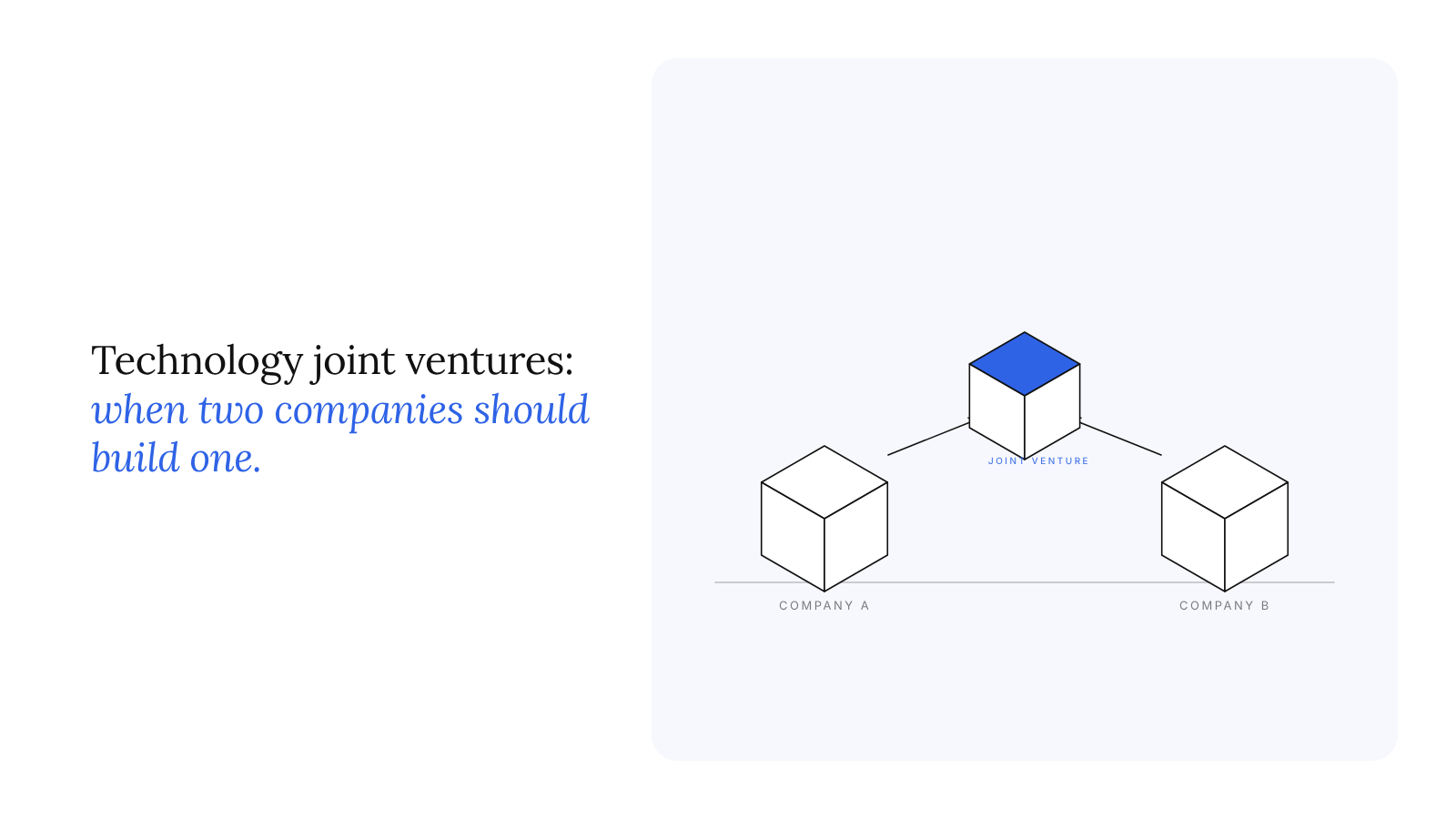
A joint venture is the most optimistic structure in corporate strategy. Two companies, each unable or unwilling to build something alone, agree to create a third entity that combines what both bring. The history of the structure is less optimistic. Senior practitioners interviewed by McKinsey, with combined experience of more than 300 joint ventures, estimated that as many as 40 to 60% of their completed ventures had underperformed their potential. A technology joint venture in India adds its own layers: foreign investment rules, company law on articles and shareholder agreements, pricing rules on exits, and an Indian contract law that is unfriendly to non-competes.
None of this makes joint ventures a bad idea. It makes them a specific idea, suited to a narrow set of situations and dependent on a few clauses that are usually drafted in a hurry. This piece offers a decision test for when two companies should build one, and identifies the five clauses that, on the evidence, decide whether a technology joint venture works.
It is written for strategy heads and general counsel at Indian corporates considering a technology partnership, for foreign technology companies entering India through a partner, and for deeptech founders who are being offered a JV in place of a customer contract or an investment. Where the questions overlap with licensing corporate IP to new ventures or spinning out a corporate venture, separate PanScience Research pieces cover those subjects; this one stays with the two-parent structure.
Why joint ventures underperform
The most useful research on joint venture failure focuses on process rather than on structure. In a February 2004 Harvard Business Review article, James Bamford, David Ernst and David Fubini noted that more than 5,000 joint ventures had been launched worldwide in the previous five years, and that the success rate of joint ventures and alliances was "on a par with that for mergers and acquisitions", which, as they observed, is not very good. Their diagnosis was that companies are disciplined about integrating acquisitions but rarely commit comparable resources to launching joint ventures of similar size. They identified four launch challenges: keeping strategic alignment between parents with different goals and shareholders; creating shared governance; managing the economic interdependencies between the parents and the venture; and building a cohesive organisation when managers come from, return to or hold dual roles in the parents.
McKinsey's later work, by John Chao, Eileen Kelly Rinaudo and Robert Uhlaner (originally published in 2014 and updated in 2020), drew on interviews with practitioners at 30 S&P 500 companies. Beyond the familiar best practices, it identified four blind spots. Deal teams rush to completion, emphasising financials over operational issues and using boilerplate for key terms and arbitration. Leadership is discontinuous: each phase of a joint venture's life typically has a different owner, and no group covers more than two phases. Parent involvement declines after the early stage until signing. And partners plan poorly for changing risk, leaving contingency planning to lawyers who frame it adversarially.
Both pieces point to the same conclusion. Joint ventures rarely fail because the idea was wrong. They fail because the parents did not agree, in writing and in advance, on the things that would later divide them.
The technology joint venture in India: the legal frame
Before turning to the decision test, it helps to set out the Indian frame, because several of its features change what a good joint venture looks like. What follows summarises professional commentary and is not legal advice.
Foreign investment. Where one partner is foreign, investment must fit sectoral caps and entry routes (automatic or government approval) under foreign exchange regulations. Maheshwari and Co., writing in May 2025, gives examples: defence at 74% under the automatic route and 100% with approval, and telecom at 100% subject to licensing. Investment from an entity in a country sharing a land border with India, or with beneficial ownership there, requires government approval under Press Note 3 of 2020. Sharma Kemp Chambers, writing in October 2026, reads a 2026 amendment as allowing some indirect, non-controlling land-border ownership of up to 10% to use the automatic route with reporting; parties should check the current text before relying on that reading. Foreign investment must be reported within 30 days of allotment.
Articles and the shareholders' agreement. Sharma Kemp Chambers stresses that the articles of association and the shareholders' agreement "must say the same thing", because if they differ the company is bound only by its articles. A right that exists only in the shareholders' agreement may bind the partners to each other but not the company. The practical advice is to put key rights, such as reserved matters and transfer restrictions, into the articles by special resolution.
Exit pricing. Under the foreign exchange rules for non-debt instruments, a transfer from a non-resident to a resident must not exceed fair value at exit. A put option that requires the Indian partner to buy out the foreign partner at a fixed premium or guaranteed return is, in Sharma Kemp Chambers' words, "open to challenge". Maheshwari and Co. notes that put and call options are enforceable if pricing complies with valuation norms. The commonly cited example of how this plays out in practice is the Tata and NTT Docomo dispute, which Sharma Kemp Chambers describes as fact-specific.
Non-competes. Under Section 27 of the Indian Contract Act 1872, courts have generally held post-termination non-competes unenforceable. Restraints during the life of the venture are easier to defend. For a technology joint venture, this means protection after exit has to come from confidentiality, IP ownership and licence terms rather than from a promise not to compete.
Competition review. A transaction valued above ₹2,000 crore requires Competition Commission of India approval where the target has substantial business operations in India, as Sharma Kemp Chambers notes. Most early-stage technology joint ventures will be well below this, but large industrial joint ventures may not be.
Public sector partners. Where one partner is a large central public sector enterprise, its board's powers to enter technology joint ventures and invest in them are set by Department of Public Enterprises guidelines, and the establishment of joint ventures has, since an August 2016 office memorandum, required NITI Aayog concurrence through the administrative ministry. A separate PanScience Research piece covers how PSUs build and buy technology.
The JV decision test
A technology joint venture is justified only when it does something the alternatives cannot. The alternatives are a licence, a supply or development contract, a minority investment, or an acquisition. The test below is the first part of this piece's original contribution. It is an analytical framework drawn from the research above, not an observed scoring system. A joint venture should pass all five questions; failing any one suggests a simpler structure.
The first question removes many proposed joint ventures. If one partner's contribution is only money, a minority investment is simpler. If one partner's contribution is only a customer relationship, a commercial contract is simpler. The joint venture is a structure for combining two non-tradable assets, such as one partner's proprietary technology and the other's manufacturing base and regulatory standing in India.
The third question is where many technology joint ventures fail later. Partners often share an interest in the first product but diverge when the venture's success starts to compete with one parent's own roadmap. This is the strategic alignment challenge that Bamford, Ernst and Fubini put first.
The fifth question reflects McKinsey's observation that exit planning is often treated as adversarial and left to lawyers. In India, it also reflects the pricing constraint on foreign partner exits. Agreeing an exit mechanism after the relationship has soured is far harder than agreeing one at signing.
The five clauses that decide whether it works
The second part of the contribution identifies five clauses that, read against the research and the Indian legal frame, do most of the work. The table summarises them; the text explains why each matters.
Scope and field. Because post-termination non-competes are generally unenforceable in India, the scope clause carries more weight than it would elsewhere. The parents should define precisely what belongs to the joint venture, and rely on IP licences limited to that field to protect each parent after exit. A broad scope clause invites the collision between the venture and a parent's own business that the alignment research identifies as the most common source of failure.
IP contribution and improvements. Sharma Kemp Chambers advises deciding at the outset whether contributed technology is "assigned to the JV or licensed", and specifying the licence's territory, field of use, term, quality control, royalties and termination effects. The harder question in a technology joint venture is improvements. If the venture improves a parent's technology, who owns the improvement, and may the other parent use it after exit? A joint venture that does not answer this question creates IP that, on exit, nobody can use without a dispute.
Governance and deadlock. Sharma Kemp Chambers states that a 50:50 joint venture with a long list of reserved matters and "no deadlock mechanism is the commonest source of disputes" the firm sees. The alternatives are escalation to parent chief executives, mediation, a cooling-off period and, finally, a buy-sell mechanism or option at an agreed valuation. Without one, the remaining routes are a winding-up petition on just and equitable grounds or an oppression and mismanagement petition before the National Company Law Tribunal, both slow and damaging. Maheshwari and Co. notes that mechanisms such as Russian roulette and Texas shoot-out clauses are enforceable if mutually agreed.
Funding and dilution. Technology joint ventures usually need more capital than planned. The clause should state what happens when one partner declines to fund a call: dilution at a stated price, conversion of the shortfall into a loan, or a trigger for exit. Without this, the non- funding partner keeps its veto while the venture starves.
Exit and termination. McKinsey recommends planning exit contingencies in advance and treating them as tools for adapting to change rather than as adversarial weapons, suggesting release valves, go/no-go triggers and dynamic value-sharing. In India, the exit clause must also survive the fair value rules for foreign partner exits. An option priced at the higher or lower of an independent fair value, as Sharma Kemp Chambers suggests, is more robust than a fixed-return put.
What this means for deeptech founders
Deeptech founders are sometimes offered a joint venture by a large corporate in place of a customer contract or an investment. The decision test is a useful filter. If the corporate's contribution is mainly market access, a commercial contract with milestones keeps the founder's company whole. If the contribution is mainly capital, a minority investment with clear terms is simpler. A joint venture makes sense for a founder only when the venture needs something the corporate cannot sell, such as a manufacturing base, regulatory licences, or operating data that will never leave the corporate's premises.
When a joint venture does make sense, the IP clause is the founder's most important negotiation. Contributing core technology by assignment to a joint venture the founder does not control can strand that technology if the venture fails. A field-limited licence, with improvements in the field owned by the venture and improvements outside it retained by the founder's company, protects the founder's core business. A separate PanScience Research piece covers corporate anchor customers, investors and acquirers in more detail.
PanScience, a New Delhi deep-tech and AI venture studio, reports that its portfolio includes ventures such as PredCo, which builds industrial AI and predictive maintenance for manufacturing plants (company-reported). For a venture of that kind, the manufacturing partner's plant data and operational access are exactly the non-tradable asset that might justify a joint venture in a specific product line. The same test still applies: unless the combination needs its own organisation and both parties have agreed how it ends, a commercial contract is likely to serve both better.
Conclusion
The case for a technology joint venture in India is narrower than the volume of announced partnerships suggests. It applies when two companies each hold an asset the other cannot buy, when the combination needs its own organisation, when the shared interest is durable, when the scope can be separated cleanly, and when both have agreed how it ends. The research on joint venture failure, from Bamford, Ernst and Fubini in 2004 to McKinsey's blind spots work, consistently locates the problem in launch and governance rather than in the idea. The Indian legal frame, with articles that override shareholder agreements, exit pricing rules for foreign partners and weak post-termination non- competes, raises the stakes on five clauses in particular. Two companies that get those five clauses right have a reasonable chance of building one. Two that leave them to boilerplate are likely to join the 40 to 60% that underperform.
Methodology and sources
This article is based on sources opened in October 2026. Joint venture failure research comes from McKinsey, "Avoiding blind spots in your next joint venture" (https://www.mckinsey.com/capabilities/strategy-and-corporate-finance/our-insights/avoiding-blind-spots-in-your-next- joint-venture), and from Bamford, Ernst and Fubini, "Launching a World-Class Joint Venture", Harvard Business Review, February 2004 (https://hbr.org/2004/02/launching-a-world-class-joint-venture). Indian legal considerations come from Maheshwari and Co., "Joint Ventures In India: A Legal Roadmap For Global Partners In 2025", published on Mondaq (https://admin.mondaq.com/india/inward-foreign- investment/1629686/joint-ventures-in-india-a-legal-roadmap-for-global-partners-in-2025), and from Sharma Kemp Chambers, published on Global Law Experts (https://globallawexperts.com/joint-ventures-between-indian-and-foreign-companies-key-legal-issues-fdi-rules-and-how- to-structure-the-deal-2026-guide/). Public sector joint venture powers come from the DPE compilation of Maharatna delegations (https://dpe.gov.in/sites/default/files/power.pdf). The decision test and the five-clause table are the author's analytical framework, not observed data. PanScience facts are company-reported. This is not legal advice; foreign investment rules, competition thresholds and case law change, and the 2026 Press Note 3 reading cited above is one firm's interpretation.