
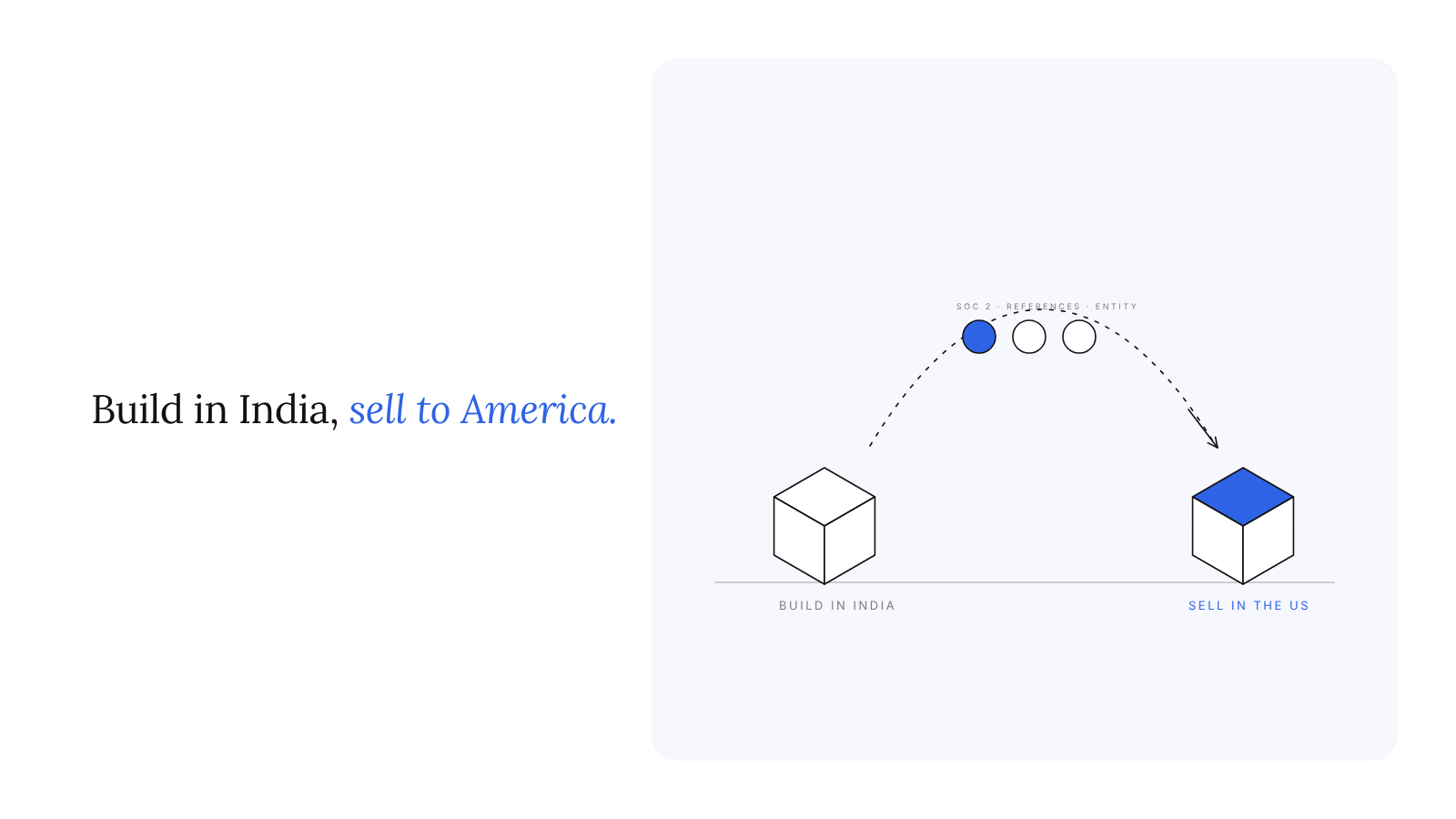
For most Indian enterprise software companies, the largest customer base has always been somewhere else. Fractal, one of India's best-known AI firms, earns nearly two-thirds of its revenue from North America and roughly a fifth from Europe, according to Inc42's reading of its pre-IPO disclosures in February 2026. Its co-founder and group chief executive, Srikanth Velamakanni, told Inc42 that "most Indian companies are spending less than a few million dollars a year on AI." The arithmetic for Indian AI startups' US market ambitions follows from those two sentences: domestic enterprise demand is growing, but the budgets that can sustain a venture-scale AI company today are concentrated abroad, and above all in the United States.
Selling there is a different business from selling at home. American enterprise buyers ask for evidence that an Indian founder may not have needed before: an audited security report, a contracting entity they recognise, customers who will take a reference call, and someone awake during their working day. None of these is technically difficult. All of them take time, and the order in which a company acquires them decides whether its first year in the US produces revenue or only meetings.
This piece is for founders, boards and investors of Indian AI companies weighing the US. Its contribution is a market-entry sequence that sets out, stage by stage, which trust assets US buyers require, what each asset proves, and what it costs in time. Timelines and cost drivers in the sequence are illustrative, drawn from the sources cited and stated as assumptions, not as measured averages.
Why the US market matters for Indian AI startups
The Indian technology industry's centre of gravity remains exports. Nasscom's Strategic Review, reported by ETV Bharat on 24 February 2026, projected FY26 industry revenue of $315 billion, with exports expected to rise 5.6% to $246 billion and domestic revenue growing faster at 7.9% from a much smaller base. Nasscom estimated overall AI revenues for the industry at $10 to $12 billion in FY26, noting that not all companies report AI revenue separately.
The services majors show how quickly AI revenue is being booked abroad. Rest of World reported in May 2026 that TCS disclosed more than $2.3 billion in annualised AI services revenue, about 7.5% of its total. For an Indian product company, those figures matter less as competition than as evidence that US and European enterprises are buying AI from Indian suppliers at scale and have procurement processes designed to do so.
Indian software products have already proved they can reach scale in global markets. A Bain and Company report in January 2023, as covered by The News Minute, estimated Indian SaaS annual recurring revenue at $12 to $13 billion in 2022, about four times the level of five years earlier, with around 14 companies above $100 million in ARR and a projection of $35 billion by 2027, about 8% of the global SaaS market. AI companies inherit both that playbook and its limits. They also inherit a new question that SaaS companies could often defer: what happens to the customer's data inside a model.
What US enterprise buyers are actually buying
The US enterprise buyer is not one person. Gartner's research on B2B buying, as verified by the editor of this cluster, finds that 77% of buyers describe their purchases as complex, that buying groups typically involve six to ten people, and that buyers spend about 5% of their buying time with any one supplier. 6sense's 2024 research put the average B2B buying cycle at 11.3 months with an 11-person buying group. Vanta's State of Trust 2024 report estimated that organisations spend 11 working weeks a year on compliance.
Read together, those numbers describe a buyer who will do most of the evaluation without the vendor in the room. The security reviewer will read the SOC 2 report, not attend the demo. The procurement lead will check the contracting entity and the insurance certificate. The business sponsor will call a reference. An Indian startup that wins the demo but has nothing for these readers will lose the deal in the 95% of the process it never sees.
The good news for AI vendors is that buyers are moving faster than before. Menlo Ventures' State of Generative AI in the Enterprise report of December 2025, also editor-verified, found that 47% of AI deals reached production compared with 25% previously, and that 76% of enterprises bought rather than built. A separate PanScience Research piece on pricing AI products covers how to structure the commercial offer once the buyer is ready.
SOC 2 in plain terms
SOC 2 is the security attestation most US software buyers ask for first. The American Institute of Certified Public Accountants describes its System and Organization Controls suite as a set of services that CPAs provide to give users assurance about a service organisation's controls; a SOC 2 report is issued by an independent CPA firm, not by a certification body, and is not a certificate in the ISO sense.
BDO, one of the audit firms that performs these engagements, sets out the two types clearly. A Type 1 report evaluates whether an organisation's controls are suitably designed at a specific point in time. A Type 2 report examines how well those controls operated over a period, which BDO describes as usually three to twelve months, with at least six months recommended. The report is organised around five trust services criteria: security, availability, confidentiality, processing integrity and privacy. Only security is mandatory.
Three practical consequences follow for an Indian AI startup. First, a Type 1 can be obtained relatively quickly and is enough to begin many security reviews, but sophisticated buyers will ask when the Type 2 is due. Second, the Type 2 clock cannot be accelerated: if the observation window is six months, the report arrives at least six months after the controls are in place. Third, an AI company should think about which criteria beyond security its buyers care about. A company processing customer documents through a model will be asked about confidentiality and, increasingly, about processing integrity, because the buyer wants to know that outputs are produced the way the vendor says. ISO 27001 is often accepted alongside SOC 2, particularly by multinational buyers, but it rarely substitutes for it in a US security review.
The trust assets behind Indian AI startups' US market entry
The sequence below is an original framework for this piece. Each stage names the question the US buyer is asking, the trust asset that answers it, and an illustrative time to acquire the asset. The times are assumptions based on the SOC 2 observation windows above and on typical legal and hiring lead times; they are not survey data.
The sequence has three design principles.
Order matters more than speed. The common mistake is to set up a US entity and hire a US salesperson first, because those are visible signals of commitment. Without design-partner results and a SOC 2 report, that salesperson will generate pipeline that stalls in security review. Stages 1 and 2 should run in parallel from India, and stage 3 can wait until a buyer actually asks to contract with a US entity.
Start the Type 2 clock early. Because the Type 2 observation window cannot be shortened, the date the controls are in place, not the date of the first US deal, decides when the company can show a Type 2. A startup that implements controls during stage 1 will have a Type 2 by the time it reaches stage 4. One that waits for a buyer to ask will lose six months at the worst moment.
Treat references as a product. Indian enterprise clients often sit under confidentiality agreements that prevent them being named. US buyers understand this but will still ask for someone to speak to. Founders should negotiate reference rights, anonymised case-study rights, or at minimum permission for a private reference call, at the point of signing early customers, not after.
Where AI companies differ from SaaS companies
Everything above applies to software companies in general. AI companies face four additional questions that US security and legal teams now ask routinely.
Is our data used to train your models? The answer must be specific, written into the contract, and consistent with how the system actually works. Ambiguity here ends deals.
Which third-party models do you call, and where? A product that routes customer data to a foundation-model API inherits that provider's terms and data locations. Buyers want a sub-processor list that includes model providers. A separate PanScience Research piece on LLM gateways covers how to control and log this routing.
How do you know the outputs are right? Buyers increasingly ask for evaluation evidence: test sets, error rates, and how the vendor detects degradation. A separate PanScience Research piece on evaluation before deployment covers what a credible evaluation pack contains.
Can you deploy in our environment? Regulated US buyers in health, finance and manufacturing often prefer deployment inside their own cloud account or on premises. A separate PanScience Research piece on on-premise AI economics covers the trade-offs. Offering a private deployment option can shorten security review considerably because less data leaves the buyer's control.
A practice example: shared trust assets
PanScience Innovations offers one illustration of how trust assets can be built once and used many times. PanScience reports holding ISO 9001:2015, ISO 27001, ISO 45001:2018, GDPR and AICPA SOC attestations, and providing shared in-house product, technology, GTM, operations, finance and legal functions to the ventures it builds. PredCo, one of those ventures, is described by PanScience as an industrial AI and predictive maintenance company for manufacturing plants; all of this is company- reported.
The structural point is not specific to a venture studio. Industrial AI is a category in which buyers ask hard questions about data leaving the plant, about deployment inside their own networks, and about who is accountable when a prediction is wrong. A young company answering those questions alone must fund its own compliance programme, legal templates and security tooling before its first large contract. A company that can draw on an established control environment, audited policies and standard contracts reaches stage 2 of the sequence faster. Founders without access to such shared functions can approximate the benefit by using compliance automation software, adopting a template control set from the start, and treating the first SOC 2 as a company-wide project rather than an engineering side task. A separate PanScience Research piece on how venture studios share functions across a portfolio covers the model in more detail.
Entity, people and time zones
Two practical questions recur.
The first is the corporate structure. Many Indian founders assume a US parent company is required to sell to US enterprises. In practice, the buyer's requirement is usually narrower: a counterparty they can contract with under a familiar law, invoice in dollars and pursue if something goes wrong. A US subsidiary of an Indian company can meet that requirement. Whether to go further and place the parent in the US is mainly a fundraising and tax question, and founders should take specialist advice on both sides of the border before deciding.
The second is presence. US buyers do not require a large US team, but they do require responsiveness during their working day. The minimum is a support rota covering US hours and a senior person, often a founder in the first year, who can be in a buyer's office within a week. The first US hire is usually most valuable in customer success rather than sales, because referenceable customers unlock everything after stage 4.
Conclusion
Indian AI startups' US market entry is less a question of product quality than of evidence. The product may be as good as anything built in San Francisco, but the US buyer evaluates most of it without the vendor present, through documents and references. The sequence in this piece puts those assets in order: prove value with design partners, pass the first security review with a SOC 2 Type 1 and clear data-handling terms, contract through a recognisable entity when a buyer asks, accumulate references and the Type 2, then build presence and channels. Starting the controls early, negotiating reference rights from the first contract and answering AI-specific questions about training data, sub-processors and evaluation in writing will save more time than any amount of travel.
Methodology and sources
This article combines published figures with an original market-entry sequence; the stage timings and cost drivers in that sequence are illustrative assumptions, not observed averages. Fractal's geographic revenue mix and Srikanth Velamakanni's quotation are from Inc42, 22 February 2026 (inc42.com/features/fractal-analytics-india-dilemma-the-missing-demand-engine-in-enterprise-ai). Industry revenue, export and AI revenue estimates are from ETV Bharat's report of Nasscom's Strategic Review, 24 February 2026 (etvbharat.com/en/business/india-fy26-tech-revenues-hit-usd-315- billion-enn26022404879). TCS AI revenue is from Rest of World, 27 May 2026 (restofworld.org/2026/u-s-companies-have-an-ai-problem-indian-it-wants-to-be-the-solution). Indian SaaS figures are from The News Minute's coverage of Bain and Company's January 2023 report (thenewsminute.com/amp/story/money/indian-saas-firms-reach-35-bn-revenue-five-years-report- 172389). Gartner, 6sense, Vanta and Menlo Ventures figures are taken from the editor-verified list for this cluster. The description of SOC as a CPA service is from the AICPA (aicpa-cima.com/topic/audit- assurance/audit-and-assurance-greater-than-soc-2), and Type 1, Type 2 and trust services criteria definitions are from BDO (bdo.cz/en-gb/services/digital-en/third-party-assurance/soc-reporting-1/soc2- 1). PanScience and PredCo descriptions are company-reported, from panscience.xyz. Nothing here is legal or tax advice.