
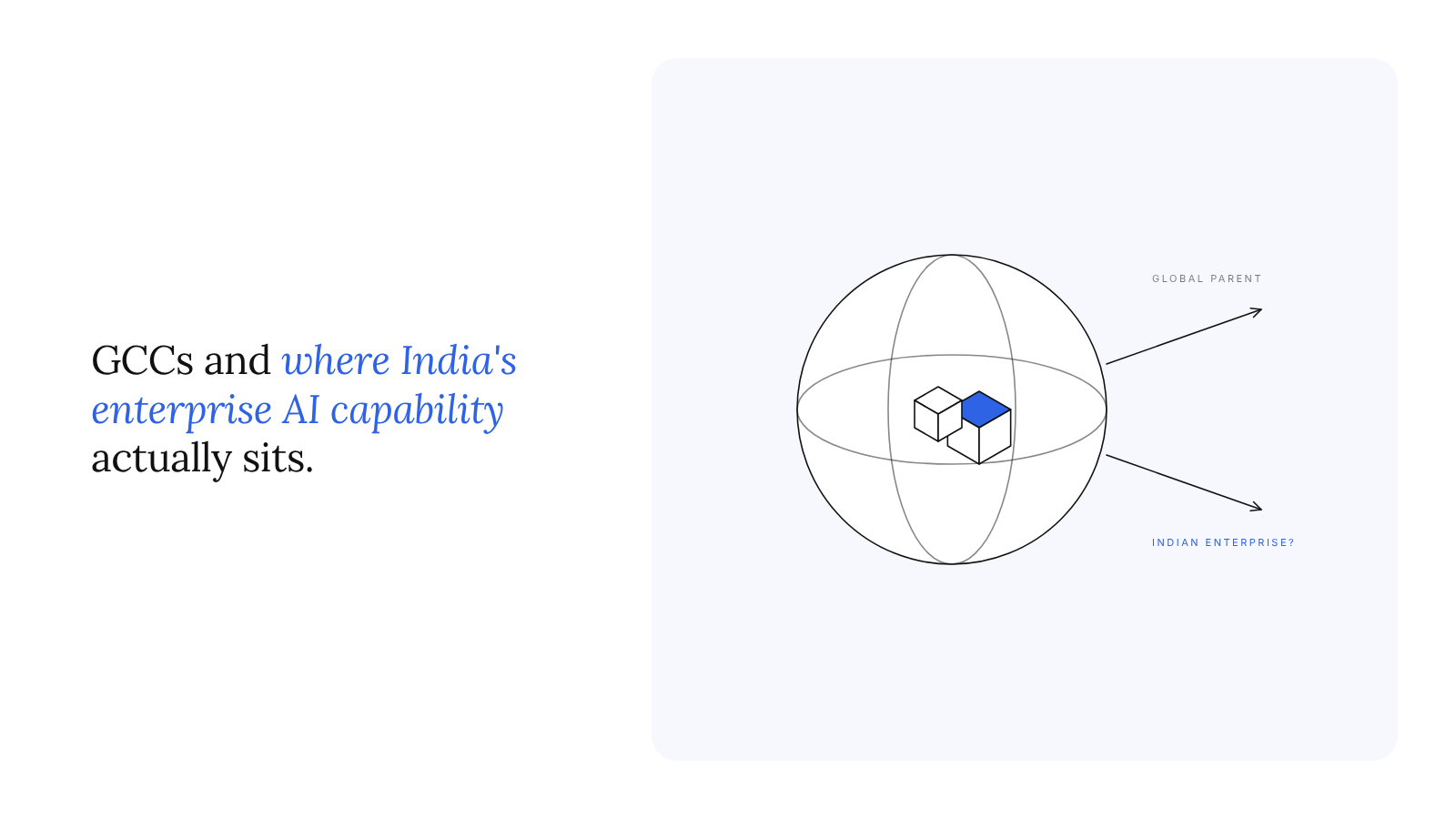
India has more people building enterprise AI than almost any country on earth, and a surprisingly small share of them are building it for Indian enterprises. The largest concentration sits inside global capability centres, the offshore units of multinational companies that, by the Nasscom and Zinnov count for FY26, number 2,117 centres employing about 2.36 million people and generating $98.4 billion in revenue. More than 1,200 of them have embedded AI and machine learning capabilities. Over 250 run dedicated AI centres of excellence. Roughly half of India's estimated 5.5 lakh AI and machine learning professionals work in one.
That is the GCC AI India story as it is usually told: a cost centre that became a capability centre and is now becoming, in the language of the latest report, an "enterprise nerve centre". The story is accurate and it is incomplete. The capability is real, but it is owned by a parent in Seattle, Frankfurt or Tokyo, deployed into that parent's workflows, and measured against that parent's P&L. An Indian bank, hospital chain or manufacturer cannot buy it, and the engineers who built it work on problems defined somewhere else.
This article asks where India's enterprise AI capability actually sits, across the four places it could sit: GCCs, IT services firms, domestic enterprises and startups. It sets out the evidence on each, proposes a capability-location matrix that compares them on who owns the problem, the data, the IP and the value, and draws out what the pattern means for an Indian enterprise trying to get AI into production and for a policymaker trying to turn the country's AI workforce into Indian productivity.
The GCC AI India numbers, and how fast they moved
The scale of the GCC sector is well documented, because Nasscom and Zinnov publish a joint count most years and the business press reports it. In September 2024, the two organisations reported that India had crossed 1,700 GCCs operating more than 2,975 units, employing over 1.9 million people and generating $64.6 billion in revenue in FY24, of which engineering research and development accounted for $36.4 billion. Around 23 per cent of the Global 2000 multinationals had a centre in India; over 1,20,000 professionals were working on AI-led transformation across GCCs and their centres of excellence; and about 6,500 global roles, positions with worldwide rather than site responsibility, sat in Indian centres, a figure the report expected to pass 30,000 within six years.
By the FY26 report, "GCC Value Orbit: From Delivery Engine to Enterprise Nerve Centre", released at the Nasscom GCC Summit in 2026 and reported by CXOToday in May, the Tribune in July and Business Today in August, the count had reached 2,117 GCCs and 3,728 units, a 32 per cent increase in centres since FY21, with about 2.36 million professionals and $98.4 billion in revenue. The AI figures are the ones that matter for this article. More than 1,200 GCCs have embedded AI and machine learning capabilities. Over 250 run dedicated centres of excellence. The report counts a talent base of 250,000 AI professionals in GCCs, and Business Today's reading of the Zinnov data puts India's total AI and machine learning workforce at around 5,50,000, roughly half of them in GCCs. Nearly half of the GCCs set up since FY21 were built with AI as a core focus from inception, and 96 per cent of those launched after FY21 began with a product, research and development or engineering mandate rather than a support one. Generative and agentic AI accounted for 52 per cent of AI use cases in Indian GCCs, overtaking traditional machine learning for the first time. Nearly half of all centres now operate at what the report calls a high maturity stage, 64 per cent of site leaders hold dual mandates combining global functional ownership with site leadership, and Zinnov's chief executive expects three quarters to operate at high maturity by 2030.
Set those figures against the industry they sit within. Nasscom's annual review of February 2026 projected the Indian technology industry at $315 billion in revenue in FY26, growing 6.1 per cent, with 5.95 million employees, and estimated that AI and new-age technology revenues accounted for $10 billion to $12 billion of the total. GCCs are therefore just under a third of the industry's revenue and about 40 per cent of its headcount, and on the AI measures available they hold a disproportionate share of the specialist talent.
Two features of this growth deserve emphasis. The first is that the AI capability was built with intent, not inherited. Half of the new centres were set up for AI, and the use-case mix has already shifted to generative and agentic systems. The second is that the mandate has moved up the value chain faster than the headline growth: a 32 per cent rise in the number of centres since FY21 is modest, but a shift from support to product mandates in 96 per cent of new centres is not. India's GCCs are not scaling the old model. They are building a different one, and that model is the parent's own AI programme, run from India.
The four places capability can sit
Any country's enterprise AI capability sits in some combination of four locations, and the mix determines who benefits from it. In India the four are unusually distinct.
GCCs hold the largest concentration of specialist talent, work on real production systems at global scale, and own none of the output. The problem is the parent's, the data is the parent's, the IP is assigned to the parent, and the value is captured in the parent's reporting currency. The spillover to the Indian economy is salaries, real estate, supplier ecosystems and, over time, people who leave with experience.
IT services firms hold the second largest pool, work across hundreds of clients, and build AI for those clients under contracts that typically assign IP to the client or retain it as reusable platform capability within the firm. Their domestic Indian business is a minority of revenue; the capability is deployed mostly for overseas clients. The Gartner forecast of November 2025, which expects 60 per cent of IT services to be powered by generative AI and hyper- automation by 2028, describes the transformation of this location.
Domestic enterprises, the banks, insurers, hospital chains, manufacturers, utilities and retailers that serve India's own economy, hold the problems and the data but the smallest share of the specialist talent. Gartner's forecast puts Indian IT spending at about $176 billion in 2026, up 10.6 per cent, with software growing 17.6 per cent and data centre systems 20.5 per cent; this is the budget from which domestic enterprises buy capability they do not have. The EY India survey of over 200 enterprise leaders in November 2025 found 47 per cent with multiple generative AI use cases live in production but only 10 per cent scaling across the business, and 91 per cent ranking speed of deployment as the top buy-versus-build factor. Domestic enterprises are, in other words, buyers of capability rather than owners of it.
Startups hold the smallest pool but own their IP outright and sell it to anyone. The Nasscom-Zinnov Indian Tech Start-up Report 2025 counted over 4,200 deeptech startups, with deeptech raising $2.3 billion in 2025 and AI accounting for 91 per cent of that funding. Stanford's AI Index 2025 placed India second in GitHub AI contributions at 19.9 per cent and top in AI hiring vibrancy, but seventh in cumulative private AI investment from 2013 to 2024 at about $11.3 billion. The talent is here; the capital that would turn it into owned, sellable products is thinner.
A capability-location matrix for GCC AI India and its alternatives
The matrix below is this article's original contribution. It compares the four locations on the questions that determine who benefits from the capability: who defines the problem, who owns the data and the IP, where the specialist talent sits, who captures the value, what each location can do that the others cannot, and what it structurally cannot do. The talent and revenue figures are from the sources above; the ownership and capability rows are the author's analytical reading and are qualitative.
Three patterns in the matrix explain most of what is puzzling about enterprise AI in India.
The first is that the talent and the problems are in different columns. The largest pool of production-grade AI engineers sits in GCCs and services firms, working on problems defined in other countries. The problems that would move Indian productivity, in domestic banks, plants, hospitals and courts, sit in a column with the thinnest specialist talent. This is why the EY survey's 91 per cent emphasis on speed of deployment is rational: a domestic enterprise that cannot hire the capability must buy something that deploys fast.
The second is that IP ownership follows the money, not the engineering. In three of the four columns the people who build the AI do not own it. Only the startup column produces owned, sellable IP as its default outcome, and that column is the smallest and the most capital-constrained. India produces a great deal of AI engineering and comparatively little AI product, and the matrix shows why: the structures that employ most of the engineers are designed to transfer the output elsewhere.
The third is that the spillover from GCCs is real but indirect. A GCC that trains 500 engineers on agentic systems for a European insurer has, over five years, created 500 people who understand agentic systems, some of whom will join domestic enterprises or found companies. The report's finding that 64 per cent of site leaders hold global functional mandates means Indian managers are increasingly making the global decisions. But none of this puts a working system into an Indian enterprise this year. The spillover arrives as people, with a lag, not as product.
What the location of capability means for an Indian enterprise
For a CIO or transformation lead in a domestic enterprise, the matrix is a sourcing map. Each column offers something and withholds something.
A GCC in the same city cannot be a vendor, but it can be a talent source and, increasingly, a peer. The alumni of GCC AI centres of excellence are the most experienced production AI engineers available to a domestic employer, and the growth of global mandates in India means that an Indian bank's head of AI and a multinational's India-based global head of AI now attend the same conferences and face the same regulators. What a domestic enterprise should not expect is to replicate a GCC's capability by hiring three of its engineers: the GCC's advantage is scale, data and the parent's willingness to invest for years before return, and none of those transfer with the people.
IT services firms are the default route and the fastest at scale, with the structural limitation the matrix names: the firm's incentive is to deploy its platform across its portfolio, and a domestic client's problem is one of hundreds. The 60 per cent GenAI-powered services forecast for 2028 means the services route will improve rapidly in cost and speed; whether it improves in fit to a specific enterprise's workflow depends on how the contract is written. A separate PanScience Research piece on the AI innovation partner, comparing vendor, consultant, services firm and builder, sets out the incentive differences.
Startups offer owned product and speed and lack the balance sheet to survive enterprise procurement; this is the gap that venture builders and co-build structures exist to fill, and a separate PanScience Research piece on build, buy or co-build sets out the economics. The relevant observation here is that the startup column is where capability becomes Indian product, and that it is the column most in need of patient demand from domestic enterprises. An Indian enterprise that pilots with a domestic AI startup and converts the pilot is, in the terms of the matrix, moving capability from a column where it leaves the country to one where it stays.
Venture studios with a portfolio across regulated sectors sit in the fourth column and see the first three as the environment. PanScience Innovations, the New Delhi deep-tech venture studio, reports co-founding 24-plus ventures across nine verticals with shared product, technology, go-to-market, operations, finance and legal functions, and an ecosystem it describes as 25-plus corporates and 10-plus government agencies. These are company-reported figures and this article has no independent measure of them. The structural point they illustrate is that the fourth column's weakness, the inability to carry an enterprise through procurement and compliance alone, is the one that shared infrastructure held above individual ventures is designed to address.
What it means for policy
For a policymaker, the matrix poses a different question: how to move capability from the columns where it is largest to the columns where it is owned. Three levers follow from the evidence.
The first is demand. The IndiaAI Mission, with its outlay of ₹10,371.92 crore, 38,000-plus GPUs at about ₹65 per hour and twelve selected foundation-model startups, supplies the startup column with compute and models. It does less for demand. Public procurement that converts pilots into contracts, in courts, health systems built on ABDM's 93 crore ABHA numbers and 104 crore linked records, and public-sector banks, would move capability into the owned column faster than any supply-side subsidy, because it is the eighteen-month sales cycle and not the cost of GPUs that kills most Indian enterprise AI startups.
The second is the alumni channel. GCCs and services firms will continue to employ most of India's AI engineers, and the spillover arrives as people. Policy that lowers the cost of those people founding or joining domestic companies, in how employee stock options are taxed and how early-stage firms are recognised and procured from, converts the indirect spillover into direct product.
The third is honesty about what the GCC figures measure. A count of 250,000 AI professionals in GCCs is a measure of India's attractiveness as a location for other countries' AI programmes. It is not a measure of AI in Indian enterprises, and treating it as one leads to the complacent conclusion that India's enterprise AI problem is solved. The matrix suggests the opposite: the country has built the world's largest offshore AI workforce and has yet to build the domestic demand, ownership structures and patient capital that would turn it into Indian productivity.
Conclusion
India's enterprise AI capability sits mostly in GCCs and IT services firms, where it is large, sophisticated and owned by someone else. It sits least in the domestic enterprises that have the problems and in the startups that could own the solutions. The GCC story is a genuine success and its latest chapter, half of new centres built around AI and 96 per cent with product mandates, is more impressive than the headline count. But it is a story about where multinationals choose to put their AI programmes, not about what AI is doing inside Indian firms.
The capability-location matrix is a way of keeping the two stories apart. For an enterprise it is a sourcing map, for a policymaker a diagnosis, and for a builder a description of the gap. The talent is here. The problems are here. The structures that connect them, domestic demand that converts, ownership that stays, and capital patient enough to wait out procurement, are what the next five years of GCC AI India will be judged on.
Methodology and sources
The capability-location matrix is the author's original framework; its ownership, capability and spillover rows are qualitative analytical readings, and only the scale row is sourced. GCC figures for FY26 are from the Nasscom- Zinnov report "GCC Value Orbit: From Delivery Engine to Enterprise Nerve Centre" as reported by CXOToday, "From Delivery Engines to AI Nerve Centers: India's GCCs Take the Global Lead" (cxotoday.com, 6 May 2026), the Tribune, "India's GCCs are increasingly leading the AI mandate for global enterprises" (tribuneindia.com, 3 July 2026), and Business Today, "India's GCCs move from cost centres to global innovation hubs" (businesstoday.in, 20 August 2026). FY24 figures are from ThePrint's report of the Nasscom-Zinnov study (theprint.in/economy/indias- position-as-gcc-capital-of-the-world-nasscom-zinnov-study, 15 September 2024). Industry figures are from Nasscom's February 2026 review as reported by Storyboard18 (storyboard18.com, 24 February 2026). Gartner India IT spending figures are from the Gartner forecast of 18 November 2025 as reported by CXOToday. The EY India figures are from The AIdea of India: Outlook 2026 (ey.com/en_in/insights/ai/agentic-ai-india/aidea-survey-findings), 16 November 2025. Startup figures are from the Nasscom-Zinnov Indian Tech Start-up Report 2025 (zinnov.com, 25 February 2026) and the Stanford AI Index 2025. IndiaAI Mission figures are from the PIB backgrounder of February 2026; ABDM figures from the PIB backgrounder of 6 July 2026. The report-level ER&D share for FY26 was not available in any page opened and is not stated. PanScience Innovations facts are company-reported from panscience.xyz, read 24 October 2026; no client of any PanScience venture is named.