
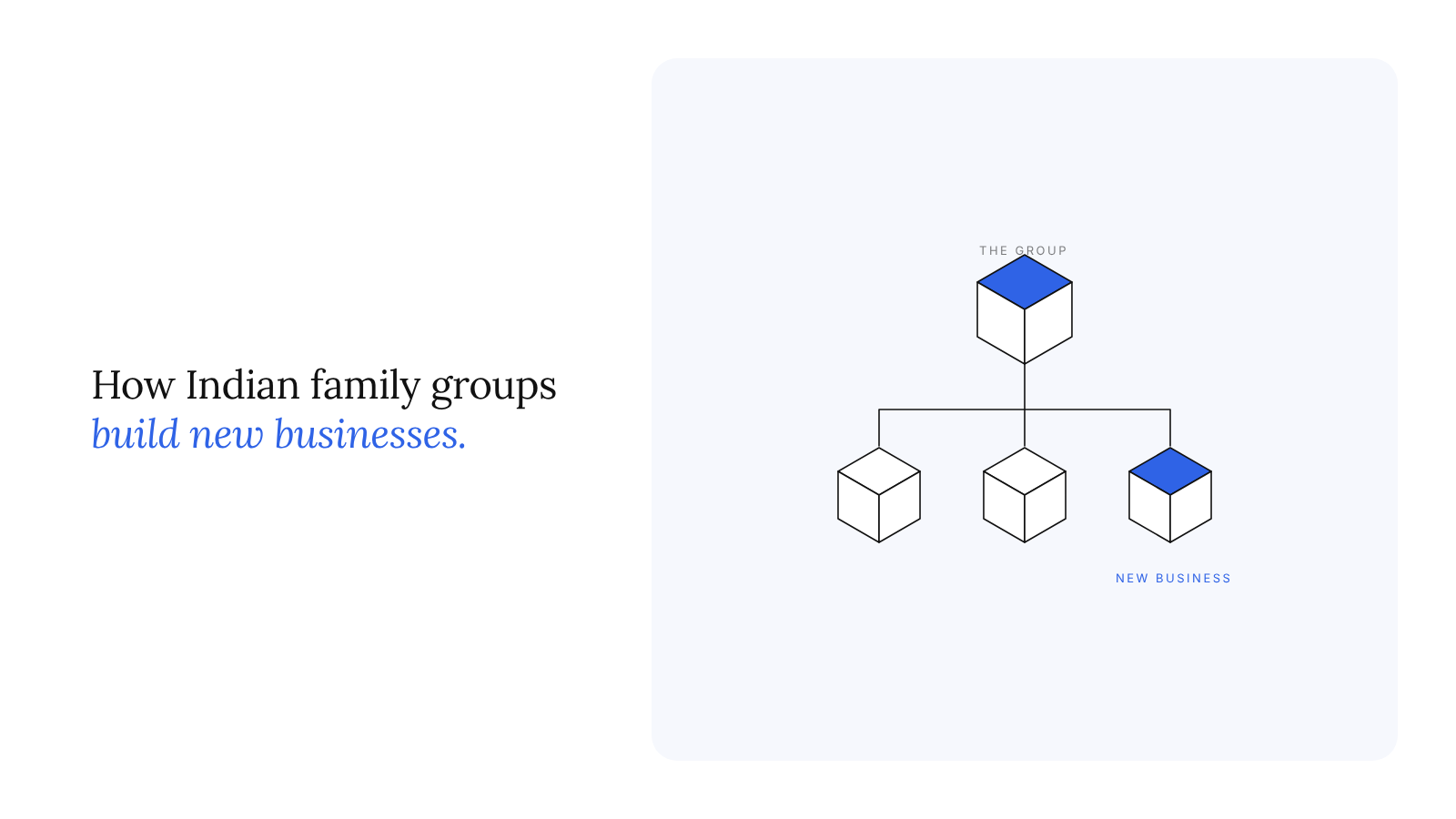
India's family business groups have been building new businesses for as long as they have existed. Many of the country's largest groups are, in effect, portfolios of ventures started at different points over several generations: a textile company that became a cement company, a trading house that became a manufacturer, a manufacturer that became a telecom or financial services group. What is changing is the kind of business being built, the speed expected and the range of ways a group can build it.
Family business innovation in India now runs through several distinct routes. A group can build a new business inside a listed flagship company, set up a new subsidiary with a foreign technology partner, put capital into startups through a family office or fund, back a venture led by a member of the next generation, or co-build with an external team. Each route answers a different question about control, capital and risk, and each creates a different governance problem. Choosing the route without understanding its governance implications is one of the most common reasons a group's new business disappoints.
This article reviews what research says about family business groups as venture creators, sets out five archetypes of how Indian groups build new businesses, drawing on named examples only where public sources report the facts, and gives the governance implications of each.
Family business groups as venture creators: what the research says
Family businesses are a large part of India's listed economy. Credit Suisse's 2018 Family 1000 study, as reported by Business Standard, counted 111 Indian family-owned companies with a combined market capitalisation of $839 billion, the third-highest number of any country after China and the United States. Indian family-owned companies generated a 13.9% annual average share price return since 2006, against 6% for non-family-owned peers in the same study. These are market return figures for listed firms over a specific period, not evidence about innovation as such, but they establish the scale of the group as an owner of Indian capital.
Research at the Indian School of Business looks directly at new venture creation. A 2016 discussion paper by K. Ramachandran, S. Ray and A. Chakrabarti studied 16,455 new projects started by 1,659 firms between 1988 and 2015, comparing group-affiliated firms with multinationals and standalone domestic private firms. It found that firms affiliated with family business groups showed, on average, a higher positive impact on new venture creation, and that groups differed among themselves in how much they engaged in it, a variation the authors attributed to the resources each group could command.
A 2022 chapter by Santanu Bhadra, Sougata Ray, Sankaran Manikutty and Kavil Ramachandran argues that business groups in emerging economies have mostly been explained through "institutional void" logic, the idea that groups exist because markets for capital, talent and contracts are weak. The authors propose a family logic alongside it: family-level interests and motivations shape the group's strategic choices, including innovation, and groups would continue to thrive even as institutions improve. A related chapter by Navneet Bhatnagar and Kavil Ramachandran, based on four in-depth case studies of Indian business families, finds that next-generation "champions" shape both which ventures a family starts and how resources are allocated, and classifies families as "guarded Conservatives" or "adventurous Pathfinders".
Read together, the research suggests three things that matter for practice. Groups are capable venture creators, but not uniformly so. The resources a group can command shape how much it builds. And family dynamics, including the ambitions of the next generation, influence what gets built as much as market logic does.
Five archetypes of family business innovation in India
The table below is this article's contribution: a classification of five routes through which Indian family groups build new businesses, with the governance implications of each. Named examples are used only where a public source reports the specific fact cited; the archetypes themselves are an analytical framework, not a census of Indian groups, and most large groups use more than one route at once.
Archetype 1 the flagship build
The most visible recent example is Aditya Birla Group's entry into decorative paints. According to the group's press release, the business was set up by Grasim Industries with an upfront investment of ₹10,000 crore, a total commercial capacity of 1,332 million litres a year across six plants, which the group described as a 40% addition to the industry's capacity at the time, and an ambition of ₹10,000 crore in gross revenue within three years of full-scale operations. Products went on sale in Punjab, Haryana and Tamil Nadu from mid-March 2024, with a target of reaching all towns with populations above one lakh by July 2024.
The flagship build has obvious strengths: access to a large balance sheet, existing distribution relationships, procurement scale and brand. Its governance problem is that a listed flagship's minority shareholders carry the risk of a venture they did not choose separately, and the venture competes for capital and management attention with the businesses that already generate the flagship's profits. The design response is transparency and discipline: a defined investment envelope, segment reporting that lets shareholders see the venture's progress, and a leader with real authority over its operating choices.
Archetype 2 the partnered greenfield subsidiary
In February 2024, the Union Cabinet approved a semiconductor fabrication plant at Dholera in Gujarat by Tata Electronics Private Limited in partnership with Taiwan's Powerchip Semiconductor Manufacturing Corporation, with an investment of ₹91,000 crore and a capacity of 50,000 wafers a month, as Inc42 reported. A separate chip assembly and testing unit in Assam by Tata Semiconductor Assembly and Test, with ₹27,000 crore of investment, was approved at the same time.
This archetype suits technology the group does not have and cannot build quickly alone. The governance questions are about dependence and commitment. The group relies on a partner's process technology and on policy timelines it does not control, and the scale of capital makes reversal impractical once construction starts. The protections are long-horizon technology and IP terms, capital released against construction and qualification milestones, and independent technical oversight at board level. A separate PanScience Research piece covers technology joint ventures and the clauses that decide whether they work.
Archetype 3 the capital route
Some groups build exposure to new businesses by investing rather than operating. Inc42 reported in May 2023 that the promoters of Godrej Industries were setting up a family office to invest in new-age businesses, to be overseen by Pirojsha Godrej, starting with a corpus of a few hundred crores. The same report noted that Godrej's consumer products arm had, about two months earlier, planned to invest ₹100 crore to anchor an external early-stage fund, and quoted Nadir Godrej saying that the group, being highly diversified, usually invests through its businesses.
The capital route is flexible and preserves optionality. Its weakness is that investment decisions can drift away from the group's operating strategy, producing a portfolio that earns financial returns but teaches the operating businesses little. A clear mandate helps: either the vehicle is explicitly financial, in which case it should be judged on returns, or it is strategic, in which case it needs defined pathways for portfolio companies to become suppliers, customers or partners of group businesses. A separate PanScience Research piece compares CVC with venture building.
Archetype 4 the next-generation venture
The ISB research on next-generation champions describes a pattern familiar to anyone who has worked with Indian business families: a member of the next generation starts a venture, sometimes inside the group and sometimes alongside it, reflecting personal interests and the family's wish to provide career paths or extend its legacy. Bhatnagar and Ramachandran note that some families start ventures for strategic depth, competitive advantage or growth, while others start social ventures tied to legacy or to a cause the champion supports.
The governance risk is specific: commercial judgement can be overridden by succession and family dynamics, and it is hard to close a venture led by a family member. Family constitutions that set rules for venture funding, external directors on the venture's board and arm's length terms for any business with group companies reduce that risk. They also protect the venture, because a business that depends on favourable intra-group treatment is fragile when leadership changes.
Archetype 5 the co-built venture
The fifth route pairs the group's assets, such as distribution, data, customers and capital, with an external team that brings product and technology capability. The group typically acts as anchor customer and significant shareholder, with external investors joining as the venture matures. PanScience, which reports more than 24 co-founded ventures across nine verticals and work with more than 25 corporates, is one example of the kind of builder involved, though the archetype does not depend on any particular partner.
Its governance risk runs in two directions. If the group treats the venture as a vendor, it will extract favourable pricing and leave the venture undercapitalised. If the group exerts too much control, external investors will not fund it and founders will not stay. The protections are licence terms that let the venture own or reliably control its technology, minority protections for founders and a defined path to external capital. Separate PanScience Research pieces cover corporate IP licensing and co-build terms.
Choosing the route: a governance test
The archetypes are not ranked. The right route depends on four questions a family council or group board can answer before committing.
Does the group already have the core capability? If yes, the flagship build or a new subsidiary run by group managers is natural. If not, a partnered subsidiary, an investment or a co-build brings it in.
Whose capital is at risk, and do they know it? A flagship build risks listed shareholders' money. A family office risks the family's. A co- build shares risk with external investors. Mismatches between whose capital is at risk and who decides are the root of most governance disputes.
How reversible is the commitment? A ₹100 crore fund commitment and a ₹91,000 crore fab are different decisions in kind. The less reversible the route, the more the governance should emphasise staged release and independent oversight.
What role does the family want to play? Some families want to operate; others want to own and oversee. The Bhadra and colleagues argument that family logic shapes strategy suggests this question is not secondary. A route that conflicts with what the family actually wants to do will be undermined from within.
Conclusion
Family business innovation in India is not a single model. Groups build new businesses inside listed flagships, through partnered greenfield subsidiaries, through capital vehicles, through next-generation ventures and through co-builds with external teams. Research from ISB suggests that groups are, on average, active venture creators, that their capacity depends on the resources they command and that family dynamics shape what they build.
The practical lesson is that each route carries its own governance problem, and the problem is predictable. Flagship builds put minority shareholders' capital at risk. Partnered subsidiaries create dependence and irreversibility. Capital vehicles drift from strategy. Next-generation ventures mix commercial and family judgement. Co-builds fail when the group behaves as either a demanding customer or a controlling parent. A group that chooses its route with these problems in mind, and designs governance to address them from the start, gives its new businesses the best chance of becoming the next generation's core.
Methodology and sources
This article combines academic research and named public examples with an original classification. The Credit Suisse Family 1000 figures are as reported by Business Standard on 14 September 2018 (https://www.business-standard.com/article/current-affairs/india-has-third- highest-number-of-family-owned-businesses-in-the-world-118091400409_1.html); the Credit Suisse report itself was not opened. The new venture creation study is K. Ramachandran, S. Ray and A. Chakrabarti, "The Influence of Family Business Group on New Venture Creation: Evidence from India", ISB discussion paper, 2016 (https://eprints.exchange.isb.edu/id/eprint/1318/). The family logic argument is from S. Bhadra, S. Ray, S. Manikutty and K. Ramachandran, "Family Business Groups in India: Perspectives on Their Roles, Strategies, and Innovations", Palgrave Macmillan, 2022 (https://www.isb.edu/faculty-and-research/research-directory/family-business-groups-in-india- perspectives-on-their-roles-strategies-and-innovations). The next-generation champions typology is from N. Bhatnagar and K. Ramachandran in the De Gruyter Handbook of Business Families (https://www.isb.edu/faculty-and-research/research-directory/influence-of-next-generation- family-champions-on-new-venture-creation-by-business-families-an-indian-perspective). The paints example comes from the Aditya Birla Group press release (https://www.adityabirla.com/media/press-releases/aditya-birla-group-set-to-disrupt-paint-industry-with-40-percent- addition-to-industry-capacity/). The semiconductor approvals come from Inc42 (https://inc42.com/?p=445693, February 2024). The Godrej family office report comes from Inc42, 15 May 2023 (https://inc42.com/buzz/godrej-family-office-invest-new-age-businesses/). PanScience figures are company-reported. The five archetypes, their governance implications and the four-question test are original analysis; named examples illustrate archetypes and are not assessments of those groups' governance.