
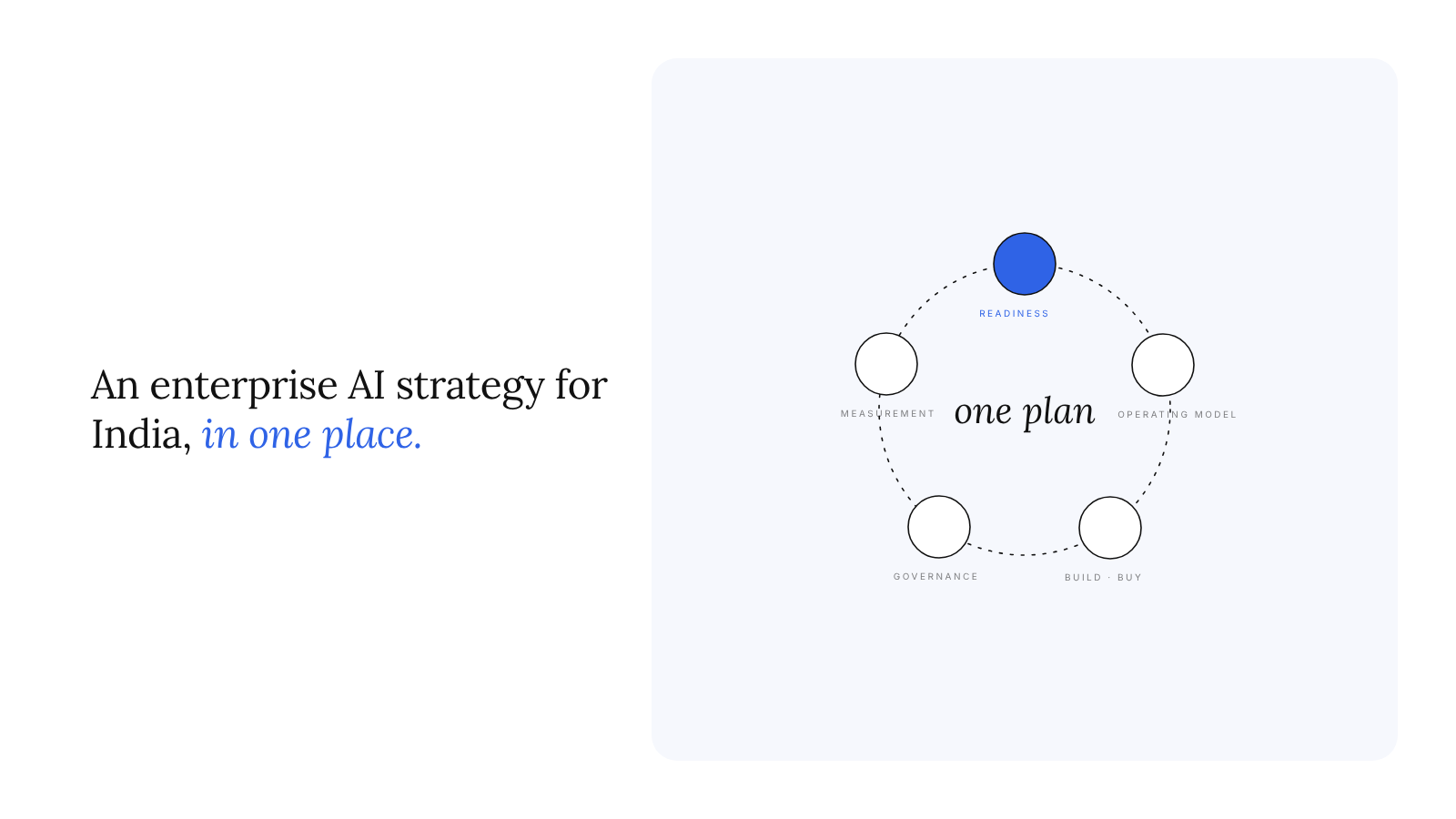
Over twenty-four articles, PanScience Research has examined enterprise AI in India one question at a time: why pilots stall, what the adoption surveys actually measure, when to build, buy or co-build, what the on-premise economics look like, how the regulated sectors are governed, how to evaluate a system before it goes live, how to measure what it returns. Each article stands alone. None of them, on its own, tells a chief executive what to do on Monday.
This article is the one-page version. It is a reference, not an argument, and it is built around a single master table that links the five decisions every enterprise AI strategy in India has to make, readiness, operating model, sourcing, governance and measurement, to the questions that decide them, the evidence that bears on them and the failure that follows from getting each wrong. Where a cell summarises a longer treatment, the separate PanScience Research piece is named so the reader can go deeper. The figures used are only those already established in the cluster; nothing new is introduced here, because the purpose is synthesis.
The framework rests on one premise that the whole cluster supports: an enterprise AI strategy in India is a sequence, not a list. Readiness decides which operating model is viable. The operating model decides what can sensibly be built rather than bought. The sourcing decision decides which governance obligations are the enterprise's own and which are a vendor's. And governance decides what can be measured, because a system that cannot be audited cannot be credited with a return. Enterprises that treat the five as independent choices, picking an operating model from a consulting deck and a sourcing policy from a procurement template, discover the dependencies the hard way.
Why an enterprise AI strategy in India needs its own framework
The global playbooks are not wrong for India; they are incomplete. McKinsey's State of AI 2025 survey found that 88 per cent of organisations use AI regularly in at least one function, that about one-third have begun to scale, and that only about 6 per cent, the "high performers", attribute 5 per cent or more of EBIT to AI. Those high performers were three times as likely to intend transformative change and nearly three times as likely to have fundamentally redesigned individual workflows. The lesson, that value follows workflow redesign rather than tool deployment, holds everywhere.
What is specific to India is the shape of the gap between pilots and scale and the regulatory floor beneath both. EY India's survey of over 200 enterprise leaders in November 2025 found 23 per cent at the pilot stage, 47 per cent with multiple generative AI use cases live in production and only 10 per cent scaling across the business; 47 per cent said more than a tenth of their proofs of concept had reached production; 91 per cent ranked speed of deployment as the top factor in deciding whether to buy or build. Indian enterprises are, by this evidence, better than the global average at getting to production and no better at getting to scale, and they are overwhelmingly buyers.
The regulatory floor is also distinctive. The Digital Personal Data Protection Rules notified on 14 November 2025 run on an eighteen-month phased window and impose additional obligations on significant data fiduciaries, including local storage of specified data. The Reserve Bank's FREE-AI committee report of August 2025 sets out seven sutras and 26 recommendations across six pillars for financial-sector AI; they are recommendations, not yet binding regulation. SEBI's cloud framework of March 2023 and the RBI's payment data localisation circular of April 2018 shape where data and inference may sit. An Indian enterprise AI strategy that does not begin from these constraints is a global strategy with the hard part left out.
The enterprise AI strategy India master table
The table is this article's contribution: a synthesis that places the five decisions in sequence and makes their dependencies explicit. Each row names the decision, the question that settles it, the options, the evidence from the cluster that bears on it, the failure mode when it is skipped or taken out of order, and the separate PanScience Research piece that treats it in full. Entries in the evidence column are drawn only from figures already verified in this cluster.
The order is the argument. An enterprise that begins at row 3, as most do, because the vendor conversation is the one that arrives unprompted, chooses a sourcing route for a workflow whose data it has not assessed, in an operating model it has not designed, with governance it will attach afterwards and measurement it will reconstruct from memory. The table does not say that rows 1 and 2 must be complete before row 3 begins. It says they must be answered for the workflow in question, and that the answers constrain what row 3 can sensibly choose.
Reading the table by sector
The master table is sector-neutral; the sector articles in this cluster apply it. Three readings illustrate how the rows interact.
In banking and financial services, row 4 dominates. The FREE-AI report's seven sutras (Trust is the Foundation; People First; Innovation over Restraint; Fairness and Equity; Accountability; Understandable by Design; and Safety, Resilience and Sustainability) and its 26 recommendations, including indigenous financial-sector models and sector data infrastructure, define the governance floor even before they bind. That floor pushes row 3 towards on-premise or hybrid inference for anything touching customer data, which raises the unit cost in row 5 and makes row 1, the quality of the bank's own data, the binding constraint on whether a domain model is worth building. The separate PanScience Research piece on AI in BFSI compliance under FREE-AI maps the use-case ladder to the sutras. PanScience Innovations reports that its venture OnFinance AI builds a BFSI compliance LLM with, by the company's description, 70-plus agents across 40-plus regulators; the description is company-reported and is cited here only as an example of the kind of system row 4 governs.
In health, row 1 is transformed by public rails. ABDM's 93 crore ABHA numbers, 104 crore linked health records and 23.21 crore scan-and-share tokens mean that a hospital group's data readiness is partly inherited from a national standard rather than built from scratch, which changes what rows 2 and 3 can assume. The separate piece on building health AI on ABDM rails sets out what the rails give a builder and what they do not. PanScience reports that its venture Parchaa is an ABDM-compliant healthtech platform with HMIS and PHR functions; again, company- reported and illustrative.
In the judiciary and public service, rows 1 and 5 are unusually legible. eCourts Phase III, with its ₹7,210 crore outlay, 18,735 computerised courts and 27.64 crore orders and judgments on the National Judicial Data Grid, has created a data estate on which AI can be evaluated, and pendency figures of 4.77 crore district cases, 63.66 lakh High Court cases and 92,101 Supreme Court cases supply a measurable baseline for row 5 that few enterprises possess. The separate piece on AI in the Indian judiciary maps the court workflow. PanScience reports its venture Nyaay AI, judicial workflow automation, with deployments in 14-plus Indian High Courts and three national supreme courts, a company-reported figure cited as an example of the category.
In manufacturing, row 1 is physical. The separate piece on industrial AI in Indian plants sets out a readiness ladder across data, connectivity, people and process, and the PLI schemes' ₹2.40 lakh crore of reported investment and 14.15 lakh jobs describe the capital base on which plant AI is being added. PanScience reports its venture PredCo as industrial AI and predictive maintenance for manufacturing plants.
What the framework does not decide
A reference framework should be explicit about its limits.
It does not decide the ambition. The McKinsey finding that high performers are three times as likely to intend transformative change describes a correlation among a small group; it does not tell a particular enterprise whether to pursue transformation or incremental efficiency, and the separate piece on digital transformation versus AI transformation argues that the two require different playbooks. The master table works for either, but it does not choose between them.
It does not decide the budget. The figures in the cluster describe what others spend, from Gartner's $176 billion of Indian IT spending to the more-than-20-per-cent-of-digital-budget commitment of McKinsey's high performers; they do not say what a given enterprise should spend. Row 5 tells it how to know whether it spent well.
It does not decide the language. A separate PanScience Research piece on Indic language AI in enterprise and public service maps use cases by the depth of language they require, from script handling to open conversation in dialect, and that depth interacts with every row: readiness in row 1 is per language, evaluation in row 4 is per language, and unit cost in row 5 is per language because of tokeniser economics. The master table assumes a single language for simplicity; most Indian deployments cannot.
It does not decide where the capability comes from. The separate piece on GCCs and where India's enterprise AI capability sits shows that the largest pools of production AI talent in India work for overseas parents and IT services clients, and that domestic enterprises are mostly buyers. Row 3's sourcing options are the same for every enterprise; the realistic mix depends on a talent market the framework describes but does not change.
And it does not decide when an internal capability should become a product. The separate piece on enterprise AI commercialisation sets out a five-part readiness test for that decision, a second customer, data rights, a dedicated team, margin and independence, which sits outside this table because it is a question about what to do with a capability after the five decisions have produced one.
Conclusion
An enterprise AI strategy for India is five decisions in a fixed order: establish whether the data is ready, decide where capability sits, choose for each workflow whether to build, buy or co-build and on what infrastructure, attach governance that satisfies both the enterprise's own standard and the regulator's floor, and measure against a baseline agreed before deployment. The evidence in this cluster says that Indian enterprises are good at getting to production and poor at getting to scale, that they are overwhelmingly buyers who prize speed, and that their regulatory environment is becoming more specific by the year. The master table is a way of holding those facts together with the decisions they bear on.
The twenty-four preceding articles are the detail. This one is the map. A reader who keeps only one page from the cluster should keep the table, and should read its rows from top to bottom.
Methodology and sources
This article is a synthesis and introduces no new figures. The master table is the author's original framework; the sequencing argument and the failure-mode column are analytical readings, not measured findings. All figures are drawn from sources verified for this cluster: McKinsey, The State of AI in 2025 (mckinsey.com/capabilities/tech-and- ai/our-insights/the-state-of-ai-2025), 1,993 participants in 105 nations, fielded 25 June to 29 July 2025; EY India, The AIdea of India: Outlook 2026, chapter 2 survey findings (ey.com/en_in/insights/ai/agentic-ai-india/aidea-survey- findings), 16 November 2025; the RBI FREE-AI committee report, August 2025, as released by RBI and summarised by KPMG; Gartner's India IT spending forecast of 18 November 2025 as reported by CXOToday; MIT NANDA, "The GenAI Divide: State of AI in Business 2025", August 2025, whose methodology has been publicly criticised; Menlo Ventures, State of GenAI in the Enterprise 2025, 9 December 2025; Vanta, State of Trust 2024; PIB releases on the DPDP Rules notification of 14 November 2025, eCourts Phase III (13 September 2023 and December 2024), ABDM (6 July 2026) and PLI schemes (Lok Sabha reply of 21 July 2026); the Lok Sabha reply on pendency of 13 February 2026 as reported by IANS; SEBI's cloud framework of 6 March 2023 and the RBI payment data localisation circular of 6 April 2018; NIST AI RMF 1.0 (January 2023) and ISO/IEC 42001:2023. Article titles cited are those of the other pieces in this PanScience Research cluster. PanScience Innovations facts are company-reported from panscience.xyz, read 24 October 2026; no client of any PanScience venture is named and no figure beyond the company's own published descriptions is stated.