
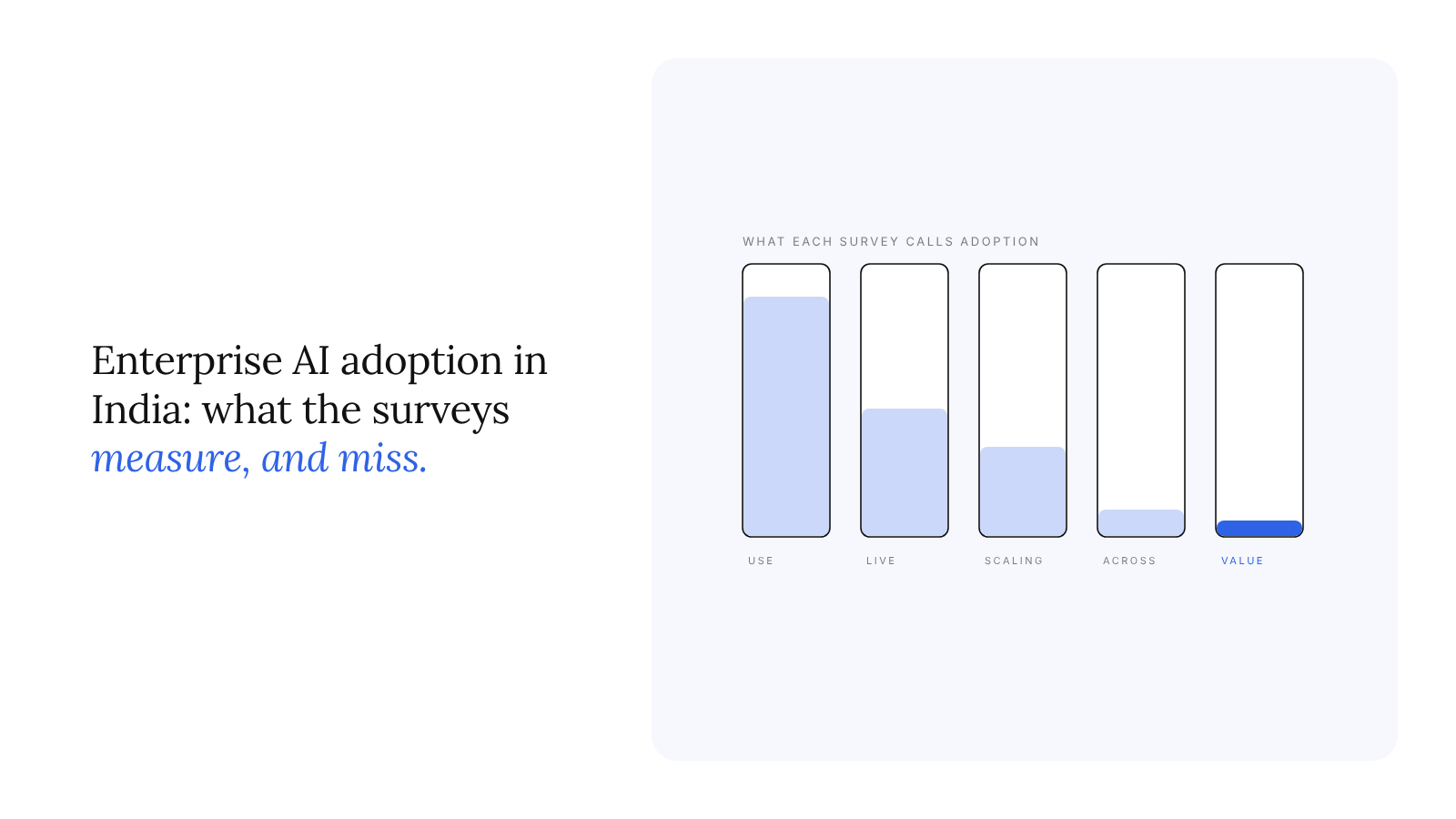
Ask five surveys about enterprise AI adoption in India and you will receive five answers that cannot all be true at once. One says 88 per cent of organisations use AI regularly. Another says 47 per cent of Indian enterprises have multiple generative AI use cases in production. A third scores India's AI maturity at 2.47 on a four-point scale and finds three-quarters of companies still planning at the proof-of-concept level. A fourth finds that only 4 per cent of Indian organisations are demonstrably ahead of their peers. A fifth, widely quoted, says 95 per cent of enterprise GenAI pilots deliver nothing.
Every one of these figures is accurate as a description of what its survey counted. The confusion arises because "adoption" is used to mean at least four different things: that someone in the organisation uses an AI tool; that a pilot exists; that a system is in production for a defined workflow; and that the system produces value a finance function would recognise. Enterprise AI adoption India figures move by tens of percentage points depending on which rung is being measured, and most commentary quotes them without saying which.
This article reconciles the main surveys available for 2026, states what each counts, places them on a common adoption ladder and then turns to what none of them measure well: the small and mid-sized enterprise, the shadow use of personal tools, the activity inside global capability centres, and the gap between a production deployment and a profit-and-loss effect. It is a reading of other people's datasets rather than a new one, and it says so where the reading is interpretive.
Enterprise AI adoption in India: the surveys, and what each one counts
Five sources carry most of the weight in the discussion. Their populations, dates, definitions and headline numbers differ, and the differences are the story.
McKinsey's State of AI 2025 is global. It surveyed 1,993 participants in 105 nations between 25 June and 29 July 2025, weighted by national share of GDP, so India is present but not separable in the published figures. Its headline, 88 per cent using AI regularly in at least one business function, counts use, the lowest rung. Its one-third "begun to scale" counts something closer to production. Its 39 per cent attributing any EBIT impact to AI, most under 5 per cent of EBIT, counts value, and its 6 per cent high performers (5 per cent or more of EBIT attributed to AI) count substantial value.
EY India's AIdea of India: Outlook 2026, published 16 November 2025, surveyed over 200 Indian enterprise leaders. Its distribution is 23 per cent at early stage or pilots, 47 per cent with multiple GenAI use cases live in production, and 10 per cent scaling across the business. The remaining fifth is not described on the published page. Its 47 per cent reporting that more than 10 per cent of proofs of concept have reached production is a conversion measure, and it is specifically about generative AI rather than AI in general.
The Nasscom-EY AI Adoption Index 2024, reported in August 2024 and January 2025, surveyed 500 companies (315 in its 2022 edition) and scored them on strategy, budget, talent, project management, data readiness, technology stack, and audit and control. India's overall score rose from 2.45 to 2.47 on a four-point scale. It found 87 per cent of enterprises in the middle "Enthusiast" and "Expert" stages, 45 per cent at Expert, 75 per cent with an AI strategy "at the proof-of-concept level", 40 per cent with dedicated AI funds and 64 per cent allocating at least 5 per cent of technology budget to AI. This is a preparedness index. Its stages are defined by organisational behaviour ("beyond proof-of-concepts to drive AI adoption" for Enthusiast; "collaborated with industry disruptors to implement AI solutions" for Expert), not by whether any system is in production or producing value.
The IDC InfoBrief commissioned by Dell Technologies and NVIDIA, dated January 2025 and released in India in August 2025, draws on IDC's APAC surveys of up to 919 respondents. It reports that 4 per cent of Indian organisations are demonstrably outpacing their industry peers in AI and machine-learning adoption and 32 per cent are "stuck in early stages". This is a relative-position measure: it ranks organisations against each other rather than against a fixed definition.
MIT NANDA's The GenAI Divide, August 2025, is not an Indian survey at all. It rests on a review of more than 300 public AI initiatives, 52 structured interviews and 153 survey responses gathered at four conferences, largely in the United States. Its 95 per cent figure, as a 2026 critique on the 80,000 Hours podcast set out, describes organisations that had not achieved a "marked and sustained" P&L effect from a custom GenAI tool within six months, a population that includes the roughly 80 per cent who had never piloted such a tool. It is quoted in Indian boardrooms constantly and measures nothing about India.
The reconciliation table
The table places each headline figure on a four-rung ladder: use (someone uses an AI tool), pilot (a proof of concept exists), production (a system runs in a live workflow), and value (a measurable financial or operational effect). The rung assignments are the author's reading of each survey's definitions and are stated as such.
Read down the ladder, the figures stop contradicting each other. Use is near universal, in India as elsewhere. Pilots exist in most large Indian enterprises, and the Nasscom-EY finding that three-quarters plan at the PoC level is consistent with EY's finding that a fifth are still only piloting while another half have a few things live. Production, in the sense of a system that runs in a live workflow, covers roughly half of large Indian enterprises on EY's count and roughly a third globally on McKinsey's, a difference that is more likely a definitional artefact (EY's "multiple use cases live" is a lower bar than McKinsey's "begun to scale") than a sign that India is ahead. Value is a minority everywhere, and no Indian survey yet measures it at the EBIT level McKinsey uses.
What the figures say about India specifically
Three observations survive the reconciliation.
First, Indian enterprise AI adoption is budget-constrained more than intent-constrained. Nasscom-EY found 68 per cent of organisations with ad hoc or basic AI budgets in 2022 and 40 per cent with dedicated funds in 2024; budget was the main concern in industrials and healthcare. EY's 76 per cent expecting significant business impact sits against its 10 per cent scaling. The intent is present; the recurring budget line is not. Gartner's forecast that Indian IT spending will rise 10.6 per cent to about $176 billion in 2026, with data-centre systems up 20.5 per cent and software up 17.6 per cent, suggests the money is arriving, but it arrives as infrastructure and licences before it arrives as production AI.
Second, adoption is sector-shaped. Nasscom-EY placed manufacturing and telecom, media and entertainment at the Expert stage and found 39 per cent of manufacturers and 65 per cent of transport and logistics firms pursuing transformation-focused strategies, while banking, retail, energy and healthcare were PoC-heavy with over 50 per cent in each. That pattern is plausible: manufacturing has measurable physical outcomes (yield, downtime, defects) and transport has measurable logistics outcomes, so pilots can be judged on money. Banking and healthcare carry heavier regulatory load, which this article returns to below. The practice of PanScience's ventures reflects the same split: PredCo, its industrial AI venture, works in plants where the metric is downtime; OnFinance AI, its BFSI compliance venture, reports agents mapped to 40 or more regulators, a problem shaped by regulation rather than by physics. Both are company-reported descriptions, not deployment data.
Third, India's buying posture is speed-first. EY found 91 per cent of leaders ranking speed of deployment as the top buy-versus-build factor, and Nasscom-EY noted that firms often start with AI-as-a-service. This is consistent with the MIT NANDA interview finding that externally sourced tools reached deployment about twice as often as internal builds, and with Menlo Ventures' 2025 finding that 76 per cent of enterprise AI deals are buy rather than build. A separate PanScience Research piece in this cluster sets out the build, buy and co-build economics.
What the surveys miss
The reconciliation also exposes four blind spots that the headline figures share.
The small and mid-sized enterprise is absent
Every survey above samples large organisations: enterprise leaders, C-suite executives, companies large enough to have an AI budget line to ask about. India's economy is not shaped like that sample. The PLI schemes alone have drawn ₹2.40 lakh crore of investment and 14.15 lakh jobs, much of it into mid-sized manufacturers whose AI adoption is nobody's survey population. The 88 per cent and the 47 per cent describe the top of the firm-size distribution. There is no comparable number for the firm with 300 employees and one IT manager, and policy that assumes the enterprise figures apply to it will be wrong.
Shadow use is not adoption, but it is not nothing
MIT NANDA's most robust finding was that workers at over 90 per cent of companies reported regular use of personal AI tools for work while only 40 per cent of companies had purchased an official subscription. The report dismissed this as individual productivity rather than P&L performance. That dismissal is too quick. Shadow use is how a workforce learns a technology, and it is also an unmanaged data-protection exposure: an employee pasting customer records into a consumer tool is a DPDP Act event in waiting, and the Rules notified in November 2025 give organisations an 18-month window to get this under control. Adoption surveys that count only sanctioned systems understate both the learning and the risk.
The capability centre question
A large share of the AI engineering done in India is done inside global capability centres for foreign parents, and it appears in no Indian enterprise adoption survey because the enterprise that adopts it is elsewhere. Stanford's AI Index 2025 ranks India second in GitHub AI contributions at 19.9 per cent and first in AI hiring vibrancy, figures that describe capability, not domestic adoption. The gap between where India's AI capability sits and where its enterprise adoption is measured is large enough to deserve its own treatment, and a later piece in this cluster gives it one.
Production is not value
The most consequential blind spot is the one the ladder makes visible. The Indian surveys stop at production. EY measures use cases "live"; Nasscom-EY measures preparedness; neither measures the rupee effect. McKinsey's global data shows why this matters: a third scaling collapses to 6 per cent seeing substantial EBIT impact. If India follows the same ratio, EY's 47 per cent with systems live translates to something under 10 per cent seeing a financial result a board would recognise, and the 10 per cent "scaling across the business" is the better proxy for value than the 47 per cent. This is an inference, not a measurement, and it is the measurement India's survey industry most needs to add.
Reading adoption figures in 2026 a short discipline
For a leader or investor confronted with an adoption statistic, four questions recover most of its meaning.
Which rung does it count? Use, pilot, production or value. A figure that does not say is almost always counting use or pilot.
Who was asked? A survey of 200 C-suite leaders at large enterprises describes large enterprises. A conference sample describes conference attendees.
Is it absolute or relative? "4 per cent outpacing peers" and "47 per cent in production" cannot be compared; one is a ranking and the other a count.
Is it India? The most quoted enterprise AI statistic of 2025 was American, built on 153 survey responses, and described a six-month P&L window its authors did not define.
Applied to the five figures in this article's opening paragraph, the discipline resolves the contradiction: 88 per cent use; roughly half of large Indian enterprises have something in production; three-quarters are still strategising at pilot scale; a small single-digit minority are clearly ahead; and the 95 per cent describes neither India nor failure in any ordinary sense.
Conclusion
Enterprise AI adoption in India in 2026 is real, broad and shallow. The surveys agree once their definitions are aligned: near-universal use, pilots in most large firms, live systems in perhaps half, scaling in a tenth, and value measured by almost no one. The country's position is not behind the global pattern so much as a year or so into it, with a budget posture that is still largely ad hoc and a buying posture that favours speed. The work for the next survey cycle is to count the rung that matters, which is value, and to count the firms that matter, which include the mid-sized ones nobody has yet asked.
Methodology and sources
This article is a reconciliation of published surveys; it introduces no new primary data. The four-rung adoption ladder (use, pilot, production, value) and the assignment of each survey figure to a rung are the author's interpretive reading and are labelled as such in the text. The inference that Indian value rates are likely to be below 10 per cent if global ratios hold is explicitly an inference. PanScience venture descriptions (PredCo, OnFinance AI) are company-reported from panscience.xyz and name no clients.
Observed figures come from: McKinsey, The state of AI in 2025 (https://www.mckinsey.com/capabilities/tech-and- ai/our-insights/the-state-of-ai-2025), 1,993 respondents in 105 nations, fielded 25 June to 29 July 2025. EY India, The AIdea of India: Outlook 2026, survey findings, 16 November 2025 (https://www.ey.com/en_in/insights/ai/agentic-ai- india/aidea-survey-findings). EY and Nasscom AI Adoption Index, 2022 edition page (https://www.ey.com/en_in/insights/ai/ey-nasscom-ai-adoption-index-is-ai-still-incubating-in-your-organization-or- driving-innovation) and 2024 edition as reported by Business Standard, 29 August 2024 (https://business- standard.com/amp/industry/news/indian-firms-should-scale-ai-beyond-pocs-prioritise-data-standardisation- 124082901051_1.html) and W.Media, 6 January 2025 (https://w.media/marginal-improvement-in-indias-ai-adoption- maturity-nasscom-report/). IDC InfoBrief for Dell Technologies and NVIDIA, January 2025, as released via CXOToday, 18 August 2025 (https://cxotoday.com/press-release/dell-technologies-releases-new-insights-india- forges-ahead-in-ai-adoption-driven-by-government-and-industry-leadership/). MIT NANDA, The GenAI Divide, as reported by Virtualization Review, 19 August 2025 (https://virtualizationreview.com/articles/2025/08/19/mit-report- finds-most-ai-business-investments-fail-reveals-genai-divide.aspx) and critiqued on the 80,000 Hours podcast, published 28 April 2026 (https://80000hours.org/podcast/episodes/ai-workplace-mit-study/). Gartner India IT spending forecast, 18 November 2025 (cxotoday.com); Stanford AI Index 2025; PLI scheme figures from the Lok Sabha reply of 21 July 2026; DPDP Rules notified 14 November 2025 (PIB); Menlo Ventures State of GenAI in the Enterprise 2025: all as held in the PanScience Research editorial register.