
Most large Indian enterprises have been through at least one digital transformation in the past decade. ERP consolidation, core banking migration, a customer app, a data lake, a cloud programme. The people who ran those programmes are now being asked to run the AI programme, and they are reaching, reasonably, for the playbook that worked last time: a transformation office, a target architecture, a multi-year roadmap, a change management stream and a vendor to carry the delivery risk.
Some of that playbook transfers. A good deal of it does not, and the parts that break are not the obvious ones. This piece sets out the digital transformation vs AI transformation comparison as a side-by-side: what the two programmes share, what the AI programme inherits intact, and where the old playbook actively misleads. It draws on McKinsey's 2018 global survey on digital transformation success, BCG's 2020 study of transformation odds, and McKinsey's 2025 global survey on AI, and it is written for the transformation leads and CIOs who have been handed both.
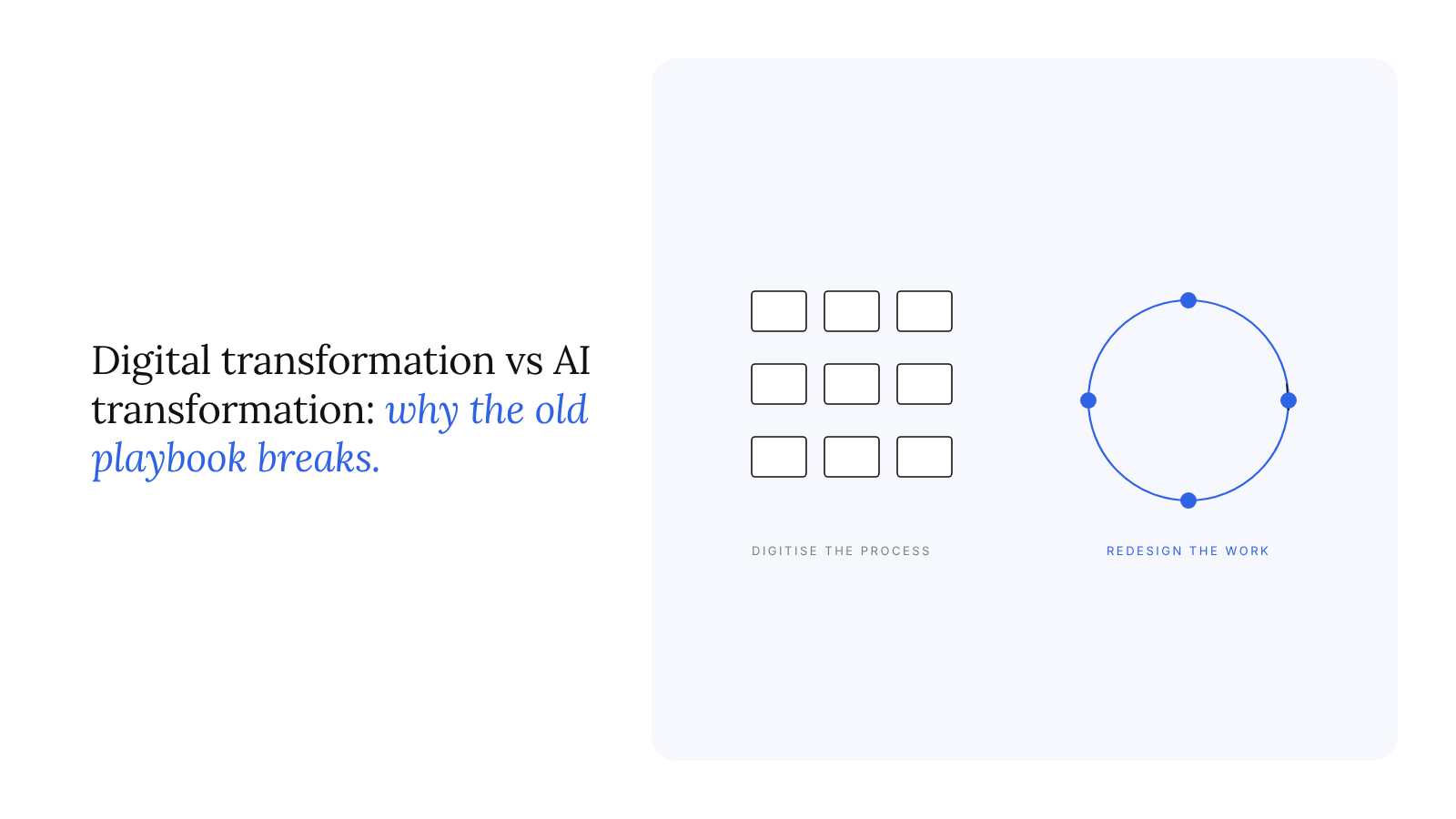
The central claim is that a digital transformation changed how the enterprise executed a known process, while an AI transformation changes what the enterprise is able to decide and at what cost. The first is an implementation problem with a known end state. The second is a capability problem whose end state moves while you build it. The playbook was written for the first.
What the digital transformation record actually shows
The record on digital transformation is sobering and well documented. McKinsey's October 2018 global survey of 1,793 participants, 1,521 of whom had been part of at least one digital transformation in the previous five years, found that only 16% said their transformation had improved performance and sustained the change, with a further 7% reporting improvement that was not sustained. McKinsey noted that transformations in general succeed less than 30% of the time, with earlier surveys reporting 20% in 2016, 26% in 2014 and 20% in 2012. Digitally savvy industries such as high tech, media and telecom did no better than 26%, and traditional industries including oil and gas, automotive, infrastructure and pharmaceuticals ranged from 4% to 11%. Organisations with fewer than 100 employees were 2.7 times more likely to report success than those with more than 50,000.
BCG's 2020 study, based on a survey of 825 senior executives and BCG's own data from about 70 client companies, found that only 30% of digital transformations achieved their objectives. 44% landed in what BCG called the worry zone, creating some value but missing targets and producing limited lasting change, and 26% in the woe zone, creating less than half the targeted value and no sustainable change. BCG identified six success factors: an integrated strategy with clear, quantified goals; leadership commitment from the CEO through middle management; top talent assigned to the programme; agile governance that drives adoption; effective monitoring against defined outcomes; and a business-led, modular technology and data platform. Getting all six right, BCG reported, raised the odds of success from 30% to 80%.
McKinsey's 2018 analysis identified 21 practices correlated with success, grouped into five categories: digitally savvy leaders in place; capabilities for the future workforce; empowering people to work in new ways; a digital upgrade to day-to-day tools; and frequent communication. Several effects were large. A clear change story made success more than three times as likely. Redefining roles and responsibilities raised the odds by 1.5 times. Engaging a chief digital officer, which fewer than a third did, made success 1.6 times more likely.
These findings are now the canon of transformation practice. Almost every transformation office in Indian industry has, somewhere, a version of the six factors or the five categories pinned to its wall.
What the AI transformation record shows so far
The AI record is younger and already different in shape. McKinsey's The state of AI in 2025, a survey of 1,993 participants in 105 nations, found 88% of organisations using AI regularly in at least one function, up from 78% a year earlier, and about one-third beginning to scale AI programmes. Yet only 39% attribute any EBIT impact to AI, and most of those put it at under 5% of EBIT. About 6% of respondents qualify as high performers, attributing 5% or more of EBIT to AI. The defining behaviour of that 6% is instructive: they are nearly three times as likely as others to have fundamentally redesigned individual workflows, more than three times as likely to intend AI-driven transformative change, three-quarters are scaling AI against one-third of others, and more than a third commit over 20% of their digital budgets to AI.
Adoption is therefore nearly universal and value is concentrated. That is a different distribution from digital transformation, where adoption itself was the programme. Nobody in 2015 had "accidentally" migrated their core banking system. In 2026, most enterprises have AI in use somewhere whether or not a transformation was declared, because it arrived inside the software they already buy.
The failure modes are also different. The MIT NANDA report of August 2025 claimed about 95% of enterprise GenAI pilots deliver no measurable P&L impact, a figure whose methodology has been criticised and which this piece treats as directional only. Gartner forecast in June 2025 that over 40% of agentic AI projects would be cancelled by the end of 2027, citing escalating costs, unclear business value and inadequate risk controls. The digital transformation literature talks about programmes that ran over budget and under-delivered. The AI literature talks about pilots that succeeded technically and never became anything. Those are not the same disease.
Digital transformation vs AI transformation: the side-by-side
The table compares the two programmes across the dimensions that determine how they should be run. The classification of what transfers and what breaks is the authors' analytical reading of the two bodies of evidence, not a survey result.
Six of thirteen dimensions break outright and four more transfer only with revision. The three that transfer intact, leadership commitment, change story and talent discipline, are the human elements, and that is the first lesson: the people side of the playbook is the part worth keeping.
Four places the old playbook misleads
The side-by-side points to four specific traps for a transformation leader who runs the AI programme as a digital one.
The fixed-scope contract. The digital playbook's strongest instinct is to define the scope and transfer delivery risk to a vendor. Under AI, scope is the thing that cannot be fixed. The model that was best at contract signing is not best at go-live. The use case that justified the business case turns out to have a data problem, and the adjacent one nobody scoped turns out to be the valuable one. A fixed-scope contract converts this learning into change requests. EY India's November 2025 survey of over 200 enterprise leaders found 91% ranking speed of deployment as the top factor in buy-versus-build decisions, which is understandable but sits uneasily with the traditional procurement cycle. A separate PanScience Research piece covers build, buy and co-build economics in detail.
Adoption as the goal. Digital transformations measured success partly by adoption, because getting people to use the new system was the hard part. AI adoption is nearly universal at the surface and means little. McKinsey's 88% regular-use figure and 39% EBIT-impact figure describe the same population. A transformation office that reports "AI adopted in nine functions" has reported nothing about value. The right metric is the measured effect in the three tiers of cost, revenue and risk; a separate PanScience Research piece sets out that ledger.
The end-state architecture. A target architecture is the digital programme's north star. For AI, a target architecture drawn in 2024 would have specified models, context sizes, costs and deployment patterns that were obsolete by 2026. What endures is the data layer and the control layer: where data lives, who may reach it, how every model call is logged and governed. The architecture to fix is the one around the models, not the models themselves.
The programme end. Digital programmes end. There is a go-live, a hypercare period and a handover to run. AI programmes do not end in this sense, because the models drift, the costs change, the regulation moves and the next workflow is always available. The budget shape must change from a capital programme to a sustained operating capability, and the organisation must change from a programme office that disbands to a function that persists. McKinsey's observation that high performers commit more than 20% of digital budgets to AI is a statement about ongoing allocation, not a one-off project.
What the Indian context adds
Two features of the Indian enterprise landscape sharpen the comparison.
The first is regulation that treats the system's behaviour, not just its delivery, as the object of oversight. The DPDP Rules notified in November 2025, SEBI's cloud and cyber frameworks, and the RBI's FREE-AI recommendations all reach into how an AI system makes decisions, where its data sits and who is accountable for its errors. A digital transformation's regulatory workstream was mostly about data residency and audit trails. An AI transformation's regulatory workstream is about the decisions the system takes. A separate PanScience Research piece covers the board-level obligations.
The second is the IT services and GCC ecosystem. Indian enterprises are used to buying transformation as a service from firms that have run hundreds of ERP and cloud migrations. Those firms are now selling AI transformation in the same frame, and some of what they bring, programme discipline, change management, integration skill, transfers well. What transfers less well is the delivery model built around fixed scope and transferred risk, for the reasons above. A separate PanScience Research piece compares the partner types available to an Indian enterprise for AI.
A revised playbook, in outline
The comparison suggests not a new playbook but a revised one, keeping the human elements and replacing the delivery mechanics.
Keep the leadership commitment, the change story, the attention to roles and talent, and the business-led platform. These are BCG's factors two, three and six and McKinsey's five categories, and the AI evidence suggests they matter at least as much.
Replace the fixed end state with a direction and a set of decision gates. Replace scope-and-transfer contracting with staged commitments that can be stopped, in which the Gartner cancellation statistic is a planned outcome for a share of experiments rather than a failure. Replace adoption metrics with measured value by tier. Replace the target architecture with a fixed data and control layer and a replaceable model layer. Replace the programme office that ends with a capability that persists and a budget line that recurs.
The organisations McKinsey identifies as high performers look, on the survey evidence, like organisations that have already made these substitutions: they redesign workflows rather than install systems, they scale what works, they fund AI continuously and their senior leaders own it. They are 6% of the sample. The other 94% are, for the most part, running the old playbook well.
Conclusion
Digital transformation vs AI transformation is not a question of which is harder. Both have poor success rates, documented over years. It is a question of which parts of a hard-won discipline apply to a new kind of problem. The evidence from McKinsey and BCG on digital transformation says the human factors, leadership, communication, talent and a business-led platform, drove success. The evidence from McKinsey's 2025 AI survey says those same factors still matter, but that the delivery mechanics, fixed scope, target architecture, adoption as the goal and a programme that ends, now mislead. Transformation leaders who keep the first half of their playbook and rewrite the second will be better placed than those who keep all of it or throw all of it away.
Methodology and sources
The side-by-side classification of what transfers and what breaks, and the four traps, are an original analytical reading of the sources below and are not themselves survey findings. McKinsey, "Unlocking success in digital transformations", 29 October 2018, based on a global survey fielded 16 to 26 January 2018 with 1,793 participants (https://www.mckinsey.com/capabilities/people-and-organizational-performance/our-insights/unlocking-success-in- digital-transformations): 16% improved and sustained, 7% improved but not sustained, less than 30% general success rate, industry ranges, size effect, 21 practices in five categories, change story, role redefinition and chief digital officer effects. BCG, "Flipping the Odds of Digital Transformation Success", 2020, survey of 825 executives and about 70 BCG client companies (https://www.bcg.com/publications/2020/increasing-odds-of-success-in-digital- transformation): 30% success, 44% worry zone, 26% woe zone, six success factors, 30% to 80%. McKinsey, The state of AI in 2025, survey of 1,993 participants in 105 nations fielded 25 June to 29 July 2025 (https://www.mckinsey.com/capabilities/tech-and-ai/our-insights/the-state-of-ai-2025): 88% regular use, one-third scaling, 39% EBIT impact mostly under 5%, high performers about 6% and their characteristics. Gartner press release, 25 June 2025 (https://www.gartner.com/en/newsroom/press-releases/2025-06-25-gartner-predicts-over-40- percent-of-agentic-ai-projects-will-be-canceled-by-end-of-2027): over 40% of agentic AI projects cancelled by end- 2027 and causes. EY India, The AIdea of India: Outlook 2026, 16 November 2025 (https://www.ey.com/en_in/insights/ai/agentic-ai-india/aidea-survey-findings): 91% rank speed of deployment top buy-versus-build factor, editor-verified. MIT NANDA, The GenAI Divide, August 2025: about 95% of pilots without measurable P&L impact, editor-verified and treated as directional given published criticism of the methodology. The DPDP Rules notification of 14 November 2025, SEBI frameworks and RBI FREE-AI report are referenced for context and are covered in detail, with sources, in the companion PanScience Research piece on AI governance for boards.