
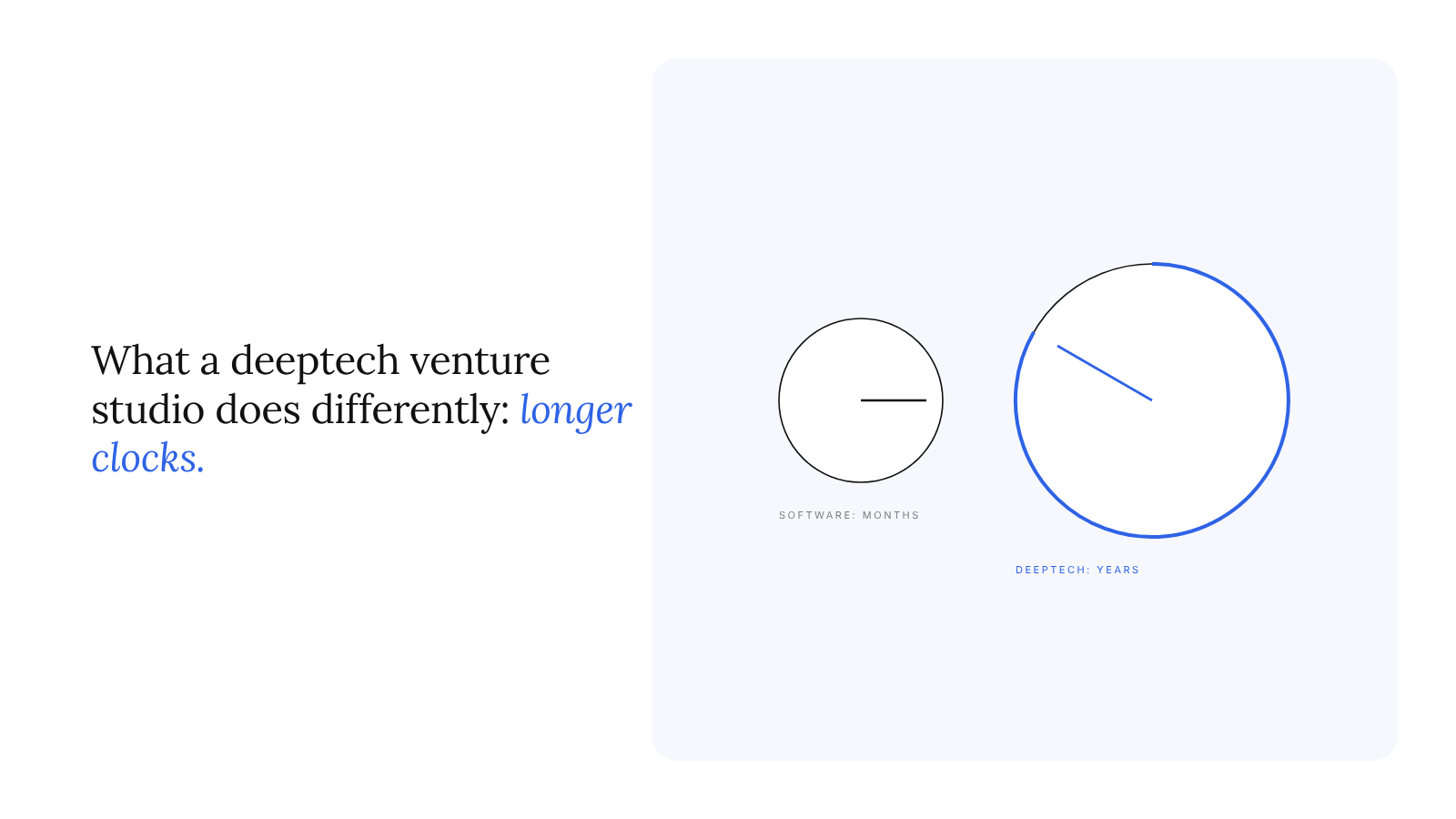
A software venture studio and a deeptech venture studio share a name and a basic idea: a permanent team that originates companies, supplies shared functions and co-founds ventures rather than waiting for founders to arrive with a pitch. Past that point the two models diverge. The software studio is optimised for speed of iteration against a market that already exists. The deeptech venture studio is optimised for something harder: carrying a scientific or engineering result across years of technical uncertainty until it becomes a product that someone will pay for, and doing so without running out of money, people or patience on the way.
The difference is not a matter of degree. Boston Consulting Group and Hello Tomorrow, in a 2019 study built on a survey of more than 2,000 startups, defined deep technologies as "novel" and offering "significant advances over technologies currently in use", and named three traits that set them apart: large impact, a long time to market-ready maturity, and substantial capital needs. Their numbers make the contrast concrete. A biotech startup in the sample took about four years from incorporation to market, 1.8 years of it to reach a first prototype, and spent almost $1.3 million to build that prototype. A blockchain startup reached market in 2.4 years and spent about $200,000 on its first prototype. A studio that treats these two companies with the same playbook will get one of them wrong.
This piece sets out what changes when a studio commits to deep technology: the clocks it runs on, the science it has to manage, the money it has to assemble and the exits it can realistically plan for. It closes with a side-by-side comparison of the two studio types. The general mechanics of venture studios, their legal structures and the terms on which they co-build with founders are covered in PanScience Research's first cluster and are not repeated here.
Why deep technology breaks the standard studio model
The standard studio model, as it developed for internet and software businesses, rests on three assumptions. First, that the technology is available and the risk is in the market: will customers want this, and can the venture reach them cheaply? Second, that a venture can be validated in months, so a studio can run many experiments and kill most of them quickly. Third, that a seed round followed by venture capital will fund the company once it shows early traction.
Deep technology weakens all three. The technical risk comes first and is often binary: the catalyst works at scale or it does not, the protein folds and binds as designed or it does not, the sensor holds its accuracy outside the laboratory or it does not. Validation takes years rather than months, because experiments are physical, regulated or both. And the venture capital model, as BCG's 2021 report "Deep Tech and the Great Wave of Innovation" put it, is "insufficient in scope" for companies that need "continuous investment from conception through commercialization". Public and private funds, the same report notes, are often essential in the early years.
None of this means that deep technology is uninvestable. BCG estimated that investment in deep tech, counting private rounds, minority stakes, M&A and IPOs, rose from $15 billion in 2016 to more than $60 billion in 2020, and that the average disclosed private investment per event rose from $13 million to $44 million over the same period. It means that the shape of the company, and of the studio that builds it, has to match the shape of the risk.
In India the gap between interest and capital is visible in the data. The Nasscom-Zinnov Indian Tech Start-up Report 2025 counts more than 4,200 deeptech startups and puts deeptech funding at $2.3 billion in 2025, with artificial intelligence taking 91% of it. The IVCA Bharat DeepTech Report 2026, as reported by YourStory, puts cumulative deeptech funding since 2015 at $11.4 billion and finds that only about 15% of funds back ventures at technology readiness levels 1 to 3, with investor participation falling sharply after seed. Read together, these figures say that most Indian deeptech money flows to AI applications that sit close to software, and that the earliest and hardest science is the least funded. That is precisely the territory a deeptech venture studio is meant to occupy. A separate PanScience Research piece on deeptech funding in India maps where each kind of capital runs out.
Three clocks instead of one
The most useful way to describe a deeptech studio's job is that it runs three clocks at once, and a software studio runs only one.
The science clock measures how long it takes to move a result from a controlled demonstration to a reliable, repeatable capability. It is set by physics, chemistry, biology and engineering, and it cannot be compressed by hiring more salespeople. BCG's 2021 report describes the "design-build-test-learn" engineering cycle as the engine that drives deep tech, and notes that machine learning and automation are shortening it: in one early demonstration it cites, development time for a class of OLED materials fell from seven years to 1.5 years. The studio's contribution on this clock is to shorten each loop of the cycle by giving the team equipment, data, simulation tools and experienced reviewers, rather than leaving a postdoctoral founder to assemble them alone.
The product clock measures how long it takes to turn a capability into something a buyer can install, certify, maintain and pay for. A working sensor is not a product until it has an enclosure, firmware, calibration routines, a support process and, in many sectors, a certificate. This clock is where many scientist-led companies stall: the science is done, but nobody on the team has shipped a product to an industrial or regulated customer. A studio's shared product, engineering and quality functions matter most here.
The market clock measures how long it takes for buyers to be ready. In deep technology this is often set externally, by regulation, by a mission's procurement calendar, by a corporate's capital expenditure cycle or by the arrival of a complementary technology. A carbon accounting product depends on disclosure rules being enforced. The studio's job on this clock is to watch the external timetable and to make sure the venture reaches product readiness close to the moment the market opens, rather than years before it, burning cash, or years after it, behind a competitor.
A software studio can usually assume the science clock is at zero and the market clock is already running. A deeptech venture studio has to synchronise all three, and the most common failure is a mismatch: a technology that is ready before its market, or a market that opens before the product is certifiable. The next article in this cluster maps each technology readiness level to the commercial milestone that should accompany it, which is one practical way to keep the clocks aligned.
Harder science: what the studio has to supply
In a software studio the shared services are typically product management, design, engineering, growth and finance. In a deeptech studio those remain, but three further capabilities become decisive.
The first is scientific diligence that is independent of the founding scientist. A deeptech venture often starts from one person's or one laboratory's result. The studio has to be able to judge whether that result is robust, whether it has been reproduced, whether the claimed performance holds outside ideal conditions and whether the intellectual property is clean. This requires reviewers who understand the field well enough to ask awkward questions, and a culture in which the founding scientist accepts them.
The second is access to physical and computational infrastructure. A protein design venture needs wet laboratory validation as well as compute. An emissions measurement venture needs field sites and reference instruments. A quantum venture needs cryogenics, photonics or specialised fabrication. The studio either owns some of this, negotiates access to it through research institutions and corporate partners, or helps the venture budget for it explicitly. The third is regulatory and certification knowledge. Many deep technologies enter markets where a product cannot be sold until it has passed a standard: medical device rules, safety certifications for industrial equipment, telecom approvals, defence qualification. A studio that has taken one venture through a certification process carries that knowledge into the next one, and this is one of the clearest arguments for the studio model in deep technology. McKinsey's 2024 survey of 1,176 executives on corporate venture building found that experienced builders were roughly twice as likely to succeed as first-timers, and that novices were about three times as likely to fail to reach product-market fit. That finding concerns corporate builders, but the logic of accumulated experience applies with more force where the hard parts are technical and regulatory.
PanScience offers one example of how a studio organises this. Alongside its operating ventures, the company reports an internal Quantum Lab run as an R&D initiative, and lists stealth ventures under three category labels on its site: agentic operations, protein design and emissions AI. The pattern is a common one in deeptech studios: an internal research unit where the science clock runs before any company is incorporated, and a set of early ventures in fields where the science is moving fast but the product and market clocks have not yet started. The point is not the specific fields but the sequencing. Incorporating too early starts the cost of a company, including founders' expectations of salary and equity, before the science justifies it.
Different money: assembling capital for a long clock
Capital is where the deeptech studio differs most visibly. A software studio typically funds a venture's first months from its own balance sheet and then hands it to seed investors. A deeptech studio has to assemble a capital stack that matches the three clocks, and that stack has more layers.
Non-dilutive money comes first in most cases: research grants, government mission funding, challenge prizes and sponsored research from corporates. In India, national programmes such as the Anusandhan National Research Foundation and the ₹1 lakh crore Research Development and Innovation fund are meant to widen this layer, and a separate article in this cluster examines what they make possible. Grant money is slow and comes with reporting obligations, but it lets a venture reach the end of the science clock without giving away most of its equity.
Studio capital comes next. The studio's own investment, often in the form of people and services rather than cash, pays for the period in which the venture is too early for grants alone and too risky for venture investors. Because deeptech ventures need this support for longer, the studio's economics depend on taking a larger and longer position than a software studio would, and on being honest with founders about why. Strategic and corporate money becomes important once the product clock is running. Corporates can fund pilots, co-development and early purchase commitments, and they are often the only buyers able to judge a deep technology's value. They also bring the risk that a single corporate partner shapes the venture around its own needs. Venture capital arrives last, once technical risk is largely retired and the remaining risk is commercial. The IVCA finding that participation drops sharply after seed suggests that, in India, this hand-off is where many deeptech ventures stall.
The practical consequence for a deeptech studio is that fundraising is a continuous function rather than an event. Someone in the studio has to track grant calls, mission procurement calendars and corporate budget cycles, and match each venture's next milestone to the money that can pay for it.
Exits on a deeptech timeline
The exit question follows from the clocks and the capital. Software studios plan for venture-backed growth and an eventual acquisition or listing, and they can often see a path within five to seven years. Deeptech ventures may need longer simply to reach meaningful revenue, and the acquirers most likely to value them are strategic: industrial groups, pharmaceutical companies, defence and infrastructure firms, and large technology companies buying capability rather than revenue.
This has three implications. The studio must plan for liquidity that may arrive a decade after incorporation, which affects how it funds itself and what it promises its own investors. The venture must build relationships with likely acquirers early, typically as customers or co- development partners, because a strategic buyer rarely acquires a deep technology it has never tested. And the studio must accept that some ventures will end as licensing businesses or acqui-hires rather than independent companies, which is a reasonable outcome for a scientific result that matters more as a component of someone else's system than as a stand-alone product.
Software studio and deeptech venture studio compared
The table below sets out the differences discussed above. It is an analytical comparison built from the sources in this article and from the logic of the three clocks; the ranges are illustrative rather than measured averages, except where a source is named.
Two features of the table deserve emphasis. The first is that kill decisions in a deeptech studio are slower but not rarer. A studio that never stops a deeptech project is not patient, it is indecisive. The difference is that the kill criterion is a technical milestone with a date, not a traction metric. The second is that the founding team is wider. Most successful deeptech ventures pair a scientist who understands what the technology can do with someone who knows how the target industry buys. A studio can supply the second person, and finding that person is often its single most valuable act.
What this means for founders, corporates and policymakers
For scientists considering a studio, the comparison suggests a useful test. Ask whether the studio has independent scientific reviewers in the field, access to the infrastructure the venture will need, and experience of the relevant certification process. A studio that offers only software services and seed introductions is a software studio, whatever it calls itself.
For corporates, a deeptech studio is most useful as a route to technology their own R&D cannot deliver in time, and as a way to test it as a customer before investing. Later articles in this cluster cover these relationships.
For policymakers, the three clocks suggest that public money is most valuable where private money is weakest: at the end of the science clock and the start of the product clock, where the IVCA data show funding thinning out. Grants that fund only laboratory work, and procurement that buys only certified products, leave a gap in between that neither laboratories nor investors are equipped to fill.
Conclusion
A deeptech venture studio is not a software studio with longer runways. It manages three clocks rather than one, retires technical risk before market risk, assembles capital from grants, studio resources, corporates and only later venture investors, and plans for exits that are mostly strategic and often a decade away. The evidence from BCG and Hello Tomorrow on prototype times and costs, and from Indian data showing that the earliest science attracts the least capital, points to the same conclusion: the value of a deeptech studio lies in synchronising science, product and market, and in staying solvent and decisive for long enough to do it.
Methodology and sources
This article is an analytical synthesis. The comparison table and the three-clocks framework are original to PanScience Research; the ranges in the table are illustrative except where a figure is attributed to a named source. Deep tech definitions and the biotech and blockchain prototype times and costs come from BCG and Hello Tomorrow, "The Dawn of the Deep Tech Ecosystem" (March 2019; media- publications.bcg.com/BCG-The-Dawn-of-the-Deep-Tech-Ecosystem-Mar-2019.pdf); those figures come from the authors' survey of Hello Tomorrow Global Challenge applicants and exclude pre-incorporation research grants. Deep tech investment figures, the design-build-test- learn cycle and the OLED example come from BCG, "Deep Tech and the Great Wave of Innovation" (March 2021; bcg.com/publications/2021/deep-tech-innovation); BCG describes the investment figures as preliminary estimates. Indian startup and funding figures come from the Nasscom-Zinnov Indian Tech Start-up Report 2025 (February 2026; zinnov.com) and from YourStory's August 2026 coverage of the IVCA Bharat DeepTech Report 2026 (yourstory.com). Corporate venture building success rates come from McKinsey, "How CEOs are turning corporate venture building into outsize growth" (October 2024; mckinsey.com). Information about PanScience's Quantum Lab and stealth venture categories is company-reported from panscience.xyz. RDI fund and ANRF figures are from Department of Science and Technology statistics reported in Parliament and are examined in more detail elsewhere in this cluster.