
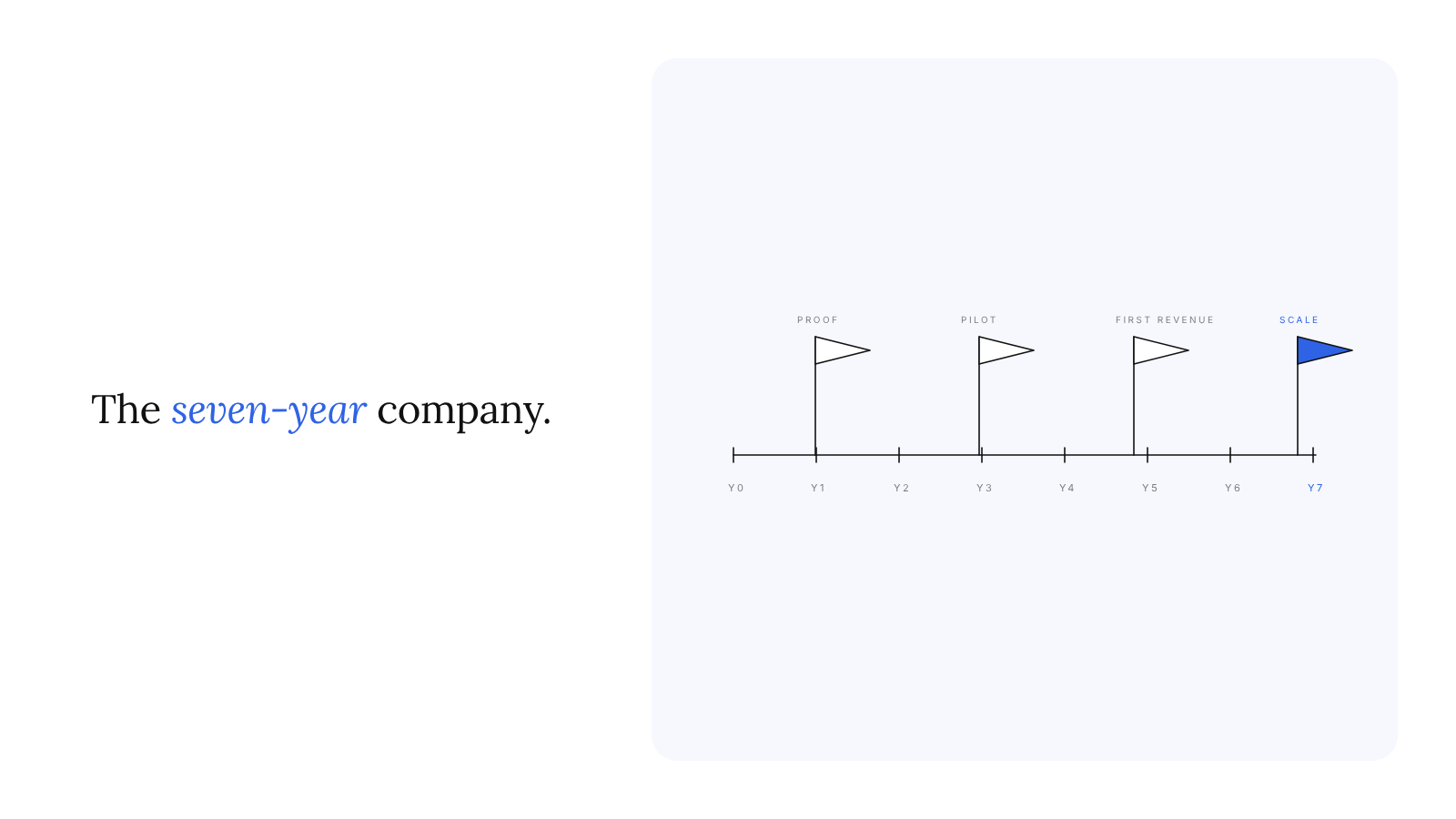
A software founder who has not found product-market fit by year three is usually told to pivot or stop. A deeptech founder in year three may be exactly on schedule: the core science is validated, the first engineering prototype is running and the first serious customer has agreed to a pilot. The two companies can look identical on a cap table and be on entirely different clocks.
Planning a deeptech startup timeline is therefore not a matter of stretching a software plan. It means setting milestones that make sense for a company whose technical risk is retired in stages over five to ten years, raising money in a market whose investors mostly work on shorter horizons, and keeping a team motivated through long periods when progress is visible only in the lab. This article draws on the available evidence on deeptech time to market, sets out how India's rules now acknowledge the longer clock, and offers a milestone plan template with explicit go and no-go criteria for each phase.
The template is meant to be argued with. Its value lies less in the specific durations than in forcing a founding team, its board and its investors to agree in advance what success at each stage looks like and what would cause them to stop.
What the evidence says about deeptech timelines
Systematic data on deeptech time to market is thinner than founders might hope, but the evidence that exists points in one direction. BCG and Hello Tomorrow's 2019 study of startups in the Hello Tomorrow Challenge between 2016 and 2018 found that biotech ventures took about four years from incorporation to market: 1.8 years to a first prototype and a further 2.2 years from prototype to market. Blockchain ventures, closer to software, took about 2.4 years in total. The same study noted that deep tech development almost always takes longer than building on widely available technology such as a mobile app, and that venture funds must return capital to their investors after a set period, often under ten years.
A later BCG Digital Ventures paper from June 2022 drew a similar distinction between "pioneering" technologies such as industrial IoT and applied AI, which can offer go-to-market opportunities within 12 to 18 months, and "visionary" technologies such as quantum computing, synthetic biology and nanotechnology, which may take more than five years to reach commercialisation.
Two cautions apply. First, "time to market" in these studies means a first product, not a self-sustaining business; repeatable revenue usually comes later. Second, the BCG figures come from a competition population, which may be more advanced than the average lab spin-out. If anything, they understate the typical clock.
India's capital market sharpens the problem. The IVCA Bharat DeepTech Report 2026, as reported by YourStory, estimated $11.4 billion of cumulative deeptech funding in India from 2015 to mid-2026, found that only about 15% of funds back ventures at TRL 1 to 3, and noted that investor participation drops sharply after seed. A company on a seven-year clock is likely to need several rounds from a shrinking pool of investors.
How India now recognises the longer clock
Policy has started to adjust. Under DPIIT notification G.S.R. 108(E) of 4 February 2026, general startup recognition now runs for 10 years and up to ₹200 crore of turnover, while a new Deep Tech Startup category runs for 20 years and up to ₹300 crore. A separate PanScience Research piece covers what the new category changes in detail. For timeline planning, the significance is that the state now formally accepts that a science-based company may still be a startup in its second decade, which affects eligibility for procurement relaxations and other benefits across a much longer plan.
Why a deeptech startup timeline needs a different structure
Three structural features set a deeptech plan apart.
Risk is retired in a fixed order. Technical risk comes first: does the effect work, can it be engineered, can it be made reliably? Commercial risk follows: will a buyer pay, at what price, through which channel? Software companies often reverse the order, testing demand before building. Deeptech companies can test demand early through conversations and letters of intent, but cannot fully retire commercial risk until the technology exists in a usable form.
Capital needs are lumpy. Costs jump at specific points: the first engineering prototype, field pilots, certification, pilot production or clinical work. A separate PanScience Research piece sets out a cash ladder for hardware companies in India; the general point is that rounds should be sized to reach the next milestone that changes the company's risk profile, not to a fixed number of months.
Morale has long dry spells. In software, a team sees users, releases and metrics every week. In deeptech, months can pass between visible results. Founders who plan for this, by making intermediate technical results visible and by celebrating milestones that outsiders would not notice, keep teams longer.
A milestone plan template with go and no-go criteria
The template below is this article's original contribution. It divides a seven-year deeptech company into five phases. Each phase has a technical milestone, a commercial milestone, a capital event, and explicit go and no-go criteria that the board agrees at the start of the phase. Durations are indicative and assume a venture in the middle of the range: harder than applied AI, easier than a new drug.
How to use the template.
1. Agree criteria before the phase starts. The go and no-go criteria are useful only if set in advance. Retrospective criteria are always met. 2. Overlap phases deliberately. The year ranges overlap because commercial work should start before technical work finishes. A company that waits for a finished prototype before talking to buyers loses a year. 3. Tie each round to a phase exit. A seed round should be sized to complete phase 2 with a buffer; a Series A to complete phase 4. Raising for a period of time rather than a milestone is how deeptech companies end up raising bridges. 4. Name a no-go decision maker. Someone on the board, often an independent director or the lead investor, should be responsible for calling a no-go review when signals appear. This is not a vote of no confidence; it is a scheduled check. 5. Allow one pivot per phase. A no-go signal should usually trigger a defined pivot, such as a different application of the same technology, a different first market or a different business model, before a decision to stop.
Reading the template against a worked case
Consider a hypothetical industrial sensing venture, spun out of a materials laboratory, whose core claim is that a new sensing film can detect corrosion inside pipelines earlier than existing inspection methods. The case is illustrative and not based on any specific company.
In phase 1, the go criterion is not "the film works". It is that the film detects a defined level of corrosion, under temperature and humidity ranges typical of a refinery, in tests run by someone other than the inventor. The commercial half of the criterion is that at least three plant maintenance heads describe unplanned shutdowns from corrosion as a budgeted problem. If the film only performs in a controlled chamber, the no-go review asks whether a narrower environment, such as indoor water systems, is a viable first market before deciding to stop.
In phase 2, the prototype has to survive installation by a plant technician, not a PhD student. The design partner's commitment is measured in hours of their engineers' time and access to a test site, not in enthusiasm. In phase 3, the pilot threshold is agreed in writing before installation: for instance, detection of a specified share of known corrosion points against the plant's existing inspection record over six months. A pilot that ends with "promising" and no number has failed the criterion, however pleasant the meetings.
The worked case shows why the criteria must be written in the buyer's terms as well as the scientist's. Most deeptech plans state technical milestones precisely and commercial ones loosely. The template's purpose is to make both equally testable.
Runway: how many rounds the clock implies
The template implies a capital sequence of four to six rounds over seven years, including at least one bridge. That has consequences for ownership that founders should model at the start.
Carta reported in July 2026 that median dilution at both seed and Series A was 18%. Inc42 reported a median Indian seed ticket of $1 million in the first half of 2025. Using these figures as anchors, an illustrative sequence with stated assumptions looks like this.
The assumptions are that all dilution is proportional, that founders do not participate in later rounds, and that grants carry no equity. Under them, founders hold about half the company entering phase 4. Each additional bridge at 10% takes roughly another five percentage points at that stage. The lesson is not that dilution is bad; it is that every round raised to buy time rather than to reach a milestone costs ownership without changing the company's risk profile, which makes the next round harder.
Non-dilutive capital changes the arithmetic most in phases 1 and 2. Research grants, mission-linked funding and paid design partnerships can carry the science and early engineering, which is exactly where equity is most expensive.
Morale: managing the long middle
The hardest stretch in most deeptech companies is phase 3, the long middle between a working prototype and repeatable revenue. The science has been proven, so the early excitement has passed. The market has not yet confirmed the company, so external validation is scarce. Team members can see peers in software companies shipping and growing.
Four practices help.
Make technical progress visible. Internal demonstrations, short written updates and dashboards of technical performance against specification give the team evidence of movement. A number that improves every month is worth more than a vision statement.
Separate milestones from outcomes. Teams can control whether a pilot runs well; they cannot fully control whether a customer's procurement cycle completes on time. Celebrating controllable milestones avoids tying morale to external delays.
Be honest about the clock at hiring. Engineers who join a deeptech company expecting a two-year path to scale will leave in year three. Explaining the phases, and where the company stands in them, at the point of hire filters for people who want the longer journey.
Structure equity for the long clock. Vesting schedules designed for four-year software companies can leave key scientists fully vested before the product is ready. Refresh grants tied to phase exits keep incentives aligned with the plan.
The same logic applies to the founders. A plan with explicit no-go criteria gives founders permission to pivot without treating it as failure, which is one of the most important protections against burnout in a company on a long clock.
Where the template fits, and where it does not
The template fits ventures in the broad middle of deeptech: advanced materials, sensors, industrial hardware, applied AI in physical systems, and some biotechnology platforms. It needs adjustment at both ends.
Applied AI ventures building on existing models can compress phases 1 and 2 substantially, often into the 12 to 18 months BCG Digital Ventures describes for pioneering technologies. Ventures in drug development, novel semiconductors or quantum computing usually stretch phases 2 to 4, sometimes well beyond seven years, and need capital structures, often including strategic or government partners, that can carry a longer journey. A protein design venture, one of the stealth categories PanScience lists, would sit towards the longer end if it develops its own molecules, and towards the shorter end if it licenses design capability to others. The choice of business model is itself a timeline decision.
Conclusion
A deeptech startup timeline is a sequence of risks retired in order, funded by rounds sized to milestones, and held together by a team that understands where it is in the journey. The evidence that exists, from BCG's studies to India's own funding data, points to a clock of roughly four years to a first product for many science-based ventures and longer to a business, with capital thinning after seed. Indian policy now recognises that clock in the 20-year Deep Tech Startup category.
The milestone plan template above turns that understanding into a working tool. Its essential features are simple: agree go and no-go criteria in advance, overlap commercial work with technical work, tie every round to a phase exit, and give the board a scheduled moment to call a pivot. Companies that plan this way do not make the clock shorter, but they waste much less of it.
Methodology and sources
This article combines published evidence on deeptech timelines with an original milestone plan template and an illustrative dilution model. The template, its durations and its criteria are a PanScience Research framework, not observations from a dataset; the dilution table is a calculation from stated assumptions anchored to Carta's median figures. Time-to-market figures are from BCG and Hello Tomorrow, "The Dawn of the Deep Tech Ecosystem", March 2019 (media-publications.bcg.com/BCG-The-Dawn-of-the-Deep-Tech-Ecosystem-Mar- 2019.pdf), and from BCG Digital Ventures, "The Case for Building Corporate Ventures Using Deep Tech", June 2022 (edb.gov.sg/content/dam/edb-en/business-insights/market-and-industry-reports/the-case-for-building-corporate-ventures-using-deep-tech/the- case-for-building-corporate-ventures-using-deep-tech.pdf). Indian deeptech funding figures are from the IVCA Bharat DeepTech Report 2026 as reported by YourStory (editor-verified). The DPIIT recognition rules are from notification G.S.R. 108(E) of 4 February 2026 as summarised by Nishith Desai Associates, Lakshmikumaran and Sridharan and TaxGuru (editor-verified). Dilution and seed ticket figures are from Carta (July 2026) and Inc42 (H1 2025), both editor-verified. The reference to PanScience's stealth venture categories is company- reported from panscience.xyz.