
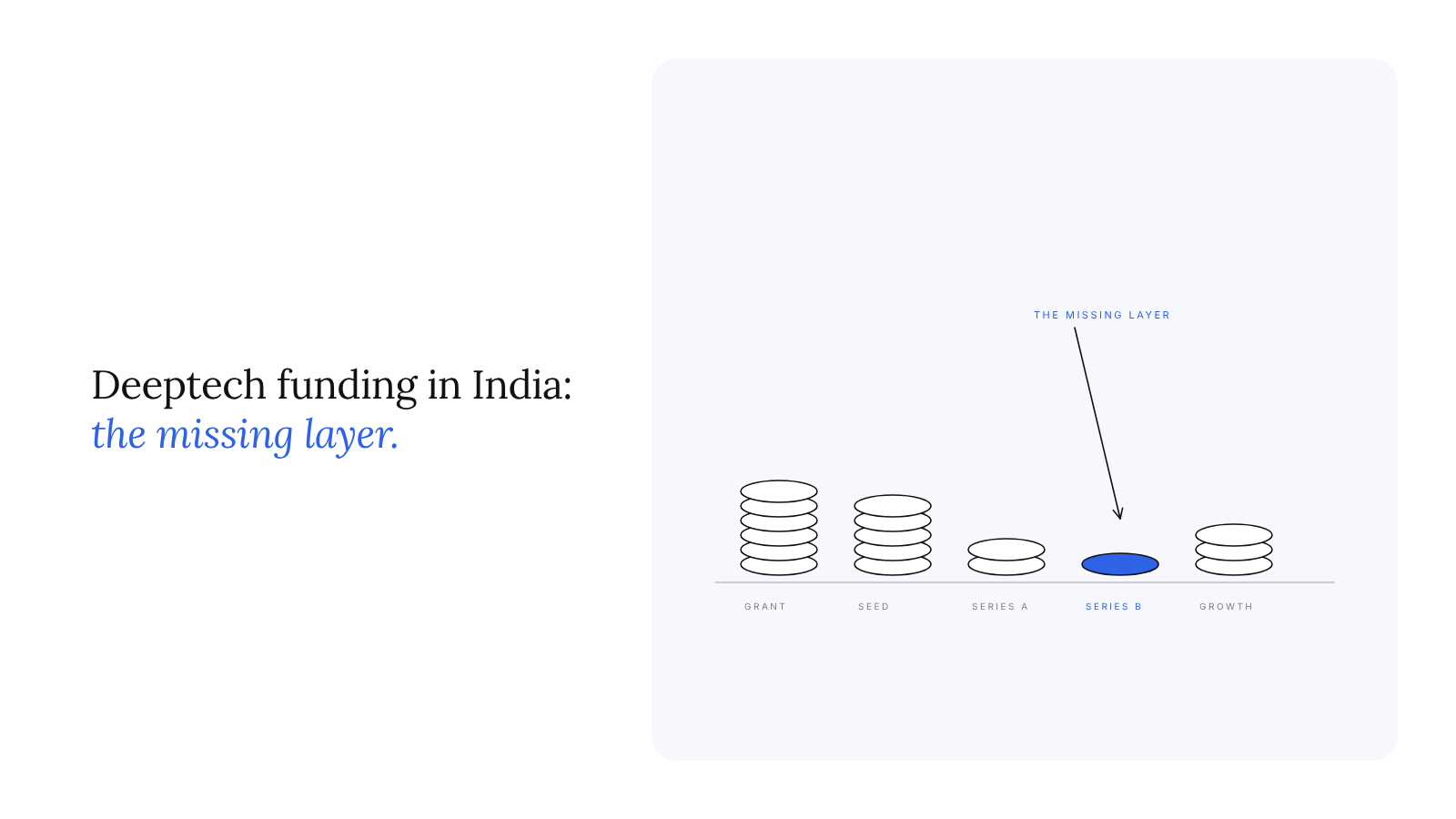
On the headline numbers, deeptech funding in India has never been stronger. The Indian Venture and Alternate Capital Association's Bharat DeepTech Report 2026, released in August, counts close to $11.4 billion of private equity and venture capital invested in Indian deeptech between 2015 and mid-2026, and calls 2025 the strongest year on record, with $2.96 billion across 189 deals. The Nasscom-Zinnov Indian Tech Start-up Report, using its own definitions, puts 2025 deeptech funding at $2.3 billion, up 37% on the year, across a base of more than 4,200 deeptech startups. The government has added a ₹1 lakh crore Research Development and Innovation scheme designed to pull private money into research.
Underneath those totals, the picture is more uneven. Nasscom and Zinnov find that artificial intelligence accounts for 91% of deeptech funding. The IVCA survey finds that only 15% of funds are willing to back projects at technology readiness levels 1 to 3, that participation falls sharply after seed, and that 40% of surveyed funds have not engaged with any government capital vehicle. The money is real, but it is concentrated in the stages and sectors that look most like software.
This article reads the available data stage by stage. It sets out which kinds of capital exist in India at each band of technology readiness, where each runs out, and what that implies for founders, investors, corporates and policymakers. Its central argument is that the scarce layer is not money in general but patient capital: money that will sit through the long, expensive middle stretch between a working prototype and a qualified product.
What the deeptech funding India data actually show
The two main datasets measure slightly different things and should not be added together or compared too precisely. IVCA counts private equity and venture capital investment in deeptech; Nasscom and Zinnov count funding to technology startups they classify as deeptech. The difference between $2.96 billion and $2.3 billion for 2025 is mostly a matter of definition. What the two agree on is direction and composition.
Three readings stand out.
The first concerns sector concentration. If 91% of the $2.3 billion that Nasscom and Zinnov count went to AI startups, the remaining deeptech categories, including semiconductors, space, advanced materials, quantum, clean energy hardware and biotechnology outside AI, shared roughly $200 million in 2025. That is PanScience Research's arithmetic on the published figures, not a number either report states, and it depends on how each AI-enabled company was classified. But it shows how thin the non-AI layer is. IVCA's own sector reading is more varied: it names AI and generative AI and electric vehicle and battery technologies as the largest recipients, and semiconductors and spacetech as the fastest-growing segments, so the concentration is somewhat less extreme on its definitions.
The second concerns stage. Nasscom and Zinnov report that 74% of all tech startup deal activity in 2025 was at seed and early stages, and identify the transition from seed to Series A as the ecosystem's most significant progression gap. IVCA, looking at deeptech specifically, describes a "Series B/C gap", with very few funds writing the larger cheques that growth-stage deeptech companies need. Taken together, these describe two drop-offs: one after seed and another at the point where a deeptech company needs tens of millions of dollars to build manufacturing, qualify a product or scale a plant.
The third concerns readiness. The IVCA finding that only 15% of funds will back TRL 1 to 3 is not surprising on its own, since early research has always been funded mainly by grants. It matters because the next band, TRL 4 to 7, where a separate PanScience Research piece locates the valley of death, is also poorly served. Grants are designed for the earlier stages. Seed capital is too small for the later ones.
The scale problem becomes clear when the Indian seed market is set against the cost of deeptech prototypes. Inc42 reported a median Indian seed ticket of about $1 million in the first half of 2025. BCG and Hello Tomorrow's 2019 survey of deeptech startups found that the average biotech startup spent almost $1.3 million just to reach a first prototype, excluding research grants. A median seed round, on those figures, does not pay for one biotech prototype, let alone the pilot and qualification work that follows.
The public layer: grants, missions and the RDI scheme
India's public research system has historically been the main funder of early deeptech. Department of Science and Technology statistics reported in Parliament put gross expenditure on research and development at ₹2,44,767.81 crore in 2023-24, or 0.84% of GDP. That share is low by the standards of countries India often benchmarks against, and much of the spending sits in government laboratories rather than in companies.
Two recent instruments are meant to change the mix. The first is the Anusandhan National Research Foundation, which the Cabinet approved in June 2023 with an estimated total cost of ₹50,000 crore over the five years from 2023 to 2028, according to the Prime Minister's Office release on the bill. ANRF absorbs the earlier Science and Engineering Research Board and is designed to fund research across universities, colleges and laboratories. Its natural place on the readiness scale is TRL 1 to 4.
The second is the Research Development and Innovation scheme, approved by the Cabinet on 1 July 2025 with a corpus of ₹1 lakh crore. Its design is unusual and worth reading closely. It is a two-tier structure: a Special Purpose Fund within ANRF acts as custodian, and allocates money to second-level fund managers "mainly in the form of long-term concessional loans". Those managers in turn fund research and development projects, normally through long-term loans at low or nil interest, with equity possible "especially in case of startups" and contributions to a Deep-Tech Fund of Funds also contemplated. The scheme's stated objective is to finance transformative projects "at higher levels of Technology Readiness Levels", alongside the acquisition of critical technologies and private-sector research in sunrise and strategic sectors. Governance runs through the ANRF Governing Board chaired by the Prime Minister, its Executive Council, and an Empowered Group of Secretaries led by the Cabinet Secretary, with the Department of Science and Technology as nodal department.
Two points follow from the design. First, the RDI scheme is aimed at the right gap. Financing at higher readiness levels, through long-tenor and low-cost money, is precisely what the valley of death needs. Second, its main instrument is debt. Long-term concessional loans suit companies and corporate research programmes with balance sheets and revenue. They are harder for a pre-revenue deeptech startup to use, which is why the equity and fund-of-funds routes within the scheme matter so much for startups. How the second-level fund managers are chosen, and how much of the corpus reaches early-stage companies as equity, will decide whether the scheme fills the patient-capital gap or mainly lowers the cost of research for established firms.
For scale, the ₹1 lakh crore corpus is equivalent to roughly 41% of India's entire gross research and development expenditure in 2023-24, on the DST figure above. The corpus is a multi-year commitment, not annual spending, so the comparison is a sense of proportion rather than a like-for-like ratio. It nonetheless shows that, if deployed well, the scheme is large enough to change the economics of later-stage deeptech in India.
Alongside these, mission-specific programmes fund particular technologies: the IndiaAI Mission, with an outlay of ₹10,371.92 crore; the National Quantum Mission; the India Semiconductor Mission; and sectoral funders such as BIRAC in biotechnology. A separate article in this cluster on India's deeptech ecosystem looks at the missions as a layer. For funding purposes, their main contribution is non-dilutive money and, increasingly, procurement.
The Startup India Fund of Funds is the other public route. The Prime Minister's Office reported in February 2026 that the first fund of funds had committed to 145 alternative investment funds, with ₹25,500 crore leveraged for more than 1,370 startups, and that a second fund of funds with a ₹10,000 crore corpus had been approved. Funds of funds work through private managers, so their effect on deeptech depends on whether those managers have the mandate and expertise to back long-horizon technology.
The private layer: venture, corporate and strategic money
Private deeptech capital in India has grown quickly but remains shaped by the venture model. Fund sizes, fund lives and portfolio construction are designed around companies that can show traction within a few years and raise follow-on rounds from other venture investors. That suits AI application companies, which can sell software within months. It suits a materials, semiconductor or biotechnology company less well, because the follow-on investors who would need to lead a large Series B are the ones IVCA finds in short supply.
Corporate money is the other private layer. Indian corporates accounted for about 36% of the more than 140 technology M&A deals that Nasscom and Zinnov counted in 2025, which suggests that corporate acquirers are becoming a more active exit route. Corporates can also fund deeptech earlier, as design partners, pilot customers, co-development partners or strategic investors. Later pieces in this cluster cover corporate venture capital, venture clienting and the relationship ladder between corporates and deeptech ventures. For the capital stack, the key point is that a corporate purchase order or co-development contract is often the cheapest money a deeptech venture can raise, because it is non-dilutive and it validates the product at the same time.
Exits close the loop. IVCA records $600 million of deeptech exits in 2025. That is small relative to cumulative investment of $11.4 billion, and limited exits make domestic limited partners cautious, which in turn restricts the supply of later-stage deeptech funds. IVCA's president, Rajat Tandon, named improving exit pathways and deepening domestic limited partner participation among the priorities, alongside closing the Series B/C gap. Survey participants also called for dedicated tax incentives and for public procurement to create a predictable demand pipeline.
A capital-stack map by readiness stage
The table below is PanScience Research's map of the capital available to Indian deeptech ventures at each band of technology readiness, where it runs out, and what can fill the gap. The judgments about depth are qualitative, based on the figures cited in this article and on the design of the schemes as published; they are not measured shares.
Three conclusions follow from the map.
The gap is a band, not a point. Discussion of Indian deeptech funding often focuses on the Series B/C gap. The map suggests that the shortfall begins earlier, at TRL 4, and persists through qualification. A company that crosses the first gap with grants and a seed round meets the second with no change in the underlying problem: the money available is smaller and shorter than the work requires.
The missing layer is patient, not merely large. The UK House of Commons Science and Technology Committee's 2013 report on the valley of death recorded "a failure in the marketplace to provide significant sums of patient capital". The Indian data describe a similar failure. More seed money would not fix it, because seed investors expect follow-on rounds within two years. What is needed is money that can wait five to ten years for a qualified product and a strategic exit, and that can tolerate binary technical risk.
Non-dilutive revenue matters more than in software. Because patient equity is scarce, the cheapest way for an Indian deeptech venture to cross the valley is to be paid for pilots and co-development by the organisations that will later buy the product: corporates, public sector undertakings and government missions. This is why IVCA's survey participants asked for procurement mandates, and why a separate article in this cluster examines government as first customer.
What each participant can do
Founders can plan their capital stack by readiness band rather than by funding round. The useful question is not "when do we raise our Series A?" but "which money pays for TRL 5 to 7, and what evidence will release it?" The answer often combines a grant, a paid pilot and a smaller equity round, timed to technical milestones. The companion piece on technology readiness levels pairs each level with the commercial milestone that should unlock the next tranche.
Investors can treat the RDI scheme's second-level fund manager role as an opportunity to build long-horizon deeptech vehicles with concessional capital at their base. The scheme's design allows equity for startups and contributions to a deeptech fund of funds; managers who can underwrite technical risk will be best placed to use it.
Corporates can act earlier and more cheaply than they do now. A paid pilot or co-development agreement at TRL 5 or 6 costs a corporate far less than a later acquisition, and it gives the corporate first sight of technology it may later need. Indian corporates' growing share of tech M&A suggests appetite exists at the later end; the opportunity is to move some of it earlier.
Policymakers can measure the RDI scheme and the fund of funds by how much capital reaches TRL 4 to 8 deeptech companies as equity or patient debt, not by total commitments. IVCA's finding that 40% of surveyed funds have not engaged with any government capital vehicle suggests that the routes are not yet well understood by private managers.
Conclusion
Deeptech funding in India has grown fast enough to make 2025 a record year, but its composition reveals the gap. Most of the money goes to AI and to seed and early rounds; the earliest science relies on grants; and the long middle stretch from prototype to qualified product, where deeptech ventures most often fail, is served by capital that is too small and too impatient. The ₹1 lakh crore RDI scheme is aimed at that stretch, and its two-tier design could make long-horizon money available at scale. Whether it does will depend on how much of it reaches startups as equity and patient debt, and on whether corporates and the state become paying customers early enough to make the rest of the stack work.
Methodology and sources
The capital-stack map, the depth judgments within it and the estimate of non-AI deeptech funding are original to PanScience Research. The non-AI estimate (roughly $200 million) is our arithmetic on the Nasscom-Zinnov figures ($2.3 billion, 91% to AI) and is illustrative; the comparison of the RDI corpus with gross research expenditure is a ratio of a multi-year corpus to a single year's spending and is offered for proportion only. IVCA figures come from YourStory, "Indian deeptech investments reach $11.4B: Report" (17 August 2026; yourstory.com/2026/08/indian-deeptech-investments-reach-114-billion-report) and CXOToday's coverage of the same report (cxotoday.com/others/ivca-report-indias-deeptech-funding-reaches-11-4b-as-2025-hits-record-2-96b). Nasscom-Zinnov figures come from Zinnov's press release of 25 February 2026 (zinnov.com/press-releases/indias-tech-start-ups-at-a-strategic-inflection-point-as-funding-rises- to-9-1-bn-nasscom-zinnov-tech-start-up-report-2026). RDI scheme details come from the Prime Minister's Office release of 1 July 2025 (pmindia.gov.in/en/news_updates/cabinet-approves-research-development-and-innovation-rdi-scheme-to-scale-up-research-development-and- innovation-in-strategic-and-sunrise-domains). The ANRF cost estimate comes from the Prime Minister's Office release of 28 June 2023 on the National Research Foundation Bill (pmindia.gov.in). GERD figures are from DST R&D Statistics 2025-26 as reported in Parliament replies. The IndiaAI Mission outlay is from a PIB backgrounder (February 2026; pib.gov.in), Fund of Funds figures from a PMO note of 14 February 2026, the seed ticket median from Inc42's H1 2025 funding report, and biotech prototype costs from BCG and Hello Tomorrow, "The Dawn of the Deep Tech Ecosystem" (March 2019; media-publications.bcg.com/BCG-The-Dawn-of-the-Deep-Tech-Ecosystem-Mar- 2019.pdf). The patient capital quotation is from the House of Commons Science and Technology Committee, "Bridging the valley of death" (March 2013; publications.parliament.uk/pa/cm201213/cmselect/cmsctech/348/34805.htm).