
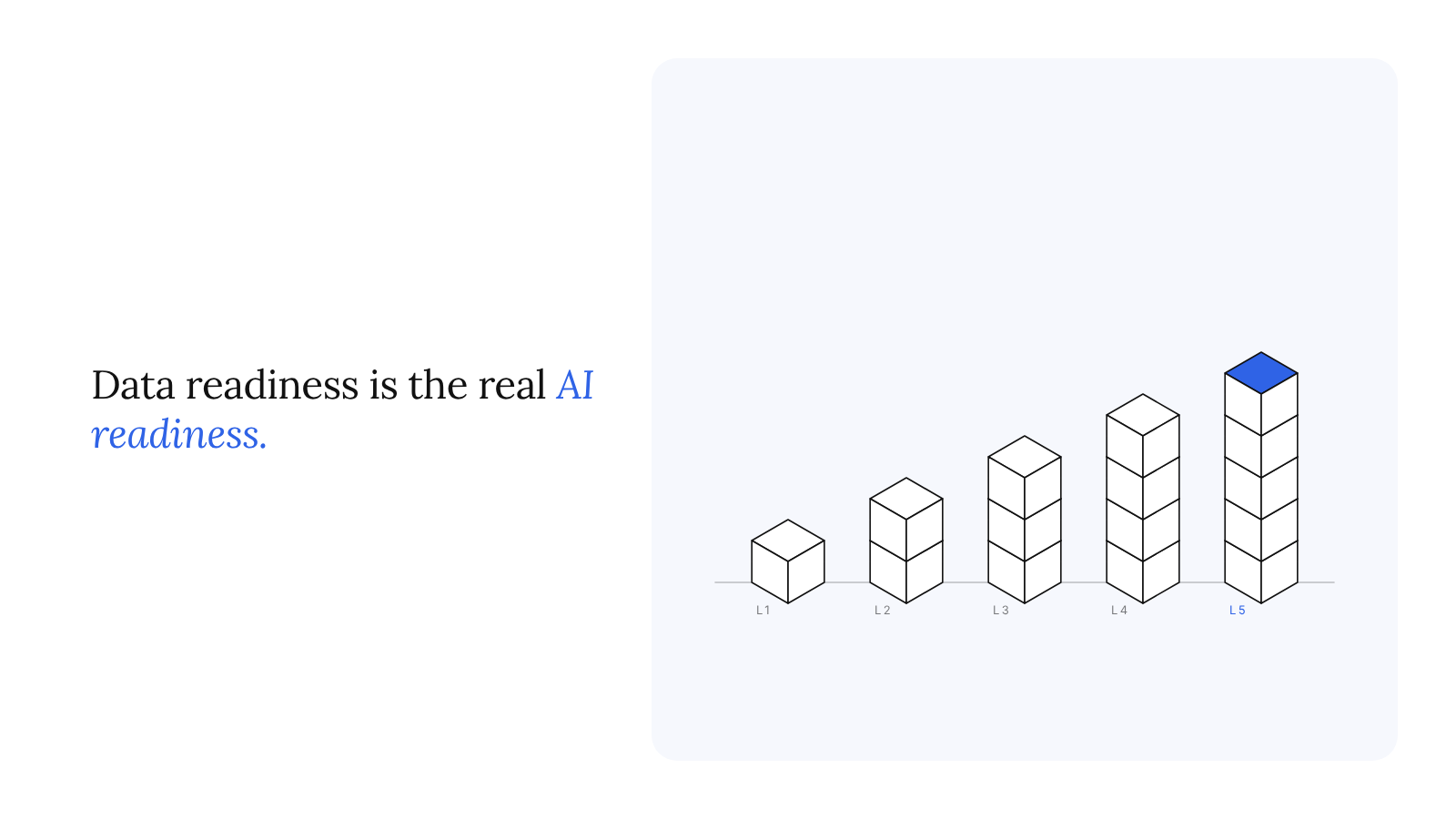
Most AI readiness assessment exercises begin in the wrong place. They ask about strategy, leadership sponsorship, talent and use-case pipelines, and they produce a score that correlates with how many consultants the organisation has already hired. The variable that actually decides whether a model reaches production is less glamorous: whether the data the model needs exists, can be found, can be joined, can be trusted, and may lawfully be used for that purpose. Everything else can be bought. Data readiness has to be built.
Gartner put a number on the consequence in February 2025. In its survey of data management leaders, "Sixty-three percent of organizations either do not have or are unsure" whether they have the right data management practices for AI, and the firm predicted that "through 2026, organizations will abandon 60% of AI projects unsupported by AI- ready data." That prediction sits comfortably beside the survey evidence on pilots: McKinsey's State of AI 2025 found 88 per cent of organisations using AI regularly in at least one function but only about a third scaling, and EY India's 2026 outlook survey of over 200 Indian enterprise leaders found 10 per cent scaling AI across the business. The distance between "using" and "scaling" is, to a first approximation, the distance between a demonstration on curated data and a system on live data.
This piece proposes a five-level data readiness model for Indian enterprises, with a test at each level that can be observed rather than self-reported. It is written for CIOs, chief data officers, transformation leads and the boards that approve AI budgets, and it argues that an AI readiness assessment that cannot be failed is not an assessment.
Why the usual readiness frameworks mislead
The standard AI readiness assessment has a shape: a questionnaire across six or eight dimensions, scored one to five, rendered as a radar chart. The dimensions usually include strategy, culture, talent, technology, data and governance. The problem is not the dimensions but the method. Self-reported maturity is inflated by the people who answer, who are typically the sponsors of the AI programme. The dimensions are weighted equally when they are not equally binding. And "data" is treated as one axis among several when it is the axis on which the others depend.
Gartner's definition of AI-ready data is useful because it is specific. Data is AI-ready when it represents the use case, "including every pattern, error, outlier, and unexpected occurrence needed to train or run the specific AI model", and when that readiness is evidenced through metadata that aligns, qualifies and governs it. "Proving AI readiness of the data is a process and a practice." Two consequences follow. First, readiness is relative to a use case; there is no such thing as enterprise data that is AI-ready in general. Second, readiness is demonstrated, not asserted, which means a readiness assessment should consist of demonstrations.
MIT CISR's research on data monetisation supplies the second idea the model needs. Its 2021 briefing defines data liquidity as "the ease of data asset reuse and recombination", and its 2025 survey report, based on information from 349 executives collected in 2023 and 2024, found that data and AI capabilities, data democracy, data liquidity, leadership, value realisation and measurement practices together "explain 53 percent of the variation in data monetization value", with that value in turn "accounting for 36 percent of its variance" in overall firm performance. The practical reading is that an enterprise's ability to reuse and recombine data assets, rather than the volume of data it holds, is what converts into value. A readiness model should therefore test for reuse, not for storage.
The five-level data readiness model
The model below is an original framework. It has five levels, each defined by what the organisation can demonstrate, and each with a test that an assessor can run without relying on a questionnaire. The tests are written for one named use case, because readiness is use-case relative; an enterprise may be at level 4 for credit decisioning and level 1 for maintenance records.
The level names are deliberately plain. The tests are deliberately uncomfortable. A level 2 test that takes three days and two escalations is a fail, however advanced the data platform brochure. A level 3 test with a 70 per cent match rate is a fail for a model that will make decisions about the unmatched 30 per cent.
Gartner's nine data quality dimensions supply the vocabulary for level 4: accessibility, accuracy, completeness, consistency, precision, relevancy, timeliness, uniqueness and validity. Not every dimension matters for every use case, but the assessor should be able to say which ones do and see them measured. Gartner's own estimate, from 2020 research, is that poor data quality costs organisations "at least $12.9 million a year on average"; at the editorial conversion rate of ₹95 to the dollar that is over ₹120 crore, a figure large enough to make the measurement worth doing for its own sake.
Level 5 is where Indian enterprises face an obligation that did not exist when most of their data was collected. The Digital Personal Data Protection Act 2023 and the Rules notified on 14 November 2025 impose a phased compliance window of 18 months, additional obligations on significant data fiduciaries including local storage of specified data, and a rule on cross-border transfers. A model trained on personal data must be able to show the basis on which that data may be processed for that purpose. An enterprise that reaches level 4 without level 5 has a well-measured dataset it may not be allowed to use.
How the levels interact with the AI readiness assessment
The model changes what an AI readiness assessment is for. Instead of producing a composite score, it produces a level per use case and a cost to reach the next level. Three patterns recur when it is applied.
The platform mirage. An enterprise has invested in a data lake or lakehouse and reports high technology maturity. Run the level 2 test and the data is findable; run the level 3 test and the match rate across customer master, transaction system and service records is poor because identifiers were never reconciled when the systems were loaded. The platform has moved the data without making it joinable. The fix is master data work, which is unglamorous, slow and the single largest determinant of whether the use case will work.
The pilot plateau. A pilot succeeded on an extract that a data scientist cleaned by hand. Production requires the same data continuously. The enterprise is at level 3 for the extract and level 1 for the pipeline, because the cleaning steps live in a notebook and nobody else can reproduce them. Gartner's five steps for AI-ready data include building pipelines that supply both training datasets and live feeds, and assuring data through testing, monitoring and observability; the pilot plateau is what happens when the first step is done and the last two are not. A separate PanScience Research piece examines why pilots fail to become products across six causes; data pipeline reproducibility is one of them.
The consent gap. A BFSI or healthcare enterprise has clean, joined, measured data and cannot use it, because it was collected under a notice that did not cover model training, or because the purpose recorded for a regulated dataset is narrower than the proposed use. This is a level 5 failure with a level 4 appearance. It is also the failure most likely to surface late, in a legal or compliance review after engineering money has been spent. Running the level 5 test at the start of an assessment moves it to the front.
What a level costs to climb
The model's second use is budgeting. Each step has a characteristic cost profile, and the profile is what the board should see before approving an AI programme.
The right-hand column is the one that matters for procurement. In each step there is a component the vendor can supply and a component only the enterprise can perform. An AI proposal that prices only the first component, and assumes the second, will arrive at a pilot and stall. A proposal that names the second component and asks who owns it is more expensive on paper and cheaper in outcome. The build, buy or co-build question that a separate PanScience Research piece treats in detail turns, in practice, on who carries these climbs.
Applying the model to an Indian plant, a bank and a court
Three sketches show the model in use. They are illustrative, not case studies.
A manufacturing plant wants predictive maintenance. The level 1 test passes: vibration is logged by the PLC, failures are recorded in a maintenance system. The level 2 test fails: the PLC historian is on an isolated network and the maintenance system is a free-text log. The plant is at level 1 for this use case and the climb to level 3 is a connectivity and record-structuring project, not an AI project. A separate PanScience Research piece on industrial AI sets out a four-dimension readiness ladder for plants; the two frameworks agree that the first money goes to the gateway and the log, not the model.
A bank wants a model to prioritise anti-money-laundering alerts. The level 3 test passes with a high match rate, because regulatory reporting has forced identifier discipline. The level 4 test passes for completeness and timeliness but has no figure for accuracy of the alert disposition labels, which are entered by analysts under time pressure. The level 5 test raises a question: are the disposition labels, which include analysts' judgements about customers, usable for training under the purposes the bank has recorded? The bank is at level 4 with two specific gaps, both of which can be closed, and both of which should be closed before model development begins. The RBI's FREE-AI committee report of August 2025 recommends sector data infrastructure among its 26 recommendations; a bank that has done this level of work will be ready for that infrastructure when it arrives.
A High Court registry wants to classify incoming filings. Orders and judgments are on the National Judicial Data Grid, which under eCourts Phase III has 27.64 crore of them; the level 1 and level 2 tests pass for historical documents. The level 3 test is partial, because case metadata and document text are held in different systems with inconsistent case identifiers across years. The level 4 test has no owner. The registry is at level 2 for this use case, and the first project is a case identifier reconciliation that would benefit every later system, AI or not.
In each sketch the model does the same work: it converts a vague question ("are we ready for AI?") into a specific one ("what does it cost to move this use case from level 2 to level 4, and who pays?").
A practice note
PanScience Innovations reports that two of its ventures work on the supply side of this problem: Indika AI in data- centric AI and model operations, with a company-reported annotation accuracy of about 98 per cent, and FlexiBench as a managed AI workforce of over 30,000 annotation experts. The company-reported figures are offered only to make a structural point about level 4. Where the field a model needs is a label that does not yet exist, the climb from level 3 to level 4 is a labelling and quality-control operation with a measurable accuracy figure, and that figure belongs in the readiness assessment alongside completeness and timeliness. Who performs the labelling, in-house or through a managed workforce, is a build-or-buy decision; that a measured accuracy figure must exist before the model is trusted is not.
What boards should take from this
Three things. First, ask for a level, not a score, and ask for it per use case. A composite readiness score hides the one binding constraint behind five non-binding strengths. Second, ask to see the tests run, not reported. The level 2 test takes a day; the level 3 test takes a week; both are cheaper than a stalled pilot. Third, fund the climb explicitly. Gartner's 60 per cent abandonment prediction describes projects that were funded as AI and failed as data. A board that approves the model and the master data work as one programme, with the data work first, will see a different outcome from one that approves the model and discovers the data work afterwards.
The deeper point is that data readiness is not a precondition for AI that can be waited out. It is the work. The model, increasingly, is the part that can be procured; the data that makes it useful, trustworthy and lawful in a particular enterprise cannot be, and an AI readiness assessment that does not say so is measuring the wrong thing.
Methodology and sources
This article presents an original five-level framework and applies it to three illustrative sketches; the sketches are constructed to show the method and are not case studies of named organisations. The 63 per cent and 60 per cent figures, the definition of AI-ready data and the five steps are from Gartner's press release "Lack of AI-Ready Data Puts AI Projects at Risk", 26 February 2025 (https://www.gartner.com/en/newsroom/press-releases/2025-02-26-lack- of-ai-ready-data-puts-ai-projects-at-risk); the release's body cites a July 2024 survey of 1,203 data management leaders while its summary cites 248 leaders, and the sample should be confirmed with Gartner. The $12.9 million cost of poor data quality (Gartner research from 2020) and the nine data quality dimensions are from Gartner's data quality topic page (https://www.gartner.com/en/data-analytics/topics/data-quality); the rupee conversion uses ₹95 per dollar, an editorial assumption. The data liquidity definition is from MIT CISR Research Briefing XXI-5, 20 May 2021 (https://cisr.mit.edu/publication/2021_0501_DataLiquidity_WixomPiccoli); the 349-executive survey and the 53 per cent and 36 per cent variance figures are from MIT CISR Working Paper 468, published 20 November 2025 (https://cisr.mit.edu/publication/MIT_CISRwp468_DataMonetizationSurveyReport_WixomVanderMeulenBeath). McKinsey State of AI 2025 figures (https://www.mckinsey.com/capabilities/tech-and-ai/our-insights/the-state-of-ai- 2025), EY India AIdea of India Outlook 2026 survey findings (https://www.ey.com/en_in/insights/ai/agentic-ai- india/aidea-survey-findings), the DPDP Rules notification of 14 November 2025, the RBI FREE-AI committee report of August 2025 and the eCourts Phase III NJDG figure were verified by the editor from the sources listed in the series specification. PanScience venture descriptions and figures are company-reported (https://panscience.xyz) and are used to illustrate the structure of the labelling problem, not as evidence of outcomes.