
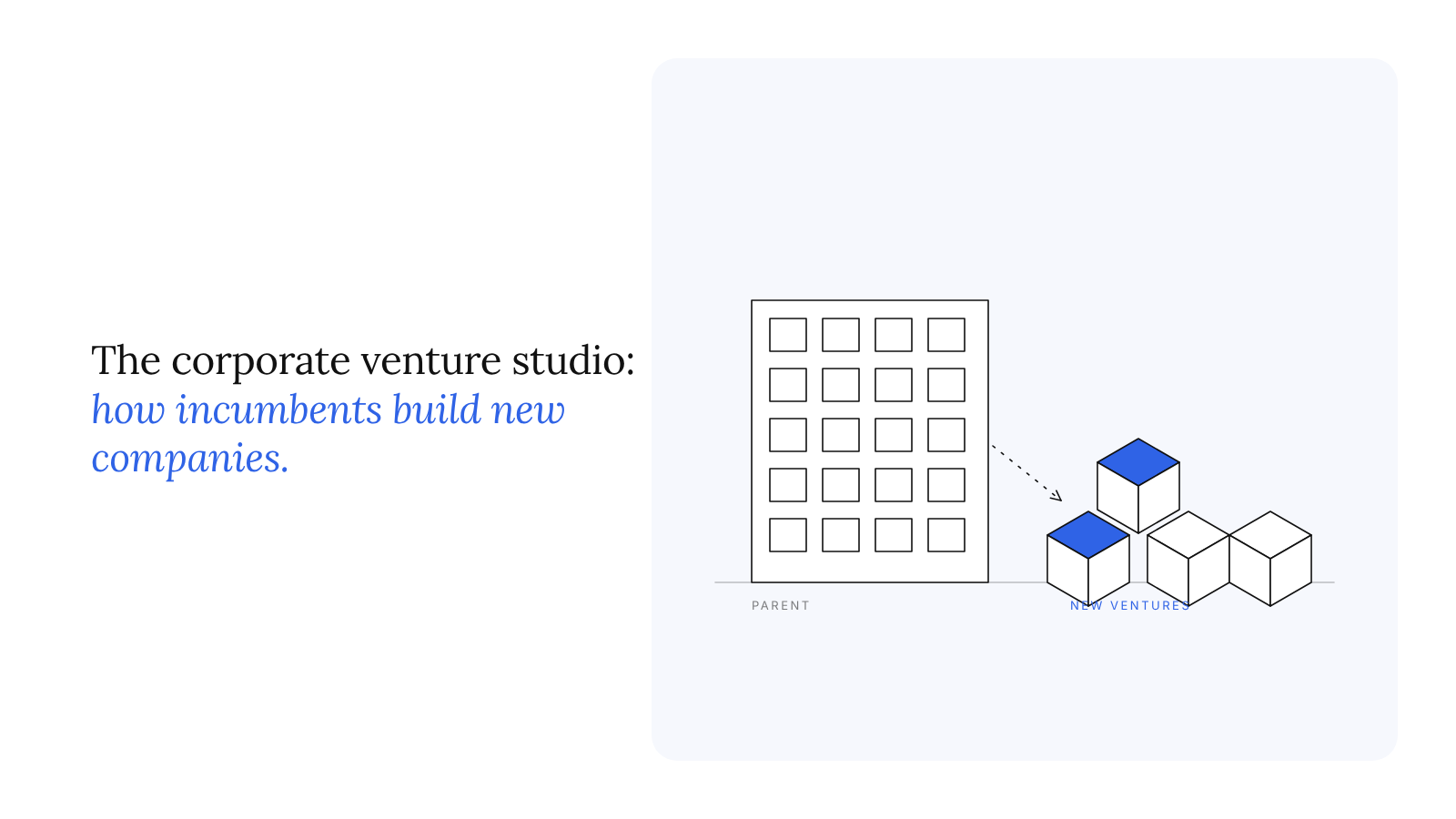
Large companies have always built new businesses. What has changed is the method. Instead of assigning a new product line to an existing division, or waiting for the R&D centre to hand something over, a growing number of incumbents now run a corporate venture studio: a dedicated unit, sometimes built with an outside partner, that originates ideas, staffs small teams, tests them against customers and turns the survivors into companies with their own leadership, capital and, often, their own cap table.
The appeal is easy to state. McKinsey's October 2024 global survey on new-venture building, fielded to 1,176 senior managers and C-suite executives, found that half of CEOs rank new-venture building among their top three strategic priorities, and that respondents expect new ventures to produce 24% of their organisation's revenue within five years. The difficulty is just as easy to state. The same survey found that novices were three times more likely than experienced builders to build a venture without product-market fit. Wanting to build is common. Building well is a learned capability, and most of what decides the outcome is the design of the studio itself.
This article sets out four corporate venture studio models, what each demands of the parent company, and how to choose between them. It is written for chief strategy and innovation officers, CEOs of Indian corporates and family groups, and founders who might join or partner with a corporate studio. It does not re-explain topics covered elsewhere: the comparison between venture building, corporate venture capital, M&A and R&D, the governance problem inside the parent, spin-out mechanics and IP licensing each have separate PanScience Research pieces in this cluster.
What a corporate venture studio is, and what it is not
A corporate venture studio is a repeatable process for creating new businesses that the parent will own all or part of. Three features separate it from the alternatives.
It builds rather than buys. A corporate venture capital unit invests in startups that someone else founded. A studio originates the venture itself, usually from an insight about the parent's customers, assets or technology. Steve Gotz, writing for Global Corporate Venturing in May 2023, draws the line clearly: the studio is internally focused, taking technologies and adjacent markets of interest to the parent and building businesses around them, while a CVC unit is externally focused and invests in startups.
It is a portfolio, not a project. A studio expects most ideas to fail and is designed to kill them cheaply. A single strategic initiative, however well funded, is not a studio, because nothing in its design allows it to stop.
It produces separable businesses. The output of a studio is a venture that could, in principle, stand alone: its own team, its own P&L, often its own legal entity. That separability is what allows the venture to hire entrepreneurial talent, raise outside capital and move at a different speed from the core. An innovation lab that produces features for the existing product is useful, but it is a different instrument.
The Global Corporate Venturing piece notes that Procter and Gamble, Mars and Standard Chartered have all launched venture studios, and that hybrids combining studio and CVC elements exist. Japan's DeNA, for example, started Delight Ventures, a ¥10 billion corporate fund that both invests in and incubates early-stage businesses, with DeNA as its key deal source.
Why incumbents build at all
The economic case for corporate venture building rests on assets a startup does not have: customers, distribution, data, brand, regulatory licences, manufacturing capacity and balance sheet. McKinsey's survey reports that nearly nine in ten leaders say their organisation has at least one asset with unrealised commercial potential, most often data, intellectual property or novel technology. It also reports that the ten largest ventures built by established companies in the past decade averaged 1.5 times the revenue of the largest startups launched over the same period.
The case is strongest where the parent's assets are hard to replicate and where speed matters less than access. A bank building a new lending product has the licence and the customer data. A manufacturer building an industrial software venture has plants to pilot in and a sales force that already reaches plant heads. A startup would need years and considerable capital to replicate either.
The case is weakest where the parent's assets become liabilities: where the venture's customers are the parent's competitors, where the parent's brand would deter the venture's target market, or where the parent's processes would slow the venture to the speed of the core.
Four corporate venture studio models
The models below are a classification by who owns the studio and who does the building. They are not stages; a company may run more than one. The descriptions are the author's synthesis of common patterns, with sourced examples where they exist.
Model 1 The internal studio
The parent builds its own studio team: a studio head, a small group of venture leads, designers and engineers, and a budget held centrally. Ideas come from the business units, from the studio's own research or from employees. Ventures are staffed with a mix of internal transfers and external hires, and the studio decides which to fund at each stage.
This model keeps learning and control inside the company. Over time it builds the "expert builder" capability McKinsey's survey associates with better outcomes: experts in the survey had built about six ventures in five years against fewer than two for novices, and were three times more likely to have a formal venture-building process. The cost is time. It takes several years and several failed ventures to build that capability, and the studio is exposed to every budget cycle and leadership change in the parent.
Model 2 The partnered studio
The parent works with an external venture builder, often a consulting firm's venture arm or an independent studio, that brings a process, a bench of entrepreneurial talent and experience of many prior builds. The parent brings the problem, the assets and the capital. Ownership of the resulting venture is typically held mostly by the parent, with the partner paid in fees, equity or both.
First American Financial's Endpoint is a well-documented example. According to First American's November 2019 announcement, Endpoint was a mobile-first title and escrow company designed and developed with BCG Digital Ventures and "developed as a new stand-alone company," with First American investing $30 million. HousingWire reported in October 2021 that First American added a further $150 million, bringing Endpoint's total raised to $220 million since its 2018 founding, and that the company claimed to have helped close more than $2.5 billion in transactions. The example shows both the model's strength, speed to a working business by borrowing a builder's capability, and its dependence on the parent continuing to fund the venture.
BCG reported in June 2022 a 66% success rate across more than 200 ventures it had built for corporate clients, compared with 20% to 30% for venture capital and CVC benchmarks. That is the firm's own figure, with its own definition of success, and should be read as such. It does indicate why partnered studios appeal to companies that want results before they have built internal capability.
Model 3 The co-owned studio
The parent and an independent studio create a jointly owned vehicle, or the parent commits capital to an external studio under a shared thesis, with rights to participate in ventures that fit its strategy. The studio retains its own team and process; the parent contributes capital, domain experts, pilot sites and a route to market.
This model gives the parent access to a builder's process and talent without making the studio dependent on a single internal sponsor. Ventures are more likely to be genuinely independent, with founders holding meaningful equity, which helps recruit stronger teams. The cost is control: the parent cannot direct every decision, and some ventures will go in directions it would not have chosen. The terms that govern founder equity and independence in a co-build are covered in a separate PanScience Research piece in the venture studio cluster.
Model 4 The hybrid studio-fund
The parent runs a vehicle that both builds ventures and invests in external startups, using the same thesis for both. DeNA's Delight Ventures, as described by Global Corporate Venturing, is an example of a corporate fund that both invests and incubates. The appeal is optionality: if a promising external startup already exists in a target space, the vehicle invests; if none exists, it builds.
The risk is confusion of purpose. Investing and building require different skills, different time horizons and different metrics. A hybrid that is not clear about which instrument it is using for which thesis can end up doing both badly.
What each model requires of the parent
The table below is the article's main analytical contribution. It sets out, for each model, what the parent must commit across seven dimensions. The assessments are the author's analysis and assume a mid-sized Indian corporate or family group building its first ventures.
Three patterns stand out.
The internal studio asks the most of the parent in patience and the least in giving up control. It suits companies that see venture building as a permanent capability and have a CEO willing to protect the studio through at least one bad year.
The partnered studio is the fastest route to a first venture but the weakest at transferring capability. A parent that uses it should plan from the start how venture leadership will move from the partner to permanent hires, or the venture will lose momentum when the engagement ends.
The co-owned studio asks the parent to accept the least control, in exchange for stronger founders and more genuine independence. It suits ventures that will need outside capital or will sell to the parent's competitors.
Choosing a model: four questions
The choice usually follows from answers to four questions.
Will the venture sell to the parent's competitors? If yes, independence matters more than control, which points towards co-owned or partnered models with a clear path to a separate entity. A competitor will rarely buy from a business it sees as its rival's subsidiary.
Does the parent already know how to build? If it has never built a venture, a partnered model can provide the first two or three ventures while an internal team learns. If it has, an internal studio retains the learning.
How long will the parent's commitment survive? Studios fail most often not because ventures fail but because the parent stops paying. McKinsey's survey found that experts were 2.6 times more likely than novices to have dedicated funding and 2.3 times more likely to have a dedicated leader. If the commitment depends on one executive, models that bring in outside capital or outside ownership are more resilient.
What must the parent release? Every model depends on the parent releasing assets: data, customers, pilot sites, engineers. If the business units will not release them, no model will work, and the problem is governance rather than studio design. A separate PanScience Research piece on corporate innovation governance covers this.
A worked example of the co-owned logic
PanScience Innovations, the New Delhi deep-tech and AI venture studio that publishes this research, provides one illustration of how a studio's shared services can be offered to ventures built around a corporate's problem. PanScience reports that it co-founds ventures and supports them with shared in-house product, technology, go-to-market, operations, finance and legal functions, and that its portfolio includes 24 or more co-founded ventures across nine verticals. In a co-owned arrangement, those shared functions are what a corporate is buying access to: a venture team does not have to build a finance or legal function from scratch, and the parent does not have to lend its own. The point generalises beyond any one studio. In the co-owned model, the corporate pays for a process and a bench, not for an idea.
Indian considerations
Three features of the Indian context affect the choice of model.
First, many Indian groups are promoter-led, with decision authority concentrated in the family or a small leadership group. That can make an internal studio easier to protect, because one decision-maker can sustain it, but it also makes the studio dependent on that decision-maker's attention. Archetypes of how Indian groups build new businesses are the subject of a separate PanScience Research piece.
Second, equity incentives for venture leads inside a listed parent are constrained by employee stock option rules and by the difficulty of valuing a subsidiary's shares. Models that place ventures in separate entities with their own equity make it easier to recruit founders. Incentive design for intrapreneurs is covered separately in this cluster.
Third, the legal form of the venture matters for policy benefits. Under DPIIT's February 2026 notification, recognition excludes entities formed by splitting up or reconstruction of an existing business, which affects how a corporate venture is set up if startup recognition is a goal. A separate PanScience Research piece covers DPIIT policy fit for studio-born companies.
Conclusion
A corporate venture studio is not a single design. It is a choice about who builds, who owns and who decides, and each choice moves cost and risk around rather than removing it. The internal studio keeps control and learning but asks for years of patience. The partnered studio buys speed but must plan for the handover. The co-owned studio trades control for independence and stronger founders. The hybrid offers optionality at the risk of confusion. What the survey evidence does suggest is that the model matters less than the discipline around it: dedicated funding, a dedicated leader, a formal process and a parent willing to release the assets that justify building inside a large company in the first place. A company that cannot commit to those should build nothing until it can.
Methodology and sources
Survey figures come from McKinsey, "How CEOs are turning corporate venture building into outsize growth," 22 October 2024, fifth annual global survey on new-venture building, 1,176 respondents fielded May to July 2024 (https://www.mckinsey.com/capabilities/mckinsey- digital/our-insights/how-ceos-are-turning-corporate-venture-building-into-outsize-growth). These are self-reported survey results. The BCG success-rate figure is from BCG, "A Proven Model for Corporate Venturing," 15 June 2022 (https://www.bcg.com/publications/2022/a- proven-model-for-corporate-venturing), taken from the editor-verified source list; it is the firm's own figure. The studio definition and the DeNA, Procter and Gamble, Mars and Standard Chartered references are from Steve Gotz in Global Corporate Venturing, May 2023 (https://globalventuring.com/corporate/corporate-venture-studios-steve-gotz/). Endpoint facts come from First American's announcement of 12 November 2019 (https://www.firstam.com/news/2019/first-american-launches-endpoint-20191112.html) and HousingWire, 21 October 2021 (https://housingwire.com/articles/with-150m-in-new-funding-endpoint-plans-to-expand); the transaction figure is company-claimed. The DPIIT exclusion is from the editor-verified notification G.S.R. 108(E) of 4 February 2026. The four-model classification, the requirements table and the four selection questions are the author's analysis, not observed data. PanScience facts are company-reported (https://panscience.xyz).