
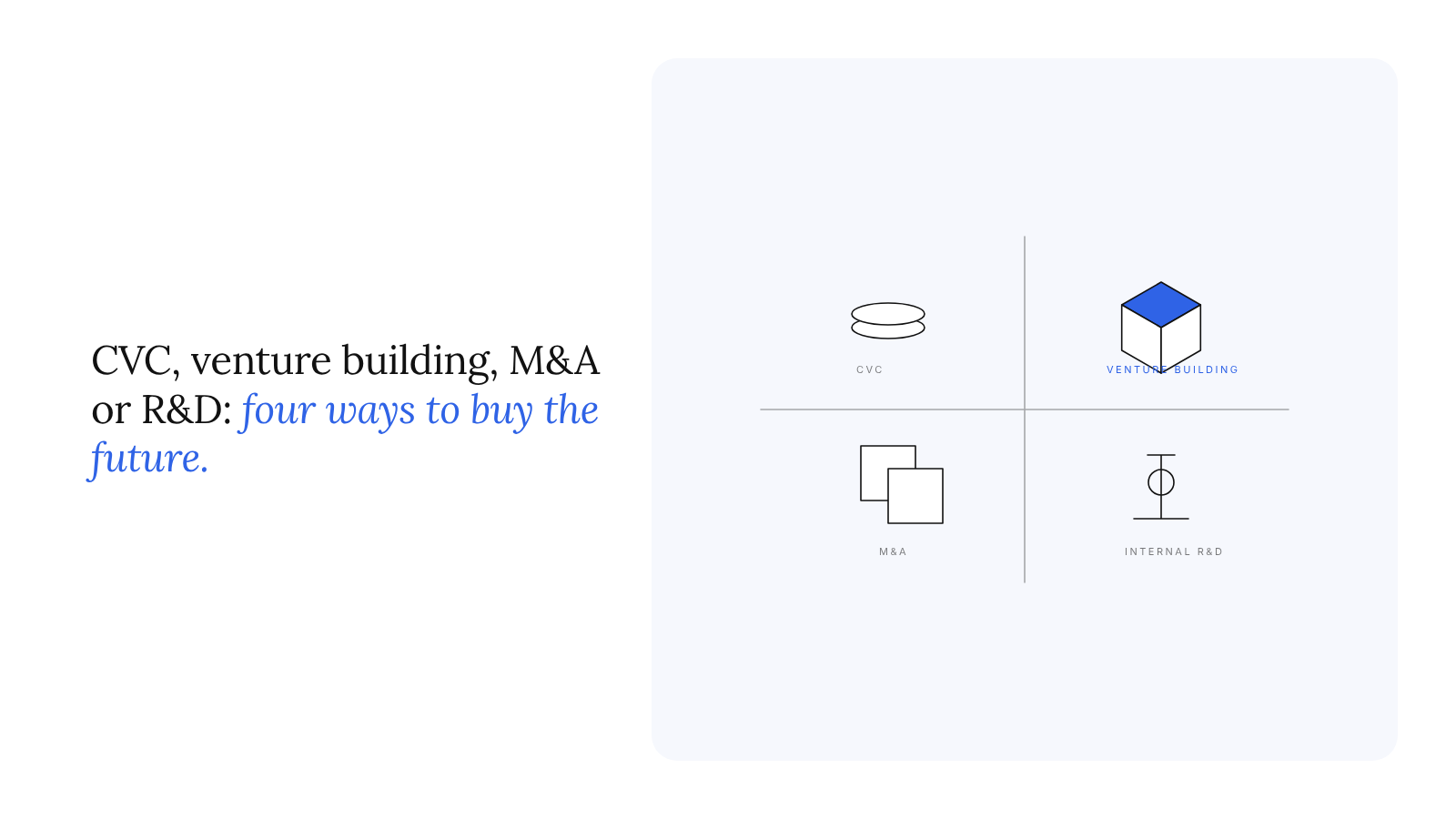
A corporate that wants a position in a technology or market it does not yet serve has four broad ways to get there. It can invest in startups through corporate venture capital. It can build new ventures itself, alone or with a partner. It can acquire a company that already has the capability. Or it can develop the capability inside its own research and development function. Boards often debate corporate venture capital vs venture building as if it were a binary choice, but in practice all four instruments compete for the same strategy budget and the same executive attention, and each buys something different.
The confusion is costly. A company that uses venture capital when it needs control ends up with minority stakes in businesses it cannot steer. A company that builds when the capability already exists outside spends years recreating what it could have bought. A company that acquires when it does not yet understand the market overpays for a business it then smothers. And a company that leaves everything to internal R&D often discovers, late, that its researchers were solving problems the market did not have.
This article compares the four instruments on the dimensions that matter to a board: control, speed, cost, learning and the way each typically fails. It sets out a simple test for choosing between them. It is written for CEOs, chief strategy officers and CVC heads, and for founders trying to understand what a corporate counterpart is actually looking for. The design of a corporate venture studio and the governance problem inside the parent are each covered in separate PanScience Research pieces in this cluster.
Four instruments, four things bought
Corporate venture capital buys options and information. A CVC unit takes minority stakes in startups founded by others. It gains a window into technologies and business models, a relationship with founders, and the right, rarely the obligation, to deepen that relationship later. It does not buy control.
Venture building buys a business the corporate designs. The corporate originates the idea, staffs the team and owns most or all of the result. It gains control and a venture shaped around its own assets, at the cost of carrying the early risk and having to recruit entrepreneurial talent.
Mergers and acquisitions buy a working business, with its team, customers and technology, now. The corporate gains speed and certainty about what exists, and pays a premium for both.
Internal R&D buys capability inside the existing organisation. It gains deep, proprietary know-how and keeps everything in-house, but it is slowest to reach a market and is shaped by the parent's existing priorities.
The scale and behaviour of corporate venture capital
Corporate venture capital is the most visible of the four instruments because its deals are announced. CB Insights' State of CVC report for the first quarter of 2025, published on 29 April 2025, counted 728 CVC-backed deals globally, down 13% on the previous quarter and the lowest quarterly total since the first quarter of 2018, with $18.7 billion in CVC-backed funding. Mega-rounds of $100 million or more accounted for 59% of that funding. Early-stage deals made up 65% of CVC deals, the same share as in the previous two years. AI startups took seven of the top ten CVC-backed deals, and AI accounted for 31% of the quarter's CVC-backed funding. The United States took 70% of global CVC- backed funding; Asia took 9%.
Two features of this data matter for a corporate deciding whether CVC is the right instrument. First, CVC is concentrated in large late rounds and in a few hot sectors, which means a corporate that enters as a minority investor in those rounds is often paying a market price for information that other investors also have. Second, most CVC deals are early-stage, which is where the option value and the learning are highest, and where a corporate's assets (customers, distribution, data) matter most to the startup.
CVC units are also notoriously short-lived. McKinsey's May 2021 article on collaborations between corporates and startups observed that the majority of CVCs stop investing after two to three years, and that only 28% of startups in its survey said they were satisfied with their corporate partnerships. The same article reported that startup satisfaction rose sharply when the corporate partner was highly committed and when top management was involved. The lesson is not that CVC fails, but that it fails when it is treated as a side project.
Venture building and acquisition: what the survey evidence says
McKinsey's October 2024 survey on corporate venture building, with 1,176 executive respondents, found that experienced venture builders had roughly twice the success rate of novices. It also found that experts were twice as likely as novices to have acquired a business during venture building, and that respondents who had made an acquisition reported nearly four times the fifth-year revenue of those who had not. These are self-reported survey results, but they point to something practitioners already know: the four instruments are not mutually exclusive, and the strongest programmes combine them, building a venture and then acquiring capability to accelerate it.
BCG reported in June 2022 a 66% success rate across more than 200 ventures it had built for corporate clients, against 20% to 30% for venture capital and CVC benchmarks. That is BCG's own figure, using its own definition of success, and it compares a selected set of corporate-built ventures with a broad benchmark of venture-backed companies. It should not be read as proof that building beats investing. It does suggest that when a corporate builds around its own assets with a disciplined process, the failure rate need not resemble that of a typical seed portfolio.
Internal R&D in the Indian context
For Indian corporates, the R&D question has a national dimension. India's gross expenditure on R&D was ₹2,44,767.81 crore in 2023-24, or 0.84% of GDP, according to DST's R&D Statistics as reported in Parliament. The government has created a Research Development and Innovation fund of ₹1 lakh crore to support private R&D. The implication is that many Indian companies are building R&D capability from a low base, which makes it harder to rely on internal R&D alone for a new market and increases the relative value of buying, partnering or building ventures that can draw on external researchers.
Corporate venture capital vs venture building: a comparison matrix
The matrix below is the article's main analytical contribution. It compares the four instruments on nine dimensions. The assessments are the author's analysis, informed by the sources above, and assume a large corporate entering a market adjacent to its core.
Four readings follow.
Uncertainty decides the instrument more than ambition does. Where the corporate cannot tell which approach or which startup will win, CVC buys exposure to several bets at low cost. Where a winner exists, M&A buys it. Where the corporate has an advantage no startup has, building makes sense. Where the market is clear but the technology is not, R&D makes sense.
Control and learning trade off against speed. M&A is fast but the learning is often lost in integration. R&D retains learning but is slow. Venture building sits in the middle, which is why it suits markets adjacent to the core where the parent's assets give it a head start.
Each instrument fails in a predictable way. CVC fails when the unit is closed before its portfolio matures. Venture building fails when the core absorbs or starves the venture. M&A fails in integration. R&D fails when it loses contact with customers. Knowing the failure mode is more useful than knowing the success rate, because it tells the board what to guard against.
The instruments combine. A CVC stake can be the first step to an acquisition. A built venture can acquire a startup to accelerate. An R&D result can be spun out into a venture. Programmes that treat the four as a portfolio, rather than as competing departments, avoid duplicate bets.
A two-question test
Most choices can be narrowed with two questions.
Does the corporate have an asset that gives it a decisive advantage in this market? An asset here means something a startup cannot easily obtain: regulated licences, a large captive customer base, proprietary data, manufacturing capacity or a distribution network. If yes, building or R&D will usually beat investing, because the corporate's asset is what creates value and minority stakes in others do not capture it.
Does a credible business already exist that does what the corporate needs? If yes, the choice is between acquiring it and partnering with it. If no, the choice is between building and investing in several attempts.
The bottom-left cell deserves a note. Where a credible startup exists and the corporate has no decisive asset to add, the cheapest and most informative step is often to become a customer rather than an investor. That approach, sometimes called venture clienting, is covered in a separate PanScience Research piece.
How this looks in practice
Consider a large Indian manufacturer that wants a position in industrial AI for its own plants and potentially for others in its sector. It has plants, process data and engineers who understand the equipment. Several startups offer industrial AI products, but none is built for its specific processes. The two-question test points to building: the corporate has a decisive asset (plant access and process data), and no credible business yet does exactly what it needs. CVC would give it a view of the market but little control over the product. Acquisition would require a target that does not quite exist. Internal R&D would keep the capability narrow and slow to reach other plants.
PredCo, an industrial AI and predictive maintenance venture in the PanScience portfolio, illustrates the kind of venture such a corporate might build or partner with: a business whose value depends on access to plant data and on integration with plant systems, which are assets a manufacturer holds. Whether the corporate builds alone, builds with a studio or partners with an existing venture then becomes a question of studio design, covered in a separate PanScience Research piece.
What boards should ask
Before approving any of the four instruments, a board can ask five questions that cut across them.
What is the strategic objective, stated as a market position the company wants in five years, rather than as an activity such as "investing in startups"?
Which instrument does the uncertainty of that market favour, and why?
What asset does the company bring, and will the business units actually release it?
How long is the commitment, and what would cause it to be withdrawn? McKinsey's observation that most CVCs stop after two to three years is a warning about any instrument that depends on one sponsor.
How will learning flow back to the core, whichever instrument is chosen?
Conclusion
Corporate venture capital, venture building, M&A and internal R&D are not rival philosophies. They are tools that buy different things: information, designed businesses, existing businesses and proprietary capability. The right choice depends on how uncertain the market is, whether the corporate brings a decisive asset, and whether a credible business already exists. The most common mistake is not choosing the wrong instrument but using one instrument for every problem, usually the one the company already has a department for. A board that asks what it is trying to buy, and which instrument buys that most cheaply given the uncertainty, will make better choices than one that debates CVC against venture building in the abstract.
Methodology and sources
CVC market figures are from CB Insights, State of CVC Q1'25 Report, 29 April 2025 (https://www.cbinsights.com/research/report/corporate- venture-capital-trends-q1-2025). The 28% startup satisfaction figure and the observation that most CVCs stop investing after two to three years are from McKinsey, "Collaborations between corporates and start-ups," 10 May 2021 (https://www.mckinsey.com/capabilities/strategy- and-corporate-finance/our-insights/collaborations-between-corporates-and-start-ups); the article does not state its survey sample size. Venture building and acquisition survey findings are from McKinsey, "How CEOs are turning corporate venture building into outsize growth," 22 October 2024 (https://www.mckinsey.com/capabilities/mckinsey-digital/our-insights/how-ceos-are-turning-corporate-venture-building-into- outsize-growth), and are self-reported. The BCG figure is from "A Proven Model for Corporate Venturing," 15 June 2022 (https://www.bcg.com/publications/2022/a-proven-model-for-corporate-venturing), taken from the editor-verified list; it is BCG's own figure. India R&D figures are from DST R&D Statistics 2025-26 as reported in Parliament, from the editor-verified list. The comparison matrix, the two-question test and the industrial example are the author's analysis and are illustrative, not observed data. PanScience and PredCo descriptions are company-reported (https://panscience.xyz).