
Boards are asked to approve two kinds of investment. The first is an extension of something the company already knows how to do: a new plant, a new market for an existing product, an upgrade to a system. For these, a conventional business case works, because the assumptions are grounded in experience and the forecast is a reasonable estimate. The second is a new venture, where the market, the product, the customer and sometimes the technology are all unproven. For these, the conventional business case is not just weak. It is misleading, because it presents guesses in the format of knowledge.
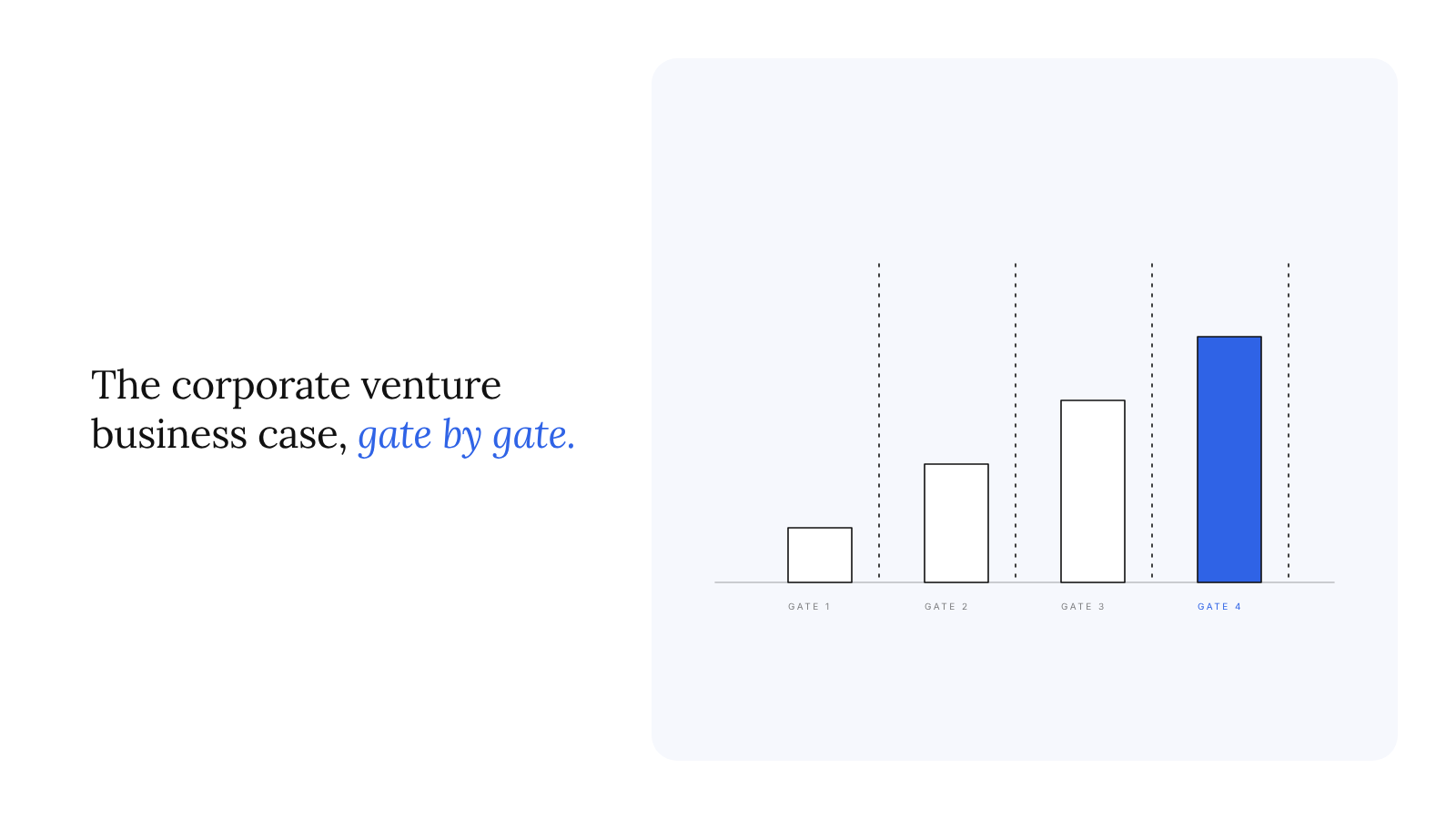
The corporate venture business case has to solve a problem that most capital approval processes were not designed for. It must ask a board for money while admitting that most of the numbers in it are assumptions, and it must give the board a way to control the risk without killing the venture through impatience or starving it through caution. The answer that experienced builders have converged on is a staged case: one that asks for a small amount of money to test the most important assumptions, then returns for more only when those assumptions have been converted into evidence.
This article explains why the single-shot business case fails for new ventures, draws on discovery-driven planning and recent survey evidence on milestone-based funding, and sets out a stage-gated business case template that specifies what a venture team should claim, and what it should not claim, at each gate.
Why the conventional business case fails for new ventures
In their 1995 Harvard Business Review article "Discovery-Driven Planning", Rita McGrath and Ian MacMillan opened with a list of expensive failures by capable companies entering unfamiliar territory: the Walt Disney Company's European theme park, which had accumulated losses above $1 billion by 1994; Federal Express's Zap-mail, which cost about $600 million before it was dropped; and Polaroid's instant movies, which lost about $200 million. Their diagnosis was blunt: "New ventures require a new way to plan."
The conventional business case fails a new venture in three specific ways. It requires a single forecast, which forces the team to pick one set of assumptions and defend it as if it were known. It approves a total budget up front, which means the board commits money before the riskiest assumptions have been tested. And it measures the venture against the plan, which punishes the team for learning that an assumption was wrong, when learning that is exactly what the money was for.
The predictable result is a business case that is optimistic by design, because a modest case will not be approved, and a venture that then spends a year explaining why it is behind a plan nobody believed.
What discovery-driven planning changes
McGrath and MacMillan's method, as summarised in standard references, rests on five disciplines: define what success must look like for the venture to be worth doing, including a "reverse" income statement; benchmark the plan against market and competitive parameters; specify the operations the venture will need; document every assumption explicitly; and set checkpoints at which the plan is reviewed. Plan parameters change as new information arrives, and funding is released as key milestones are reached rather than committed in full at the start.
The reverse income statement is the discipline that matters most for a board. Instead of starting with a market size and projecting revenue forward, the team starts with the profit the venture must eventually make to matter to the parent, and works backwards to the revenue, customer numbers, prices and costs that profit implies. Each step backwards exposes an assumption that can be tested.
A simple illustration shows how this works. The figures are illustrative and do not describe any real venture.
Nothing in that table is a forecast. Each row is an assumption, and each can be tested cheaply long before the venture needs the capital to reach 1,000 customers. If the first ten customers will only pay ₹10 lakh, the venture needs five times as many customers to reach the same profit, and the board should know that before it approves the scale-up budget, not after.
What the evidence says about milestone-based funding
Survey evidence on corporate venture building supports staging. McKinsey's sixth annual corporate venture-building survey, published on 28 October 2025, drew on 715 senior managers and C-level executives in 66 nations at companies with at least $100 million in annual revenue. Respondents reported a weighted average investment to break even of about $77 million, down from about $125 million in the previous year's research, equivalent to about 2% of the core organisation's annual revenue. More than eight in ten respondents reported breaking even within three years, and 22% within the first year. Nearly one-third of ventures built on data or intellectual property broke even on investments of less than $1 million.
Discussing the findings, McKinsey senior partner Jason Bello told CFO Dive that ventures "are most successful when funded in a milestone- based way", with tranches for four stages: feasibility testing with go or no-go assumptions, design and blueprinting, reaching a minimum viable product, and scaling. He also argued that finance teams should fund ventures on a different cadence from the annual or semi-annual cycle used for operations, and manage them as a portfolio in which concepts that are not working are closed.
Experience compounds. McKinsey's 2024 research on CEOs and venture building, based on a survey of 1,176 executives, found that experienced builders were roughly twice as likely to succeed, while novices were about three times as likely to fail to reach product-market fit. The 2025 survey adds that companies that built at least three ventures in five years generated 1.9 dollars of revenue per dollar invested until break-even, against 1.3 for companies with one or two.
These are self-reported survey figures from executives at companies that chose to answer a venture-building survey, and they should be read as indicative rather than as base rates. They are, however, consistent in direction: staged funding, faster break-even targets and repeated practice go together.
A stage-gated corporate venture business case template
The template below is this article's contribution. It sets out five gates. For each, it specifies the question the board is answering, what the team should claim, what the team should explicitly not claim, the evidence that should accompany the claim, the approximate scale of funding the gate releases, and the kill or pivot criteria agreed in advance. The gate names map onto the four funding stages Bello describes, with an additional thesis gate at the front. The funding proportions are illustrative guides to sequencing, not benchmarks.
How to write each section of the case
The template changes not only how much money is asked for but how the case is written. Four practices make a material difference.
Separate knowledge from assumption in every number. Each figure in the case should be labelled as either observed, with its source, or assumed, with the reason for the assumption. A board that can see which numbers are known can decide how much risk it is taking. A board that cannot will either approve blindly or refuse defensively.
Name the assumptions that would kill the venture. Discovery-driven planning asks for a documented list of assumptions. The more useful version for a board is the short list of assumptions that, if wrong, would make the venture not worth doing, ranked by how cheaply they can be tested. The first gate's money should go to testing the first items on that list.
Agree the kill criteria before the money is spent. The most important line in each gate is the last one in the template. Kill criteria agreed in advance protect the board from sunk-cost reasoning and protect the team from being judged on politics rather than evidence. They also make it possible for a sponsor to close a venture without losing face, because closing was always a defined outcome.
Show the parent's advantage explicitly. A corporate venture should be able to answer why the parent is a better owner than an independent startup. The answer may be distribution, data, brand, regulatory standing, manufacturing capacity or a customer relationship. If the case cannot name an advantage, the board should ask whether it would be better to invest in, or buy from, an external company instead. A separate PanScience Research piece compares venture building with CVC, M&A and internal R&D.
What the board should ask at each gate
A staged case changes the board's role from approving a plan to buying information. At each gate, the useful questions are narrow. What did we learn since the last gate, and which assumptions changed? Which assumption is now the most important untested one, and what will it cost to test? Did the team hit the kill criteria, and if so, why are they asking to continue? What is the next tranche buying, in evidence rather than activity?
Questions to avoid are the ones that pull the venture back into the conventional format, such as asking for a revised five-year forecast at the feasibility gate, or comparing the venture's early revenue with a mature business unit's. Those questions do not reduce risk. They teach the team to manufacture confidence.
PanScience reports that it has co-founded more than 24 ventures across nine verticals. For any organisation building ventures repeatedly, the advantage the McKinsey research describes is less about any single business case and more about the habit of staging: a shared template, a shared set of gate questions and a willingness to close ventures that do not pass.
Funding cadence and the finance function
Staged business cases need a finance function that can release money outside the annual budget cycle. If every tranche must wait for the next budget round, a venture that passes a gate in month two waits ten months for its money, and the staging becomes a delay mechanism. The practical fixes are a ring-fenced venture budget approved annually at portfolio level, with tranche releases delegated to a venture committee that meets on a shorter cycle, and clear accounting treatment so that venture spending is visible but does not distort the core business's reported margins.
Indian corporates have an additional consideration when the venture is likely to be spun out. The business case should anticipate the structure in which external capital will come in, because a venture built for two years as a division may face tax and transfer questions when it becomes a company. A separate PanScience Research piece covers carve-out mechanics.
Conclusion
The corporate venture business case a board will approve is not the one with the most confident forecast. It is the one that is honest about what is known and what is assumed, that asks for only as much money as is needed to test the next set of assumptions, and that commits in advance to the criteria on which the venture will be continued, changed or closed.
Discovery-driven planning provides the logic: start from what success must look like, work backwards to the assumptions it implies, and fund the testing of those assumptions in stages. Recent survey evidence, while self-reported, points the same way: milestone-based funding, shorter paths to break-even and repeated practice are associated with better outcomes. The stage-gated template in this article turns that logic into a document a board can read and a team can be held to.
Methodology and sources
This article combines published planning methodology and survey evidence with an original business case template. The opening examples and the quotation "New ventures require a new way to plan" come from the opening of Rita McGrath and Ian MacMillan, "Discovery-Driven Planning", Harvard Business Review, July 1995 (https://hbr.org/1995/07/discovery-driven-planning); the five disciplines and the principle of releasing funding at milestones are as summarised in the Wikipedia entry on discovery-driven planning (https://en.wikipedia.org/wiki/Discovery-driven_planning), because the full HBR text was behind a paywall. Survey figures on break-even investment, timing and serial builders come from McKinsey, "The way to win in corporate venturing: Serial building and AI", 28 October 2025 (https://mckinsey.com/capabilities/business-building/our-insights/the-way-to-win-in-corporate-venturing-serial-building-and-ai). Jason Bello's description of four funding tranches comes from CFO Dive's report on that survey (https://www.cfodive.com/news/companies-fund- skinnier-ventures-shorter-leashes-report-finds/804042/). The 2024 McKinsey figures on experienced and novice builders are editor-verified from "How CEOs are turning corporate venture building into outsize growth" (22 October 2024). PanScience's portfolio count is company- reported from panscience.xyz. The reverse income statement example and the stage-gated template, including funding proportions and kill criteria, are original and illustrative; they do not describe any real venture.