
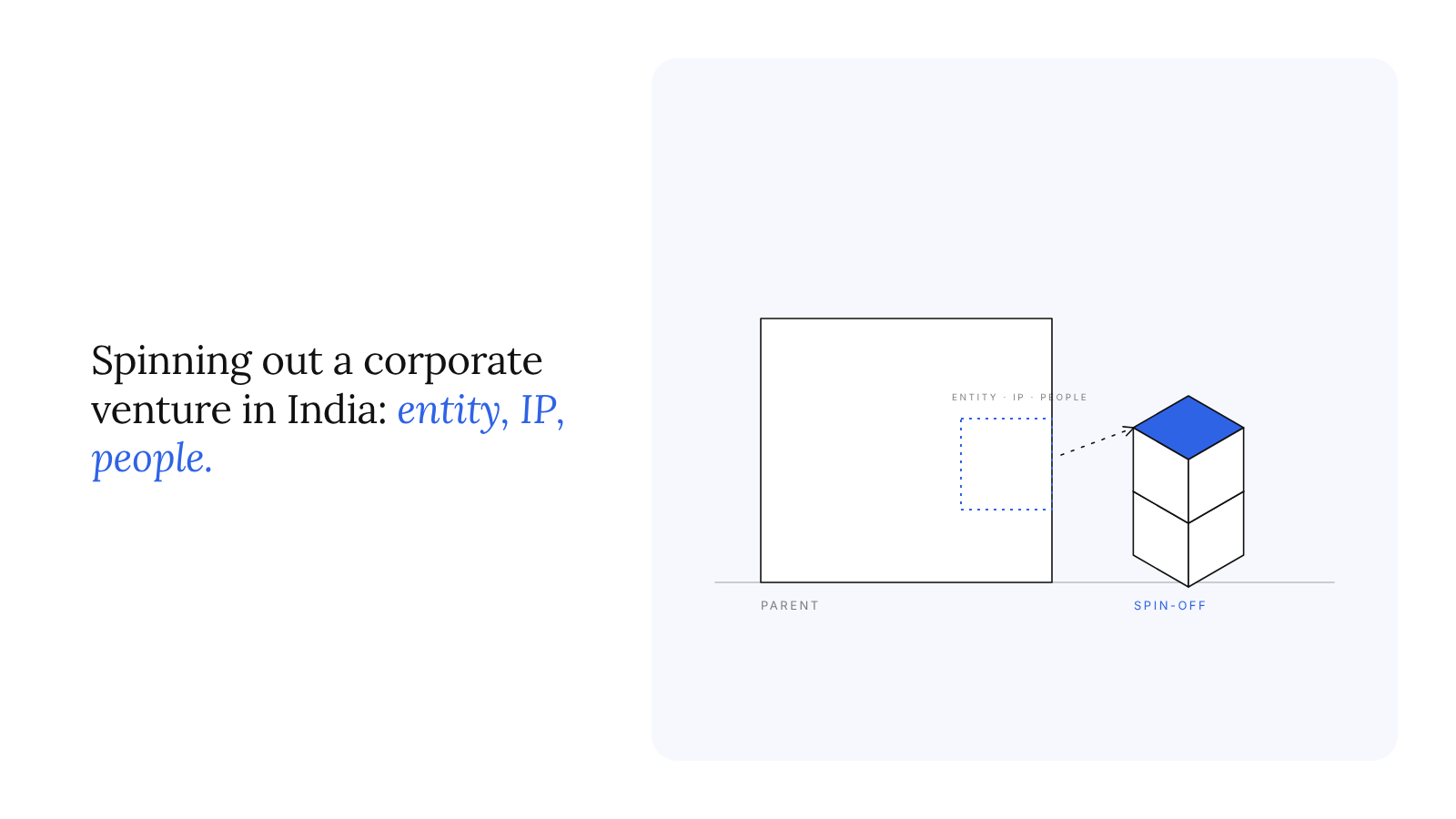
Most corporate ventures that succeed inside a parent reach a point where the parent becomes the constraint. The venture needs its own cap table to hire, its own balance sheet to raise money, its own contracts so customers who compete with the parent will buy from it, and its own board so decisions are not queued behind the group's annual planning cycle. At that point the question changes from "should we build this?" to "how do we get it out?", and in India the answer is more mechanical than most strategy decks admit.
A corporate spin-off in India is not one transaction. It is six workstreams running in sequence: the legal entity, the operating assets, the intellectual property, the people, the contracts and the capital. Each has its own statute, its own tax treatment and its own failure mode. Get the order wrong and a venture can spend a year in limbo with customers it cannot invoice, engineers who are still on the parent's payroll and patents that sit in the wrong name.
This article sets out the main routes for a corporate spin-off in India, what each means for tax and for people, and a carve-out sequence table that a corporate development team can use as a working plan. It is a practitioner's map, not legal or tax advice: every carve-out has facts that change the answer, and the structuring should be signed off by counsel and tax advisers who have seen the balance sheet.
Why ventures leave the parent, and when
The case for spinning out is usually made in governance terms. A separate PanScience Research piece covers why corporate ventures die inside the parent; the short version is that decision rights, funding cadence and talent rules built for a mature business suffocate a young one. Spinning out is the structural answer to that problem, but it is expensive, irreversible in practice and hard to do twice. The right moment is narrower than it looks.
Three signals tend to mark it. The first is an external capital need: the venture needs money the parent will not or should not provide, from investors who will only buy equity in a clean entity. The second is a customer conflict: buyers who compete with the parent will not sign with a division of a rival, however well ring-fenced. The third is a talent ceiling: the people the venture needs want equity in the thing they are building, not in a conglomerate whose share price they cannot move.
If none of these signals is present, a separate business unit with its own budget and governance is usually cheaper than a legal carve-out. If one or more is present and growing, delay costs more than structuring.
The three routes for a corporate spin-off in India
In practice, Indian corporates move a business into a new company through one of three routes. They differ in how the assets move, how the transfer is taxed and who ends up owning the new entity.
Slump sale into a new subsidiary. The parent incorporates a new company and transfers the undertaking to it under a business transfer agreement for a lump-sum consideration, without assigning values to individual assets and liabilities. The Income-tax Act, 1961 defined a slump sale in section 2(42C), and the definition was widened by the Finance Act, 2021 so that a transfer "by any means", including an exchange for bonds or preference shares, now counts. The parent remains the shareholder of the new company, which makes this the natural route when the parent wants to keep control and bring in outside investors at the subsidiary level.
Demerger under a scheme of arrangement. The parent transfers the undertaking to a resulting company under a scheme sanctioned under sections 230 to 232 of the Companies Act, 2013, and the resulting company issues its shares directly to the parent's shareholders. The parent's shareholders end up owning the new company in proportion to their holding in the parent. This is the route for a true separation, where the venture is meant to stand beside the parent rather than below it.
Licence and hire. The parent does not transfer a business at all. A new company is incorporated, the parent licenses it the relevant IP, transfers or seconds specific people, and signs a services or supply agreement. This is the lightest route and the one most often used for very early ventures, where there is little to transfer except know-how and a team. A separate PanScience Research piece covers the licence terms themselves.
Tax treatment: what changes between a slump sale and a demerger
Slump sale. Before 2021, the gain on a slump sale was the sale consideration less the "net worth" of the undertaking, calculated on the book value of its assets, and a transfer at or below net worth produced no capital gains. The Finance Act, 2021 changed this. Under the amended section 50B, as summarised by Conventus Law, "the sale consideration is deemed to be the fair market value" of the capital assets on the transfer date, regardless of the contract price, with effect from 1 April 2021 and retroactive to 1 April 2020. Rule 11UAE prescribes the valuation: Taxmann's summary explains that the deemed consideration is the higher of the fair market value of the assets transferred and the fair market value of the consideration received. The cost of acquisition remains the net worth of the undertaking, and an undertaking held for more than 36 months before transfer is treated as a long-term capital asset. The same summary from Conventus Law notes that no indirect tax such as GST applies to a slump sale.
Two consequences matter for spin-offs. First, an internal transfer at book value no longer automatically avoids tax if the assets have a higher fair value, which bites hardest when the undertaking holds land or securities. Second, every slump sale now needs a fair valuation report. Conventus Law's analysis observes that parties to internal restructurings may prefer a demerger where the slump sale tax cost is high.
The Income-tax Act, 2025 replaced the 1961 Act from 1 April 2026, and LawSikho's guide describes its section 77 as "the re-enacted Sec. 50B of the 1961 Act". Section numbers in older advice, board papers and valuation reports will need to be mapped to the new Act. The commercial logic described here is unchanged by the renumbering, but the mapping should be checked by a tax adviser for any transaction dated after 1 April 2026.
Demerger. A demerger is tax-neutral for both the company and its shareholders when it meets the statutory conditions. Taxmann's summary lists them: all assets and liabilities of the undertaking move to the resulting company; they move at book value, without revaluation (with an exception where Indian Accounting Standards require otherwise); the resulting company issues shares to the demerged company's shareholders on a proportionate basis; shareholders holding at least 75% in value of the demerged company's shares become shareholders of the resulting company; the undertaking moves as a going concern; and any further conditions notified under section 72A(5) are met. The shareholder's original cost is then split between the old and new shares in the ratio of the net book value of the transferred assets to the demerged company's net worth.
The conditions explain why a demerger is rarely used for an early-stage venture. "All assets and liabilities" and "going concern" assume there is an undertaking substantial enough to stand alone. Proportionate issue to shareholders means the parent itself does not hold the new company, which is the opposite of what most corporates want when a venture still needs their support. Demergers are the right tool for separating a mature business; they are the wrong tool for launching a young one.
People: the workstream that decides whether the venture survives
A spin-off without its people is a shell. The people workstream is also where Indian law has recently changed.
The four labour codes, including the Industrial Relations Code, 2020, came into force on 21 November 2025, as EY's alert on their implementation records, with some supporting central and state rules still to be notified at that time. Section 73 of the Industrial Relations Code deals with the transfer of an establishment. Workers with at least one year of continuous service are entitled to notice and compensation as if retrenched when ownership or management passes, whether by agreement or by operation of law, unless three conditions all hold: their service is not interrupted by the transfer, their terms after the transfer are no less favourable, and the new employer is legally bound to pay retrenchment compensation on the basis of continuous service. This carries forward the logic of section 25FF of the Industrial Disputes Act, 1947.
Two practical points follow. First, the three conditions are the minimum design for any transfer of staff into the new company: continuity of service, matching terms and recognition of past service for tenure-linked benefits such as gratuity. Second, the statutory route covers "workers"; it does not settle the position of managers and specialists outside that category. JSA's June 2024 employment newsletter, written under the earlier law, noted that courts had disagreed on whether the transfer provision overrides the need for consent and that a consent requirement is triggered when service conditions change or when non-workman employees move. Most organisations, it observed, prefer a consent-based route. For a deeptech or software venture, where most of the team will be engineers and managers, written consent with a clear offer letter from the new company is the safer default.
The harder people questions are commercial, not legal. Will transferring employees lose parent-company stock options, and will the new company replace them with its own? Can a person return to the parent if the venture fails, and on what terms? Who carries accrued leave and gratuity liabilities, and is that reflected in the transfer price? A venture that answers these questions on paper before the transfer date keeps its team. One that answers them afterwards often loses its best people to the parent's internal job board.
IP and contracts: what the new company must actually own
Investors and acquirers will diligence the new company's right to the technology it sells. If the IP stays in the parent's name, the venture needs a licence that is exclusive in its field, long enough to build a company on, and protected against the parent's change of control. If the IP moves, the assignment must be recorded, and patent and trademark records updated with the relevant registries. In a slump sale, IP moves with the undertaking; in a licence-and-hire carve-out, it does not move at all. In both cases, improvements made by the venture after the spin- off need a clear owner from day one.
Contracts are the slowest workstream because they depend on counterparties. Customer contracts, supplier agreements, software licences and leases often carry anti-assignment or change-of-control clauses. Each needs either consent to assignment, a novation or a back-to-back arrangement through the parent until the counterparty agrees. Regulatory licences and registrations usually cannot be assigned at all and must be applied for afresh by the new entity, which can take longer than the transaction itself.
Most carve-outs also need a transitional services agreement, under which the parent continues to provide payroll, finance, IT, legal or facilities for a fixed period at an agreed price. Shared-function models make this easier to scope. PanScience reports that its venture studio runs shared in-house product, technology, go-to-market, operations, finance and legal functions across its portfolio; whatever the model, the principle a parent can borrow is that shared services should be priced, time-limited and documented, not provided as an informal favour that later becomes a dispute.
Capital: entity choice, recognition and the first round
Capital is the reason many spin-offs happen, so the capital workstream should drive the choice of route rather than follow it.
Two constraints are easy to miss. The first is recognition. Under DPIIT notification G.S.R. 108(E) of 4 February 2026, an entity formed by splitting up or reconstruction of an existing business is excluded from startup recognition. A carve-out that moves an existing undertaking into a new company should assume it will not qualify for startup benefits, and should not build its funding plan on tax or procurement advantages tied to recognition. A separate PanScience Research piece covers recognition rules for studio-born companies in detail.
The second is valuation discipline. The price at which the parent transfers the undertaking, the valuation at which the parent subscribes for shares and the price at which outside investors come in should tell a consistent story. A low transfer value followed by a high external round invites questions from tax authorities and investors alike; a high transfer value can leave the venture with an inflated cost base and a parent that expects returns the venture cannot deliver.
The carve-out sequence: a working plan
The table below is this article's contribution: a sequence for a corporate spin-off in India, organised by the six workstreams and three phases. It is illustrative, built from the statutory requirements above and from the general logic of carve-out practice, not from a dataset of Indian transactions. Timelines vary with the size of the undertaking, the number of contracts and whether a tribunal process is needed.
Three principles sit underneath the table. Decide the capital story first, because it determines the route. Move people and IP together, because investors value one only with the other. And put an end date on every transitional arrangement, because a venture that still depends on the parent's payroll after a year has not been spun out; it has been relabelled.
Conclusion
A corporate spin-off in India is a governance decision expressed through tax law, company law and labour law. The slump sale is the workhorse route for a parent that wants control and outside capital at subsidiary level, and since 2021 it carries a capital gains cost computed on deemed fair market value. The demerger is tax-neutral but built for separating mature businesses to existing shareholders, not for launching young ones. The licence-and-hire route is fastest but leaves the venture's core asset in the parent's hands unless the licence is written well.
Whichever route is chosen, the venture's fate is decided less by the transfer document than by the five workstreams around it: whether the team moves willingly with its service and benefits intact, whether the IP title is clean, whether customers can contract with the new entity, whether transitional services end on time and whether the capital story is consistent from transfer price to first round. Corporates that plan those workstreams before they announce the spin-off give the venture a running start. Those that plan them afterwards give it a year of administration.
Methodology and sources
This article is a practitioner synthesis of Indian statutory requirements, drawn from professional summaries opened on 25 October 2026. It is not legal or tax advice. The slump sale definition and the 2021 change to section 50B come from Conventus Law's analysis "India: Taxing Times Ahead For Slump Sale" (https://conventuslaw.com/report/india-taxing-times-ahead-for-slump-sale/, June 2021). The demerger conditions, Rule 11UAE valuation logic, the 36-month holding period and shareholder cost apportionment come from Taxmann's guide to business restructuring under the Income-tax Act (https://www.taxmann.com/post/blog/business-restructuring-under-income-tax-act/). The correspondence of section 77 of the Income-tax Act, 2025 to section 50B, and the 1 April 2026 commencement date, come from LawSikho's guide (https://lawsikho.com/blog/?p=6741). The commencement of the four labour codes on 21 November 2025 comes from EY India's alert (https://www.ey.com/content/dam/ey-unified-site/ey-com/en-in/alerts-hub/2025/11/new-labour-codes-implemented-across-the-country- effective-21-november-2025.pdf); the text of section 73 of the Industrial Relations Code, 2020 was read on CourtBook (https://courtbook.in/industrial-relations-code-2020/section-73). The discussion of consent and court disagreement under section 25FF comes from JSA's employment newsletter of June 2024 (https://www.jsalaw.com/newsletters-and-updates/jsa-newsletter-employment-june-edition- 2024/), which predates the codes. The DPIIT recognition exclusion is from notification G.S.R. 108(E) of 4 February 2026, editor-verified. The PanScience shared-function model is company-reported from panscience.xyz. The route comparison table and the carve-out sequence table are original analytical frameworks; they are illustrative and are not derived from a dataset of Indian transactions.