
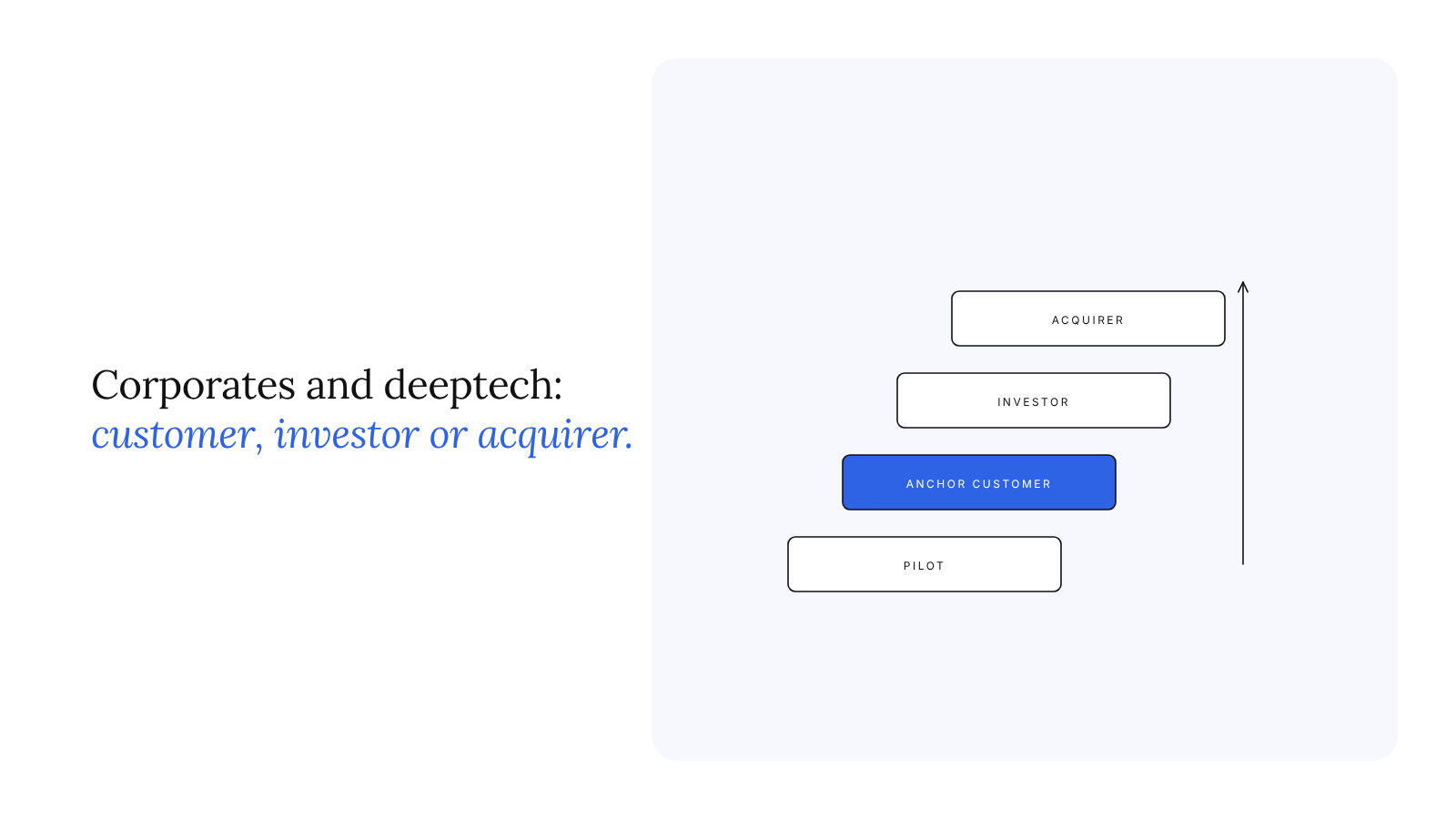
When a large company and a deeptech venture start working together, both sides tend to talk about "partnership" as if it were one thing. It is not. A corporate can be a venture's pilot sponsor, its development client, its anchor customer, its strategic investor, its exclusive channel or its eventual acquirer, and each of those roles has a different price, a different set of rights and a different effect on the venture's future. A corporate deeptech partnership that drifts between roles without naming them tends to give the corporate options it did not pay for and the venture obligations it did not intend.
The evidence suggests most of these relationships disappoint at least one side. In McKinsey's research on corporate and startup collaborations, only 28% of startups said they were satisfied with their corporate partnerships, and the majority of corporate venture capital units stopped investing after two to three years. Yet the same research found startup satisfaction rose sharply when the corporate partner was highly committed and when top management was involved. The problem is not that corporates and deeptech ventures cannot work together. It is that they rarely agree what step of the relationship they are on.
This piece sets out a relationship ladder from pilot to acquisition, with what each step should cost the corporate and give the venture, and what each step should not include. It is written for corporate innovation and strategy heads, corporate venture capital teams and deeptech founders. A separate PanScience Research piece covers lighthouse partners, the first customers who validate a new venture's product in the market; this article takes that idea further, into what happens when the relationship deepens into money and ownership.
Why corporate deeptech partnership is different from ordinary sales
Three features make the corporate relationship unusually consequential for a deeptech venture.
The first is concentration. A deeptech venture's first large customer may be its only large customer for several years. The terms of that relationship, including any exclusivity or preferential rights, shape the company's entire future market.
The second is capital scarcity. Deeptech ventures in India face a thin funding market after seed. The IVCA Bharat DeepTech Report 2026, as reported by YourStory, found that investor participation drops sharply after seed and that only about 15% of funds back ventures at technology readiness levels 1 to 3. A corporate that offers money alongside a contract can be the most important investor at a stage when few others will write a cheque, which gives it leverage over terms.
The third is information asymmetry. A corporate partner learns a great deal about the venture's technology during a pilot. Without clear terms, it may also acquire, by default, rights to the improvements made during the work.
There is also an upside that ordinary sales lack. Thomas Chemmanur, Elena Loutskina and Xuan Tian, in a study published in the Review of Financial Studies and summarised on the Harvard Law School Forum on Corporate Governance in July 2014, found that CVC-backed firms that went public produced 26.9% more patents in the three years before their IPOs than firms backed by independent venture capital, with patents receiving 17.6% more citations. They linked this partly to technological fit, finding that ventures operating close to the parent's industrial expertise were more innovative, and partly to failure tolerance: corporate investors were more tolerant of failure than independent investors. For a deeptech venture, a corporate partner in its own field can be more than a buyer.
The relationship ladder
The ladder below is the original contribution of this piece. It describes six steps a corporate deeptech partnership can occupy, with what each step should cost the corporate, what it should give the venture, and what it should exclude. The costs and terms are analytical recommendations based on the sources discussed in this article, not observed market rates.
Each step has a logic, and most of the trouble in corporate and venture relationships comes from mixing the terms of one step with the price of another.
Step 1 the paid pilot
McKinsey's research found that companies "often get stuck in pilots" with no path to scale, and that partnerships fail "for lack of established metrics up front". The correction is to treat the pilot as a paid engagement with a named business owner and pre-agreed criteria for moving to step 2 or step 3. The pilot should be sized, as McKinsey suggests, to prove that the concept can scale, not merely that it works in a lab.
What the pilot should not include is ownership of improvements. A deeptech venture improves its product during every serious deployment. If the pilot agreement assigns improvements to the corporate, the venture's core technology fragments across customers.
Step 2 the development contract
Many deeptech products need adaptation to a corporate's plant, data or regulatory environment. That adaptation is real engineering work and should be paid as such. A field-limited licence, giving the corporate rights to use the adaptation in its own operations while the venture retains the underlying IP, is the cleanest structure. A separate PanScience Research piece covers licensing corporate IP to new ventures, which is the mirror image of this question.
Step 3 the anchor customer
The anchor customer is the step that matters most for a deeptech venture's financing. A commercial contract with a credible corporate is evidence that other customers and investors can rely on. In enterprise AI specifically, Menlo Ventures' State of Generative AI in the Enterprise 2025 reported that 47% of AI deals reached production, up from 25% the year before; the move from pilot to production is precisely the step at which a corporate becomes an anchor customer.
The anchor customer should pay a price that reflects value. Corporates sometimes ask for steep discounts in return for being first; a modest discount for reference rights is reasonable, but a venture that sells its first large contract below cost has set a benchmark that later customers will cite. Most-favoured customer pricing, if granted, should be tied to volume.
Step 4 the strategic minority investor
At this step the corporate becomes a shareholder. Professional guidance is consistent on how this should be done. Torys, writing in 2019 for strategic investors, advised that "successful CVCs generally participate on the same customary terms and conditions as traditional VC investors". It noted that many corporate investors take a board observer seat rather than a voting seat, which gives visibility while reducing conflicts, and that it is prudent to negotiate a standalone confidentiality agreement because the corporate's nominee often sits on the parent's executive team.
The term that most often damages ventures at this step is the right of first refusal on a sale. WilmerHale, writing for founders in 2023, observed that such a right "may have a chilling effect on potential offers to acquire the company by potential third party acquirers". Torys made the same point from the investor's side, warning that it could "discourage third party bidders, complicate the sale process and possibly depress the potential sale price". WilmerHale also noted that a strategic investor can deter the investor's competitors from becoming the venture's customers, because they fear information will leak. That cost is often larger than the investment.
The Chemmanur, Loutskina and Tian findings suggest that a corporate investor with technological fit can add real value. The ladder's recommendation is to capture that value through the commercial relationship and an observer seat, and to price the equity close to a financial lead, rather than to extract preferential rights that narrow the venture's future.
Step 5 the field-limited exclusive partner
Some corporates want exclusivity as the price of commitment. Torys advises that a licence "almost always should not be on an exclusive basis", and that if exclusivity is granted, "the most likely exit outcome of the investment relationship is an outright acquisition by the strategic investor". That observation is the key to pricing exclusivity. A venture granting exclusivity is giving up part of its market, and with it part of its independent value. The corporate should pay for that through minimum volumes or fees, and the exclusivity should be limited by field, territory or period.
Step 6 the acquirer
The cleanest acquisition is one in which the corporate competes with other bidders on price. A corporate that wants to be the eventual acquirer of a deeptech venture is better served by building the relationship through steps 1 to 4, so that it knows the venture better than any other bidder, than by negotiating a right of first refusal at step 4 that suppresses the competition it would otherwise face.
What corporates get wrong
McKinsey's research names the corporate side's failures directly: "a lack of internal sponsorship and strategic buy-in", slow processes, unclear strategic intent and no impact tracking. Its positive findings are equally direct. Startup satisfaction rose by 93% when the corporate partner was highly committed, and by 86% when top management was involved. Acknowledging cultural gaps raised partner satisfaction by 30%. The same research recommended no more than eight ventures per executive.
Read through the ladder, these findings suggest three corporate disciplines. Name the step. Pay for the step. Assign an executive who owns the move to the next step. The 28% satisfaction figure is what happens when a corporate runs a step 1 pilot with step 5 expectations and step 0 commitment.
What founders get wrong
Founders make the mirror-image mistakes. The most common is accepting step 4 or step 5 terms in return for step 1 or step 3 money, because the venture is short of cash and the corporate is the only party offering it. The IVCA finding that investor participation falls sharply after seed explains why this happens in India. It does not make it a good trade.
The second mistake is failing to price exclusivity. A founder who grants exclusivity for free has given away the venture's most valuable option.
The third is underestimating the competitor effect. A strategic investor who is a market leader may close doors to its competitors, who may be the venture's next five customers.
PanScience, a New Delhi deep-tech and AI venture studio, reports that its ventures include PredCo, which builds industrial AI and predictive maintenance for manufacturing plants, and Eigen, which builds on-premise AI for regulated industries (company-reported). Ventures of this kind typically sell into a small number of large industrial or regulated buyers, which is exactly where the ladder matters. A manufacturing group that sponsors a plant pilot is at step 1. If it wants to become an investor or an exclusive partner, the venture should treat that as a separate negotiation at a separate price, not as the natural next phase of the pilot.
Choosing the right step
The ladder is not a sequence that every relationship must climb. Many of the best corporate relationships stop at step 3: a corporate that is a demanding, well-paying anchor customer is often more valuable to a deeptech venture than one that also wants equity. A separate PanScience Research piece covers venture clienting, the practice of a corporate buying from startups instead of investing in them, which is in effect a disciplined decision to stay at steps 1 to 3.
The question for each step is whether both parties gain enough from the move to justify its terms. A corporate should climb to step 4 only when ownership adds strategic value that a contract cannot, such as protection of a supply relationship or alignment on a long roadmap. A venture should accept step 5 only when the exclusivity premium compensates for the market it gives up. And both should approach step 6 knowing that a competitive process, not a pre-agreed right, usually produces the fairest price.
Conclusion
A corporate deeptech partnership is a ladder, not a single relationship, and most of the disappointment on both sides comes from confusing the rungs. The corporate wants the rights of an investor or exclusive partner at the price of a pilot sponsor; the venture accepts those terms because capital after seed is scarce. The research offers a way out. McKinsey's work shows that commitment and senior involvement transform startup satisfaction. Chemmanur, Loutskina and Tian show that a corporate investor with technological fit can make ventures more innovative. Professional guidance from Torys and WilmerHale shows which terms, particularly rights of first refusal and broad exclusivity, cost the venture far more than they give the corporate. Naming the step, paying for it, and agreeing in advance what would justify the next one is a simple discipline. It is also the difference between a partnership that builds a company and one that quietly constrains it.
Methodology and sources
This article is based on sources opened in October 2026 and on editor-verified figures. McKinsey's research on corporate and startup collaborations is from "Collaborations between corporates and start-ups" (May 2021; https://www.mckinsey.com/capabilities/strategy-and- corporate-finance/our-insights/collaborations-between-corporates-and-start-ups). The Chemmanur, Loutskina and Tian findings are from the summary of their Review of Financial Studies paper on the Harvard Law School Forum on Corporate Governance (https://corpgov.law.harvard.edu/2014/07/15/corporate-venture-capital-value-creation-and-innovation). Guidance on strategic investor terms comes from Torys, "Ten things strategic investors should consider when investing in startups" (https://www.torys.com/en/our-latest- thinking/publications/2019/07/ten-things-strategic-investors-should-consider-when-investing-in-startups), and WilmerHale, "Pros and Cons of Strategic Investors in Early-Stage Companies" (https://launch.wilmerhale.com/research/blog/20230807-pros-and-cons-of-strategic- investors-in-early-stage-companies). The IVCA Bharat DeepTech Report 2026 figures (as reported by YourStory, yourstory.com, August 2026) and the Menlo Ventures State of Generative AI in the Enterprise 2025 figure (menlovc.com, 9 December 2025) are editor-verified. The relationship ladder and its recommended costs and exclusions are the author's analytical framework, not observed market terms. PanScience facts are company-reported. This is not legal advice.