
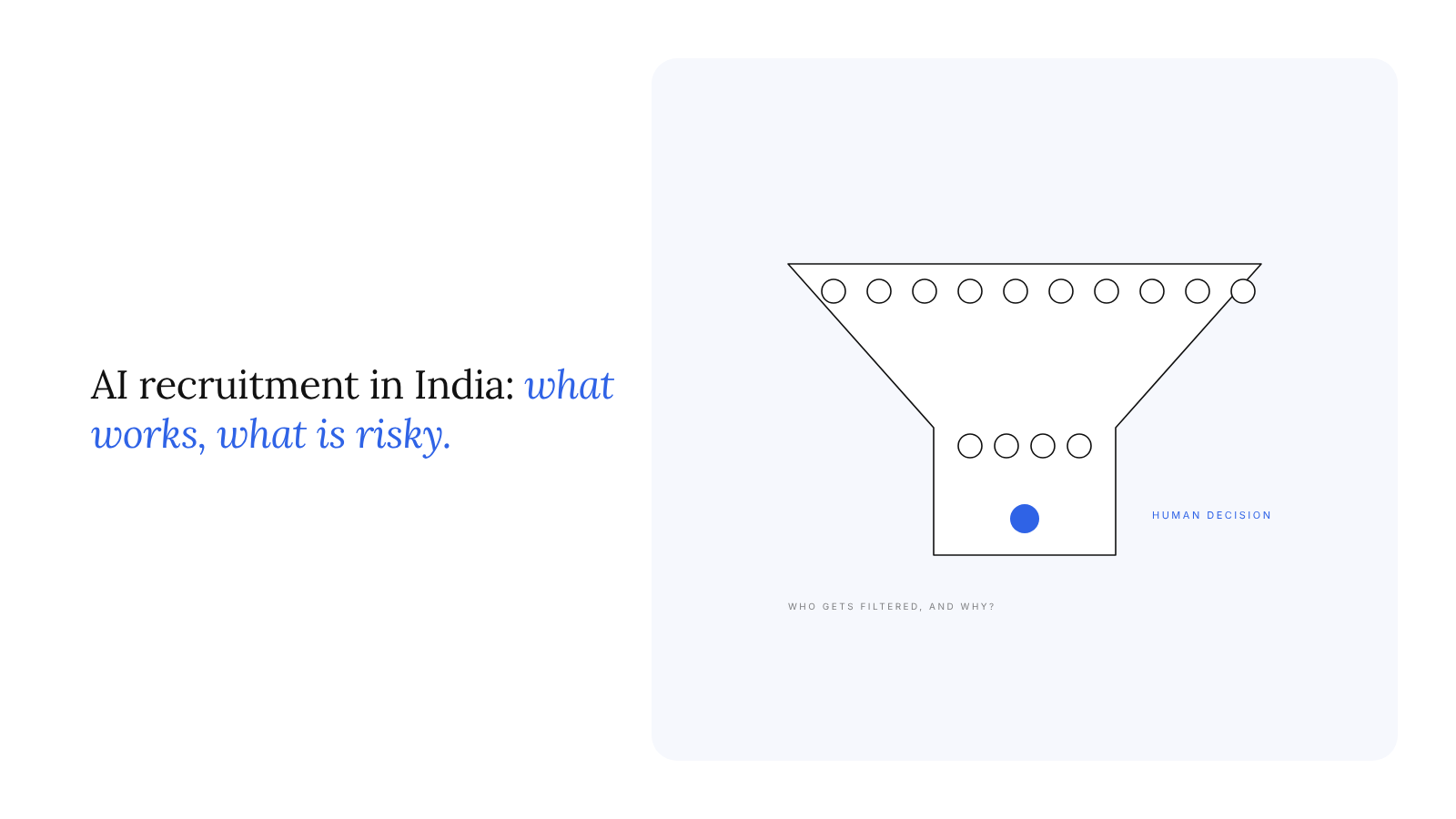
Indian recruiters have moved faster on artificial intelligence than most of the functions they serve. A LinkedIn report covered by IANS in February 2026 found that 71% of Indian recruiters said AI had helped them find candidates with skills they would otherwise have missed, and around eight in ten planned to expand its use for sourcing, evaluating applicants and setting hiring goals. The same coverage recorded a less comfortable number: half of recruiters said they were under pressure to explain how AI is used in their hiring process, especially in screening and shortlisting. AI recruitment in India has therefore reached the stage where the question is no longer whether to use these tools but which uses an employer can defend to a candidate, an auditor or a court.
This piece is written for chief human resources officers, general counsel, CIOs and founders building hiring products. It sets out what the evidence says works, where the documented risks sit, and what Indian law currently requires. Its central contribution is a risk ladder that ranks common AI hiring tools by the harm they can cause and maps each rung to the obligations of the Digital Personal Data Protection Act, 2023 and its Rules, and to the anti-discrimination principles that a careful employer should apply even where Indian statute is silent. It is analysis, not legal advice; any employer deploying these systems should take advice on its specific facts.
The short version is that the low rungs, scheduling, drafting and candidate communication, are mostly safe and mostly valuable. The middle rungs, ranking and shortlisting, are where both the productivity gains and the discrimination risks concentrate. The top rungs, automated rejection and inference about personality or emotion, carry a level of risk that the evidence does not yet justify.
Why AI recruitment in India is growing so quickly
Volume is the simplest explanation. The IANS coverage of the LinkedIn data reported that 74% of Indian recruiters said they now struggle to find qualified candidates even though hiring activity is 40% above pre-pandemic levels, and among recruiters who said hiring had become harder, 53% cited a surge in AI-generated applications. When candidates use generative tools to produce tailored CVs and cover letters at scale, the recruiter's inbox grows faster than the team. Employers respond with tools of their own, and an arms race follows.
The second explanation is structural. Indian technology employers hire at a scale few other markets match. Nasscom's Strategic Review release of February 2026, as reported by ETV Bharat, put the industry's direct workforce at 59.5 lakh at the end of FY26, with net additions of 1.35 lakh in the year. Global capability centres add another large hiring engine: the Nasscom-Zinnov GCC landscape report of July 2026 counted 2,117 centres employing about 2.36 million people. Campus intake, lateral hiring and contract staffing at that scale produce exactly the conditions in which automated screening looks attractive.
The third explanation is that the tools are now cheap to build. A large language model can read a CV, compare it with a job description and produce a ranked list in seconds. That ease is also the problem. The same simplicity that lets a startup ship a screening product in a quarter lets it ship one that has never been tested for bias.
What the evidence says about bias in AI hiring tools
The most useful recent study for anyone using language models to screen CVs comes from the University of Washington. Kyra Wilson and Aylin Caliskan tested three language models from Mistral AI, Salesforce and Contextual AI on more than 550 real CVs and over 500 real job listings across nine occupations, varying 120 first names associated with white and Black men and women. Across more than three million comparisons, the models favoured white-associated names 85% of the time and Black-associated names 9% of the time; they favoured male-associated names 52% of the time and female-associated names 11% of the time. Black male-associated names were never favoured over white male-associated names. The work was presented at the AAAI/ACM Conference on AI, Ethics and Society in October 2024 and funded by the US National Institute of Standards and Technology.
That study used US racial categories, and its numbers cannot be transplanted directly to India. The mechanism, however, travels. A model that has learnt statistical associations from text will attach them to whatever signals a CV contains. In India those signals include surnames that can indicate caste or religion, the name of a college, a home town, a gap year, a career break after childbirth, or the language in which a candidate writes. No published study known to this author has measured caste or regional bias in commercial Indian screening tools at the scale of the Washington work, and that gap is itself a finding. Indian employers cannot currently rely on public evidence that the tools they buy are fair on the dimensions that matter most locally.
The other consistent lesson from the evidence is that bias enters through training data that reflects past hiring decisions. If an employer's historical shortlists skewed towards a handful of campuses, a model trained to imitate those shortlists will reproduce the skew and give it a veneer of objectivity. A separate PanScience Research piece on evaluation before deployment sets out how to test a model against a held-out set before it touches live decisions; hiring is a domain where that discipline is not optional.
How other jurisdictions regulate AI in hiring
Two regimes are worth understanding because Indian employers with US or European operations already fall under them, and because they show where Indian practice is likely to be judged.
New York City's Local Law 144 of 2021 prohibits employers and employment agencies from using an automated employment decision tool unless it has been audited for bias within one year of use, a summary of the audit results is publicly available, and required notices have been given to candidates and employees. The city's Department of Consumer and Worker Protection began enforcement on 5 July 2023, and its guidance materials refer to notice 10 business days before use. The law's weakness is enforcement. A December 2025 audit by the New York State Comptroller found that the department received only two complaints about such tools between July 2023 and June 2025, and that while the department's own review of 32 companies found a single instance of non-compliance, the Comptroller's auditors found at least 17 instances of potential non-compliance among the same 32.
The European Union's AI Act goes further. Annex III lists as high-risk "AI systems intended to be used for the recruitment or selection of natural persons" and systems used to make decisions affecting the terms of work relationships. Deployers of high-risk systems must assign human oversight to people with "the necessary competence, training and authority", and employers must inform workers' representatives and affected workers before a high-risk system is put into service at the workplace. Article 5 separately prohibits AI systems that infer the emotions of a person in the workplace or in education, except for medical or safety reasons. The timetable has moved: a Gibson Dunn alert reported that EU institutions reached provisional political agreement on 6 May 2026 to defer the Annex III obligations from 2 August 2026 to 2 December 2027, with the change taking legal effect on publication in the Official Journal.
The pattern across both regimes is consistent: disclosure to candidates, independent testing for disparate outcomes, documented human oversight, and outright prohibition of the most intrusive inference.
What Indian law requires today
India has no statute specific to AI in hiring. The binding framework is the Digital Personal Data Protection Act, 2023, read with the DPDP Rules notified on 14 November 2025. The PIB explainer on the Rules describes an 18-month period for phased compliance, and Storyboard18's reading of the notification is that most substantive rules, including notice, security safeguards and breach intimation, come into force 18 months from publication, placing them in May 2027. Employers that start now will be ready; employers that wait will be retrofitting systems under deadline.
Five provisions matter most for hiring.
Notice and consent. The Rules require a consent notice that is clear, stands on its own and states the specific purpose of processing. A notice that says data will be used "for recruitment" is weaker than one that says a CV will be scored by an automated tool, by whom, and how a candidate can ask for human review.
Legitimate use for employment. Section 7(i) of the Act allows processing "for the purposes of employment or those related to safeguarding the employer from loss or liability". Employers will be tempted to rely on it to avoid consent altogether. Whether it extends to applicants who are not yet employees is a question the text does not settle, and a conservative employer will treat candidate screening as consent-based until guidance or case law says otherwise.
Accuracy when data drives a decision. Section 8(3) requires a fiduciary to ensure the "completeness, accuracy and consistency" of personal data likely to be used to make a decision affecting the data principal. A model that misreads a CV and rejects a candidate is, on a plain reading, a failure of this duty.
Erasure. Section 8(7) requires erasure when consent is withdrawn or when it is reasonable to assume the purpose is no longer served, whichever is earlier, and obliges the fiduciary to make its processors erase too. The common practice of keeping every unsuccessful CV in a talent pool indefinitely, and of letting a screening vendor retain them for model training, sits uneasily with this provision.
Rights, breaches and penalties. The PIB explainer states that requests for access, correction and erasure must be answered within a maximum of 90 days. Storyboard18 reports that a detailed breach report must reach the Data Protection Board within 72 hours, and that processing logs must be retained for at least one year. Under the Act, penalties reach up to ₹250 crore for failing to maintain reasonable security safeguards and up to ₹200 crore for failing to notify a breach.
On discrimination, Indian law is narrower than the US or EU frameworks and is spread across sector statutes and constitutional principles. This piece therefore treats non-discrimination as a design principle rather than a mapped legal duty. That is a deliberate choice: an employer that builds to the standard of disclosure, testing and human review used in New York and Brussels will be well placed whichever way Indian law develops, and will be defensible in the meantime.
A risk ladder for AI recruitment in India
The ladder below ranks common tools by the harm they can do to a candidate if they fail, and by how hard that harm is to detect. It is an original classification for this piece. Each rung inherits the controls of the rungs below it.
| Rung | Tool category | Typical examples | Main harm if it fails | DPDP touchpoints | Minimum controls |
| 1 | Administrative support | Interview scheduling, job description drafting, offer letter templates | Low; errors are visible and reversible | Ordinary security safeguards | Human review of external text; vendor security terms |
| 2 | Candidate communication | Application chatbots, status updates, FAQ assistants | Misinformation, poor candidate experience | Notice of automated interaction; purpose limitation on chat logs | Clear disclosure that the candidate is talking to software; escalation to a person |
| 3 | Sourcing and matching | Searching databases, recommending profiles to recruiters | Qualified people never seen; skew in who enters the funnel | Lawful basis for sourced data; erasure of unused profiles | Periodic comparison of recommended pools against applicant pools by gender and region |
| 4 | Screening and ranking with human decision | CV scoring, shortlist ranking, skills extraction | Systematic disadvantage to groups through proxies such as college or surname | Section 8(3) accuracy; specific consent notice; processor erasure | Pre-deployment bias test on held- out data; names and photos masked; recruiter sees reasons, not only scores; logged overrides |
| 5 | Automated rejection or assessment | Auto-reject below a score, scored video or voice interviews, game- based tests | Rejection without any human seeing the file; disability and accent penalties | All of the above, plus a route for the candidate to seek correction | Human review of every rejection, or of a statistically valid sample; accessibility alternatives; annual independent audit |
| 6 | Inference about the person | Emotion or personality inference from video, social media profiling, predicting attrition or pregnancy | Opaque judgments on traits the candidate never disclosed | Purpose and data minimisation are hard to satisfy | Do not deploy; prohibited in the EU workplace context for emotion recognition |
Three observations follow from the ladder. First, most of the productivity gain is in rungs 1 to 4. Recruiters lose time to scheduling, repetitive candidate questions and first-pass reading, and all three can be automated without letting software make the final call. Second, the jump from rung 4 to rung 5 is the critical boundary. Once a tool can reject a candidate without a human reading the file, any bias in the model becomes a bias in outcomes, and the employer loses the ability to say a person decided. Third, rung 6 has a weak evidence base and a strong regulatory headwind. Inferring personality or emotion from a video interview is the kind of use the EU has chosen to prohibit in the workplace, and Indian employers have no good reason to adopt it ahead of evidence that it works.
What works in practice
The employers getting value from AI in hiring tend to share four habits.
They separate reading from deciding. A model that extracts skills, years of experience and certifications from a CV and presents them in a consistent format makes a recruiter faster and fairer, because every file is read the same way. A model that turns the same information into a single score invites the recruiter to stop reading.
They mask what should not matter. Removing names, photographs, dates of birth and addresses before a model or a person sees a file reduces the proxies through which bias travels. Masking college names is harder because they carry real information, but it can be tested: run the same shortlist with and without them and see what changes.
They measure outcomes by group. The New York approach of comparing selection rates across groups is simple enough for any HR analytics team to replicate on gender and, where lawfully collected and voluntarily disclosed, on other characteristics. The point is not to hit quotas but to notice when a tool's shortlist looks very different from its applicant pool and to investigate why.
They write the vendor contract around the law. A hiring tool vendor is a data processor under the DPDP Act. The contract should cover where candidate data is stored, whether it may be used to train the vendor's models, how quickly it is erased, how breaches are reported within the Rules' timelines, and what bias testing the vendor has done and will share. A separate PanScience Research piece on AI governance for boards covers how these commitments should be reported upward.
What founders building hiring products should do
For Indian startups selling AI recruitment tools, the ladder doubles as a product strategy. Products that live on rungs 1 to 4 and are designed to keep a human in the decision are easier to sell to large employers, easier to defend, and easier to take abroad, because they already align with the disclosure and oversight expectations of New York and the EU. Products that sell automated rejection or behavioural inference will face longer procurement cycles and, in Europe, a high-risk compliance burden from late 2027 on the current timetable.
Three design choices make the most difference. Publish a plain-language description of what the model does and does not consider. Ship bias testing as a feature, with reports a customer can hand to its own auditors. And build erasure and access requests into the product so that a customer can meet its 90-day obligation without a support ticket.
Conclusion
AI recruitment in India is useful where it removes drudgery and makes reading more consistent, and risky where it replaces judgment with a score no one can explain. The evidence on bias in language- model screening is strong enough that no employer should deploy CV ranking without testing it first, and the absence of India-specific public evidence on caste, region and language makes local testing more important, not less. The DPDP Act and Rules give Indian employers a clear compliance runway to May 2027 on notice, accuracy, erasure and breach handling. The risk ladder offers a way to decide which tools to adopt now, which to adopt with controls, and which to leave alone.
Methodology and sources
This article combines published evidence and official legal texts with an original classification, the risk ladder, which is the author's analytical framework rather than an observed dataset. Recruiter survey figures come from IANS coverage of a LinkedIn report published on 3 February 2026 (ianslive.in/over-70-pc-indian-recruiters-turning-to-ai-to-find-hidden-talent-report--20260203131314); the coverage does not state how many of the 6,554 respondents were in India. Bias findings come from the University of Washington news release of 31 October 2024 (washington.edu/news/2024/10/31/ai- bias-resume-screening-race-gender). New York City requirements are taken from the Department of Consumer and Worker Protection page on automated employment decision tools (nyc.gov/site/dca/about/automated-employment-decision-tools.page), and enforcement findings from the New York State Comptroller's audit of 2 December 2025 (osc.ny.gov/state- agencies/audits/2025/12/02/enforcement-local-law-144-automated-employment-decision-tools). EU AI Act text is quoted from Annex III, Article 5 and Article 26 as published at artificialintelligenceact.eu (artificialintelligenceact.eu/annex/3, artificialintelligenceact.eu/article/5, artificialintelligenceact.eu/article/26); the revised timetable is from Gibson Dunn's alert on the Omnibus agreement (gibsondunn.com/eu-ai-act-omnibus-agreement-postponed-high-risk-deadlines- and-other-key-changes). DPDP provisions are quoted from the Act as published by MeitY (meity.gov.in) and from the PIB explainer on the Rules dated 17 November 2025 (static.pib.gov.in/WriteReadData/specificdocs/documents/2025/nov/doc20251117695301.pdf), with the phased timetable, breach timeline and log retention from Storyboard18 (storyboard18.com/digital/breaking-govt-notifies-final-dpdp-rules-sets-staggered-rollout-with-key- obligations-for-data-fiduciaries-84201.htm). Workforce figures come from ETV Bharat's report of Nasscom's Strategic Review release of 24 February 2026 (etvbharat.com/en/business/india-fy26-tech- revenues-hit-usd-315-billion-enn26022404879) and the Nasscom-Zinnov GCC report as carried by The Tribune on 3 July 2026 (tribuneindia.com/news/business/india-s-gccs-are-increasingly-leading- the-ai-mandate-for-global-enterprises-driving-global-value-creation-nasscom-zinnov-report). The statement that no large-scale public study of caste or regional bias in Indian commercial screening tools is known to the author reflects the author's search, not a proof of absence. Nothing here is legal advice.