
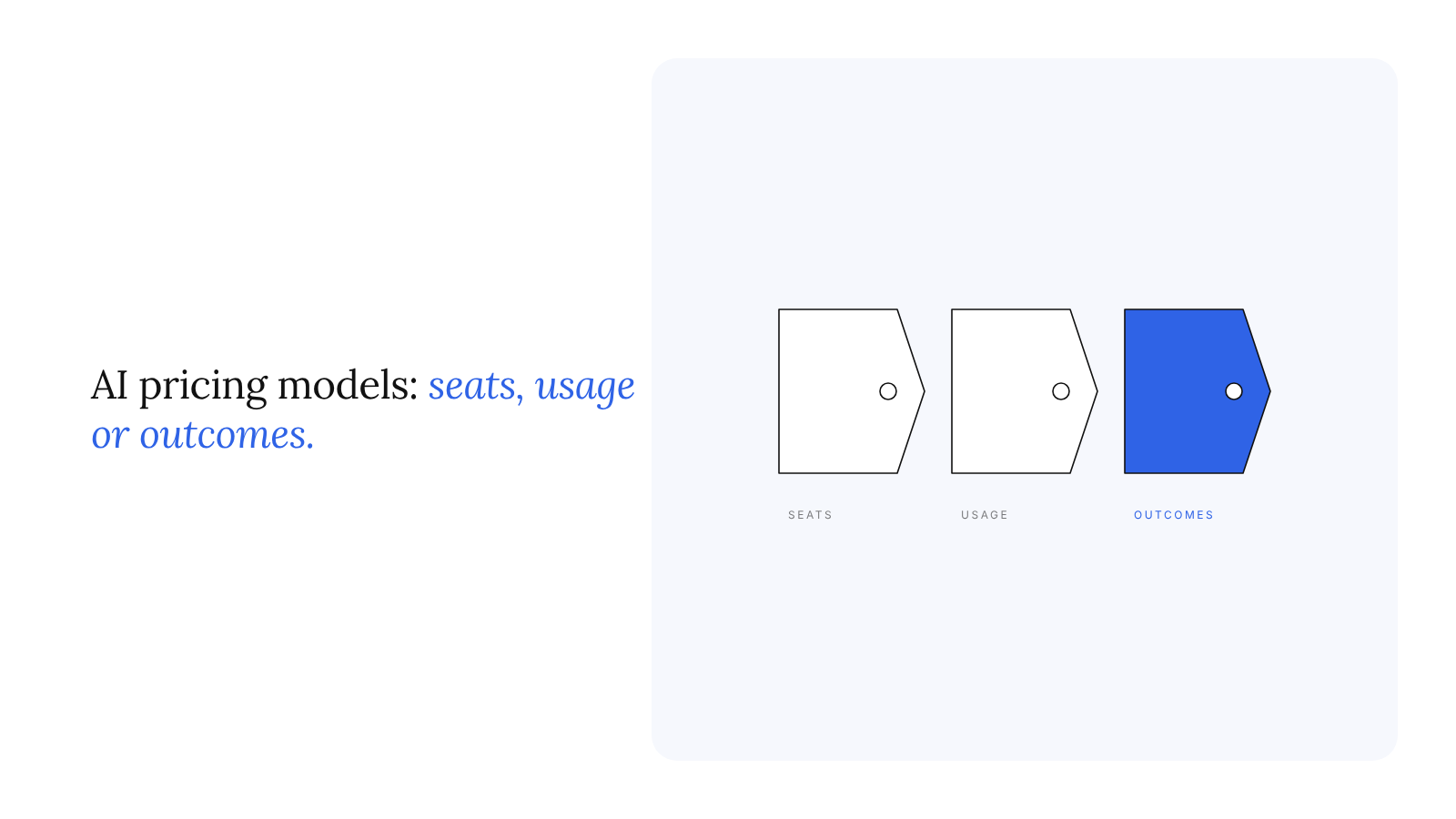
For two decades, enterprise software had a settled answer to the question of what a customer pays for: a seat. The number of people using the product was a reasonable proxy for the value it delivered, the vendor's marginal cost of serving one more user was close to zero, and procurement teams knew how to budget for it. AI unsettles all three assumptions at once. A product that completes work rather than assisting a worker breaks the link between headcount and value, every task it performs carries a real inference cost, and buyers are asked to fund it from budgets that used to pay for labour.
The choice among AI pricing models is therefore not a marketing decision to be made after the product is built. It shapes gross margin, sales cycles, customer trust and how a vendor's revenue behaves when the customer succeeds. Price on seats and a product that reduces the customer's headcount shrinks its own revenue. Price on usage and the customer's finance team may cap adoption to control an unpredictable bill. Price on outcomes and both sides must agree, in writing, on what an outcome is and who caused it.
This piece reviews the evidence on how software and AI vendors are actually pricing, explains the cost structure that makes AI different, and offers a decision matrix that maps pricing models to two variables: how heavy and variable the vendor's marginal cost is, and how measurable the customer's value is. It is written for founders and product leaders setting prices, and for enterprise buyers trying to understand what they are being offered.
What the market is actually doing
The loudest claim in the debate is that seat pricing is dead. The evidence suggests something more gradual. Bain and Company's October 2025 brief, by partners Eric Maltiel and Josh Sandberg, analysed more than 30 established SaaS vendors that had introduced generative AI features, excluding AI-native companies. Roughly 35% had simply raised per-seat prices and bundled AI into existing tiers. About 65% had moved to a hybrid model, layering a usage or feature-access meter on top of seat pricing. None had moved fully to usage- or outcome-based pricing, and none now sold AI exclusively as a separate add-on, although several had done so a year earlier. Bain calls the claim that seats are dead an overstatement while acknowledging that the sentiment is not entirely off base.
Survey data from builders points the same way. ICONIQ's 2025 State of AI report, drawing on an April 2025 survey of 300 software executives, describes many companies using hybrid pricing that combines a subscription with charges based on consumption, treats usage and outcome pricing as experiments, and finds that 37% plan to change their pricing within the next year. The direction is clear; the destination is not.
The most visible experiments are in customer service, where the unit of work is easy to count. Zendesk announced outcome-based pricing for its AI agents on 28 August 2024, under which customers incur costs only for issues the AI resolves autonomously, with a starter level of usage included in all Suite and Support plans and a dashboard showing automated resolutions and automation rate. Intercom's pricing page lists its Fin AI agent from $0.99 per outcome. Salesforce described its existing conversational pricing for Agentforce as $2 per conversation, and on 15 May 2025 added Flex Credits, sold at $500 for 100,000 credits, with each agent action consuming 20 credits or $0.10, alongside per- user licences with unmetered employee-facing usage and a Flex Agreement allowing customers to convert between the two.
Salesforce's move is instructive. Within roughly a year, one of the world's largest software vendors went from a single per-conversation price to offering three models at once: per action, per user, and the right to switch between them. That is not indecision. It reflects a market in which different customers, and different use cases within one customer, need different meters.
Why AI changes the cost structure
Bain identifies two ways AI alters software economics. It can complete tasks with little human involvement, which weakens the link between headcount and value, and it adds costs that classic SaaS did not carry, including inference, fine-tuning and AI-specific research and development.
The second point matters more than it first appears. In conventional SaaS, the marginal cost of an additional user is small, so almost any pricing meter produces healthy gross margins. In an AI product, every task consumes tokens or GPU time. A heavy user on a flat seat price can be unprofitable. A customer who connects an agent that runs overnight can generate costs that no seat price anticipated. A separate Cluster 4 piece on AI cost optimisation covers how those costs are built and controlled; for pricing, the consequence is that a vendor must know its cost per unit of work before it can choose a meter.
Inference costs are also moving. The Stanford AI Index 2025 reports that the cost of GPT-3.5-level inference fell more than 280-fold between November 2022 and October 2024. A price fixed per unit of work today may carry a much better margin in two years, or competitors may pass that saving to customers and force prices down. Pricing that is tied to the customer's value, rather than to the vendor's cost, is more insulated from this deflation; pricing tied to tokens passes it straight through.
Finally, the buyer's budget is changing. Bain notes that the move to new models is hard externally because procurement habits are entrenched and because spend must shift from labour budgets to software budgets. Its illustrative example is a $40,000 AI agent that might replace an $80,000 sales development representative: during evaluation, the customer runs both, raising its cost by 50% for an undefined period before any saving appears. Bain suggests vendors may need incentives such as delayed payments, flexible contracts or performance guarantees to get through that window.
The three meters and their failure modes
Each pricing model is a bet about what the customer values and what the vendor can measure.
Seat pricing charges per named or active user. It is predictable for the buyer, simple to procure and familiar to finance teams. It fails when the product replaces work rather than assisting it, because success reduces the number of seats, and when a small number of power users drive most of the cost.
Usage pricing charges per unit of consumption: tokens, API calls, documents processed, minutes of audio, actions taken. It aligns revenue with the vendor's cost and scales naturally with adoption. It fails when customers cannot forecast their bill, because finance teams then cap usage, which suppresses the adoption the vendor needs. It also fails when the unit is technical rather than meaningful to the buyer: few business leaders want to approve a budget denominated in tokens.
Outcome pricing charges per result the customer recognises: a resolved ticket, a processed claim, a qualified lead, a completed compliance check. It aligns revenue with value and makes the business case self-evident. It fails when outcomes are hard to define, slow to materialise, or caused jointly by the product and the customer's own people and processes. It also shifts risk to the vendor, which must absorb the inference cost of attempts that do not produce a billable outcome.
Hybrid models combine a base fee, often seat or platform based, with a usage or outcome meter. Bain describes hybrids as the dominant interim approach, and the evidence from both its sample and the customer service vendors bears that out.
A decision matrix for AI pricing models
The original contribution of this piece is a matrix that maps the choice to two variables. The first is marginal cost intensity: how large and how variable is the vendor's cost of serving one more unit of work, relative to price. The second is value measurability: can the customer and vendor agree, cheaply and without dispute, on a unit of value the customer recognises.
| Value hard to measure or attribute | Value easy to measure and attribute | |
| Low, stable marginal cost | Seat or platform pricing. Example: an AI writing assistant used by knowledge workers. Bundle AI into tiers, protect margin with fair-use limits. | Outcome pricing is possible but seat pricing may capture more value. Example: AI features inside a CRM with clear conversion metrics. Consider a seat base with outcome-linked bonuses. |
| High or variable marginal cost | Hybrid: platform fee plus usage meter with committed volumes. Example: document analysis or compliance research across large corpora. Use credits or tiers expressed in business units, not tokens. | Outcome pricing with a floor. Example: autonomous ticket resolution. Charge per outcome, include a platform minimum to cover cost of failed attempts, cap total spend for predictability. |
Three further tests refine the choice within each cell.
The first is attribution control. If the outcome depends heavily on the customer's own data quality, processes or staff, outcome pricing invites disputes. Customer service resolution is a good fit because the AI either closes the ticket or hands it to a human, and the record shows which. A sales outcome that depends on the customer's sales team following up is a poor fit.
The second is time to value. If the outcome materialises months after the work, such as a reduced penalty from a regulator or a lower default rate on a loan book, outcome pricing pushes revenue far into the future and exposes the vendor to events it does not control. Usage or platform pricing is safer.
The third is budget ownership. If the buyer is a function that holds a labour budget, such as a contact centre, outcome pricing that mirrors a cost per handled contact will feel familiar. If the buyer is IT, which budgets for software, a platform fee with predictable usage tiers will procure faster.
| Test | Favours outcome pricing when | Favours seat, platform or usage pricing when |
| Attribution control | The product completes the task end to end and logs show which outcomes it produced | Results depend on customer staff, data or downstream processes |
| Time to value | Outcome is visible within the billing period | Outcome appears months later or is probabilistic |
| Budget ownership | Buyer holds a labour or per-transaction budget | Buyer holds a software or IT budget |
| Cost of failed attempts | Low, or vendor can absorb it through a floor | High and variable |
| Customer forecasting need | Customer can tolerate variable spend tied to results | Customer needs a fixed annual number |
A worked example from regulated finance
Compliance work in banking, insurance and capital markets illustrates the bottom-left cell. PanScience reports that its venture OnFinance AI builds NeoGPT, a large language model for BFSI compliance, and operates more than 70 agents across more than 40 regulators (company-reported). The example is used here to illustrate pricing logic, not to describe the venture's commercial terms.
Consider what an outcome would mean in this setting. The value of a compliance tool is largely an avoided cost: a missed circular that did not become a breach, a filing that did not draw a penalty, an audit that closed without findings. That value is real but difficult to attribute and slow to appear. A regulatory change that the tool flags today may matter only when an inspection happens next year, and whether a breach was avoided because of the tool or because of the compliance officer who read its output is unknowable.
At the same time, the cost to serve can be substantial and variable: tracking regulatory publications across dozens of regulators, comparing new circulars against internal policies, and answering ad hoc questions over large document sets all consume inference. Indian financial regulators also impose their own expectations on technology adoption. The RBI's FREE-AI committee report of August 2025 set out seven sutras and 26 recommendations for responsible AI in the financial sector, which remain recommendations rather than binding regulation, but which shape how a bank's risk function evaluates any AI vendor.
The matrix therefore points away from pure outcome pricing and towards a hybrid: a platform fee that reflects the breadth of regulatory coverage, with usage measured in units the compliance team recognises, such as regulators tracked, documents reviewed or queries answered, rather than in tokens. Committed annual volumes give the bank a predictable number for its budget cycle and give the vendor a floor that covers its fixed cost of maintaining coverage.
Contract mechanics that make new models work
Whichever meter is chosen, the details of the contract determine whether it survives contact with procurement.
Define the unit precisely. An outcome-priced contract needs an operational definition: what counts as a resolution, how long a ticket must stay closed, what happens if the customer reopens it, and who adjudicates disputes. Intercom's pricing page, for instance, lists a price per outcome; the definition behind such a price is what the customer's lawyers will negotiate.
Give the buyer a ceiling. Variable pricing becomes acceptable to finance teams when it is bounded. Monthly or annual caps, committed-use discounts and alerts at spend thresholds all convert an open- ended bill into a manageable one.
Give the vendor a floor. A platform minimum protects the vendor from customers who connect the product but route little work to it, and from the cost of attempts that do not produce a billable outcome.
Build telemetry first. Bain notes that the internal barriers to new pricing models include telemetry, billing systems and silos between sales, finance and product. A vendor that cannot measure usage or outcomes reliably per customer cannot bill on them, and a customer that cannot see the same data will not trust the invoice. Zendesk's inclusion of a dashboard showing automated resolutions and automation rate is a recognition of that.
Plan for convertibility. Salesforce's Flex Agreement, allowing customers to move between per-user licences and consumption credits, reflects the reality that a customer's needs will change during a multi-year contract. Allowing conversion reduces the risk of choosing the wrong meter at signature.
What buyers should ask
For enterprise buyers, the shift creates both risk and leverage. Questions worth asking any AI vendor include: what unit of work drives your cost, and how does that map to the price; what happens to my bill if adoption doubles; how is an outcome defined and verified; what share of attempts do not produce a billable outcome, and who pays for them; and can I convert between pricing models during the contract.
A separate PanScience Research piece on the unit-cost model for enterprise AI sets out how to calculate cost per task internally. Buyers who know their own cost per resolved ticket or per reviewed contract, with and without AI, negotiate outcome prices from a position of strength.
Conclusion
AI pricing models are converging on hybrids not because the industry lacks imagination but because AI products combine two properties that classic SaaS kept apart: meaningful marginal cost and value that sometimes, but not always, can be measured directly. Where both are present and the product completes work end to end, outcome pricing with a floor and a cap is increasingly viable, as customer service vendors have shown. Where value is diffuse or delayed, as in compliance and advisory work, a platform fee with usage in business units is more durable. The matrix in this piece is a starting point for that choice. The harder work is building the telemetry and contract definitions that let both sides trust the meter.
Methodology and sources
This article draws on published research, vendor announcements and an original decision matrix. Market evidence comes from Bain and Company, "Per-Seat Software Pricing Isn't Dead, but New Models Are Gaining Steam", 9 October 2025 (bain.com/insights/per-seat-software-pricing-isnt-dead- but-new-models-are-gaining-steam); ICONIQ, 2025 State of AI: The Builder's Playbook (iconiq.com/growth/reports/2025-state-of-ai); Zendesk's announcement of outcome-based pricing, 28 August 2024 (zendesk.com/newsroom/articles/zendesk-outcome-based-pricing); Salesforce's Agentforce pricing announcement, 15 May 2025 (salesforce.com/news/press- releases/2025/05/15/agentforce-flexible-pricing-news); and Intercom's pricing page, read 25 October 2026 (intercom.com/pricing). The inference cost figure is from the Stanford AI Index 2025, chapter 1 (hai.stanford.edu). The RBI FREE-AI reference is from the editor-verified summary of the August 2025 report (rbi.org.in). Bain's percentages come from its own analysis of more than 30 SaaS vendors and its $40,000 agent example is hypothetical. The decision matrix, the refinement tests and the compliance worked example are the author's analysis; the OnFinance AI description is company- reported by PanScience Innovations (panscience.xyz) and is not a description of that venture's commercial terms.