
Most large enterprises now use AI somewhere. Very few have organised themselves to get value from it. McKinsey's 2025 global survey of 1,993 participants found 88 per cent reporting regular AI use in at least one business function, up from 78 per cent a year earlier, while only about one-third had begun to scale AI programmes and just 39 per cent reported any impact on enterprise EBIT, most of them under 5 per cent. The gap between use and value is not a technology gap. It is a question of AI operating model: who owns the talent, the platform, the use-case pipeline and the governance, and how those owners relate to the business units that must change how they work.
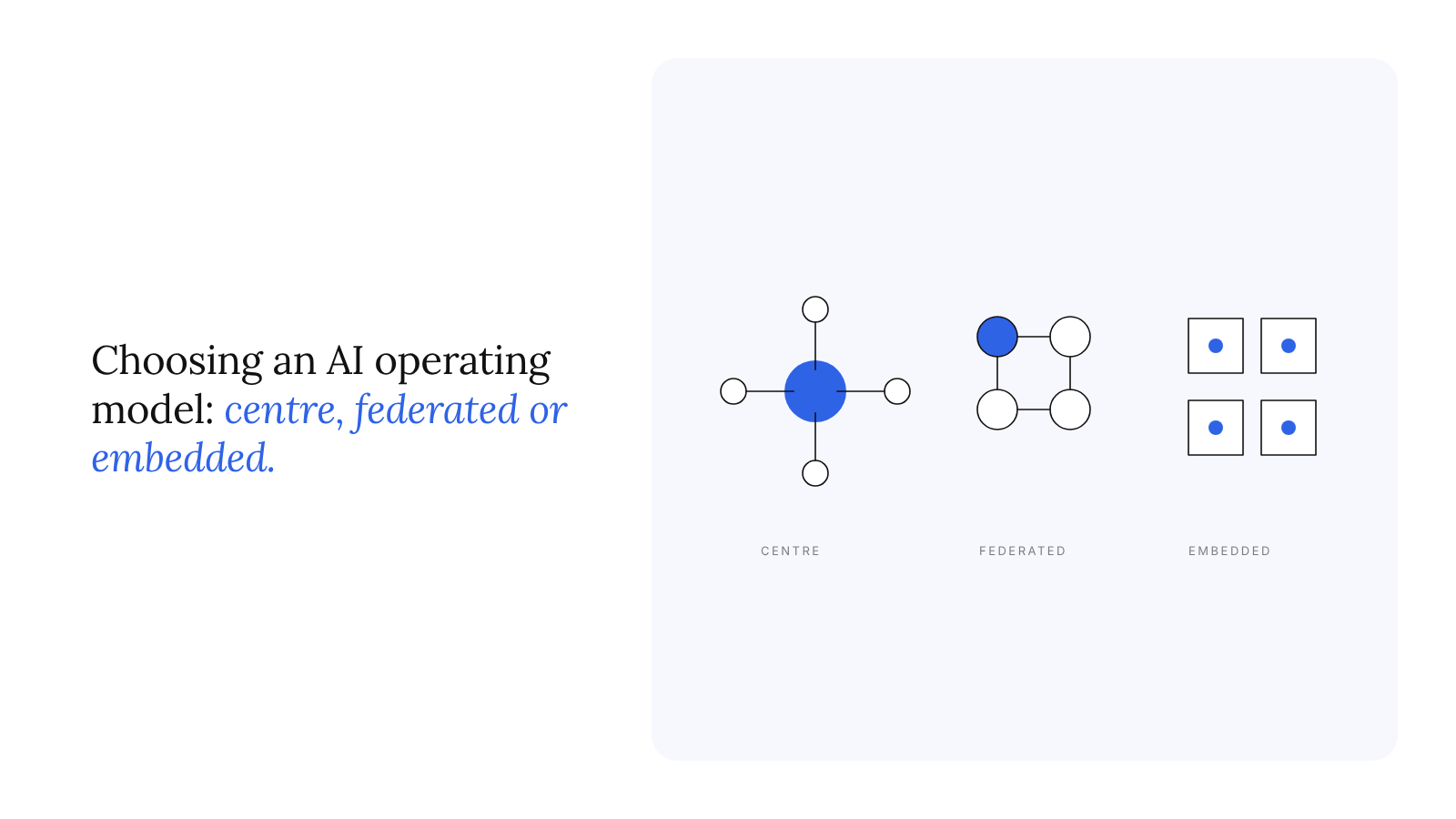
Three organisational designs dominate the discussion. A centre of excellence concentrates AI capability in one unit that builds for the business. A federated or hub-and-spoke model keeps a central platform and standards while business units own their own use cases and some of their own talent. An embedded or decentralised model places AI capability inside each business unit with minimal central coordination. Each has advocates, and each has a graveyard of failed implementations.
This article describes the three AI operating model archetypes, sets out the conditions under which each one is the right choice, and argues from the McKinsey, BCG, Gartner and Deloitte evidence that the choice matters less than two other things: whether the organisation redesigns workflows rather than layering AI on top of them, and whether it treats the operating model as a trajectory to be moved along rather than a structure to be chosen once.
Three archetypes and what each one owns
The table below is a classification rather than a survey finding. It names the five things an AI operating model must allocate and shows where each archetype places them.
The centre of excellence is the model most organisations start with and, according to Gartner, the one most still prefer. A Gartner analysis published in June 2025, drawing on its 2024 AI Mandates for the Enterprise survey, states that "most organizations of all AI maturity levels prefer a centralized operating model for their AI capabilities", while noting that "organizational preference for hybrid and decentralized operating models varies by AI maturity". The centralised model's attraction is control: one place to hire scarce talent, one platform to secure, one review process to satisfy a regulator.
The federated model is the one most consultancies recommend as the destination. BCG's August 2026 piece on the AI hub describes an evolution in which the hub first delivers most initiatives itself and supplies most of the talent, then shares resources with business units in a "centre and pod" phase, then becomes "a strategic center of excellence focused on governance and enablement" while business units "own and deliver AI use cases". Deloitte's description of an AI centre of excellence says it "functions best when aligned to the organizational matrix" and that the task is to "strike the right balance between centralization of a function and organizational flexibility". Both are describing federation as the mature state and centralisation as the starting state.
The embedded model is rarely chosen deliberately. It is what exists when business units adopt AI tools faster than the centre can organise them, and it is the model many Indian enterprises are in without having named it. Its advantage is speed and proximity to the problem; its costs are duplication, uneven risk control and no reuse.
Choosing an AI operating model: the conditions that favour each
The original contribution of this piece is a set of six conditions, each with an observable indicator, that tilt the choice toward one archetype. An organisation should score itself on all six; the pattern of answers, not any single one, points to the model.
Three readings of the table follow.
First, regulatory intensity dominates the others in Indian financial services. The RBI's FREE-AI committee report of August 2025 recommends that regulated entities adopt a board-approved AI policy covering governance, accountability, risk appetite, safeguards, auditability, consumer protection and disclosure, and that they maintain an inventory of deployed AI systems with periodic audit and disclosure in annual reports. These are recommendations rather than binding rules, but a bank cannot satisfy them with an embedded model in which each business line runs its own tools. It can satisfy them with a centre of excellence or with a federated model whose central platform enforces the policy technically. A separate PanScience Research piece in this series maps those requirements against the full stack.
Second, talent scarcity and maturity move together over time, which is why the right model changes. When capability is scarce and maturity low, pooling is unavoidable. As business units learn, the pool becomes a bottleneck. The organisation that does not move from the first column toward the second ends up with a centre that owns a backlog it cannot clear.
Third, the embedded column is rarely the right destination for a large enterprise, but it is often the right description of the present. Recognising that is the first design step: an organisation cannot federate what it has not first made visible.
Why structure alone does not produce value
The most robust finding across the evidence is that the operating model is necessary and not sufficient. What separates organisations that get value from those that do not is whether they change the work.
McKinsey's 2025 survey identifies a group of "high performers", about 6 per cent of respondents, who attribute 5 per cent or more of EBIT to AI. They are "nearly three times as likely as others are to fundamentally redesign their workflows", three times as likely to report that senior leaders demonstrate ownership of and commitment to AI initiatives, more likely to have "defined processes to determine how and when model outputs need human validation", and more likely to commit more than 20 per cent of digital budgets to AI. About three-quarters of them are scaling or have scaled AI, against one-third of other organisations. Workflow redesign is reported as among the strongest contributors to meaningful business impact of the factors tested.
BCG frames the same point as a proportion: "10% of the value from AI comes from algorithms and 20% from data", while "the remaining 70% comes from changes to the operating model and new ways of working". Deloitte's 2026 State of AI survey of 3,235 senior leaders in 24 countries reports that 34 per cent describe themselves as deeply transforming, reinventing products, processes or business models; 30 per cent are redesigning key processes around AI; and 37 per cent use AI at a more surface level. Its conclusion is that "organizations must redesign work holistically rather than layering AI onto legacy processes".
The implication for the operating model debate is uncomfortable for all three archetypes. A centre of excellence can build excellent models and hand them to business units that bolt them onto unchanged processes. A federated model can give business units ownership of use cases that they then use to automate existing steps rather than remove them. An embedded model can ship fast and change nothing structural. In each case the organisation measures use and reports no EBIT.
The design question that matters, therefore, is not where the AI team sits but who has the authority and the incentive to redesign a workflow end to end. In most enterprises that authority belongs to a business unit head, not to a chief AI officer. An operating model that does not give business leaders ownership of the change, with the centre supplying platform, standards and talent, is organised for pilots.
The operating model as a trajectory
A second reading of the evidence is that no organisation should expect to choose an AI operating model once.
BCG's four-phase evolution, from hub-led through centre-and-pod to business-unit-led and finally an AI-first organisation, is explicit that "many companies should begin hub-led and gradually shift ownership to business units". Gartner's observation that preference for hybrid and decentralised models varies by maturity says the same thing from survey data. The McKinsey finding that high performers are three times as likely to report senior-leader ownership suggests what moves an organisation along the path: executive sponsorship that is willing to redistribute authority as capability spreads.
The practical consequence is that the design documents an enterprise writes should include the conditions under which the model will change. A centre of excellence chartered in 2026 should state the maturity indicators, such as the number of business units with production use cases or the share of the platform's capacity consumed by unit- originated projects, at which it will hand ownership outward. Without that clause, centres defend their mandate and the organisation stalls in the first column.
BCG also notes that an AI hub "can have as few as 10 full-time employees or as many as 100 or more" and may report to the CIO, CTO, chief strategy officer, CFO, chief HR officer or directly to the CEO, with the reporting decision made "at the CEO level". Its 2026 AI at Work survey found "73% of CEOs report that they have the final say on AI decisions", while half of respondents said their companies lack clear governance for managing people and AI teams. The combination, strong CEO ownership and weak governance below it, is the signature of an organisation that has chosen a structure and not yet built the operating model.
The Indian context
Indian enterprises face the same choice with three local features.
The first is distribution of maturity. EY India's Outlook 2026 survey of over 200 enterprise leaders found 23 per cent at early stage or pilots, 47 per cent with multiple generative AI use cases in production and 10 per cent scaling across the business; 91 per cent rank speed of deployment as the top buy-versus-build factor. Most respondents are in the middle band where the centre of excellence has done its initial work and the hand-off to business units is due. That is exactly the transition organisations find hardest.
The second is regulatory pull toward the centre. As described above, FREE-AI's recommended board-approved policy, inventory and audit push financial institutions toward central governance regardless of where talent sits. The DPDP Rules, whose substantive obligations for significant data fiduciaries become enforceable in May 2027, add annual impact assessments and audits. A federated model that enforces central standards through the platform is the natural answer: business units own use cases, but every model call passes through infrastructure the centre controls.
The third is the location of capability. A substantial share of India's enterprise AI engineering sits in global capability centres serving foreign parents, and in IT services firms, rather than in domestic enterprises' own teams. A separate PanScience Research piece in this series examines where that capability sits and what it means for domestic adoption. For the operating model question, the consequence is that many Indian enterprises will federate across a boundary with a services partner, which makes the central platform and standards layer more important, not less.
PanScience Innovations' portfolio offers a company-reported illustration of the technical layer this implies. Own360 is described as a control plane for AI-native enterprises and Proteus as an LLM gateway that routes, secures and monitors model calls. Both are, in operating-model terms, tools for the hub in a federated design: the centre sets policy and sees every call, while business units build on top. PanScience does not report which model its clients adopt, and no client is named here; the point is that the federated design has a technical shape, and without it federation degrades into the embedded model with better slides.
How each model fails
Each archetype has a characteristic failure, and naming it helps an organisation recognise where it is.
The centre of excellence fails as an ivory tower. It builds well, hands over badly, and accumulates a backlog of business requests it prioritises by its own criteria. Business units stop asking and start buying tools of their own, and the organisation drifts to the embedded model without deciding to. The early signal is a growing gap between the centre's roadmap and the business units' stated priorities.
The federated model fails through inconsistency. Spokes interpret standards differently, platform adoption is partial, and the centre discovers at audit that three units have built the same capability three ways with three different risk postures. The early signal is a platform team that cannot say how many models are in production.
The embedded model fails through invisibility. No one can produce the inventory FREE-AI recommends because no one knows what exists. Data leaves the perimeter through tools no central function approved. The early signal is a chief information security officer learning about a deployment from a vendor's press release.
Across all three, the shared failure is the one the McKinsey, BCG and Deloitte findings point at: AI applied to unchanged work. Deloitte's finding that "only one in five companies has a mature model for governance of autonomous AI agents" suggests that the next wave, agentic systems that act rather than advise, will test whichever model an organisation has chosen harder than the last.
Conclusion
The choice among a centre of excellence, a federated model and an embedded model is real, and the six conditions set out here, maturity, use-case diversity, regulatory intensity, talent scarcity, data architecture and speed, give an organisation a way to make it on evidence rather than fashion. For most large Indian enterprises in 2026 the answer is a trajectory: start or stay centralised while capability is scarce and the regulator wants one accountable policy, and federate deliberately, with stated triggers, as business units mature, keeping platform and standards at the centre.
But the operating model is the frame, not the picture. The organisations that attribute material earnings to AI are distinguished less by where their AI teams sit than by whether they redesigned the work, whether senior leaders owned the change, and whether they kept moving authority outward as capability spread. An AI operating model designed to produce those three behaviours will succeed in any of the three archetypes. One designed to avoid them will fail in all of them.
Methodology and sources
The three-archetype allocation table, the six-condition selection framework and the failure-mode descriptions are the authors' analytical contribution; they are interpretive classifications drawn from the sources below and from PanScience Innovations' company-reported practice, not survey results. Where survey figures are cited, the survey's population and date are given.
Sources opened on 25 October 2026: McKinsey, The state of AI in 2025 (mckinsey.com/capabilities/tech-and-ai/our- insights/the-state-of-ai-2025), a survey of 1,993 participants fielded 25 June to 29 July 2025, also as verified by the editor; BCG, "Why Your Organization Needs an AI Hub", August 2026 (bcg.com/publications/2026/why-companies- need-centralized-ai-hub); Gartner, abstract of a 12 June 2025 analysis of AI operating model preferences drawing on the 2024 Gartner AI Mandates for the Enterprise Survey (gartner.com/en/documents/6587502), of which only the public abstract was read; Deloitte, AI Center of Excellence (deloitte.com/us/en/what-we-do/capabilities/applied- artificial-intelligence/articles/ai-center-of-excellence.html) and Deloitte, State of AI in the Enterprise, 2026 edition, surveying 3,235 senior leaders in 24 countries in August to September 2025 (deloitte.com/us/en/what-we- do/capabilities/applied-artificial-intelligence/content/state-of-generative-ai-in-enterprise.html); RBI, FREE-AI committee report, August 2025 (rbi.org.in/scripts/PublicationReportDetails.aspx?ID=1306), whose recommendations are cited as recommendations; AZB and Partners on the DPDP Rules phasing (azbpartners.com/bank/indias-digital- personal-data-protection-act-phased-rollout-and-key-compliance-milestones/). EY India's AIdea of India Outlook 2026 figures (ey.com/en_in/insights/ai/agentic-ai-india/aidea-survey-findings) are as verified by the editor. Own360 and Proteus descriptions are company-reported from panscience.xyz; no client, deployment count or revenue is stated.