
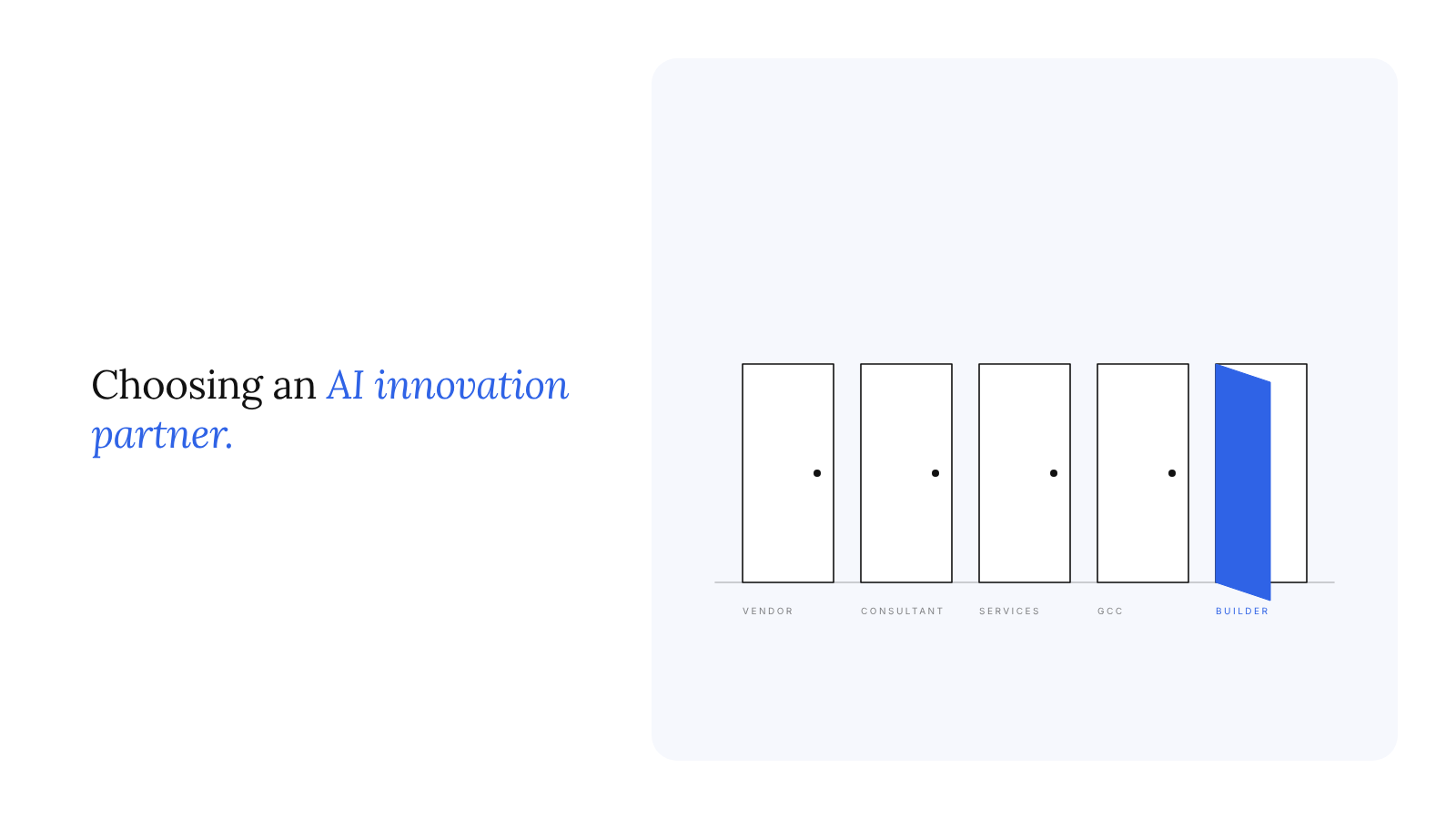
Every Indian enterprise that has decided to do something serious with AI faces the same second decision: who to do it with. The options have multiplied. A software vendor will sell a product with AI inside it. A strategy consultancy will design the programme. An IT services firm will deliver it at scale. A global capability centre, for the multinational, will build it in-house in Bengaluru or Hyderabad. And a newer category, the venture builder or studio, will co-found a company around the capability. Each of these calls itself an AI innovation partner. Each means something different by it.
This piece compares the five partner types on the four dimensions that matter most after the contract is signed and the demo is forgotten: who owns the resulting capability, what the partner is paid to optimise, who holds the intellectual property, and what happens when the relationship ends. The comparison is an analytical framework, informed by the published record on India's IT services and GCC sectors and by the global survey evidence on how enterprises buy AI. It is not a ranking. The right AI innovation partner depends on what the enterprise is trying to own at the end.
The reason the question is urgent is that the partner market has changed faster than the enterprise's procurement habits. India's technology industry, by Nasscom's February 2026 estimate, reached $315 billion in FY2026 with AI and new-age technologies contributing $10 billion to $12 billion of that. The largest services firms now report that most of their deal wins carry an AI component. An enterprise that still buys AI the way it bought application maintenance is buying from a market that no longer sells that way.
Why the AI innovation partner decision is different from outsourcing
Outsourcing, as Indian enterprises and the global clients of Indian services firms have practised it for three decades, rests on a clean separation. The client owns the process and the data; the provider supplies labour and method; the output is specified in advance and the provider is paid for delivering it. The capability built up by the provider is the provider's to reuse elsewhere, and nobody minds, because the capability was generic.
AI breaks the separation at three points. The capability is not generic: a model fine-tuned on an enterprise's claims history, or a workflow redesigned around its approval chain, embodies that enterprise's specific knowledge. The output cannot be fully specified in advance, because what the model can do is discovered in the building. And the economics do not end at delivery, because inference is a continuing cost and the model needs continuing care. Each of these points turns a question that outsourcing never had to answer, who owns what and who is paid to care about it afterwards, into the central question.
The global survey evidence shows enterprises leaning heavily towards partners rather than internal builds, and shows the partner choice affecting outcomes. Menlo Ventures' December 2025 survey of enterprise buyers found 76% buying rather than building. The MIT NANDA report of August 2025, whose methodology has been criticised and whose figures should be read as directional, reported that purchased vendor tools succeeded roughly twice as often as internal builds. EY India's November 2025 survey of more than 200 Indian enterprise leaders found 91% ranking speed of deployment as the top factor in buy-versus-build decisions. Speed is pushing enterprises towards partners. The question this piece asks is what they give up in exchange.
The five partner types
The software vendor sells a product, increasingly with AI features embedded or a platform on which the enterprise configures its own. The vendor's incentive is renewal and expansion of the subscription. Ownership of the capability stays with the vendor; the enterprise owns its configuration and, usually, its data. Gartner's June 2025 estimate that only about 130 of the thousands of self-described agentic AI vendors are "real" is a reminder that the category is wide and uneven.
The strategy consultancy designs the programme: the use-case portfolio, the operating model, the business case, often the governance. The consultancy's incentive is the next engagement and its reputation for the recommendation; it is rarely paid on the result and rarely stays to deliver. Ownership of the design passes to the enterprise; the consultancy keeps its methods.
The IT services firm delivers at scale: integration, data engineering, model operations, change management, and increasingly the AI build itself. Nasscom's Strategic Review of February 2025 reported that over 90% of the top 20 Indian services companies were integrating AI, cloud, data and GenAI across business functions, that more than 55% of AI activity by Indian tech services firms focused on long-term co-creation partnerships, and that only 10% to 15% of enterprise GenAI proofs of concept were moving to full-scale production. By January 2026, Business Today reported TCS's AI services at $1.8 billion in annualised revenue, roughly 6% of its total and up 17.3% quarter on quarter, with 81 AI deals making up about 76% of its wins in the December quarter according to an HDFC Securities analysis; HCLTech reported 139 AI-related deals, about 72% of its wins, and $146 million of "Advanced AI" revenue in the quarter; Infosys said it was working with 90% of its top 200 clients on AI-led programmes and running 4,600 AI projects. The services firm's incentive is contract value and, historically, billable effort; the shift to AI-led deals that Business Today describes as larger, longer and focused on operating-model transformation is changing that, but the firm's reusable assets remain the firm's.
The global capability centre is the multinational's own build arm in India. The Nasscom-Zinnov study of September 2024 counted over 1,700 GCCs in India in FY2024 employing more than 1.9 million people and generating $64.6 billion in revenue, with over 120,000 professionals working on AI-led transformation across GCCs and centres of excellence; about 23% of the world's 2,000 largest multinationals have set one up. The GCC's incentive is the parent's, and ownership of capability and IP is unambiguous: it belongs to the group. The GCC is not an option for an Indian-owned enterprise, but it is the benchmark against which the other four should be judged, because it is what full ownership looks like. A separate PanScience Research piece examines where India's enterprise AI capability sits between GCCs, services firms, domestic enterprises and startups.
The venture builder or studio co-founds a company around the capability, with the enterprise as customer, partner or shareholder, and supplies shared product, engineering, go-to-market and operating functions to it. The builder's incentive is the equity value of the new company, which aligns it with the capability becoming a product that sells beyond the first customer and misaligns it, potentially, with the first customer's wish for exclusivity. Ownership and IP are negotiated at formation and are the whole point of the structure. PanScience Innovations, the publisher of this research, operates this model and reports co-founding 24-plus ventures with shared in-house product, technology, GTM, operations, finance and legal functions; it is cited here as an example of the category and not as evidence of its outcomes. A separate PanScience Research series, Cluster 1, covers the venture studio model in depth, and this piece does not re-explain it.
Comparing the AI innovation partner types on what matters afterwards
The table compares the five types on ownership, incentives, intellectual property and exit. The characterisations are typical patterns, not contractual certainties; any of them can be altered by negotiation, and the last row of the table is a reminder that the enterprise's own choices determine much of the outcome.
Three readings of the table are worth drawing out.
The first is that ownership and speed trade against each other across the table. The vendor is fastest and leaves the enterprise owning least. The GCC owns everything and is limited by hiring. The services firm and the studio sit between, with the services firm faster where its accelerators fit and the studio more aligned on ownership where the capability has product potential. EY India's finding that 91% of leaders rank speed first implies that most Indian enterprises are, by default, choosing the left-hand columns and accepting the ownership position that comes with them. That is a legitimate choice. It should be a conscious one.
The second is that incentives differ in kind, not degree. The vendor and the services firm are paid by the enterprise and want more of the same. The consultancy is paid for advice and wants to give more of it. The studio is paid by the market for the new company and wants that company to succeed with customers beyond the enterprise. None of these is wrong. But only one of them has an incentive that is independent of the enterprise's continued spending, and that independence cuts both ways: the studio's new company will go where the market takes it.
The third is that the IP column is where contracts are won and lost. Nasscom's observation that over half of Indian services firms' AI activity is in long-term co-creation partnerships is significant precisely because co-creation blurs the IP line that outsourcing kept clean. An enterprise entering a co-creation arrangement with a services firm should ask what the firm will be able to sell to its next client as a result, and whether the enterprise minds. The same question applies, in reverse, to a studio arrangement: the enterprise should ask what it is giving up by allowing the new company to generalise, and price that into the equity or the licence.
Questions to put to any prospective partner
The comparison suggests five questions that work across all five types and whose answers reveal the partner's true position.
What will you own when this is finished that you did not own when we started, and who else can you sell it to? This surfaces the IP and reuse position directly.
What are you paid for if this works, and what are you paid for if it does not? This surfaces the incentive. A partner paid the same either way is a vendor of effort, whatever it calls itself.
Who runs the system in year two, and what does it cost us to move it? This surfaces dependence and exit.
What data of ours will have been used to improve something you own? This surfaces the data-rights position, which is the question Indian enterprises most often leave unasked and which the DPDP Rules, notified in November 2025, now make a compliance matter as well as a commercial one.
Show us a live deployment, not a demonstration, and show us its logs. This is the only test that separates the roughly 130 vendors Gartner considers real from the rest, and it applies equally to services firms' accelerators and studios' ventures.
A note on combinations
In practice most large enterprises use more than one partner type, and the combinations are more interesting than the pure cases. A consultancy designs, a services firm delivers, a vendor's platform underlies the build. The failure pattern in combinations is the gap between them: the consultancy's design assumes a capability the services firm cannot build on the vendor's platform, and nobody owns the gap. The second failure pattern is the accumulation of dependence: three partners, each with a reasonable lock-in, add up to an enterprise that owns its AI programme in name only.
The remedy in both cases is the same. The enterprise should decide, before engaging anyone, which capabilities it intends to own outright at the end, which it is content to rent, and which it would be happy to see become a product it has a stake in. Those three categories map onto the GCC-like, vendor-like and studio-like columns of the table respectively, and a services firm or consultancy can serve any of them if the contract is written for it. An enterprise that has not made this decision will have it made for it by whichever partner it happens to engage first.
Conclusion
The phrase AI innovation partner covers five arrangements with different owners, different incentives, different IP positions and different exits. The Indian market offers all five at scale: a vendor landscape in which a minority of claimed agentic products are judged real, a services sector whose largest firms now report that around three-quarters of their deal wins carry AI and whose co-creation model blurs the old IP line, a GCC sector of 1,700-plus centres that shows what full ownership looks like, and a studio model that aligns on ownership at the price of exclusivity. The evidence that enterprises prize speed above all and buy far more than they build suggests most are choosing, without quite deciding, to own less. The comparison in this piece is offered so that the decision is made on purpose.
Methodology and sources
The five-type comparison, its four dimensions and the five questions are an original analytical framework; the characterisations in the table are typical patterns and not descriptions of any specific contract or firm. Observed figures come from the following sources, opened and read for this piece unless marked editor-verified. Nasscom Annual Strategic Review 2025 press release, 24 February 2025 (https://nasscom.in/sites/default/files/media_pdf/Nasscom%20SR%20Press%20release.pdf): over 55% of AI activity by Indian tech services firms in long-term co-creation partnerships, over 90% of top 20 services companies integrating AI, cloud, data and GenAI, 10% to 15% of enterprise GenAI PoCs moving to production, over 1,750 GCCs in 2024. Storyboard18 report on Nasscom's FY2026 estimate, 24 February 2026 (https://www.storyboard18.com/digital/indian-tech-industry-to-reach-315-billion-in-fy26-growth-edges-up-to-6-1- 90576.htm): $315 billion, 6.1% growth, AI and new-age technology revenue of $10 billion to $12 billion. Business Today, "AI bets start paying off for Indian IT as pilots turn into big-ticket deals", 21 January 2026 (https://www.businesstoday.in/amp/technology/news/story/ai-bets-start-paying-off-for-indian-it-as-pilots-turn-into- big-ticket-deals-512050-2026-01-21): TCS, HCLTech and Infosys figures, HDFC Securities deal-share analysis, executive quotations. ThePrint report on the Nasscom-Zinnov GCC study, 15 September 2024 (https://theprint.in/economy/indias-position-as-gcc-capital-of-the-world-nasscom-zinnov-study/2268673/): over 1,700 GCCs, 1.9 million employees, $64.6 billion revenue, 120,000-plus AI professionals, 23% of the world's 2,000 largest multinationals. Gartner press release, 25 June 2025 (https://www.gartner.com/en/newsroom/press-releases/2025-06- 25-gartner-predicts-over-40-percent-of-agentic-ai-projects-will-be-canceled-by-end-of-2027): about 130 real agentic AI vendors. EY India, The AIdea of India: Outlook 2026, 16 November 2025 (https://www.ey.com/en_in/insights/ai/agentic-ai-india/aidea-survey-findings): 91% rank speed of deployment first, editor-verified. Menlo Ventures, State of Generative AI in the Enterprise 2025, 9 December 2025: 76% buy versus build, editor-verified. MIT NANDA, The GenAI Divide, August 2025: purchased tools succeed roughly twice as often as internal builds, editor-verified and treated as directional given published criticism of the methodology. PanScience Innovations facts are company-reported from panscience.xyz, read 24 October 2026; the venture studio model is covered in the separate PanScience Research Cluster 1 series.